Calcium chloride solubility is one of the most practically important properties engineers rely on when specifying deicing agents, dust suppressants, desiccants, and thermal storage media. Unlike many salts whose dissolution behavior is taken for granted, calcium chloride exhibits a solubility curve that changes meaningfully across the temperature ranges found in real industrial and environmental conditions. For engineers designing systems that depend on rapid dissolution, predictable solution strength, or freeze-point depression, understanding how temperature affects the dissolving rate of calcium chloride is not an academic exercise—it directly determines whether a process performs as intended.
Many engineering teams assume that all chloride salts dissolve at roughly the same rate and that temperature is a secondary variable. In practice, calcium chloride solubility is exceptionally high and its dissolution is strongly exothermic, which means the act of dissolving itself changes the thermal environment and therefore the rate of further dissolution. This self-reinforcing behavior distinguishes calcium chloride from sodium chloride and makes temperature control a genuine design consideration.
This article explains the mechanism behind calcium chloride solubility, quantifies how temperature alters both equilibrium solubility and dissolving rate, compares calcium chloride with other common salts, and provides practical guidance for engineers specifying dissolution equipment, deicing operations, or brine preparation systems.
Calcium chloride is safe when handled properly. The key risks are thermal burns from its exothermic dissolution and skin or eye irritation from concentrated brine. The main causes of those risks are inadequate personal protective equipment, uncontrolled addition of solid to water, and confinement of heat generated during rapid dissolution.

What Is Calcium Chloride Solubility?
Calcium chloride solubility refers to the maximum amount of CaCl₂ that can be dissolved in a given quantity of water at a specified temperature before the solution becomes saturated. For engineers, the practical significance is that calcium chloride is one of the most water-soluble inorganic salts commonly used in industry, and its solubility increases with temperature rather than remaining flat.
At 20 °C, roughly 74.5 g of anhydrous calcium chloride dissolves in 100 g of water. At 0 °C, the figure is approximately 59.5 g per 100 g of water, and at 100 °C it rises to about 159 g per 100 g of water. These values are substantially higher than sodium chloride, which plateaus near 36 g per 100 g of water across most of the same range.
The high solubility matters for several reasons. It allows concentrated brines to be prepared with relatively small volumes of water, which reduces storage and transport costs. It also enables deep freeze-point depression, since concentrated calcium chloride solutions remain liquid at temperatures well below the freezing point of pure water. For a deeper look at the compound itself, see this overview of Calcium Chloride.
The dissolution process is not merely a physical mixing event. When CaCl₂ enters water, the ionic lattice dissociates into Ca²⁺ and Cl⁻ ions, and each ion becomes surrounded by water molecules in a hydration shell. This hydration releases energy, which is why the dissolution of calcium chloride is strongly exothermic.
How Does Temperature Affect Calcium Chloride Dissolution?
Temperature affects calcium chloride dissolution through two distinct but coupled mechanisms: it shifts the equilibrium solubility limit, and it changes the kinetic rate at which solid dissolves. Engineers need to distinguish between these because a system can be far from equilibrium while still dissolving rapidly.
Equilibrium solubility increases with temperature for calcium chloride. The solubility curve is steep enough that a brine prepared at 5 °C will be significantly less concentrated than one prepared at 40 °C using the same water volume. If that brine is later cooled, excess calcium chloride can crystallize out, potentially blocking lines or fouling heat exchanger surfaces.
Dissolution kinetics also accelerate with temperature. Higher temperatures increase molecular motion and reduce the viscosity of the solution near the solid surface, which thins the boundary layer through which dissolved ions must diffuse. The result is that a given mass of calcium chloride pellets or flakes dissolves faster in warm water than in cold water, even before considering the heat released by dissolution itself.
The exothermic nature of the reaction complicates the picture in a useful way. When solid calcium chloride is added to water, the solution temperature rises. For a concentrated brine, temperature increases of 20–30 °C are not unusual during rapid dissolution. That self-generated heat then accelerates further dissolution, creating a positive feedback loop during the initial mixing phase.
The practical implication is that engineers cannot treat dissolution as an isothermal process. A batch brine tank that starts at 10 °C may reach 35 °C or higher during addition of solid calcium chloride, and the rate of dissolution will vary across that temperature rise.
Calcium Chloride Solubility vs Sodium Chloride and Other Salts
Comparing calcium chloride with other chloride salts clarifies why its temperature behavior is unusual and why it is selected for demanding applications. The table below summarizes key differences relevant to engineering decisions.
| Property | Calcium Chloride (CaCl₂) | Sodium Chloride (NaCl) | Magnesium Chloride (MgCl₂) |
|---|---|---|---|
| Solubility at 20 °C (g/100 g water) | ~74.5 | ~36.0 | ~54.3 |
| Solubility trend with temperature | Increases markedly | Slight increase | Increases |
| Heat of dissolution | Strongly exothermic | Slightly endothermic | Exothermic |
| Eutectic temperature | Approximately −52 °C | Approximately −21 °C | Approximately −33 °C |
| Typical deicing effective range | Down to −25 °C or lower | Down to approximately −10 °C | Down to approximately −15 °C |
| Corrosivity to steel | Moderate to high | Moderate | Moderate to high |
The solubility advantage of calcium chloride is clear at every temperature in the table. The eutectic point is particularly important for winter maintenance engineers, because it defines the lowest temperature at which a liquid brine can remain effective. Calcium chloride brines remain liquid and active at temperatures where sodium chloride brines have already frozen or lost effectiveness.
The exothermic dissolution behavior is a double-edged property. It provides immediate melting action when solid calcium chloride contacts ice, because the released heat contributes to melting independently of the freezing-point depression effect. However, the same heat release must be managed in closed systems, storage vessels, and applications where temperature-sensitive materials are present.
ASTM and ISO standards address calcium chloride grading and testing, and engineers specifying material for regulated applications should verify conformity with the relevant standard rather than relying on general solubility data alone.
Where Is Calcium Chloride Solubility Critical in Engineering Applications?
Calcium chloride solubility is a controlling variable in several distinct engineering contexts, each with different temperature ranges and different consequences if dissolution behavior is misjudged.
Deicing and Winter Maintenance
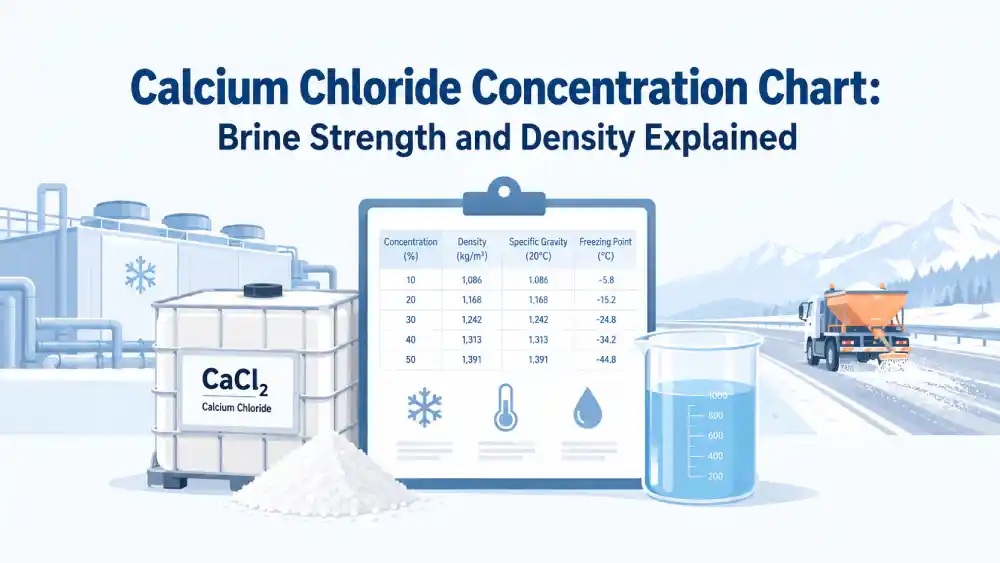
In road deicing, the ability to form a liquid brine at low temperature determines whether a treatment works. Calcium chloride brine at 30% concentration by weight remains liquid to approximately −25 °C, and the exothermic dissolution provides a rapid initial melt. Engineers designing brine-making systems must account for the fact that cold makeup water will slow dissolution, often requiring heated tanks or recirculation during winter operations.
Dust Suppression on Unpaved Roads
Calcium chloride is applied as a hygroscopic dust suppressant because it absorbs moisture from the air and keeps the road surface slightly damp. Solubility governs how the material is diluted before application and how it redistributes after rainfall. In arid conditions, the ability to hold moisture depends on the concentration of the residual brine film, which in turn depends on dissolution behavior during application.
Desiccant and Humidity Control Systems
In industrial drying and humidity control, calcium chloride is used in both solid and liquid desiccant configurations. Liquid desiccant systems require precise control of solution concentration, which is maintained by balancing water absorption against regeneration. Temperature swings in the absorber and regenerator directly change solubility limits and therefore the operating concentration window.
Concrete Acceleration and Set Control
Calcium chloride is added to concrete mixes to accelerate set time in cold weather. The chloride must dissolve rapidly and uniformly to avoid localized over-acceleration or weak zones. Dissolution rate affects mixing time requirements and the uniformity of the final mix.
Thermal Storage and Refrigeration
Concentrated calcium chloride brines are used as secondary refrigerants in industrial refrigeration. The brine must remain liquid across the full operating temperature range of the system, and solubility data at the lowest anticipated temperature determines the maximum safe concentration.
Choose calcium chloride when:
- Required operating temperature is below −15 °C
- Rapid initial melting or dissolution is needed
- High solution concentration is required in limited water volume
- Hygroscopic moisture absorption is desirable
Choose sodium chloride when:
- Operating temperature remains above −10 °C
- Cost per unit mass is the dominant factor
- Corrosivity to concrete and steel must be minimized
- Exothermic reaction is undesirable
Choose magnesium chloride when:
- Operating temperature is between −10 °C and −15 °C
- A balance between cost and low-temperature performance is needed
- Lower corrosivity than calcium chloride is preferred
What Determines How Fast Calcium Chloride Dissolves?
Several factors interact to determine the dissolving rate of calcium chloride in a given system. Engineers who understand these variables can predict performance and design accordingly.
- Water temperature: Warmer water accelerates dissolution by increasing molecular motion and reducing viscosity near the solid surface. A brine prepared at 30 °C will dissolve solid calcium chloride noticeably faster than one prepared at 5 °C.
- Particle size and form: Flake, pellet, and powder forms present different surface areas per unit mass. Powder dissolves fastest, pellets slowest, for the same total mass.
- Agitation and mixing: Mechanical agitation continuously removes the concentrated boundary layer and brings fresh water into contact with the solid, substantially increasing the rate.
- Concentration of existing solution: As the solution approaches saturation, the driving force for further dissolution decreases, and the rate slows even if temperature remains constant.
- Presence of impurities: Other dissolved salts can either increase or decrease the solubility of calcium chloride through common-ion or ionic-strength effects.
A useful rule for engineers is that doubling the surface area of the solid, or raising the water temperature by 10 °C within the normal operating range, typically produces a measurable increase in dissolution rate, though the exact magnitude depends on mixing conditions and the specific form of the material.
The practical performance comparison between calcium chloride and sodium chloride is often summarized as CaCl₂ brine at 30% concentration ≈ NaCl brine at 23% concentration in terms of freezing-point depression, but the calcium chloride brine remains effective at lower temperatures and dissolves more readily in cold water.
How to Prepare Calcium Chloride Brine for Engineering Use
Brine preparation is the most common point at which calcium chloride solubility becomes an operational concern. The following workflow reflects standard practice for preparing a known-concentration brine.
Prerequisites:
- Anhydrous or dihydrate calcium chloride in the form appropriate to the target concentration
- A calibrated scale accurate to within 1% of the batch mass
- A mixing tank with agitation capability
- A thermometer rated for the expected temperature rise
- Personal protective equipment including chemical-resistant gloves, eye protection, and face shield
- A ventilation path for any steam or aerosol generated
Step 1 — Determine the target concentration. Calculate the mass of calcium chloride required to reach the desired weight percentage in the final solution, using the temperature-adjusted solubility limit as the upper bound. Do not exceed the saturation concentration at the lowest temperature the brine will experience.
Step 2 — Add water to the tank first. Starting with water in the vessel provides a heat sink and reduces the risk of localized boiling or violent reaction when solid is added. The water temperature should be recorded before addition begins.
Step 3 — Add solid calcium chloride gradually with agitation. Introduce the solid at a controlled rate, allowing each portion to dissolve before adding the next. Continuous agitation prevents settling and keeps the dissolution interface refreshed.
Step 4 — Monitor temperature throughout. Expect a temperature rise of 20–30 °C for concentrated brines. If the temperature approaches the boiling point of the solution or the safe limit of the tank material, pause addition and allow cooling.
Step 5 — Verify concentration and adjust. After all solid is added, measure the solution density or refractive index and compare against the target. Add water or solid as needed to reach the specified concentration.
Step 6 — Allow equilibration before use. If the brine will be stored or used at a lower temperature than the preparation temperature, allow it to cool and equilibrate, then recheck for any crystallization before transferring.
Troubleshooting Common Calcium Chloride Dissolution Problems
Symptom: Solid calcium chloride settles at the bottom of the tank and does not dissolve.
Solution: Increase agitation or recirculation. Settled solid may be coated with a saturated boundary layer; breaking that layer with mechanical mixing restores the dissolution rate.
Symptom: Solution temperature rises faster than expected during addition.
Solution: Reduce the addition rate and increase the water-to-solid ratio. The exothermic heat release is proportional to the mass of calcium chloride dissolving per unit time.
Symptom: Crystals appear in the brine after cooling.
Solution: The brine was prepared above its saturation concentration for the storage temperature. Dilute with water or maintain the brine above the crystallization temperature.
Symptom: Dissolution is unexpectedly slow at low ambient temperature.
Solution: Preheat the water or use a heated tank. Cold water both reduces kinetics and lowers the equilibrium solubility limit.
Symptom: Corrosion appears on steel components in contact with the brine.
Solution: Verify concentration and temperature, as higher temperatures and concentrations increase corrosivity. Consider corrosion inhibitors or alternative materials of construction.
What Are the Safety and Environmental Considerations?
The same properties that make calcium chloride useful also create specific hazards that engineers must design around. The exothermic dissolution can generate enough heat to cause thermal burns if solid contacts skin or if concentrated solution splashes. OSHA guidance on chemical safety applies to workplace handling, and EPA regulations may govern runoff from deicing operations near waterways.
Calcium chloride is not classified as acutely toxic, but concentrated solutions are irritating to skin, eyes, and respiratory passages. Aerosols generated during rapid dissolution should be controlled with ventilation or enclosure.
Environmental considerations are primarily related to chloride loading in receiving waters. While calcium chloride is less harmful to vegetation than sodium chloride in some contexts, elevated chloride concentrations can affect aquatic organisms. Engineers designing deicing or dust suppression programs should account for runoff pathways and consider application rates that minimize excess.
FAQs
What is calcium chloride solubility at room temperature?
At 20 °C, approximately 74.5 g of anhydrous calcium chloride dissolves in 100 g of water, forming a saturated solution. This is roughly twice the solubility of sodium chloride at the same temperature. The exact value depends on whether the material is anhydrous, dihydrate, or in solution form, since water of hydration contributes to the total water content.
How does temperature change the dissolving rate of calcium chloride?
Higher temperatures increase both the equilibrium solubility and the kinetic rate of dissolution. Warmer water reduces viscosity near the solid surface and increases molecular motion, so a given mass of calcium chloride dissolves faster at 30 °C than at 5 °C. The exothermic nature of the reaction further accelerates dissolution as the solution warms during mixing.
Is calcium chloride more soluble than sodium chloride?
Yes, calcium chloride is substantially more soluble than sodium chloride across the normal temperature range. At 20 °C, calcium chloride solubility is about 74.5 g per 100 g of water, compared with approximately 36 g per 100 g for sodium chloride. This difference is one reason calcium chloride brines can achieve lower freezing points.
Why does calcium chloride release heat when it dissolves?
The release of heat comes from the energy released when Ca²⁺ and Cl⁻ ions form hydration shells with water molecules. This hydration energy exceeds the energy required to break the ionic lattice, so the net process is exothermic. The temperature rise can be 20–30 °C or more in concentrated brines.
What concentration of calcium chloride brine freezes at −20 °C?
A calcium chloride brine at approximately 25–30% concentration by weight remains liquid at −20 °C. The exact concentration depends on the purity of the material and the presence of other dissolved species. Engineers should refer to published freezing-point curves for the specific grade being used.
Can calcium chloride solubility be affected by other salts in solution?
Yes. The presence of other dissolved ions can change calcium chloride solubility through common-ion effects and changes in ionic strength. For example, dissolved calcium from other sources can reduce the amount of additional calcium chloride that will dissolve before saturation.
How long does it take for calcium chloride pellets to dissolve?
Dissolution time depends on pellet size, water temperature, and agitation. Under moderate agitation at 20 °C, typical pellets may take several minutes to fully dissolve, while flakes or powder dissolve in under a minute. Raising water temperature by 10 °C or increasing agitation can noticeably shorten this time.
Is calcium chloride safe to handle in powder form?
Calcium chloride powder is safe when handled with appropriate personal protective equipment, including gloves, eye protection, and respiratory protection if dust is generated. The primary hazards are skin and eye irritation from the hygroscopic material and thermal effects from exothermic dissolution. Dust control and ventilation are recommended in enclosed spaces.
What happens if calcium chloride brine is cooled below its saturation temperature?
If a saturated brine is cooled, the solubility limit decreases and excess calcium chloride crystallizes out of solution. This can form solid deposits in tanks, pipes, and pumps. To prevent this, brines should be prepared at or below the concentration corresponding to the lowest anticipated operating temperature.
How does calcium chloride compare to magnesium chloride for low-temperature applications?
Calcium chloride remains effective at lower temperatures than magnesium chloride, with a eutectic near −52 °C compared with approximately −33 °C for magnesium chloride. Calcium chloride also has higher solubility and a stronger exothermic effect, but it is generally more corrosive and more costly per unit mass.
Conclusion
Calcium chloride solubility is a temperature-dependent property that directly influences how engineers specify deicing agents, brine systems, desiccants, and thermal storage fluids. The key points are that calcium chloride solubility increases with temperature, its dissolution is strongly exothermic, and the dissolving rate depends on water temperature, particle form, agitation, and proximity to saturation. These behaviors distinguish calcium chloride from sodium chloride and make it the preferred choice when low-temperature performance and high solution concentration are required.
When evaluating calcium chloride for a specific application, prioritize measured solubility data at the actual operating temperature over generic specification sheets, and account for the heat released during dissolution in the design of tanks, pumps, and safety systems. For applications where corrosion or environmental chloride loading is a concern, compare calcium chloride against alternative salts using the decision criteria outlined above before finalizing the specification.