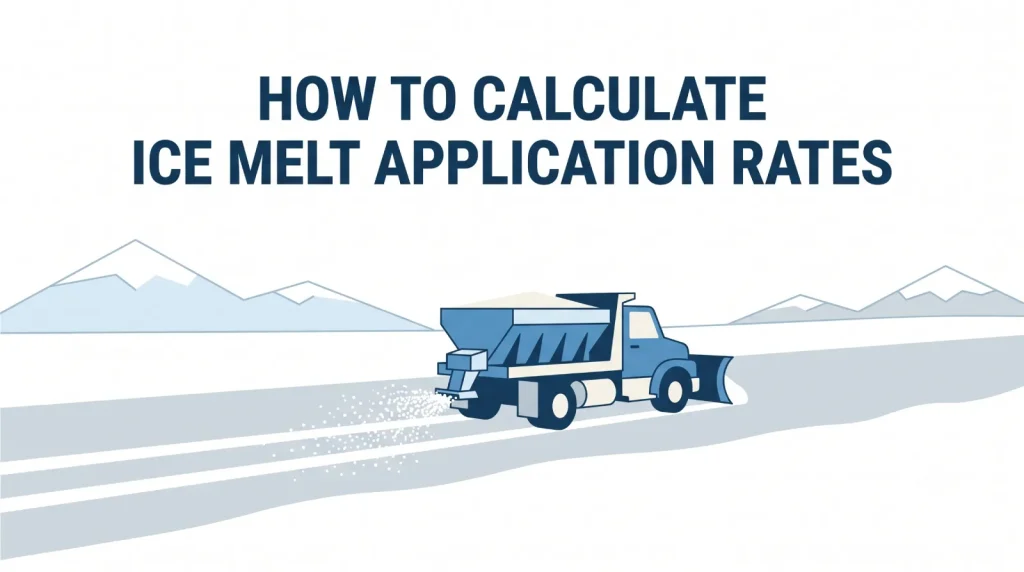
How to Calculate Ice Melt Application Rates

July 30, 2026

Winter maintenance engineering is a precise science of material logistics, not just an operational task. Facility managers and DOT engineers consistently face a critical challenge: determining the correct ice melt application rate to ensure public safety without wasting budgets or causing environmental damage. Traditional "spread and pray" approaches, relying on fixed rate cards or operator intuition, often result in over-application that corrodes infrastructure or under-application that leaves surfaces dangerously icy.

The core complexity arises from the dynamic variables at play. Pavement temperature, precipitation type, dilution from traffic, and the chemical properties of the de-icer itself all shift hourly during a storm event. A rate perfectly calibrated for a dry snow at 25°F (-4°C) becomes dangerously ineffective during a freezing rain event at 15°F (-9°C). Without a systematic calculation framework, winter maintenance teams essentially operate blind.

This tutorial provides a complete, engineering-focused guide to calculating and calibrating ice melt application rates. We will break down the deterministic variables, provide step-by-step workflows, and introduce a decision matrix to move your operations from reactive gritting to precision anti-icing and de-icing.

Calcium Chloride can deliver effective ice melting performance, but the key engineering variable is not just the chemical itself — it is the correct application rate calculated for specific pavement conditions. The primary risks of incorrect application include skid resistance loss from refreeze due to under-dosing, and environmental runoff spikes from over-dosing. Getting the calculation right eliminates these binary risks.

Key Takeaways

  • The correct ice melt application rate is a function of pavement temperature, precipitation rate, and residual chemical dilution, not a single fixed value.
  • Calcium Chloride is hygroscopic and exothermic, making it effective at temperatures as low as -25°F (-32°C), which directly influences its lower required application rate compared to rock salt.
  • Anti-icing typically requires 50-70% less material than de-icing the same lane mile because liquid chemicals prevent the bond between ice and pavement.
  • A standard 38% liquid Calcium Chloride brine requires an application rate of 10-15 gallons per lane mile for anti-icing on a standard 12-foot lane.
  • Over-application on dry pavement is the most common engineering failure; calibration must account for ground speed and lane width dynamically.
How to Calculate Ice Melt Application Rates

Pre-Condition Checklist: Data Required for Rate Calculation

Before opening the controller on a spreader or spray bar, you must gather specific environmental and operational inputs. Missing this data is the primary cause of rate miscalculation.

  • Pavement Temperature (Not Air Temperature): Use an infrared thermometer mounted on the vehicle. Air temperature lags behind pavement cooling by 5–15°F during frontal passages.
  • Precipitation Type and Rate: Identify if it is dry snow, wet snow, freezing rain, or sleet. Measure the liquid equivalent precipitation rate in inches per hour via an on-site gauge or RWIS (Road Weather Information System).
  • Residual Chemical Concentration: Test the pavement surface for residual salt from previous treatments to avoid cumulative over-dosing.
  • Vehicle Ground Speed: Confirmed GPS speed (mph) for real-time adjustment of hydraulic or auger controls.
  • Lane Width: Standard is 12 feet; must be input into the controller logic.
  • Target Concentration (BOD or LOS Goal): Define the desired Bare Pavement Regain Time. A Level of Service (LOS) A requires higher initial rates than LOS C.

Step-by-Step Workflow: Calculating Your Liquid De-Icing Rate

This workflow assumes the use of a liquid brine for anti-icing or a pre-wet solid for de-icing. The engineering logic focuses on achieving a specific mass of active ingredient per unit area.

Step 1: Establish the Baseline Mass Rate per Unit Area

The goal is to achieve the eutectic concentration necessary to break the ice-pavement bond without excessive runoff. For Calcium Chloride brines, a standard starting point for anti-icing a bridge deck or asphalt is 80 to 120 lbs of dry chemical equivalent per lane mile. Since liquid brines are diluted, calculate the gallons required.

Calculation:
*Desired Gallons = (Target Dry Weight lbs) / (Brine Concentration % * Density of Brine lbs/gal)*
Example: To apply 100 lbs of dry Calcium Chloride using a 32% solution (density ≈ 11.0 lbs/gal):
100 lbs / (0.32 * 11.0) = 100 / 3.52 ≈ 28.4 gallons per lane mile.

Step 2: Adjust for Pavement Temperature

Chemical performance drops exponentially as temperature falls. Increase the application rate multiplier based on a non-linear curve:

  • > 20°F (-7°C): Use the baseline rate (1x multiplier).
  • 10°F to 20°F (-12°C to -7°C): Apply a 1.5x multiplier.
  • 0°F to 10°F (-18°C to -12°C): Apply a 2.0x multiplier.
  • < 0°F (-18°C): Limit de-icing to critical areas only and consider abrasives. Calcium Chloride maintains exothermic reaction down to -25°F, but rate requirements may exceed practical runoff limits.

Step 3: Calibrate Delivery Rate to Ground Speed

The controller must link material flow to the vehicle’s transmission. Use the following formula to set gallons per minute (GPM) or pounds per mile:
*Flow Rate (GPM) = (Target Application Rate Gal/Lane Mile * Ground Speed mph) / 60 minutes*

Example: If the target is 28.4 gal/mile and the truck runs at 30 mph:
(28.4 * 30) / 60 = 14.2 GPM. This hydraulic setting is absolute; if the driver reduces speed to 15 mph, the flow must automatically halve to maintain the rate.

Step 4: Pre-Wet Ratios for Solid Salts

If using solid Calcium Chloride pellets, pre-wetting is mandatory to trigger the brine phase and prevent bounce. The pre-wet rate is usually 8-12 gallons of liquid per ton of solid. The ice melt application rate of the solid must be reduced by 10-15% when pre-wet is optimized, as efficiency increases.

Step 5: Real-Time Dilution Adjustment

During the storm, monitor brine dilution. If standing water is visible, the application rate must increase not to melt the snow faster, but to maintain the critical brine concentration. A heavy rain-on-snow event can dilute a pavement brine layer from 23% down to non-effective levels in under 30 minutes, requiring a re-application cycle.

Anti-Icing vs. De-Icing: A Decision Matrix for Rate Selection

Anti-icing (preventing the bond) and de-icing (breaking the formed bond) require fundamentally different physics and therefore different application rates. Choose your strategy first, then calculate the rate.

Choose Anti-Icing (Lower Rate) when:

  • The forecast is confident and precipitation begins as light snow or frost.
  • Pavement temperature is above 15°F (-9°C) and not falling rapidly.
  • You have the crew capacity to apply liquid brine 1–2 hours before the storm onset.
  • The goal is to prevent black ice formation on critical structures like concrete bridge decks.

Choose De-Icing (Higher Rate) when:

  • Precipitation has already begun and a compacted snow/ice layer has bonded to the road.
  • Dew point is dropping rapidly, indicating post-storm flash freezing.
  • Working with packed snow that exceeds 1/4 inch in thickness.
  • Traffic volume is insufficient (late night) to work the chemical into the pack via tire friction.

Troubleshooting Common Application Failures

Precision rate calculation fails when field conditions contradict the model. Here is a diagnosis of the most frequent operational issues.

Symptom: Re-freeze occurs 60 minutes after application despite correct calculated rate.
Solution: Check dilution by melt water. High precipitation rates (over 0.25 inches/hour liquid equivalent) require a "follow-up boost" application at 50% of the original rate within 45 minutes. The initial rate was correct but the chemical mass was washed away.

Symptom: Dry runaway material (bounce and scatter) exceeding 30% on the shoulder.
Solution: While spreader calibration matches the ice melt application rate target, the throw pattern is wrong. Reduce spinner RPM and ensure pre-wet liquid is activating immediately. Dry Calcium Chloride pellets without pre-wet will bounce significantly on cold, hard pavement.

Symptom: Pavement regains friction but a sticky white residue remains after drying.
Solution: Over-application relative to humidity. In high humidity (above 70%), Calcium Chloride’s hygroscopic nature draws excess moisture, keeping the road film wet longer than necessary. Reduce the rate by 10-15% on subsequent runs and monitor dew point.

How to Optimize Your Salt Brine Concentration

Understanding brine eutectics is fundamental to rate calculation. This is the point where the solution has the maximum freezing point depression capability. Exceeding the eutectic concentration does not make the de-icer stronger; it wastes material.

For Calcium Chloride, the eutectic point is approximately 29.8% concentration by weight, with a freeze point of -67°F (-55°C). However, in standard highway maintenance, the engineered viscosity limit usually targets 30–32% for consistent spray patterns. Applying a rate that results in a surface concentration below 10% is a pure waste. Your calculated rate must maintain a residual surface brine concentration of 15–23% throughout the storm's life cycle. Use a conductivity meter to test surface samples and verify your rate logic in real-time.

Conclusion

Mastering the calculation of ice melt application rate transforms winter maintenance from a cost center into a measurable safety metric. The key is abandoning flat-rate cards in favor of dynamic logic that integrates pavement temperature, precipitation rate, and residual chemical concentration. For engineering and maintenance directors, the three non-negotiables for a defensible rate program are verified pre-storm data from calibrated sensors, automatic speed-linked controllers on all spreaders, and rigorous post-storm dilution analysis. Building a strategy around these principles ensures environmental compliance and delivers consistent bare pavement regains.

FAQs

What is the standard ice melt application rate?

The standard rate is not fixed. For anti-icing with liquids, it ranges from 10 to 40 gallons per lane mile depending on the temperature and the specific chemical’s eutectic properties. For solids, it ranges from 100 to 300 lbs per lane mile. The exact ice melt application rate is a derived calculation, not a standard constant.

How does Calcium Chloride application rate compare to rock salt?

Calcium Chloride is applied at a lower total weight rate than Sodium Chloride (rock salt) per lane mile for equivalent performance below 20°F (-7°C). This is because it generates its own heat (exothermic reaction) and depresses the freezing point further.

  • Calcium Chloride is effective down to -25°F (-32°C).
  • Rock salt efficacy plummets at 15°F (-9°C).
  • The required mass of rock salt can be 30-50% higher at 0°F to achieve the same melting capacity.

Is it safe to apply Calcium Chloride on concrete?

Yes, Calcium Chloride is safe when applied at the correct engineered rate. The key risk is not chemical attack, but physical scaling from freeze-thaw cycles worsened by over-application. High-quality, air-entrained concrete shows minimal damage when the application rate is strictly controlled to prevent a saturated puddle from forming and re-freezing. Rate discipline is the safety factor.

Why does the application rate change with pavement temperature?

Chemical kinetics are temperature-dependent. As the temperature drops, the melting capacity of a single unit of chemical drops exponentially. To maintain a constant melting speed, you must increase the mass of active ingredient per unit area.

  • At 25°F: The melting potential is high, requiring a baseline rate.
  • At 5°F: The reaction speed is slowed, requiring up to a 2.5x multiplier on the baseline rate.
  • Below -10°F: The melting potential is so low that even high rates may fail without mechanical removal.

Where is pre-wetting most critical in ice melt applications?

Pre-wetting is most critical on high-speed roadways (over 40 mph) and bridge decks. On high-speed roads, dry chemicals bounce to the shoulder, wasting up to 30% of the material. On bridge decks, the cold air under the span freezes the road rapidly, requiring instant brine formation.

  • Dry material: High bounce, slow melting activation.
  • Pre-wet material: Instant adhesion and exothermic reaction.
  • Pre-wet reduces the required application rate by 10-15%.

When should you increase the ice melt application rate?

Increase the rate immediately when observed precipitation changes from snow to freezing rain. Freezing rain dilutes the existing brine layer much faster than dry snow. Also, increase the rate if pavement sensors show a temperature drop of 5°F or more in 15 minutes without a reduction in traffic volume to provide mechanical mixing.

How long does a calculated application rate remain effective?

A standard liquid anti-icing application remains effective for 4 to 8 hours on a dry road before precipitation starts. Once the storm begins and accumulation exceeds 0.5 inches per hour, the residual chemical can become diluted and ineffective within 45-90 minutes, necessitating a de-icing re-application.

What happens if the application rate is too high?

Over-applying, particularly with Calcium Chloride, leads to hygroscopic residue attraction, pulling moisture from the air and creating a slippery, soapy film on the surface. This can reduce skid resistance. Furthermore, excessive runoff spikes chlorides into adjacent waterways, potentially violating MS4 permit limits.

Does ice melt application rate differ for asphalt vs. concrete?

Yes. Concrete has a higher thermal mass and retains cold longer than asphalt, making it more susceptible to re-freeze. Consequently, concrete bridge decks often require a slightly higher initial application rate (approximately 10-15% more) than asphalt roads during the same storm conditions to compensate for the faster heat loss from the bottom.

Is manual calculation as effective as automatic spreader control?

No. Manual calculation based on route averages results in massive over- or under-application. Human operators cannot mentally re-calculate gallons per mile every 10 seconds as hill shadows change pavement temperature. Automatic Ground Speed Oriented Spreaders (GSOS) are necessary to execute a calculated rate strategy accurately.