Calcium chloride is safe to store when handled properly. The key risks are moisture ingress and uncontrolled humidity, which trigger deliquescence, bridge formation between particles, and eventual hard caking that resists dissolution. Warehouse teams managing bulk calcium chloride often discover the problem only when a solidified mass blocks discharge from a silo or requires manual breaking inside a supersack. The operational cost extends beyond the labor: caked material dissolves slowly, disrupts dosing accuracy, and can damage conveying equipment.
The hygroscopic nature of calcium chloride is not a defect to be eliminated but a property to be managed. Solid calcium chloride absorbs moisture from ambient air to the point of converting to liquid brine, and if the solids sit motionless in contact with that moisture, a hard cake forms that is slow to dissolve . The challenge for storage operations is therefore not keeping the material perfectly dry—an impractical goal in most industrial settings—but maintaining conditions where moisture absorption remains below the threshold that initiates inter-particle bridging.
This article provides a step-by-step operational workflow for warehouse and materials handling teams. It covers the moisture mechanisms that drive caking, the pre-storage conditions that must be verified, the specific controls during storage, and the troubleshooting steps when caking has already begun. The focus is on practical interventions that can be implemented with standard warehouse equipment and environmental controls.
What Makes Calcium Chloride Cake During Storage?
Caking in calcium chloride begins with a thin film of dissolved salt at particle surfaces. When calcium chloride absorbs water vapor from the air, it does not merely become damp—it enters solution. As temperature fluctuates or ambient humidity drops, that surface brine re-crystallizes, forming solid bridges at the contact points between adjacent granules or flakes. Over time, these bridges consolidate into a continuous mass.
The critical variable is the equilibrium between the material’s moisture content and the partial pressure of water vapor in the surrounding air. A calcium chloride particle exposed to air above its critical relative humidity will continuously absorb moisture. Below that threshold, it remains stable. The practical implication for storage is that relative humidity control matters more than temperature alone, though temperature swings accelerate the wetting-drying cycles that build crystalline bridges.
Coarse particles cake more slowly than fine powders because fewer contact points exist per unit mass. However, even granular calcium chloride will form a hard cake if moisture is allowed to condense or pool. If solids sit motionless in contact with liquid water, the resulting cake can become severely compacted and slow to dissolve .
Pre-Storage Checklist: Prepare Before the First Bag Enters the Warehouse
The conditions at the moment of receipt determine how long the material will remain free-flowing. Calcium chloride that arrives with elevated surface moisture or in damaged packaging begins its storage life already compromised. The following checklist should be completed before any lot is placed into storage.
- Verify packaging integrity on receipt. Inspect every pallet for tears, punctures, or compromised stretch wrap. A single pinhole in a moisture-barrier liner allows humid air to contact the product continuously.
- Confirm the supplier’s moisture specification. Request the certificate of analysis for each lot and record the reported moisture content. Material at the upper end of the specification has less capacity to absorb incidental moisture before reaching the critical threshold.
- Measure ambient relative humidity in the designated storage zone. Use a calibrated hygrometer at the start of each shift. Record the reading. Humidity above 50% at typical warehouse temperatures warrants active dehumidification.
- Inspect the storage area for water intrusion pathways. Check roof seams, wall penetrations, and floor drains. Calcium chloride should never be stored where condensation drips or standing water can contact packaging.
- Elevate all pallets on racks or dunnage. A minimum clearance of 4 inches from the floor prevents wicking from concrete slabs, which can transfer moisture through paper or woven bags.
- Segregate damaged lots immediately. Move any pallet with compromised packaging to a quarantine area and plan for priority use or repackaging. Do not assume the damage is superficial.
How Should Calcium Chloride Be Stored in Bags vs Bulk?
The physical form of the material dictates different storage controls. Bagged calcium chloride in sealed moisture-barrier packaging has a defined shelf life—typically 36 months from manufacture when the packaging remains intact . Bulk calcium chloride, whether in supersacks, silos, or heaps, presents a larger exposed surface area and lacks the individual package barrier.
For bagged material, the primary control is packaging integrity and pallet placement. An intact plastic shroud allows outdoor storage on a well-drained surface, but once the shroud is torn or removed, the pallet must be stored indoors or under a waterproof covering . Stack bags on pallets in a manner that does not compress or abrade the packaging of lower layers. Avoid stacking heights that exceed the manufacturer’s recommendation, as excessive pressure can force product through seams.
For bulk storage in silos, the critical factor is eliminating air exchange with the external environment. Silos should be sealed and equipped with adequately sized desiccant breathers on vent lines. When the silo is being filled or discharged, the displacement air must pass through the breather rather than drawing in ambient humidity. For bulk material stored in supersacks within a warehouse, the same relative humidity limits apply as for bagged material, but the larger mass per container means that moisture absorbed at the surface of the supersack can migrate inward over time.
A documented storage configuration should specify the maximum stack height, minimum aisle clearance for air circulation, and the location of humidity monitoring points. The U.S. Environmental Protection Agency’s guidance on deicing chemical storage emphasizes covered storage as a baseline practice, with permanent structures preferable to temporary tarps .
Step-by-Step Storage Workflow: From Receiving to Discharge
The following workflow translates the principles above into a sequence of operational steps. Each step includes the action, its purpose, and the expected outcome.
Step 1: Receive and inspect at the loading dock.
Action: Check each pallet for packaging damage and verify the lot number against the certificate of analysis. Purpose: Identify compromised material before it enters the storage zone. Expected result: Damaged lots are quarantined; intact lots are cleared for put-away.
Step 2: Stage in a humidity-controlled buffer zone.
Action: Move accepted pallets to an area with recorded relative humidity below 50% and a temperature above the dew point of the outside air. Purpose: Allow any condensation on packaging surfaces to evaporate before long-term storage. Expected result: Pallets enter storage without surface moisture.
Step 3: Put away using first-in, first-out rotation.
Action: Place new lots behind existing inventory on racking. Label the put-away date prominently. Purpose: Ensure older material is used before its packaging degrades or moisture gradually permeates. Expected result: No lot remains in storage beyond its validated shelf life.
Step 4: Monitor humidity at fixed intervals.
Action: Record relative humidity and temperature at three points in the storage zone at the start and midpoint of each shift. Purpose: Detect excursions before they affect product. Expected result: A trend log that triggers corrective action when humidity exceeds 55%.
Step 5: Inspect packaging at 30-day intervals.
Action: Walk the storage aisle and visually inspect pallets for tears, stains, or deformation. Squeeze a sample bag gently to check for hardening. Purpose: Detect early-stage caking and packaging failure. Expected result: Compromised pallets are removed for priority use before full caking occurs.
Step 6: Discharge with controlled air exchange.
Action: When withdrawing material from a silo or supersack, operate transfer equipment at a rate that does not create excessive negative pressure. Use dedicated venting with desiccant where available. Purpose: Prevent humid ambient air from being drawn into the container headspace during discharge. Expected result: Material flows freely and the remaining inventory is not exposed to a moisture spike.
Step 7: Reseal partially used containers immediately.
Action: If a supersack or drum is only partially emptied, fold and seal the liner, then close the outer container within 15 minutes of stopping discharge. Purpose: Limit the exposure window for surface absorption. Expected result: Remaining material maintains its free-flowing condition.
What to Do When Caking Has Already Started
Caking is a progressive condition. A lot that shows slight hardening at the bag surface can often be recovered without full rejection, but intervention must occur before the mass consolidates. The following troubleshooting steps address common symptoms.
Symptom: Bags feel rigid or “brick-like” when squeezed.
Solution: Isolate the pallet and open one bag for inspection. If the material inside breaks into small lumps under light pressure, it remains usable. Prioritize this lot for immediate consumption. If the mass requires a tool to fracture, do not attempt to use it in dry-feed systems; route it to a process that accepts slurry or solution form.
Symptom: Material bridges over the silo outlet and will not flow.
Solution: Do not strike the silo with hammers or use manual probing from the top. Apply external vibration to the hopper cone in short bursts. If bridging persists, the material at the bridge point has likely formed a cohesive arch. Introduce dry air through a bottom aeration pad if the silo is equipped; otherwise, schedule a controlled entry or use a bin whip from the top with proper safety controls.
Symptom: Dissolved calcium chloride solution contains visible undissolved chunks.
Solution: The chunks are crystalline bridges that formed during storage. Agitation and mild heating (below 40°C) will eventually dissolve them, but the dissolution time may be extended. For processes requiring rapid dissolution, screen the solution before use or pre-crush the caked material.
Symptom: Packaging shows wet stains or brine leakage.
Solution: The material has deliquesced at the surface. Move the pallet to a containment area with a drip tray. Do not stack other materials on top. Use this lot immediately in a process that accepts liquid or slurry feed. Inspect adjacent pallets for cross-contamination from the brine.
Common Mistakes That Accelerate Calcium Chloride Caking
Warehouse teams often unintentionally create conditions that promote caking through practices that seem reasonable in isolation. These are cognitive and procedural errors, not equipment failures.
Mistake: Assuming a “dry” warehouse is dry enough.
Ambient relative humidity above 50% is sufficient to drive gradual moisture absorption in calcium chloride over weeks or months. A warehouse that feels dry to human comfort can still support caking. The only reliable measure is an instrument reading, not subjective assessment.
Mistake: Stacking heavy pallets on lower bags to “save space.”
Compression forces product particles into closer contact and can deform packaging, thinning the moisture barrier at fold points. The pressure also squeezes surface brine into contact points where it crystallizes. Follow maximum stack height guidance from the packaging supplier.
Mistake: Breaking caked material with impact tools inside the storage area.
Mechanical breaking generates fines and dust, which have higher surface area and cake faster than the original granules. The dust also settles on nearby packaging, creating a localized humidity reservoir. Perform any necessary breaking in a designated area with dust collection, and consume the material promptly.
Mistake: Using the same handling equipment for wet and dry operations.
A scoop or auger that has been used for liquid brine or wet material will transfer moisture and salt residue into the next dry container. Dedicate equipment to dry calcium chloride handling or implement a documented dry-down procedure between uses.
Mistake: Ignoring the first sign of hardening because “it will break up in the mixer.”
Early-stage caking responds well to gentle mechanical action. Advanced caking does not. Waiting for the process to solve the problem often results in clogged feeders, extended mix times, and off-spec batches. Treat any detectable hardening as a trigger for priority use.
FAQs
What is calcium chloride caking?
Calcium chloride caking is the formation of solid crystalline bridges between individual particles, transforming a free-flowing granular or flake material into a consolidated mass. It occurs when surface moisture dissolves a portion of the salt, and subsequent drying or temperature change causes re-crystallization at particle contact points. The resulting cake may be soft and friable or hard enough to require mechanical breaking.
How long does calcium chloride last in storage?
Properly stored calcium chloride in intact packaging has an expected shelf life of 36 months from the date of manufacture . The material itself does not degrade, but the shelf life is limited by the potential for moisture intrusion through packaging. Once moisture enters, assay decreases and caking risk rises. Bulk material without packaging protection should be monitored continuously rather than assigned a fixed shelf life.
Is caked calcium chloride still usable?
Yes, in most cases. Caked calcium chloride retains its chemical identity unless the moisture absorption has been so severe that the material is partially or fully in brine form. Hard cakes can be broken and dissolved, though dissolution will be slower than for free-flowing material. The decision point is whether the caked material can be fed into the process without damaging equipment or causing dosing inaccuracy.
What relative humidity should a calcium chloride storage area maintain?
Storage areas should target relative humidity below 50% at typical warehouse temperatures. Above this threshold, the driving force for moisture absorption increases significantly. Continuous monitoring with a calibrated hygrometer is essential because humidity varies with weather, ventilation cycles, and the moisture content of adjacent stored materials. Where ambient humidity cannot be controlled, packaging must provide the primary moisture barrier.
Does temperature affect calcium chloride caking?
Temperature affects caking primarily through its influence on relative humidity and through thermal cycling. A temperature drop can cause condensation on packaging or product surfaces if the material is near its dew point. Repeated warming and cooling cycles drive the wetting-drying process that builds crystalline bridges. Stable, moderate temperatures reduce caking risk more than any single temperature setpoint.
Can I store calcium chloride outdoors?
Bagged calcium chloride on pallets with an intact plastic shroud can be stored outdoors on a well-drained surface . If the shroud is torn, pierced, or removed, the pallets must be moved indoors or under a waterproof covering. Bulk calcium chloride in silos can be stored outdoors if the silo is sealed and vented through desiccant breathers. Open heaps should be covered and isolated from ground moisture.
Why does calcium chloride turn liquid in storage?
Calcium chloride is deliquescent, meaning it absorbs moisture from the air until it dissolves in the absorbed water and forms a brine solution . This occurs when the material is exposed to relative humidity above its deliquescence point for a sustained period. Liquid formation is not a phase change from solid to liquid in the thermal sense; it is the result of water absorption from the atmosphere.
How should I handle a supersack that has partially caked?
Open the supersack and inspect the material without emptying it completely. If the cake is limited to the top surface or the corners, break it gently with a non-sparking tool and use the free-flowing material first. If the entire contents have formed a solid mass, do not attempt to discharge through a standard outlet. Cut the bag open in a containment area and break the material into manageable pieces for dissolution.
What is the difference between surface caking and bulk caking?
Surface caking affects only the material in contact with the container walls or exposed to the headspace atmosphere. It is usually visible as a crust or hardened layer at the bag or silo boundary. Bulk caking extends through the mass and indicates that moisture has migrated throughout the container. Surface caking is recoverable with minimal disruption; bulk caking often requires reprocessing or dissolution of the entire lot.
Are there additives that prevent calcium chloride caking?
Historically, anti-caking treatments have included surface coating with non-hygroscopic powders such as calcium carbonate or magnesium oxide, which create a physical barrier between particles . These treatments are typically applied during manufacturing rather than by the end user. For warehouse operators, the practical anti-caking measures are environmental control, packaging integrity, and inventory rotation rather than additive dosing.
Conclusion
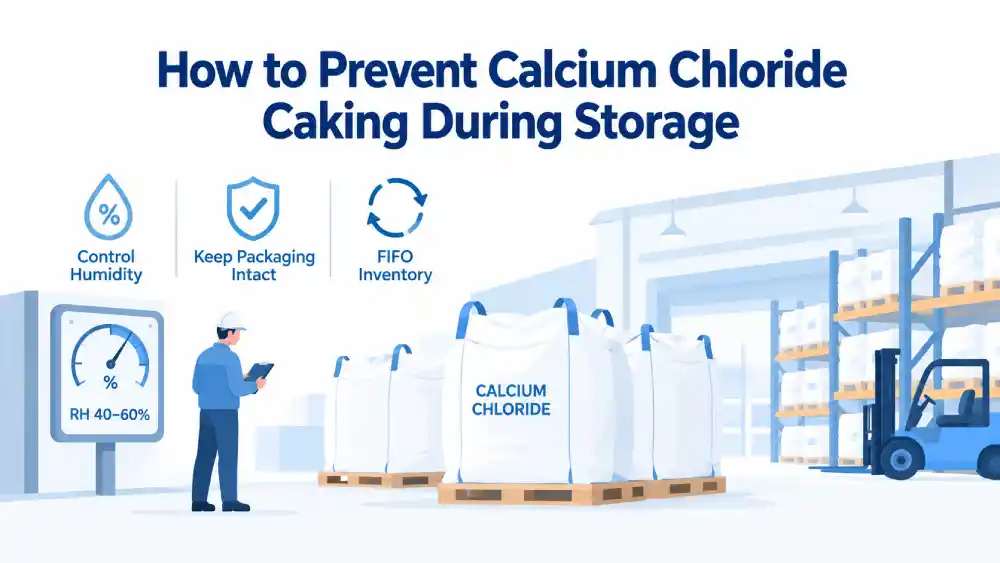
Preventing calcium chloride caking during storage is fundamentally a matter of controlling moisture before it reaches the material. Calcium chloride caking begins when surface brine forms and then re-crystallizes at particle contact points; the key to prevention is maintaining relative humidity below the threshold that drives continuous absorption. Warehouse teams should prioritize three practices above all others: verifying packaging integrity at receipt, keeping storage humidity below 50%, and rotating inventory on a strict first-in, first-out basis.
The operational workflow described here—receive and inspect, stage in controlled humidity, rotate inventory, monitor at fixed intervals, inspect monthly, discharge with controlled air exchange, and reseal promptly—provides a repeatable framework that can be adapted to different warehouse configurations. When caking does occur, early intervention preserves the usability of the lot. The distinction between surface hardening and bulk consolidation determines whether the material can be used as-is or must be routed to dissolution.
The right approach depends on the form of calcium chloride being stored and the available environmental controls. Start by assessing the humidity profile of the storage zone and the condition of existing inventory before implementing additional controls.