Is calcium chloride pH-neutral? The answer is more nuanced than a simple yes or no. Calcium chloride solutions are safe when handled properly; the key risks are misunderstanding how concentration, grade, and application environment affect actual pH behavior. Unlike a single fixed value, the pH of calcium chloride varies depending on solution strength, temperature, and the presence of other ions in the system. For technical buyers, knowing these variables is essential for selecting the right specification and avoiding costly compatibility issues.
What This Article Covers
- What calcium chloride pH actually means in practical specifications
- How concentration and hydration state shift pH values
- Why the carbonate system determines pH behavior in real applications
- Bottom line: Always request a Certificate of Analysis with measured pH at your intended use concentration, not the theoretical value.
What Is Calcium Chloride pH?
Calcium chloride (CaCl₂) is an inorganic salt that dissociates into calcium ions (Ca²⁺) and chloride ions (Cl⁻) when dissolved in water. Neither of these ions directly contributes to acidity or alkalinity in the way that hydrogen or hydroxide ions do. This means that a pure calcium chloride solution is not intrinsically acidic or basic in the conventional sense.
The pH of a calcium chloride solution is primarily determined by the ionic strength of the solution and the behavior of dissolved carbon dioxide. When CaCl₂ dissolves, it increases the ionic strength, which alters the activity coefficients of hydrogen ions and can shift measured pH values downward by a small margin. More significantly, calcium ions interact with carbonate species in water, which can either raise or lower pH depending on the system’s state of equilibrium.
For technical buyers, the practical takeaway is straightforward: calcium chloride does not have a single “pH” value. It has a range that depends on how, where, and at what concentration it is used.
How Does Concentration Affect Calcium Chloride pH?
Concentration is the most immediate variable affecting measured pH. As the percentage of calcium chloride in solution increases, the ionic strength rises, and pH typically shifts slightly toward the lower end of the range.
The effect is not dramatic but is measurable. For example, 5% calcium chloride solutions typically fall within a pH range of 4.5 to 9.5 depending on the specific grade and carbon dioxide equilibrium state. At higher concentrations, such as 10% solutions, pharmaceutical-grade calcium chloride injection shows a pH range of 5.5 to 7.5 when further diluted to 5% with water for injection. This narrow range reflects the controlled conditions and purity of pharmaceutical applications, not the broader variability seen in industrial grades.
For industrial and technical grades, dihydrate calcium chloride (CaCl₂·2H₂O) specifications commonly list a pH of 4.5 to 6.5 at 100 g/L concentration at 20°C. This represents a moderately acidic range that buyers should account for in applications involving pH-sensitive materials or downstream chemical processes.
The table below summarizes typical pH ranges by product form and concentration:
| Product Form / Concentration | Typical pH Range | Conditions |
|---|---|---|
| Dihydrate, 100 g/L solution | 4.5 – 6.5 | 20°C |
| Food grade, 5% solution | 4.5 – 9.5 | Variable |
| Injection grade, 5% solution | 5.5 – 7.5 | After dilution |
| Qualified deicing liquid | 6.0 – 10.0 | Specification range |
This variability is not a quality defect. It reflects the thermodynamic reality of calcium chloride in aqueous systems.
Why Does Calcium Chloride pH Change in Water Systems?
The pH behavior of calcium chloride in real-world water systems is dominated by its interaction with the carbonate system—the dynamic equilibrium between dissolved carbon dioxide, bicarbonate, and carbonate ions.
When calcium chloride is added to water containing bicarbonate alkalinity, calcium ions bind with carbonate ions to form insoluble calcium carbonate (CaCO₃). This precipitation removes carbonate from solution, which drives the equilibrium toward lower pH. The reaction can be summarized as:
Ca²⁺ + CO₃²⁻ → CaCO₃ (solid)
As carbonate ions are consumed, the system compensates by shifting the bicarbonate equilibrium, releasing hydrogen ions and reducing pH. This mechanism explains why adding calcium chloride to hard, alkaline water often produces a measurable pH decrease rather than a stable neutral value.
The reverse effect can also occur. In open systems exposed to atmospheric carbon dioxide, calcium chloride solutions can absorb CO₂ and form carbonic acid, which further lowers pH over time. In closed systems or under aeration, the equilibrium shifts differently.
EPA and ASTM standards recognize this complexity. ASTM D98, the historical specification for calcium chloride, does not mandate a single pH value precisely because the measurement is so system-dependent. For water treatment applications, AWWA B550-23 provides the governing framework, and buyers should specify the pH measurement conditions alongside the acceptable range.
Is Calcium Chloride Acidic or Basic?
Neither label applies cleanly. Calcium chloride is a salt of a strong acid (HCl) and a weak base (Ca(OH)₂), which theoretically predicts a slightly acidic solution. In practice, the solution pH depends almost entirely on the carbonate chemistry of the water it enters.
In deionized water with minimal dissolved CO₂, calcium chloride solutions can measure close to neutral or slightly alkaline. In natural waters with moderate to high alkalinity, the calcium-carbonate interaction pushes pH downward. In highly buffered industrial process streams, the effect may be negligible.
This means that a buyer comparing two calcium chloride suppliers on pH alone is comparing an incomplete specification. The more useful question is: What is the pH of this product in my specific application environment?
How Does Hydration State Influence pH Specification?
Calcium chloride is commercially available in anhydrous form (CaCl₂) and as dihydrate (CaCl₂·2H₂O). The hydration state affects the concentration of calcium chloride delivered per unit weight but does not fundamentally change the pH behavior once dissolved.
However, the moisture content of the product does affect the accuracy of concentration-based specifications. Dihydrate products typically contain 74–77% calcium chloride by weight, with the remainder being water of crystallization. Anhydrous products are typically 94–97% CaCl₂. When a specification states “pH of a 10% solution,” the buyer must confirm whether that percentage refers to the product as received or to the calcium chloride content on a dry basis.
A Certificate of Analysis that reports pH without stating the measurement concentration and temperature provides limited value for technical evaluation. ASTM E70 or equivalent methods for pH measurement should be referenced in the specification to ensure consistency.
What Should Buyers Look for in Calcium Chloride Specifications?
For technical procurement, pH is one parameter among several that determine fitness for use. The table below outlines the key specification elements that should accompany any pH value:
| Specification Element | Why It Matters | Typical Requirement |
|---|---|---|
| Measurement concentration | pH varies with dilution | State g/L or % w/w |
| Measurement temperature | pH is temperature-dependent | 20°C or 25°C |
| Hydration state | Affects concentration basis | Anhydrous or dihydrate |
| Grade designation | Industrial, food, or pharmaceutical | Match to application |
| Carbonate interaction data | Critical for water treatment | Alkalinity of receiving water |
| Corrosion inhibitor presence | Affects wetted materials | Specify if required |
AWWA B550-23 provides the recognized standard for calcium chloride used in water treatment applications. For road deicing and dust control, the Pacific Northwest Snowfighters specification sets pH limits of 6.0 to 10.0 for corrosion-inhibited liquid products, recognizing that added inhibitors can shift pH upward.
A supplier who cannot provide pH data at the intended use concentration is a supplier who has not fully characterized their product for your application.
When Does Calcium Chloride pH Matter Most?
Certain applications are more sensitive to pH variation than others. Buyers in these categories should prioritize pH specification accuracy:
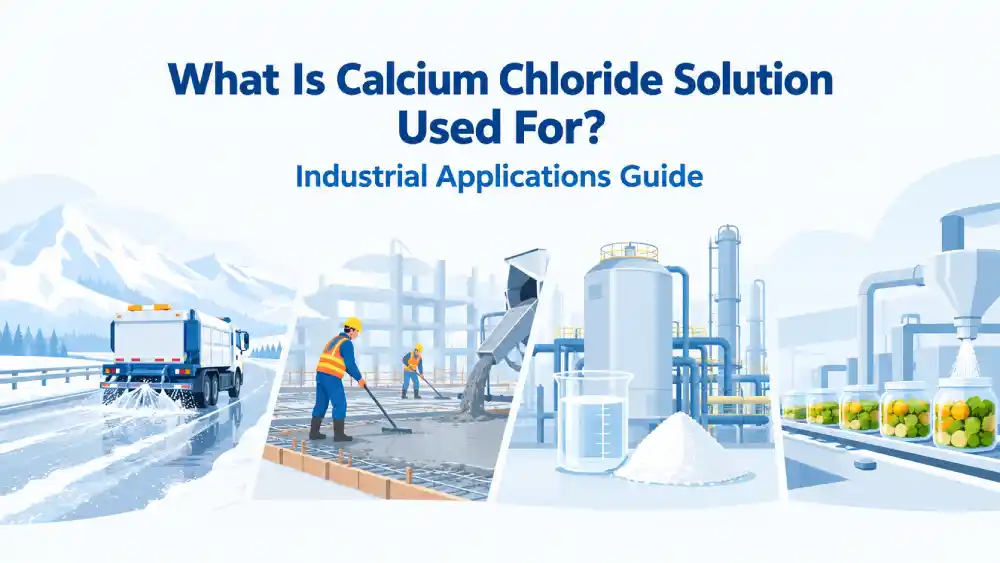
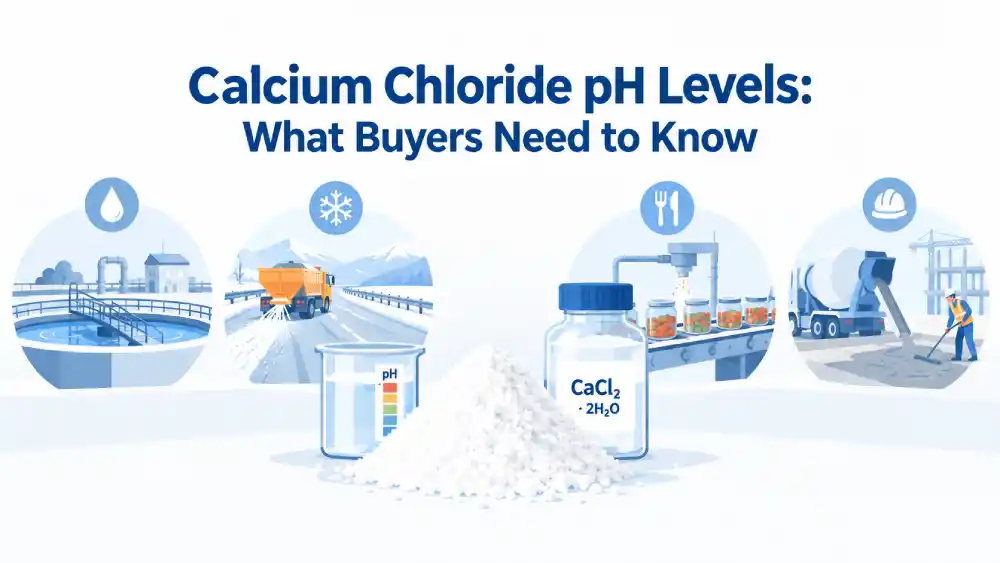
Water treatment and wastewater processing. Calcium chloride is added to adjust calcium hardness and to precipitate carbonate species. The pH effect of the addition must be modeled into the treatment process design. In denitrifying biofilters, for example, calcium chloride addition binds excess carbonate ions and causes pH to drop toward equilibrium with atmospheric CO₂.
Concrete and cement admixtures. Calcium chloride accelerates set time in portland cement, but chloride ions also promote steel reinforcement corrosion. The pH of the concrete pore solution is normally above 12.5, which passivates steel. Adding calcium chloride lowers this pH locally and can disrupt the passivation layer. ACI guidelines restrict calcium chloride use in reinforced concrete and prohibit it in prestressed concrete.
Food processing and preservation. Food-grade calcium chloride (E509) is used as a firming agent in canned vegetables and a calcium source in cheese-making. The pH of the brine or process water affects texture development and microbial stability. Food-grade specifications typically cite a pH range of 4.5 to 9.5 for 5% solutions, with the actual value dependent on the water quality used.
Chemical manufacturing and pH adjustment. In processes where calcium chloride is used to suppress excessive pH rise—such as in certain water treatment configurations—the accurate prediction of pH impact is part of the process control strategy.
Common Mistakes in Evaluating Calcium Chloride pH
Treating pH as a fixed specification. A specification sheet that lists “pH: 7” without conditions is incomplete. Calcium chloride pH is a function of solution conditions, not an intrinsic property.
Ignoring the carbonate system. In soft water with low alkalinity, calcium chloride addition may have minimal pH effect. In hard water, the effect can be substantial. Failing to account for receiving water chemistry leads to incorrect predictions.
Confusing product pH with solution pH. The pH of a concentrated liquid calcium chloride product is not the same as the pH after dilution into the application system. Measurement must be performed at use concentration.
Overlooking inhibitor effects. Corrosion-inhibited calcium chloride products for deicing contain added chemicals that raise pH to the 6.0–10.0 range. Comparing these products to uninhibited calcium chloride on pH alone is misleading.
Conclusion
Calcium chloride pH is not a single number but a range that responds to concentration, temperature, hydration state, and the carbonate chemistry of the receiving water. For technical buyers, the critical insight is that pH behavior must be evaluated at use conditions, not at the theoretical product level. Specifications that omit measurement concentration and temperature provide incomplete data for engineering decisions.
The practical framework is straightforward: request measured pH data at your intended dilution, confirm the hydration state and grade match your application, and account for the alkalinity of your process water. When those variables are controlled, calcium chloride remains a predictable and reliable chemical input across water treatment, deicing, food processing, and industrial manufacturing. The key is to prioritize system-specific pH characterization over generic specification values when evaluating potential suppliers.
FAQs
What is the pH of calcium chloride?
Calcium chloride solutions typically range from pH 4.5 to 9.5 depending on concentration and water chemistry. Dihydrate at 100 g/L measures approximately 4.5 to 6.5 at 20°C. A pure calcium chloride solution in deionized water trends slightly acidic due to dissolved CO₂, but the pH effect in natural waters depends primarily on carbonate alkalinity.
Is calcium chloride acidic or alkaline?
Calcium chloride is neither strongly acidic nor alkaline. It is a neutral salt that produces pH effects through secondary interactions with the carbonate system. In water containing bicarbonate, calcium chloride addition can lower pH by precipitating calcium carbonate and shifting the CO₂ equilibrium.
How does concentration affect calcium chloride pH?
Higher concentrations increase ionic strength, which slightly shifts measured pH. More importantly, higher calcium ion concentrations drive more carbonate precipitation in alkaline waters, producing a greater pH decrease. The effect is measurable but usually modest, typically within 1–2 pH units across practical concentration ranges.
Why does calcium chloride lower pH in water?
Calcium ions bind with carbonate ions to form insoluble calcium carbonate. This removes carbonate from solution, causing the bicarbonate equilibrium to shift and release hydrogen ions. The net result is a pH reduction proportional to the water’s initial alkalinity and the amount of calcium chloride added.
What pH should I specify for calcium chloride?
There is no universal specification. The correct approach is to specify pH at your intended use concentration and temperature, with the measurement method referenced. For water treatment, follow AWWA B550-23 guidance. For deicing, the Pacific Northwest Snowfighters specification sets 6.0–10.0 for inhibited liquids.
Does calcium chloride pH affect concrete?
Yes. Calcium chloride addition lowers the pH of concrete pore solution and can disrupt the passivation layer protecting steel reinforcement. This is why ACI guidelines restrict calcium chloride in reinforced concrete and prohibit it in prestressed concrete.
Is food-grade calcium chloride pH different?
Food-grade calcium chloride (E509) shows a pH range of 4.5 to 9.5 for 5% solutions. The actual value depends on the water used to prepare the solution and the specific grade. Food processing applications should always measure pH in the actual brine or process water.
How does temperature affect calcium chloride pH?
pH is temperature-dependent. The Nernst equation predicts a shift in measured pH of approximately 0.01 to 0.03 units per degree Celsius for typical solutions. Specifications should state the measurement temperature, typically 20°C or 25°C, to ensure comparability.
Can calcium chloride raise pH?
Yes, in certain conditions. In very soft water with minimal carbonate alkalinity, calcium chloride addition may have little pH effect or slightly raise pH by displacing hydrogen ions from surfaces. In deicing products with alkaline inhibitors, pH is deliberately adjusted upward to the 6.0–10.0 range.
What is the pH of calcium chloride injection?
Pharmaceutical-grade 10% calcium chloride injection has a pH of 5.5 to 7.5 when diluted to 5% with water for injection. Hydrochloric acid or sodium hydroxide may be added for pH adjustment. This narrow range reflects the controlled purity and conditions of pharmaceutical manufacturing, not general industrial grade behavior.