Reinforced concrete construction in cold weather creates a persistent tension: the mix needs to set fast enough to meet schedules, but the wrong accelerator can compromise the steel reinforcement for decades. Engineering and HSE teams frequently face pressure to approve calcium chloride because it is cheap, effective, and familiar—yet the corrosion consequences are often invisible until the structure is already in service.
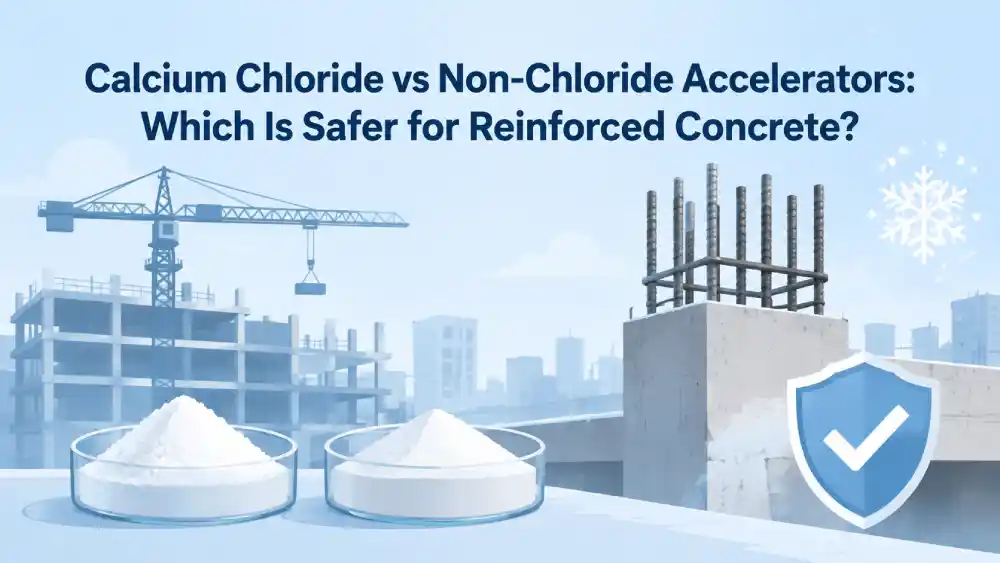
The safety question is not abstract. Calcium chloride is safe for reinforced concrete only when the total chloride ion content remains below strict ACI limits and the exposure conditions are carefully controlled. In practice, most reinforced concrete specifications prohibit its use outright because field control of chloride content is difficult to guarantee. Non-chloride accelerators eliminate the chloride-driven corrosion risk entirely, but they introduce different trade-offs in performance, cost, and dosage sensitivity that engineers must evaluate.
This comparison examines the mechanism, performance, regulatory limits, and practical selection criteria for both accelerator families. It is written for engineering and HSE professionals who need to make defensible material decisions—not marketing claims—about what goes into reinforced concrete.
Key Takeaways
- Calcium chloride accelerates set and early strength more effectively than most non-chloride alternatives, particularly at temperatures below 10°C, but introduces chloride ions that depassivate steel reinforcement.
- ACI 318 limits water-soluble chloride to 0.15% by weight of cement for reinforced concrete in dry conditions and 0.08% for wet conditions; calcium chloride at typical dosages of 1–2% can exceed these thresholds .
- Non-chloride accelerators such as calcium nitrate and calcium formate provide chloride-free acceleration, though calcium nitrate may temporarily reduce 1-day strength before matching calcium chloride performance at 28 days .
- The corrosion risk from calcium chloride is not linear with dosage—variable dosing across different elements of the same structure creates localized zones of high chloride concentration that become preferential corrosion sites .
- HSE teams should treat calcium chloride as a restricted material in reinforced concrete and require documented chloride ion calculations from all mix constituents before approval.
What Is Calcium Chloride and How Does It Accelerate Concrete?
Calcium chloride (CaCl₂) is an inorganic salt that has been used as a concrete accelerator for over a century. In its solid or solution form, it dissolves rapidly in mixing water and releases calcium and chloride ions into the pore solution. The calcium ions participate in the hydration reaction, while the chloride ions act as a catalyst that accelerates the dissolution of tricalcium silicate (C₃S) and tricalcium aluminate (C₃A)—the primary cement compounds responsible for early strength development.
The accelerating effect is dose-dependent and temperature-sensitive. At 1% by weight of cement, calcium chloride can reduce initial set time by 30–50% under moderate conditions. At 2%, the effect is more pronounced, which is why cold-weather concreting historically relied on calcium chloride to achieve adequate strength gain before freezing . The American Concrete Institute (ACI) notes that calcium chloride should not be used in amounts exceeding 2%, preferably 1%, of the mass of cementitious material .
The problem is not the acceleration mechanism itself—it is the chloride ion’s effect on embedded steel.
Why Does Calcium Chloride Corrode Reinforced Steel?
Steel reinforcement in concrete is normally protected by a passive oxide layer that forms in the high-pH environment (pH 12.5–13.5) of cement pore solution. This passive film is stable and self-healing as long as the alkalinity remains high and chloride concentrations stay below a critical threshold.
Chloride ions destroy the passive film. When chloride concentration at the steel surface exceeds a critical value—commonly expressed as a chloride-to-hydroxide ratio—the passive layer breaks down locally, creating pits. In the presence of moisture and oxygen, these pits become active corrosion sites. The corrosion products (rust) occupy 2–6 times the volume of the original steel, generating internal tensile stresses that crack and spall the concrete cover.
The process is insidious because visible damage appears years after the chloride was cast into the concrete. A structure that looks sound at 28 days can develop cracking along the rebar path within 3–5 years in moist environments. Post-mortem studies of distressed reinforced concrete have found that columns cast with variable calcium chloride contents (0 to 1.5%) exhibited cracking aligned with the reinforcing steel only in the chloride-containing portions, confirming the causal relationship .
ACI’s position is unambiguous: “To minimize corrosion, calcium chloride should not be used in any steel-reinforced concrete” . This is not a recommendation for reduced dosage—it is a categorical prohibition for the application category.
How Do Non-Chloride Accelerators Work Differently?
Non-chloride accelerators achieve set acceleration through mechanisms that do not introduce chloride ions into the pore solution. The two most common chemistries are calcium nitrate (Ca(NO₃)₂) and calcium formate (Ca(CHO₂)₂), though proprietary formulations may combine multiple salts.
Calcium nitrate accelerates set by supplying calcium ions that increase the rate of C₃S hydration. Unlike calcium chloride, the nitrate anion does not depassivate steel. Research comparing calcium nitrate and calcium chloride in cementitious systems found that calcium nitrate acts as a set accelerator, though a slight drop in 1-day strength is noted relative to dosage; by 28 days, strengths across all dosage levels were similar to calcium chloride systems . The transient early-strength gap is a practical consideration for formwork removal schedules but does not indicate a durability deficiency.
Calcium formate provides acceleration through a different pathway, supplying formate ions that react with cement phases to accelerate alite hydration. Formate-based accelerators are often preferred where nitrate sensitivity (e.g., in certain regulated environments) is a concern, though availability varies by region.
The critical distinction for reinforced concrete is simple: non-chloride accelerators contribute zero chloride ions to the total chloride load. This eliminates the need for chloride calculations across mix constituents and removes the corrosion risk pathway entirely.
Calcium Chloride vs Non-Chloride Accelerators: Performance Comparison
The performance trade-off between the two accelerator families is real but often overstated. Calcium chloride remains the more potent accelerator at equivalent dosages, particularly at early ages and low temperatures. Non-chloride options close the gap by 28 days but may require higher dosages or mix adjustments to match early strength development.
| Comparison Dimension | Calcium Chloride | Non-Chloride Accelerators |
|---|---|---|
| Set acceleration | Strong, dose-dependent; effective below 10°C | Moderate; calcium nitrate effective but slower than CaCl₂ |
| 1-day strength | Typically higher than non-chloride at equal dosage | Calcium nitrate may show slight reduction vs. CaCl₂ |
| 28-day strength | Comparable | Comparable; performance converges |
| Corrosion risk | High; chloride-induced pitting of steel | Negligible; no chloride contribution |
| ACI compliance | Requires chloride calculation; often non-compliant | Compliant by material composition |
| Dosage sensitivity | Moderate; over-dosing increases corrosion risk | Moderate; under-dosing reduces acceleration |
| Typical dosage | 1–2% by weight of cement | 200–1,200 mL per 100 kg cementitious (liquid formulations) |
| Cost per unit | Lower material cost | Higher material cost |
Typical market reference values for dosage and relative cost. Actual costs vary by region and supplier.
The performance gap matters most in cold-weather construction where early strength is critical for freeze protection and rapid formwork cycling. In moderate temperatures, the acceleration difference between the two families is less consequential, and the corrosion risk of calcium chloride becomes harder to justify.
What Are the Regulatory Limits for Chloride in Reinforced Concrete?
ACI establishes maximum water-soluble chloride ion limits based on service conditions. These limits are not suggestions—they are code requirements in jurisdictions that adopt ACI 318.
For new construction, ACI 222R specifies the following water-soluble chloride limits by weight of cement :
| Exposure Category | Maximum Water-Soluble Chloride (% by weight of cement) |
|---|---|
| Prestressed concrete | 0.06% |
| Reinforced concrete in wet conditions | 0.08% |
| Reinforced concrete in dry conditions | 0.15% |
ACI 318 is somewhat more permissive for certain categories, allowing up to 0.30% for “other reinforced concrete construction” and 1.00% for concrete protected from moisture . However, the more restrictive ACI 222R limits are generally the governing standard for durability-critical structures.
A 1% calcium chloride dosage by weight of cement introduces approximately 0.64% chloride ion by weight of cement (since CaCl₂ is 64% chloride by mass). This alone exceeds the ACI 222R wet-condition limit of 0.08% by a factor of eight. Even the dry-condition limit of 0.15% is exceeded at dosages above approximately 0.23% CaCl₂ by weight of cement—well below the 1–2% dosages historically used for acceleration.
The calculation must account for all chloride sources: cement, aggregates, mixing water, and admixtures. In practice, achieving compliance with calcium chloride as an accelerator requires dosages so low that the acceleration benefit becomes marginal.
Where Is Calcium Chloride Still Used in Reinforced Concrete?
Despite the corrosion mechanism and ACI guidance, calcium chloride is not universally banned. Its continued use falls into three categories:
Unreinforced concrete applications. Calcium chloride remains acceptable in mass concrete, foundation footings without reinforcement, and certain pavement applications where no embedded steel is present. The corrosion pathway does not exist without steel.
Historical structures under evaluation. Engineers assessing older reinforced concrete must account for calcium chloride that was cast into the concrete decades ago under different standards. Non-destructive chloride testing (ASTM C1218 for water-soluble chloride) is essential for condition assessment and repair planning.
Jurisdictions with less restrictive codes. Some regions permit calcium chloride in reinforced concrete with documented chloride calculations and enhanced inspection. HSE teams operating internationally must verify local code requirements rather than assuming ACI compliance.
For new reinforced concrete construction in jurisdictions that reference ACI standards, the practical answer is that calcium chloride should not be approved. The corrosion risk cannot be reliably managed through dosage control alone, and the cost difference between calcium chloride and non-chloride accelerators is small relative to the lifecycle cost of corrosion repair.
How Should Engineers Select the Right Accelerator?
Accelerator selection for reinforced concrete follows a decision sequence that prioritizes durability over initial cost.
Choose non-chloride accelerators when:
- The concrete contains any steel reinforcement, prestressing strand, or embedded metal
- The structure will be exposed to moisture, chlorides from external sources, or cyclic wetting and drying
- The specification references ACI 318, ACI 222R, or equivalent durability requirements
- The design service life exceeds 20 years and maintenance access is limited
- HSE or asset management policies prioritize lifecycle cost over first cost
Calcium chloride may be considered only when:
- The concrete is genuinely unreinforced (no steel fibers, no embedded conduits, no tie wires)
- The application is temporary or non-structural with no durability requirement
- Local code explicitly permits chloride-based accelerators in the specific exposure category
- A documented chloride ion calculation demonstrates compliance with applicable limits, including all mix constituents
Do not use either accelerator without first evaluating whether acceleration is actually necessary. ACI and industry guidance consistently note that accelerators should only be used when necessary, as their use may negatively impact long-term durability . Mix design adjustments—lower water-cementitious ratio, Type III cement, or additional curing—can sometimes eliminate the need for an accelerator entirely.
Common Mistakes in Accelerator Selection
Assuming “low dosage” calcium chloride is safe. There is no threshold below which chloride-induced corrosion risk becomes zero in moist environments. The critical chloride threshold varies with steel surface condition, concrete permeability, and exposure, but even low chloride additions contribute to the total load.
Using calcium chloride in prestressed concrete. Prestressing strand under tension is “very vulnerable to corrosion with serious consequences” . The ACI limit for prestressed concrete is 0.06% water-soluble chloride—effectively zero for practical purposes. No chloride-based accelerator should be permitted.
Ignoring temperature-dependent dosing. Historical practice of increasing calcium chloride dosage in colder weather creates variable chloride profiles within the same structure. The zones with higher chloride become preferential corrosion sites, as documented in post-mortem studies .
Confusing “chloride-free” marketing with compliance. Some proprietary accelerators may contain trace chlorides from raw materials. Request a certificate of analysis confirming chloride content below 0.01% and verify the contribution against the total chloride budget.
Neglecting HSE exposure controls. Calcium chloride in powder form is irritant to skin and eyes. Liquid calcium chloride solutions can cause burns with prolonged contact. HSE teams should require appropriate PPE and handling procedures regardless of the reinforced concrete prohibition.
How Do Non-Chloride Accelerators Perform in Cold Weather?
Cold-weather concreting is where accelerator selection becomes most consequential. At temperatures below 5°C, cement hydration slows dramatically, and concrete may not reach critical strength before freezing.
Calcium chloride remains the more effective cold-weather accelerator in terms of raw set acceleration. At 2% dosage, it can reduce set time by 50–70% at 5°C, enabling finishing and protection within a practical window.
Non-chloride accelerators are effective but require higher dosages or mix adjustments in cold weather. Calcium nitrate at 2–4% by weight of cement provides meaningful acceleration, though the 1-day strength may lag calcium chloride by 10–20%. This gap can be offset by using Type III (high-early) cement, reducing water content, or extending curing duration.
For projects where cold-weather construction is unavoidable and reinforcement is present, the correct approach is to specify a non-chloride accelerator and adjust the mix design and curing regime to compensate for the performance difference. The cost of heated enclosures or extended protection periods is a direct trade against the corrosion risk of calcium chloride.
FAQs
What is the maximum calcium chloride dosage allowed in reinforced concrete?
ACI does not permit calcium chloride in steel-reinforced concrete under its guidance, but where local codes allow it, the maximum dosage should not exceed 1% by weight of cementitious material—and only if the total water-soluble chloride remains below the applicable ACI limit. For wet-service reinforced concrete, that limit is 0.08%, which is exceeded by even 0.13% calcium chloride addition.
How does calcium chloride cause corrosion in reinforced concrete?
Calcium chloride releases chloride ions into the concrete pore solution. When chloride concentration at the steel surface reaches a critical threshold, it breaks down the passive oxide film that normally protects steel in concrete’s alkaline environment. Moisture and oxygen then initiate pitting corrosion, which produces expansive rust that cracks the concrete cover.
Is calcium nitrate as effective as calcium chloride for acceleration?
Calcium nitrate is a reliable set accelerator but is generally less potent than calcium chloride at equal dosages. Research shows calcium nitrate may produce slightly lower 1-day strength compared to calcium chloride, though by 28 days the strengths are comparable . For cold-weather work, higher dosages or mix adjustments may be needed.
Can calcium chloride be used in concrete that will never get wet?
ACI 222R allows up to 0.15% water-soluble chloride for reinforced concrete in dry conditions. However, “dry” is difficult to guarantee over a structure’s service life, and moisture can migrate through cracks or at connections. Most durability specifications treat reinforced concrete as potentially wet and apply the 0.08% limit.
What are the HSE risks of handling calcium chloride on site?
Calcium chloride in solid form is hygroscopic and can cause skin irritation; prolonged contact with solutions can cause burns. Dust inhalation irritates respiratory passages. HSE controls include impermeable gloves, eye protection, and dust suppression during mixing. The primary HSE concern for reinforced concrete, however, is the long-term structural risk from corrosion, not acute toxicity.
How can I verify that a non-chloride accelerator contains no chlorides?
Request a certificate of analysis from the admixture supplier specifying chloride content, typically reported as “chloride ion content, % by weight” or “less than 0.01%.” For critical projects, third-party testing of the admixture or hardened concrete (ASTM C1218) provides verification that the total chloride budget has not been exceeded.
Does calcium chloride affect concrete strength beyond corrosion?
Calcium chloride increases early strength but may reduce resistance to sulfate attack (except with Type V cement) and increases expansion due to alkali-silica reaction . Some studies also note that calcium chloride can negatively affect air-void system parameters in hardened concrete, potentially reducing freeze-thaw durability .
When should I use a non-chloride accelerator instead of calcium chloride?
Use a non-chloride accelerator whenever the concrete contains steel reinforcement, prestressing strand, or embedded metal, and whenever the structure will be exposed to moisture or external chlorides. If acceleration is needed and reinforcement is present, non-chloride is the only defensible choice under ACI-referenced codes.
Are all non-chloride accelerators equally safe for reinforced concrete?
The defining safety characteristic is the absence of chloride ions, not the specific chemistry. Calcium nitrate, calcium formate, and proprietary chloride-free formulations all eliminate the chloride-driven corrosion pathway. Selection among them depends on availability, cost, dosage requirements, and compatibility with the specific cementitious system.
What is the cost difference between calcium chloride and non-chloride accelerators?
Non-chloride accelerators typically cost 3–8 times more per unit of dosage compared to calcium chloride, depending on chemistry and region. However, this material cost difference is small relative to the cost of corrosion repair or premature structural deterioration. Lifecycle cost analysis consistently favors non-chloride accelerators for reinforced concrete.
Conclusion
Calcium chloride vs non-chloride accelerators is ultimately a question of whether the chloride ion can be kept away from steel reinforcement. Calcium chloride is safe for reinforced concrete only when handled properly—meaning total water-soluble chloride remains below ACI limits and exposure conditions are strictly controlled. The key risks are chloride-induced depassivation of steel, pitting corrosion, and eventual cracking and spalling that may not appear for years after construction.
For engineering and HSE teams, the practical framework is straightforward. Non-chloride accelerators eliminate the chloride variable entirely, removing a corrosion mechanism that is difficult to inspect, impossible to reverse, and expensive to repair. The performance gap between the two families is manageable through mix design and curing practice. The regulatory gap is not: ACI 222R and ACI 318 effectively prohibit calcium chloride in most reinforced concrete applications.
When evaluating accelerator options for a project with embedded steel, prioritize the total chloride budget over set-time convenience. Verify supplier certificates of analysis, calculate chloride contributions from all mix constituents, and document the decision basis. The correct accelerator is the one that meets the schedule without compromising the steel—and for reinforced concrete, that means non-chloride every time.