Mine water reuse is no longer a "nice-to-have" option. In water-stressed mining regions, reuse rates of 60–85% are increasingly common, driven by regulatory pressure and rising freshwater intake costs.
However, many operations still struggle to maintain stable reuse performance, with turbidity and solids loading fluctuating beyond acceptable limits.
In most cases, the root cause is not mechanical failure, but insufficient control of water chemistry.
Why Stability Matters More Than Maximum Removal
Short-term turbidity removal can often exceed 95%, yet many reuse systems fail to sustain this level over time. Field data from mineral processing circuits show that:
- A ±0.5 pH drift can increase coagulant demand by 15–30%
- Unstable floc formation may double sludge carryover events
- Clarifier upsets can reduce effective reuse availability by 10–20% annually
For continuous operations, consistency—not peak performance—defines success.
pH Adjustment: The Foundation of the Reuse Loop
pH directly controls metal solubility, particle surface charge, and coagulant efficiency. In untreated mine water, pH commonly fluctuates between 5.5 and 8.5, depending on ore mineralogy and oxidation conditions.
Without stabilization, even advanced clarification systems experience performance swings.
Defining the Effective pH Window
For most aluminum-based coagulants, including PAC, optimal clarification occurs within a pH range of 6.0–7.5. Outside this window:
- Aluminum hydrolysis becomes incomplete
- Floc density decreases
- Settling velocity may drop by 20–40%
Maintaining pH within a controlled band of ±0.2–0.3 units significantly improves downstream clarification stability.
Practical pH Adjustment Strategies
Different alkalinity agents provide different levels of control:
- Sodium bicarbonate: fine buffering, slow reaction, minimal scaling risk
- Soda ash: moderate correction, fast response, widely used in reuse loops
- Lime: high-capacity adjustment, but higher risk of over-correction and scaling
Selecting the correct reagent can reduce alkalinity consumption by 10–25% while maintaining stable operating conditions.
From Charge Neutralization to Floc Formation
Mine water often contains suspended solids in the range of 100–2,000 mg/L, with a large fraction below 10 μm, making gravity separation difficult without chemical assistance.
Performance of Poly Aluminium Chloride
PAC is widely applied in mine water treatment due to its pre-hydrolyzed structure and rapid charge neutralization. Typical field results show:
- Turbidity reduction from 300–800 NTU to <5 NTU
- Effective dosage ranges of 10–50 mg/L, depending on solids loading
- Sludge volume reductions of 20–40% compared to alum
These characteristics make PAC particularly suitable for variable mine water streams.
High-Efficiency Clarification: Quantifying the Benefits
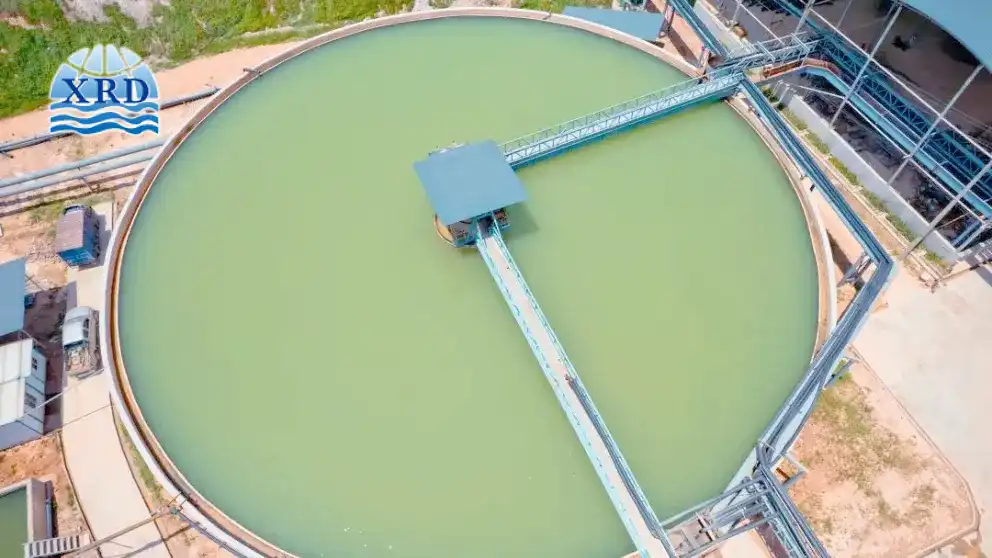
When upstream chemistry is stable, high-efficiency clarifiers demonstrate:
- Overflow rates of 2–4 m³/m²·h with consistent effluent quality
- Effluent turbidity maintained below 5–10 NTU
- Sludge solids concentration increased to 2–5%, improving dewatering efficiency
Stable clarification reduces the load on filters or membranes, often extending backwash intervals by 30–50%.
Closing the Loop: System-Level Performance Gains
Integrated chemical control delivers measurable system-wide benefits:
- Freshwater intake reduced by 30–60%
- Total chemical cost lowered by 10–20% through dosage stability
- Fewer unplanned shutdowns related to water quality excursions
These gains transform water reuse from a risk factor into a controllable asset.
Conclusion
A stable mine water reuse loop is built on chemistry control, not just infrastructure.
By maintaining pH within a narrow functional range and pairing it with high-efficiency clarification, mining operations can achieve consistent water quality, predictable reuse rates, and lower overall operating costs.
In mine water management, stability is not an abstract goal—it is a measurable performance outcome.