
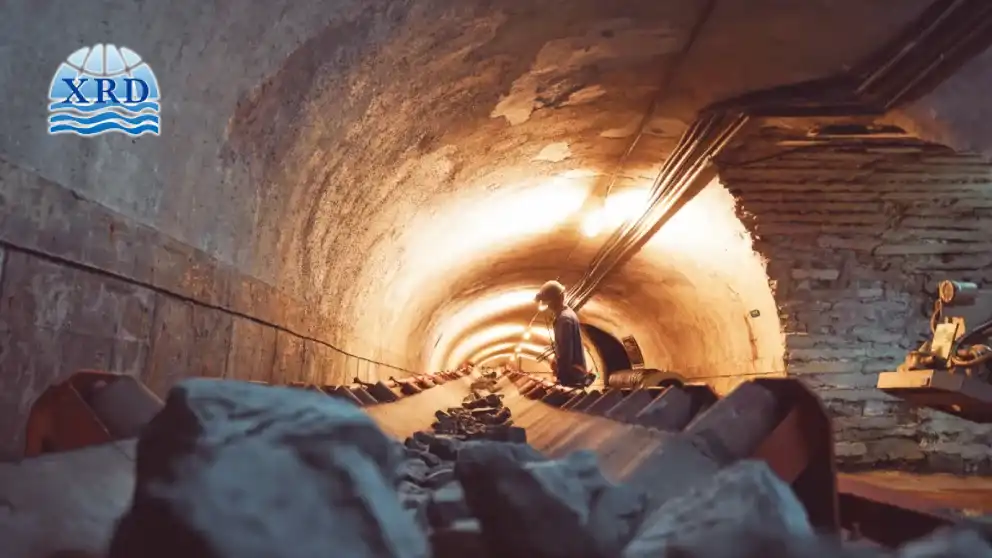
Underground mining operations depend on consistent material flow. Conveyors, feeders, and transfer points are expected to operate continuously in confined spaces where access is limited and downtime is costly.
When conveyor stoppages occur, attention is often focused on mechanical components. However, in many underground mines, the root cause originates upstream in how materials interact with moisture—and how that interaction is chemically controlled.
In practice, calcium chloride (CaCl₂) and magnesium chloride (MgCl₂) are among the most commonly used conditioning chemicals to manage moisture behavior in fine ores, coal, salt, and evaporite materials. When these controls are absent, misapplied, or mismatched to material characteristics, moisture-induced caking becomes a persistent driver of conveyor downtime.
Understanding Caking in Confined Underground Environments
Caking develops through a combination of environmental and material-specific factors common in underground mines:
- High ambient humidity from groundwater and restricted ventilation
- Condensation caused by temperature differences between intake air and rock mass
- Fine particle size distributions with high surface area
- Soluble salts and reactive mineral surfaces within the material
Moisture does not need to be excessive to create problems. Even small amounts, when unevenly distributed, can generate capillary forces that bind particles together. Under sustained load in hoppers, chutes, and on conveyors, these bonds strengthen, gradually transforming free-flowing material into compacted masses.
The Chemical Role of Calcium and Magnesium Chlorides
Moisture-induced caking is not purely a physical phenomenon. Material chemistry strongly influences whether moisture leads to nuisance buildup or severe flow restriction.
Calcium Chloride (CaCl₂)
Calcium chloride is widely used in underground mining due to its strong hygroscopic properties. By attracting and retaining moisture at the particle surface, CaCl₂ helps reduce free water migration, which is a primary driver of localized wet zones and hard caking.
CaCl₂ is commonly applied in several physical forms:
- Pellets or flakes for controlled, longer-lasting conditioning
- Powder where rapid surface coverage is required
The selection depends on application method, material size, and desired persistence. Improper dosage or uneven application, however, can lead to over-wetting or inconsistent conditioning.
Magnesium Chloride (MgCl₂)
Magnesium chloride provides similar moisture control but with greater stability under fluctuating humidity conditions. In underground environments where ventilation cycles vary or seasonal humidity shifts occur, MgCl₂ often delivers more uniform moisture retention over time.
MgCl₂ is frequently used in:
- Coal handling systems
- Salt and potash mining
- Fine mineral streams prone to hygroscopic behavior
Blended calcium–magnesium formulations are sometimes employed to balance immediate moisture control with longer-term stability.
Particle Size and Chemical Form Matter
The effectiveness of chemical conditioning depends not only on chemistry but also on particle size and product form.
- Fine powders provide rapid surface interaction but may agglomerate if overdosed
- Granular or pelletized products offer slower dissolution and more uniform moisture distribution
- Flakes balance coverage and persistence in many underground applications
Matching chemical form to material size distribution is essential. A treatment effective for coarse run-of-mine material may perform poorly on fine crushed streams.
Why Conveyors Are Especially Vulnerable
Conveyors amplify the consequences of poor moisture control:
- Enclosed environments limit evaporation
- Continuous pressure zones promote compaction
- Low belt speeds increase dwell time
- Restricted access delays early intervention
As chemically unmanaged moisture leads to caking, operations experience increased carryback, blocked transfer points, belt mistracking, and rising drive loads—symptoms often mistaken for purely mechanical issues.
Managing Moisture Before It Becomes a Conveyor Problem
Effective mitigation focuses on conditioning material behavior upstream, not reacting at the conveyor.
Best practices include:
- Applying CaCl₂ or MgCl₂ during crushing, transfer, or stockpiling
- Selecting powder, flake, or pellet forms based on particle size
- Monitoring humidity and temperature trends alongside throughput
- Adjusting chemical strategy as material properties change
When chemical conditioning aligns with material chemistry, conveyors operate within design parameters, and downtime becomes predictable rather than recurrent.
Operational Reliability Begins with Chemical Control
In underground mining, conveyor downtime is rarely random. It is often the cumulative result of uncontrolled interactions between moisture, material chemistry, and confined operating conditions.
Calcium chloride and magnesium chloride are not add-ons—they are operational tools that influence whether materials remain free-flowing or evolve into compacted, flow-restricting masses. When applied correctly and matched to material characteristics, these chemicals help restore conveyors to their intended role: reliable transport systems rather than recurring bottlenecks.
Underground reliability starts upstream—with chemical control of material behavior.