
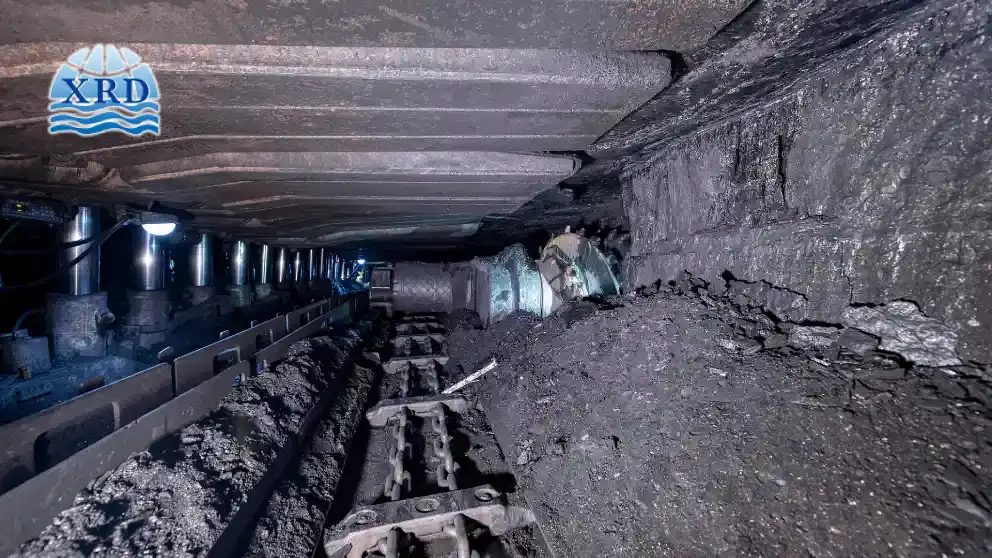
Why Moisture Control Matters More Than Mechanics
Ore flow interruptions in underground mining are often treated as mechanical failures—addressed through vibration, blasting, or manual clearing. Yet in many cases, these interventions respond only to symptoms, not causes. A growing body of operational evidence suggests that ore bridging and blockages below ground are frequently driven by moisture-induced material interactions, particularly in systems handling fine-rich ores under confined, humid conditions.
In ore passes, drawpoints, and loading chutes, even minor deviations in moisture content can trigger fines agglomeration, particle adhesion, and ultimately the formation of self-supporting arches. Within this context, the concept of controlled hygroscopic additives in underground mining, though not yet formalized as an industry standard, provides a useful framework for understanding how chemical moisture regulation could improve flow stability.
This article examines the mechanisms by which hygroscopic and surface-modifying additives may reduce underground ore bridging, drawing on established chemical materials such as calcium chloride, magnesium chloride, calcium magnesium acetate, and polyacrylamide-based polymers.
Moisture-Induced Ore Bridging: A Materials Perspective
From a materials engineering standpoint, ore bridging is rarely caused by coarse particles alone. Instead, it emerges from the interaction of three factors:
- Elevated ambient humidity typical of underground environments
- A high proportion of fine particles capable of absorbing moisture
- Repeated wet–dry cycles caused by seepage, spray systems, or ventilation shifts
Under these conditions, fines absorb water and migrate toward contact points between larger fragments. There, moisture-driven capillary forces and surface adhesion promote cohesion, allowing particle networks to carry load and resist gravity.
This phenomenon—better described as moisture-induced agglomeration in underground ore handling systems—cannot be fully addressed through mechanical means alone.
Defining “Controlled Hygroscopic Additives” in Mining Contexts
Unlike conventional desiccants designed for packaging or storage, controlled hygroscopic additives for underground mining are not intended to aggressively dry bulk ore. Their theoretical function is more nuanced: to moderate moisture at particle interfaces, where cohesion initiates, while maintaining bulk water levels compatible with downstream processing.
Key attributes of such additives include:
- Predictable moisture uptake behavior
- Surface-level rather than bulk interaction
- Compatibility with abrasive, mineral-rich environments
Several established industrial chemicals already exhibit these characteristics and can serve as reference materials for controlled hygroscopic behavior.
Calcium Chloride as a Hygroscopic Benchmark
Among hygroscopic materials, calcium chloride-based compounds are widely recognized for their strong affinity for water. In granular systems, calcium chloride—whether in anhydrous or dihydrate form—rapidly absorbs moisture from surrounding air and particle surfaces.
In underground ore handling, this behavior illustrates how localized moisture absorption at fines-rich contact points can suppress the formation of capillary bridges that initiate ore bridging. As such, calcium chloride functions as a hygroscopic benchmark material, demonstrating the upper bound of moisture-control capability.
At the same time, its high activity level highlights the importance of controlled application. Excessive moisture uptake or chloride accumulation may introduce corrosion or over-wetting risks, reinforcing the need for balance rather than maximum absorption.
Magnesium Chloride and Long-Term Moisture Equilibrium
Compared with calcium chloride, magnesium chloride exhibits a more moderate hygroscopic profile, particularly in hydrated forms. Its moisture uptake occurs more gradually and tends to stabilize at equilibrium rather than driving rapid drying.
This behavior is especially relevant in underground ore flow systems exposed to persistent humidity, where repeated wet–dry cycling accelerates fines agglomeration. By buffering humidity fluctuations, magnesium chloride-based approaches align closely with the concept of controlled moisture regulation in underground mining environments.
Rather than eliminating moisture, such materials support steady-state moisture conditions, reducing the likelihood of cohesion-driven arch formation over time.
Calcium Magnesium Acetate: Moisture Control Under Environmental Constraints
In operations where chloride exposure must be limited, calcium magnesium acetate (CMA) offers an alternative pathway. While its hygroscopic capacity is lower than that of chloride salts, CMA provides distinct advantages in terms of reduced corrosivity and environmental compatibility.
From a flow-control perspective, CMA illustrates that ore bridging mitigation below ground does not necessarily require aggressive hygroscopic action. Instead, modest surface-level moisture moderation—combined with chemical stability—may be sufficient to disrupt fines-driven cohesion in sensitive environments.
Such characteristics make CMA relevant to long-life underground assets where infrastructure protection and environmental stewardship are critical.
Complementary Role of Polyacrylamide in Fines Stabilization
Moisture alone does not fully explain ore bridging behavior. The mobility and distribution of fines play an equally important role. Nonionic and anionic polyacrylamides (NPAM and APAM), widely used as structure-modifying polymers, can influence how fine particles migrate and adhere under humid conditions.
At low dosages, these polymers may act as fine-particle adhesion modifiers, limiting the tendency of moisture-activated fines to concentrate at load-bearing contact points. In this framework, polyacrylamides do not function as hygroscopic agents, but as supporting materials that enhance moisture-controlled flow stability.
Their inclusion highlights the importance of addressing both water behavior and particle structure in underground ore handling systems.
Why Controlled Hygroscopic Strategies Remain Emerging
Despite their theoretical promise, chemical approaches to reducing underground ore blockages remain complementary to established practices. Mechanical clearing, vibration, controlled blasting, and particle size optimization continue to dominate operational responses.
The adoption of hygroscopic or surface-modifying additives must consider:
- Environmental compatibility
- Cost-effectiveness at scale
- Interaction with downstream beneficiation and flotation processes
As a result, controlled hygroscopic additives in underground mining should be viewed not as standalone solutions, but as tools within a broader flow-stability strategy.
Toward Intelligent Moisture Management Below Ground
Looking ahead, the greatest potential lies in integration. Coupling hygroscopic and fines-stabilizing materials with humidity sensors and digital monitoring could enable adaptive moisture management in underground ore handling systems.
Such an approach reframes ore bridging from a purely mechanical challenge into a materials and moisture control problem, allowing operators to intervene proactively rather than reactively.
Conclusion
Although no widely documented field cases yet demonstrate the routine use of controlled hygroscopic additives to eliminate underground ore bridging, the underlying principles of moisture regulation, fines stabilization, and adhesion control are well established across multiple industries.
As underground mining continues to move deeper into humid, constrained environments, controlled hygroscopic and surface-modifying strategies for reducing ore blockages below ground represent a credible, engineering-driven direction for future trials and system optimization.
In the transition from reactive clearing to proactive flow stability, moisture control may prove to be one of the most underutilized variables in underground mining operations.