
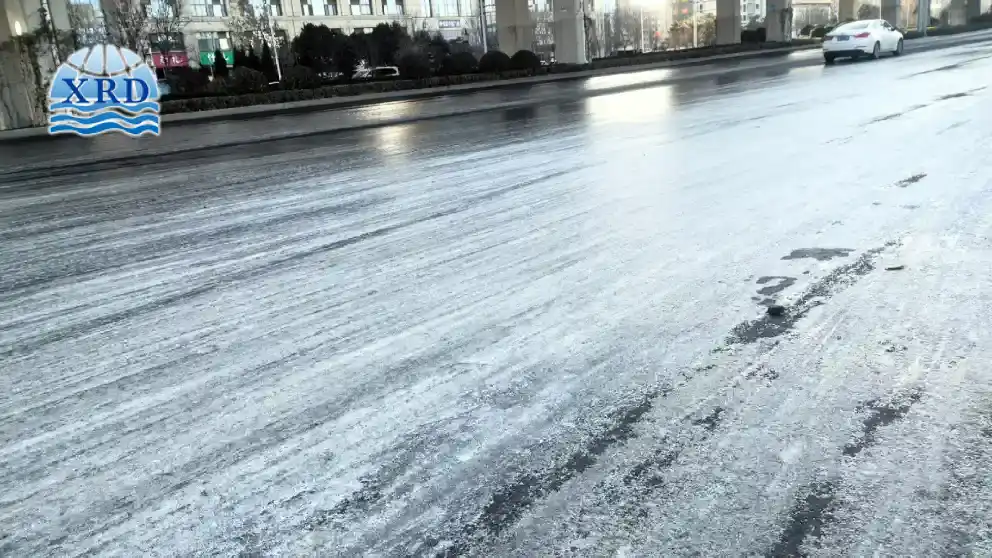
Winter road maintenance is no longer just about removing snow. One of the most dangerous and costly challenges for road authorities, airports, and contractors is refreezing after deicing. When melted snow turns into ice again due to temperature drops, it creates black ice conditions that are difficult to detect and extremely hazardous.
Reducing refreezing risk has therefore become a critical objective in modern winter road deicing strategies, and calcium chloride plays a key role in addressing this challenge.
Why Refreezing Is the Most Critical Risk in Winter Road Maintenance
Refreezing typically occurs after snow and ice have been partially melted during daytime operations. As temperatures fall at night, residual water on the pavement freezes again, often forming thin, transparent ice layers.
Key risk factors include:
- Temperature fluctuations of 10–15°C (18–27°F) within a 24-hour period
- Bridge decks and elevated roads cooling 30–50% faster than ground-level pavements
- Shaded areas where surface temperatures remain 2–4°C lower than ambient air
Statistics from winter traffic safety reports show that over 60% of winter accidents occur on refrozen surfaces, not during active snowfall. This makes refreezing prevention more important than short-term snow removal efficiency.
How Refreezing Forms After Snow Removal and Deicing
After initial deicing, a thin liquid layer remains on the road surface. This layer is highly sensitive to:
- Nighttime heat loss from pavement
- Dilution caused by additional moisture
- Insufficient salt concentration to depress the freezing point
When the solution concentration drops below its effective threshold, freezing occurs rapidly. Traditional deicing agents often lose effectiveness once diluted, leaving road surfaces vulnerable during overnight temperature drops.
Understanding this mechanism explains why long-lasting, moisture-active deicers are essential for refreezing control.
Limitations of Traditional Deicing Materials in Preventing Refreezing
Many commonly used deicers perform well for initial snow melting but struggle to control refreezing.
| Deicing Material | Effective Temperature Range | Refreezing Risk | Key Limitations |
|---|---|---|---|
| Sodium Chloride (NaCl) | Down to −9°C (15°F) | High | Loses effectiveness when diluted |
| Magnesium Chloride | Down to −15°C (5°F) | Medium | Slower melting speed |
| CMA (Calcium Magnesium Acetate) | Down to −7°C (20°F) | Low | High cost, limited melting capacity |
| Calcium Chloride (CaCl₂) | Down to −30°C (−22°F) | Low | Requires controlled application |
This comparison highlights why calcium chloride is increasingly selected for refreezing-prone environments.
Why Calcium Chloride Effectively Reduces Refreezing Risk
Calcium chloride stands out due to its unique physical and chemical properties that directly address the causes of refreezing.
Strong Hygroscopicity Maintains Active Brine
Calcium chloride absorbs moisture from the air, allowing it to:
- Maintain a liquid brine layer on pavement
- Resist evaporation and dilution
- Remain effective for 30–50% longer than sodium chloride
This sustained activity significantly reduces the chance of overnight refreezing.
Exothermic Dissolution Provides Additional Heat
When calcium chloride dissolves, it releases heat. This exothermic reaction:
- Raises surface temperature by 2–4°C locally
- Accelerates ice melting even at very low temperatures
- Improves performance during sudden cold snaps
Wider Effective Temperature Range
Calcium chloride remains effective at temperatures as low as −30°C (−22°F), making it suitable for:
- Extreme winter climates
- High-altitude roads
- Nighttime and early-morning operations
Practical Use of Calcium Chloride in Winter Road Deicing Operations
In real-world winter maintenance, calcium chloride is widely used to control refreezing through multiple application strategies.
- Anti-icing: Applied before snowfall to prevent ice bonding
- Post-deicing treatment: Maintains surface moisture activity after snow removal
- Critical zone protection: Bridges, curves, ramps, and shaded road sections
- Blended systems: Used with sodium chloride to enhance low-temperature performance
Field data indicates that roads treated with calcium chloride experience up to 40% fewer refreezing incidents compared to salt-only treatments.
Cost Efficiency: How Reducing Refreezing Lowers Total Winter Maintenance Costs
While calcium chloride has a higher unit price, its ability to prevent refreezing delivers significant economic benefits.
Key cost advantages include:
- 20–30% reduction in reapplication frequency
- Lower labor and equipment operating hours
- Fewer accident-related liabilities
- Improved traffic flow and reduced emergency interventions
When evaluated on a cost-per-lane-mile-per-season basis, calcium chloride often proves more economical than repeated sodium chloride applications.
Ideal Application Scenarios for Calcium Chloride
Calcium chloride is particularly effective in high-risk winter environments, including:
- High-traffic highways and urban roads
- Bridges, overpasses, and elevated structures
- Airport runways and taxiways
- Regions with large day–night temperature swings
Using calcium chloride strategically in these areas maximizes safety while controlling operational costs.
Conclusion: A Strategic Solution for Refreezing Prevention
Refreezing is one of the most underestimated yet dangerous challenges in winter road maintenance. Traditional deicing methods often focus on immediate snow removal, leaving roads vulnerable to overnight ice formation.
By maintaining active brine layers, releasing heat during dissolution, and remaining effective at extremely low temperatures, calcium chloride provides a reliable solution for reducing refreezing risk. For road authorities and winter maintenance professionals, integrating calcium chloride into deicing strategies represents a critical step toward safer, more efficient winter operations.