
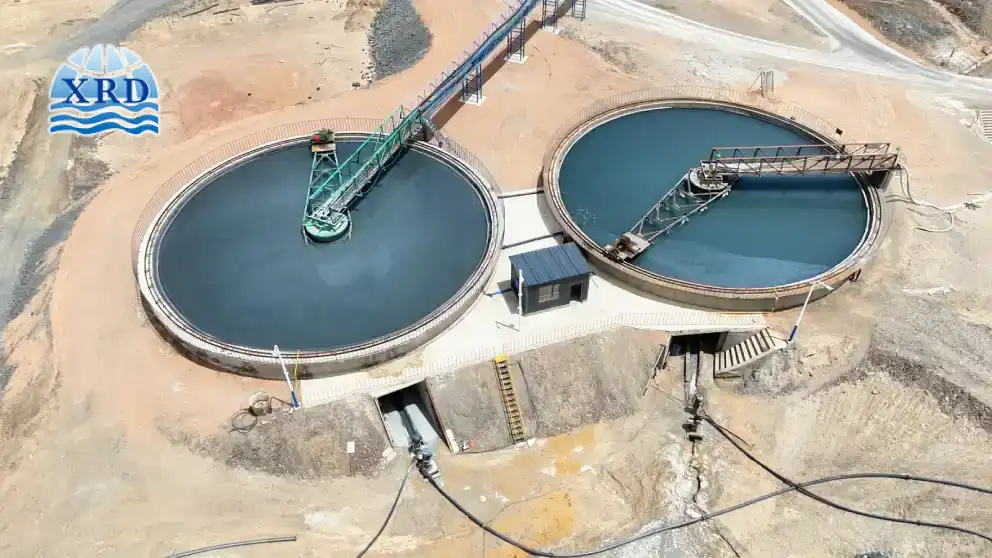
Slow-settling tailings are more than an operational inconvenience. In mineral processing plants, delayed sedimentation inside thickeners directly limits throughput, increases water losses, destabilizes underflow density, and amplifies reagent consumption downstream.
When tailings refuse to settle on time, the root cause is rarely “just bad flocculant.” It is usually a system-level flocculation bottleneck — involving water chemistry, solids characteristics, reagent selection, and shear conditions inside the thickener.
This article breaks down why tailings take too long to settle and how to systematically diagnose flocculation performance issues before they become production constraints.
Why Settling Time Matters in Thickener Performance
A thickener is designed around a target settling rate. When tailings fail to meet that rate:
- Bed levels rise uncontrollably
- Clarified overflow turbidity increases
- Underflow density becomes unstable
- Water recovery efficiency drops
- Downstream filtration or tailings disposal is compromised
Slow settling is not a standalone problem — it is a symptom of inefficient particle aggregation under real process conditions.
Common Symptoms of Flocculation Bottlenecks
Before diagnosing causes, most plants observe one or more of the following:
- Flocs appear fragile, fluffy, or easily broken
- High flocculant dosage with minimal improvement
- Large flocs forming near feedwell but collapsing in the thickener
- Cloudy overflow despite high polymer consumption
- Rising torque or bed compaction issues
These indicators point to a mismatch between particle surface chemistry and flocculation conditions.
Root Cause 1: Unstable or Inappropriate pH Conditions
Flocculation efficiency is highly pH-dependent. If pH fluctuates or sits outside the optimal window:
- Particle surface charges remain strongly repulsive
- Polymer chains cannot bridge particles effectively
- Excess flocculant is wasted without improving settling
In many mineral tailings systems:
- Sodium bicarbonate is used for mild alkalinity control and buffering
- Soda ash (sodium carbonate) is used when stronger pH elevation is required
Over-correction, however, can be just as harmful as insufficient pH control — leading to dispersive fines and fragile flocs.
Root Cause 2: Water Hardness and Ionic Strength Imbalance
Process water chemistry plays a silent but decisive role in flocculation.
Low ionic strength water:
- Increases electrostatic repulsion
- Produces weak, slow-settling flocs
Controlled addition of calcium or magnesium salts can dramatically improve aggregation by compressing the electrical double layer.
Common solutions include:
- Calcium chloride (pellets or powder) for rapid ionic adjustment
- Magnesium chloride where divalent cation balance is required
These salts do not replace flocculants — they enable flocculants to work as intended.
Root Cause 3: Incorrect Flocculant Type or Molecular Weight
Not all tailings respond to the same polymer architecture.
Typical mismatches include:
- High-molecular-weight flocculants applied to ultra-fine slimes
- Anionic polymers used where surface charge is already negative
- Overdosing leading to steric stabilization instead of aggregation
Inorganic coagulants such as Polyaluminum Chloride (PAC) are sometimes used upstream to neutralize surface charges, allowing polymer flocculants to form stronger, denser flocs with lower overall dosage.
Root Cause 4: Excessive Shear in the Feedwell
Even perfectly formed flocs will fail if subjected to high shear.
Common shear-related issues:
- Poor feedwell design or worn internals
- Excessive feed velocity
- Inadequate dilution control
Flocs may form momentarily but are continuously broken apart, resulting in a net slow settling rate despite high reagent input.
Root Cause 5: High Fines Content and Slime Coatings
Fine clay particles and slimes coat larger mineral grains, preventing effective bridging.
Symptoms include:
- High turbidity overflow
- Extremely slow initial settling
- Poor bed compaction
Addressing this often requires:
- Pre-conditioning with coagulants (e.g., PAC)
- Ionic adjustment with calcium or magnesium salts
- Optimized polymer addition points
A Systematic Approach to Diagnosing Slow Settling
Instead of trial-and-error dosing, effective plants follow a structured diagnosis:
- Verify pH stability under real operating conditions
- Analyze process water hardness and ionic balance
- Match flocculant chemistry to tailings mineralogy
- Assess shear exposure inside the feedwell
- Evaluate fines content and surface coatings
Only when all five elements align does flocculation reach its designed performance.
Conclusion: Slow Settling Is a System Problem, Not a Single Reagent Failure
When tailings take too long to settle, the instinct is often to increase flocculant dosage. In reality, slow settling is almost always the result of misaligned chemistry, hydraulics, and solids characteristics.
By diagnosing flocculation bottlenecks holistically — rather than blaming a single product — thickener systems can regain settling speed, stabilize underflow density, and maximize water recovery with lower overall reagent consumption.