
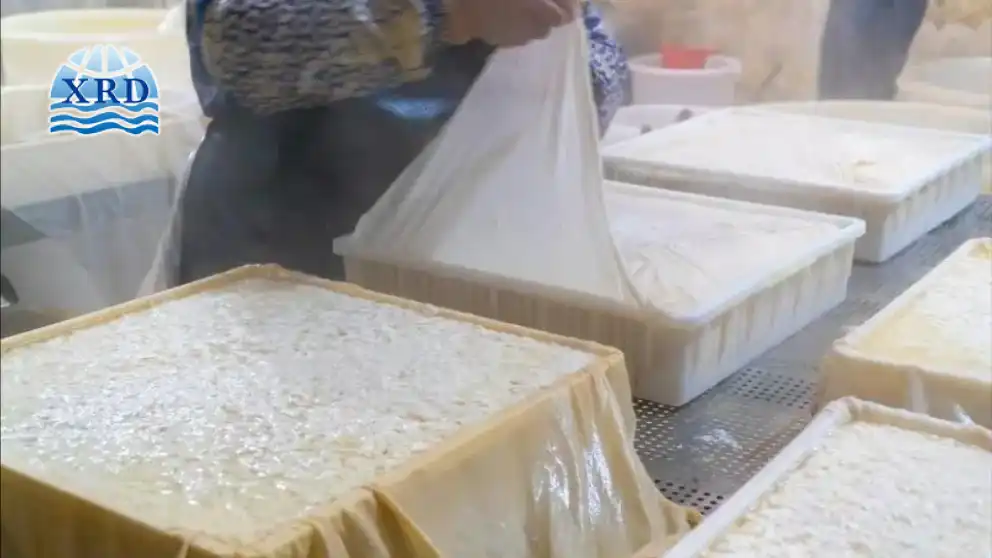
Introduction: The Hidden Coagulation Challenge in Large-Scale Tofu Production
Tofu coagulation may appear simple at first glance—add a coagulant to hot soy milk and allow the proteins to form a gel network. In small-scale or laboratory settings, this process is often stable and predictable. However, when production shifts to industrial-scale tofu manufacturing, many facilities begin to encounter unexpected problems:
- Uneven curd formation
- Excess whey separation
- Fragile tofu blocks that break during cutting
- Inconsistent texture across production batches
These issues are especially common when using Magnesium Sulfate, often referred to in tofu production as nigari or salt brine.
While magnesium sulfate is widely recognized as a reliable tofu coagulant, its dosage and addition method become critical variables in high-volume production. Small errors in dosing or mixing can quickly scale into large process failures, leading to raw material waste and costly production downtime.
Understanding how magnesium sulfate interacts with soy proteins—and how industrial conditions influence this interaction—is the key to achieving stable, high-yield tofu coagulation at scale.
The Science of Tofu Coagulation with Magnesium Sulfate
The coagulation process begins when divalent magnesium ions interact with soy proteins in heated soy milk.
Soy proteins contain negatively charged amino acid groups. When magnesium ions are introduced, they act as ionic bridges, linking protein molecules together and allowing them to form a three-dimensional gel network that traps water and fat.
The simplified mechanism can be represented as:
Soy protein (negative charge) + Mg²⁺ → cross-linked protein network → tofu gel
This ionic cross-linking process is highly efficient, which is why magnesium sulfate is considered a fast-acting coagulant.
Compared with other tofu coagulants:
| Coagulant | Reaction Speed | Texture Characteristics |
|---|---|---|
| Magnesium sulfate | Fast | Smooth, slightly tender texture |
| Calcium sulfate | Moderate | Firm and slightly dense |
| Glucono-delta-lactone (GDL) | Slow | Very soft, custard-like |
The rapid reaction speed of magnesium sulfate is advantageous for production efficiency. However, in large coagulation tanks, this speed can also create challenges.
If magnesium sulfate is not evenly distributed, the reaction may begin locally, producing partially coagulated clusters before full mixing occurs. The result is tofu with inconsistent firmness and visible curd irregularities.
Why Coagulation Fails in High-Volume Production
1. Amplified Dosing Errors
In small batches, a slight measurement error may have minimal impact. In industrial production, however, even a 1% deviation in magnesium sulfate dosing can significantly affect coagulation behavior.
For example:
- Slight overdosing can cause premature protein aggregation during mixing
- Slight underdosing may leave part of the soy milk uncoagulated
Manual addition methods often introduce these inconsistencies, especially when operators rely on estimation rather than precise measurement systems.
2. Variations in Soy Milk Concentration
Another common source of instability is fluctuating soy milk solids content.
Soy milk used for tofu typically contains 8–12% solids, depending on soybean quality and grinding efficiency. When solids increase, the protein concentration rises, requiring more magnesium ions for effective coagulation.
If magnesium sulfate dosing remains fixed while soy milk concentration changes, producers may observe:
- Weak curd formation in high-solids batches
- Over-rapid coagulation in low-solids batches
Maintaining stable Brix or total solids levels is therefore essential for consistent coagulation performance.
3. Temperature Control Issues
Temperature strongly influences soy protein denaturation, which directly affects the ability of magnesium ions to form stable gel networks.
Typical industrial tofu coagulation occurs between:
75°C – 85°C
If the temperature is too low:
- Proteins remain partially unfolded
- Magnesium ions cannot efficiently cross-link the protein structure
If the temperature is too high:
- Coagulation occurs too quickly
- Mixing becomes ineffective before gel formation begins
Large production tanks often develop temperature gradients, making uniform heat distribution another challenge.
4. Mixing Inefficiency in Large Coagulation Tanks
Fluid dynamics become increasingly complex as production scale increases.
In a large coagulation tank:
- Magnesium sulfate may enter the soy milk in a concentrated stream
- Local regions may experience extremely high ion concentrations
- Rapid localized coagulation occurs before mixing spreads the coagulant evenly
This leads to the classic tofu defect known as “old-tender curd separation”, where some parts of the tofu block are overly firm while others remain fragile.
Experimental Data: Identifying the Optimal Magnesium Sulfate Dosing Window
Industrial data from tofu processing lines shows that magnesium sulfate dosing typically falls within a relatively narrow range.
For most commercial soybean varieties, the recommended dosage is:
- 1.8–2.5% magnesium sulfate relative to dry soybean weight
- Equivalent to approximately 0.25–0.35% relative to soy milk weight
Within this range, magnesium ions are sufficient to cross-link proteins without producing excessive ionic strength that can damage the gel structure.
However, this range must often be adjusted depending on several variables.
Soy Milk Solid Content
Higher protein concentrations require slightly higher magnesium sulfate dosing.
| Soy Milk Solids | MgSO₄ Demand | Risk |
|---|---|---|
| 7–8% | Lower | Soft tofu |
| 9–10% | Optimal | Stable coagulation |
| 11–12% | Higher | Risk of uneven coagulation |
Water Hardness Effects
Water hardness introduces additional divalent ions such as calcium and magnesium.
These ions can partially contribute to protein aggregation, effectively reducing the amount of added magnesium sulfate required.
Typical industrial observations show:
- Soft water: full dosage required
- Moderate hardness: 5–10% reduction possible
- Hard water: up to 15% dosage reduction
Ignoring this factor often leads to over-coagulation and bitter flavor defects.
Soybean Protein Variability
Different soybean cultivars contain different protein concentrations and ratios of glycinin and β-conglycinin.
Higher protein soybeans generally require slightly higher magnesium sulfate levels for stable gel formation.
When tofu manufacturers change soybean suppliers, coagulation instability may appear even if the dosing system remains unchanged.
Process Optimization Strategies for Industrial Tofu Production
Precision Dosing Systems
Replacing manual addition with automated metering pumps allows magnesium sulfate to be introduced at controlled rates.
Key equipment improvements include:
- Inline dosing pumps
- Flow-linked injection systems
- Automated recipe control
These systems minimize dosing errors and stabilize coagulation results.
Two-Stage Coagulation Method
Many large tofu factories now adopt a two-stage coagulation strategy.
Instead of adding the entire magnesium sulfate dose at once:
- A small initial portion triggers protein aggregation
- The remaining coagulant is added after initial mixing
This staged approach improves mixing efficiency and reduces localized over-coagulation.
Real-Time Process Monitoring
Modern production lines increasingly use indirect monitoring tools such as:
- Electrical conductivity tracking
- pH trend monitoring
- Gel firmness measurement
These indicators help operators detect coagulation deviations early, allowing dosing adjustments before defects occur.
Use of Composite Coagulant Systems
Some manufacturers combine magnesium sulfate with slower-acting coagulants such as **Glucono‑delta‑lactone.
This hybrid system offers several advantages:
- Improved coagulation uniformity
- Reduced risk of local over-coagulation
- Better texture stability across large batches
Composite systems are especially useful in high-capacity continuous tofu production lines.
Conclusion: From Experience-Based to Data-Driven Tofu Coagulation
Coagulation failure in industrial tofu production rarely results from a single factor. Instead, it is typically the outcome of interacting variables, including dosing accuracy, soy milk concentration, temperature stability, and mixing efficiency.
Magnesium sulfate remains one of the most effective tofu coagulants available. However, its rapid reaction speed requires careful control when used in high-volume production systems.
The key lesson for tofu manufacturers is that successful coagulation is not simply a matter of how much coagulant is added, but how and when it is added within the process.
As tofu production technology continues to evolve, automated dosing systems, real-time monitoring tools, and optimized mixing strategies are gradually replacing traditional experience-based methods.
Through scientific control of magnesium sulfate dosing, producers can achieve consistent tofu texture, higher yield, and stable large-scale production performance.