
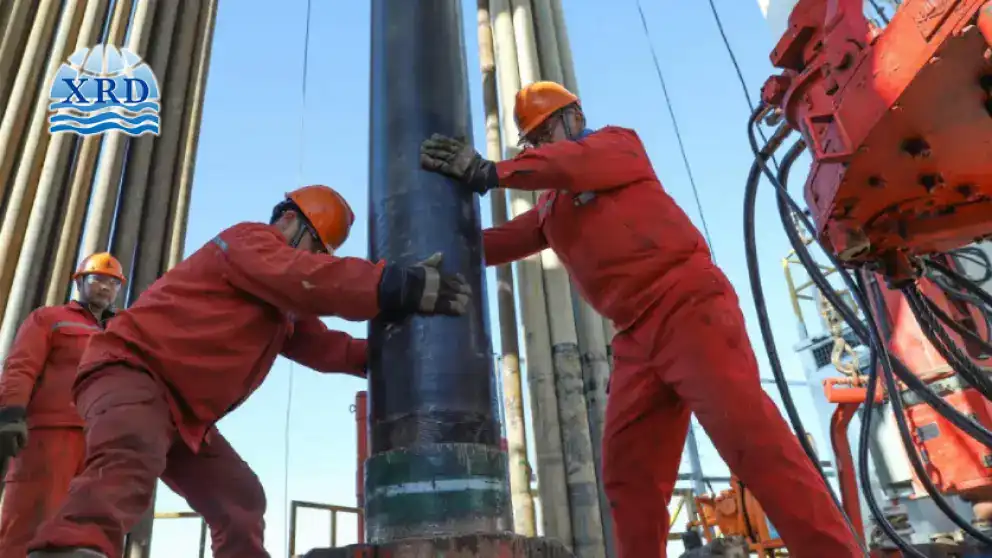
Introduction: Challenges of Drilling in Shale Formations
Shale formations are among the most common geological layers encountered in oil and gas drilling. However, they are also one of the most problematic formations for drilling operations. Shales are typically composed of fine-grained clay minerals with high water sensitivity. When exposed to water-based drilling fluids (WBM), these clay minerals can absorb water, swell, and weaken the mechanical integrity of the formation.
This swelling behavior often leads to serious operational challenges such as:
- Wellbore instability
- Shale sloughing or collapse
- Bit balling
- Stuck pipe incidents
For drilling engineers, maintaining wellbore stability in shale intervals is a constant challenge. To mitigate these risks while maintaining the environmental and economic advantages of water-based systems, specific chemical additives are required.
One of the most widely used additives for this purpose is Calcium Chloride (CaCl₂). Due to its strong ionic properties, high solubility, and ability to control water activity, calcium chloride has become a critical component in modern shale drilling fluid systems.
Chemical Mechanisms: How Calcium Chloride Stabilizes Shale
The effectiveness of calcium chloride in stabilizing shale formations is rooted in several chemical and physicochemical mechanisms. These mechanisms directly influence clay mineral behavior and fluid–formation interactions.
1. Ion Exchange with Clay Minerals
Many shale formations contain clay minerals such as montmorillonite, illite, and smectite, which possess negatively charged surfaces. These surfaces naturally attract and hold exchangeable cations such as sodium (Na⁺).
Sodium-dominated clays tend to be highly water-sensitive. When exposed to fresh water, the sodium ions allow water molecules to penetrate between clay layers, causing interlayer swelling.
Calcium chloride introduces divalent calcium ions (Ca²⁺) into the drilling fluid. These ions replace sodium ions through a cation exchange process:
Because calcium ions carry two positive charges, they bind more strongly to the clay surface than sodium ions. This stronger electrostatic attraction compresses the electrical double layer around clay particles, reducing the ability of water molecules to enter the clay structure.
As a result:
- Clay swelling is significantly reduced
- Particle dispersion is minimized
- Shale structural integrity improves
2. Reduction of Electrical Double Layer Thickness
Clay particles in shale formations carry surface charges that create an electrical double layer (EDL) when immersed in water. The thickness of this layer determines the repulsive forces between clay particles.
In low-salinity water, the EDL expands, causing clay particles to repel each other and disperse. This dispersion leads to shale disintegration and wellbore instability.
High concentrations of calcium ions compress the double layer by increasing ionic strength. The effect can be summarized as:
- Higher ionic strength → thinner double layer
- Thinner double layer → reduced particle repulsion
- Reduced repulsion → improved shale cohesion
Calcium ions are particularly effective at compressing the EDL because divalent ions have a stronger charge neutralization capability than monovalent ions like sodium.
3. Osmotic Pressure and Water Activity Control
Another critical mechanism is water activity control.
Water tends to move from regions of higher activity (chemical potential) to lower activity through osmotic pressure gradients. If the drilling fluid has a higher water activity than the formation water, water will migrate into the shale formation, causing hydration and swelling.
Calcium chloride solutions significantly reduce the water activity of drilling fluids. By adjusting CaCl₂ concentration, engineers can match or lower the activity of the drilling fluid relative to the formation water.
This creates an osmotic balance, preventing water invasion into the shale matrix.
The benefits include:
- Reduced shale hydration
- Lower swelling pressure
- Improved borehole stability
4. Inhibition of Crystalline Clay Swelling
Some clay minerals, particularly smectite, exhibit crystalline swelling where water molecules enter the crystal lattice. Calcium ions reduce this swelling because they create stronger electrostatic bonds between clay layers.
Compared to sodium clays:
- Sodium-smectite can swell dramatically
- Calcium-smectite exhibits much lower expansion
Thus, introducing Ca²⁺ effectively converts highly swelling sodium clays into more stable calcium-dominated forms.
Core Functions of Calcium Chloride in Water-Based Drilling Fluids
Beyond shale inhibition, calcium chloride contributes several operational advantages in drilling fluid systems.
Density Adjustment
Calcium chloride brines can increase the density of water-based drilling fluids. This helps maintain hydrostatic pressure control, preventing formation fluids from entering the wellbore.
Rheology Control
Proper salt concentrations can influence fluid viscosity and gel strength, which are critical for:
- Efficient cuttings transport
- Suspension of drilled solids
- Prevention of solids settling during circulation pauses
Synergy with Polymer Additives
Calcium chloride often works together with polymer-based shale inhibitors such as:
- PHPA (Partially Hydrolyzed Polyacrylamide)
- Encapsulating polymers
- Fluid-loss control agents
The salt stabilizes the shale chemically, while polymers physically encapsulate cuttings and reduce dispersion.
Key Parameters and Operational Considerations
Optimal Concentration
The optimal CaCl₂ concentration depends on shale mineralogy:
- High montmorillonite content: higher CaCl₂ concentrations required
- Illite-dominated shale: moderate concentrations sufficient
Typical concentrations range between 3–15 wt% CaCl₂ in WBM systems.
Water Activity Monitoring
Monitoring drilling fluid water activity (aw) is essential. Matching drilling fluid activity with formation water activity helps maintain osmotic equilibrium.
Mixing and Compatibility
When preparing CaCl₂-based drilling fluids:
- Add calcium chloride slowly to prevent localized overheating
- Consider the heat of dissolution, which can significantly raise fluid temperature
- Check compatibility with polymers and filtration-control additives
Comparison with Other Salts
| Property | Calcium Chloride (CaCl₂) | Potassium Chloride (KCl) | Sodium Chloride (NaCl) |
|---|---|---|---|
| Shale Inhibition Strength | Very Strong | Strong | Moderate |
| Mechanism | Divalent ion exchange + activity control | Ionic radius stabilization | Ionic strength effect |
| Cost | Medium–High | Medium | Low |
| Environmental Impact | Moderate | Low | Moderate |
Potassium chloride is widely used for shale stabilization, but calcium chloride often provides stronger ionic inhibition due to its divalent nature.
Conclusion and Future Trends
Calcium chloride plays a crucial role in stabilizing shale formations during drilling operations. Through ion exchange, electrical double layer compression, osmotic activity control, and inhibition of clay swelling, CaCl₂ significantly reduces the risks of wellbore instability, pipe sticking, and drilling delays.
As drilling operations move toward more environmentally responsible systems, the development of high-performance water-based drilling fluids (HP-WBM) continues to evolve. Future research is exploring:
- Optimized calcium-based inhibitor systems
- Hybrid polymer–salt formulations
- Environmentally friendly calcium salts with reduced ecological impact
Despite these innovations, calcium chloride remains one of the most reliable and widely used chemical additives for maintaining shale stability in modern drilling operations.