
Introduction: The Postharvest Preservation Challenge
Fresh fruits are highly perishable commodities. From orchard to consumer, they undergo a series of physiological and environmental stresses including harvesting injury, temperature fluctuations, moisture loss, microbial infection, and mechanical damage. According to global food supply studies, a significant percentage of harvested fruits are lost during transportation, storage, and retail handling due to quality deterioration, softening, and decay.
Among all quality parameters, fruit firmness is one of the most critical indicators of freshness and shelf life. Firmness directly affects:
- Consumer perception of freshness and texture
- Resistance to bruising during transport
- Ripening speed and storage tolerance
- Marketability and export quality
Softening is a natural part of fruit ripening, but excessive softening dramatically shortens shelf life and increases waste.
To address this issue, calcium chloride (CaCl₂) has become one of the most widely used postharvest treatments in agriculture. As a safe, cost-effective, and highly efficient calcium source, calcium chloride helps strengthen fruit tissues, delay ripening, and improve resistance against storage disorders and fungal diseases.
How Calcium Chloride Preserves Fruit Firmness
Calcium as the “Glue” of Cell Walls
Fruit softening largely results from the breakdown of the cell wall, particularly the degradation of pectin, a structural polysaccharide abundant in the middle lamella between plant cells.
Calcium ions Ca2+ interact with pectic acids to form calcium pectate, a cross-linked structure that reinforces cell wall rigidity.
This process is commonly described by the Egg-box model, where calcium bridges adjacent pectin chains, creating a stronger and less degradable network.
Benefits of calcium pectate formation include:
- Improved tissue firmness
- Reduced cell separation
- Greater resistance to compression and bruising
- Slower texture degradation during storage
Without sufficient calcium, fruit cell walls weaken rapidly, leading to softening, collapse, and shortened market life.
Suppression of Cell Wall-Degrading Enzymes
Fruit ripening activates multiple enzymes that degrade structural carbohydrates.
Key softening-related enzymes include:
- Polygalacturonase (PG): breaks down pectin chains
- Pectin methylesterase (PME): modifies pectin structure, facilitating degradation
- Cellulase: degrades cellulose microfibrils
Calcium chloride treatments can reduce the activity of these enzymes by stabilizing cell wall substrates and slowing metabolic processes.
As a result:
- Pectin degradation is delayed
- Tissue softening occurs more slowly
- Ripening progression becomes more controlled
This is especially beneficial for climacteric fruits such as apples, mangoes, pears, and bananas.
Maintaining Cell Membrane Integrity
In addition to strengthening cell walls, calcium stabilizes phospholipid membranes.
Calcium ions help:
- Maintain membrane selectivity
- Reduce membrane permeability
- Minimize electrolyte leakage
- Lower oxidative stress damage
Stable membranes reduce moisture loss and delay physiological aging.
This mechanism is particularly important for berries and thin-skinned fruits prone to rapid dehydration.
How Calcium Chloride Extends Shelf Life
Lower Respiration Rate
Fruit respiration consumes sugars and organic acids, generating energy while accelerating senescence.
High respiration rates lead to:
- Faster ripening
- Increased heat production
- Water loss
- Nutrient depletion
Calcium treatments can suppress respiration by slowing enzymatic metabolism and preserving tissue structure.
For climacteric fruits like apples and mangoes, calcium chloride helps reduce the intensity of the respiratory peak, thereby delaying ripening.
Benefits include:
- Extended storage duration
- Better flavor retention
- Reduced weight loss
Delayed Ethylene Production
Ethylene is the primary ripening hormone in many fruits.
Excessive ethylene production accelerates:
- Softening
- Color change
- Aroma development
- Senescence
Calcium chloride slows physiological activity and indirectly reduces ethylene biosynthesis.
This delay helps:
- Extend harvest-to-market window
- Improve transportability
- Reduce over-ripening during distribution
For exporters handling long-distance shipments, this benefit is especially valuable.
Enhanced Disease Resistance
Postharvest decay caused by fungal pathogens is a major source of fruit loss.
Common pathogens include:
- Botrytis cinerea (gray mold)
- Penicillium spp. (blue/green mold)
- Alternaria spp.
Calcium-treated fruits develop stronger structural barriers that are harder for pathogens to penetrate.
Additional effects include:
- Reduced skin cracking
- Lower wound susceptibility
- Delayed lesion expansion
As a result, calcium chloride treatments often reduce decay incidence and improve storage hygiene.
Practical Application Methods of Calcium Chloride
Preharvest Foliar Sprays
Applying calcium chloride before harvest allows fruits to absorb calcium during development.
Advantages:
- Improved internal calcium accumulation
- Reduced calcium deficiency disorders
- Better baseline firmness at harvest
Typical use:
- Foliar sprays during fruit enlargement stages
- Repeated low-dose applications
This method is commonly used in apples, grapes, strawberries, and tomatoes.
Postharvest Dipping or Immersion
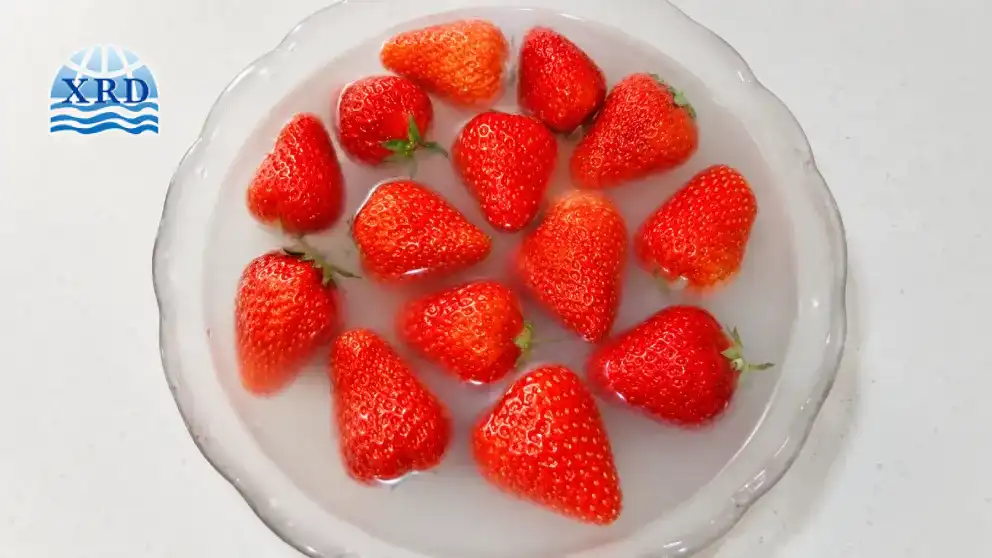
The most common preservation method is dipping harvested fruits in calcium chloride solution.
Procedure:
- Prepare calcium chloride solution
- Immerse fruits for a designated period
- Drain and air-dry before storage
Benefits:
- Simple operation
- Low cost
- High scalability
This is widely used in packing houses and cold storage facilities.
Pressure Infiltration
For fruits with limited surface absorption, pressure infiltration improves calcium penetration.
Method:
- Fruits are submerged in solution
- Vacuum or pressure is applied
Advantages:
- Higher calcium uptake
- Improved internal distribution
This technique is commonly used for apples and pears.
Edible Coating Formulations
Calcium chloride is often incorporated into edible coatings such as:
- Chitosan
- Alginate
- Pectin-based coatings
Benefits:
- Combined moisture barrier and calcium delivery
- Improved gloss and appearance
- Extended microbial protection
These hybrid systems are increasingly popular in premium fruit preservation.
Recommended Calcium Chloride Concentrations
Optimal concentration depends on fruit type, skin sensitivity, and treatment method.
General recommended ranges:
| Fruit Type | Recommended CaCl₂ Concentration |
|---|---|
| Strawberries | 1% – 2% |
| Blueberries | 1% – 2% |
| Grapes | 1% – 3% |
| Apples | 2% – 4% |
| Pears | 2% – 4% |
| Mangoes | 1% – 3% |
| Bananas | 1% – 2% |
Treatment time usually ranges from:
- 2–10 minutes for dipping
- Longer for pressure infiltration depending on protocol
Always conduct small-scale testing before commercial application.
Important Precautions When Using Calcium Chloride
While effective, improper use can cause quality issues.
Avoid Excessive Concentration
Overly concentrated solutions may cause:
- Surface spotting
- Skin burns
- Bitter taste residue
- Physiological injury
Higher is not always better.
Consider Fruit Sensitivity
Different fruits tolerate calcium differently.
Sensitive fruits such as strawberries and grapes require lower concentrations.
Thicker-skinned fruits tolerate stronger treatments.
Storage Compatibility
Calcium chloride works best when combined with proper postharvest management:
- Cold storage
- Humidity control
- Sanitation protocols
- Modified atmosphere packaging
It is not a standalone solution.
Real-World Results Across Different Fruits
Berries: Strawberries and Blueberries
Berries soften rapidly and are highly susceptible to mold.
Calcium chloride helps:
- Maintain firmness
- Reduce leakage and collapse
- Lower gray mold incidence
This can significantly extend retail display life.
Apples and Pears
For pome fruits, calcium chloride reduces storage disorders such as:
- Bitter pit
- Watercore
- Internal breakdown
It also improves crispness retention during long-term storage.
Mangoes and Bananas
Tropical fruits are highly active metabolically.
Benefits of calcium treatment include:
- Delayed ripening
- Reduced peel damage
- Better export tolerance
This is especially useful for international shipping.
Future Trends in Fruit Preservation with Calcium Technologies
Calcium chloride remains a cornerstone technology, but innovation continues.
Emerging directions include:
Nano-Calcium Delivery Systems
Nano-sized calcium formulations may improve:
- Penetration efficiency
- Controlled release
- Lower required dosage
Composite Preservation Systems
Future formulations increasingly combine calcium chloride with:
- Antimicrobials
- Natural coatings
- Antioxidants
- Plant extracts
This creates multifunctional preservation systems.
Precision Agriculture and Smart Application
Sensors and data-driven agriculture are enabling:
- Targeted calcium nutrition
- Optimized treatment timing
- Reduced chemical waste
These technologies improve sustainability and product consistency.
Conclusion
Fruit softening and postharvest deterioration remain major challenges for global agriculture and food supply chains.
Calcium chloride offers a highly practical solution by:
- Strengthening cell walls through calcium pectate formation
- Reducing softening enzyme activity
- Stabilizing membranes
- Lowering respiration and ethylene production
- Enhancing resistance to postharvest diseases
Its affordability, safety, and effectiveness make it one of the most valuable tools for improving fruit firmness and extending shelf life.
As fresh produce markets demand longer storage, better texture, and lower waste, calcium chloride treatments will continue to play a critical role in modern postharvest management.