
Introduction: The “Water-Absorbing Magician” Around Us
Have you ever opened a moisture absorber container and discovered a pool of liquid that seemed to appear out of nowhere? Or noticed that a calcium chloride desiccant packet became hard, lumpy, or even transformed into a gel-like mass after several weeks?
These common observations often raise a simple question: Where does all that water come from?
The answer lies in the unique moisture absorption mechanism of calcium chloride. Unlike many conventional desiccants that mainly trap moisture physically, calcium chloride combines both physical moisture attraction and chemical hydration processes. As it absorbs water vapor from the surrounding air, it gradually forms hydrated salts and, under sufficient humidity, can even dissolve into a concentrated brine solution.
This remarkable ability makes calcium chloride one of the most effective materials used in dehumidifiers, industrial drying systems, and moisture-control products worldwide.
The Core Mechanism: Deliquescence and Hydration Working Together
Stage 1: Surface Adsorption and Deliquescence
The first step begins when calcium chloride comes into contact with humid air.
Calcium chloride exhibits an exceptionally strong affinity for water due to its high heat of dissolution and extremely low equilibrium vapor pressure. Water molecules in the surrounding atmosphere are naturally attracted to the salt surface.
As moisture accumulates, a thin liquid film forms around the calcium chloride particles. This process is known as deliquescence, a phenomenon in which a solid absorbs enough moisture from the air to dissolve itself.
Unlike silica gel, which mainly stores moisture within microscopic pores, calcium chloride continuously attracts water and transforms into a concentrated saline solution. This explains why moisture absorber boxes often collect significant amounts of liquid over time.
Stage 2: Chemical Hydration and Bond Formation
The process is not merely water mixing with salt.
Calcium ions (Ca²⁺) act as central coordination sites, attracting water molecules through strong ion-dipole interactions. Water molecules arrange themselves around the calcium ions, forming stable coordination structures.
As hydration progresses, calcium chloride incorporates water molecules directly into its crystal lattice, creating solid hydrated compounds.
What Are Hydrated Salts?
A hydrated salt is a crystalline substance containing water molecules as part of its internal structure.
In hydrated calcium chloride, water molecules are no longer free liquid water. Instead, they become integrated into the crystal framework, often referred to as water of crystallization.
One of the most common forms is calcium chloride hexahydrate (CaCl₂·6H₂O), where six water molecules are chemically associated with each calcium chloride unit.
This combination of deliquescence and hydration explains the exceptional moisture absorption principle behind calcium chloride desiccants.
The Products Formed: From Monohydrate to Hexahydrate
Multiple Hydration States
As anhydrous calcium chloride absorbs moisture, it does not instantly become a single final product.
Depending on temperature and water vapor pressure, calcium chloride may exist in several hydrated forms, including:
- Calcium chloride monohydrate (CaCl₂·H₂O)
- Calcium chloride dihydrate (CaCl₂·2H₂O)
- Calcium chloride tetrahydrate (CaCl₂·4H₂O)
- Calcium chloride hexahydrate (CaCl₂·6H₂O)
The hydration process typically occurs gradually as more water molecules become incorporated into the crystal structure.
Visual Changes During Hydration
The physical appearance changes dramatically throughout this process.
Low Moisture Content
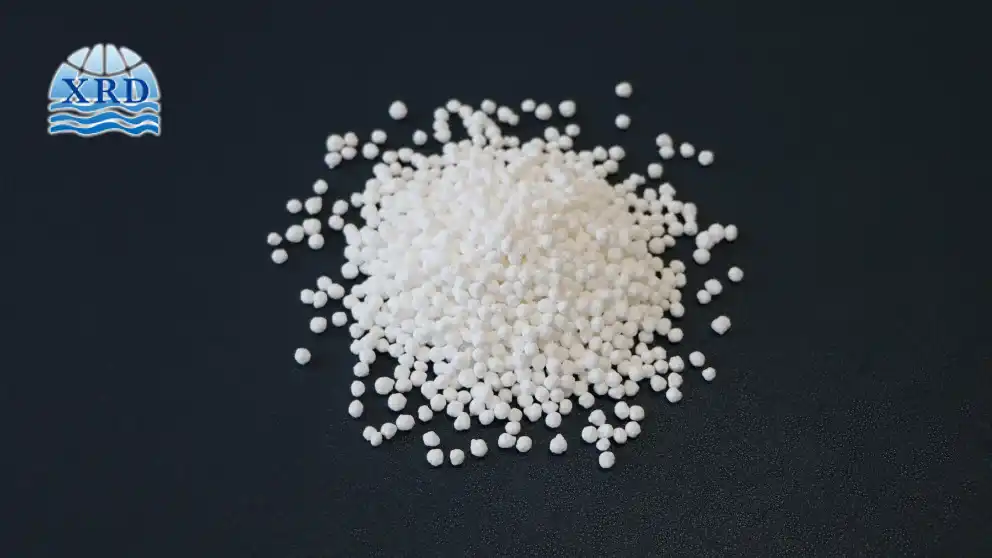
- White powder or granules
- Dry and free-flowing
- Highly porous structure
Moderate Moisture Absorption
- Damp particles
- Formation of crystal aggregates
- Partial gel-like texture
High Moisture Absorption
- Large crystal masses
- Thick saline gel
- Saturated solution formation
The “Water” Is Not Pure Water
A common misconception is that the liquid collected in dehumidifier containers is pure water.
In reality, the liquid is usually a highly concentrated calcium chloride brine containing dissolved salts and hydrated species. In some cases, partially melted calcium chloride hexahydrate crystals may also be present.
Therefore, the collected liquid should always be treated as a concentrated salt solution rather than clean water.
Connection to Phase Change Materials
Because calcium chloride hydrates undergo reversible hydration and dehydration reactions, they are widely studied as phase change and thermochemical energy storage materials.
Their ability to store and release heat during hydration cycles makes them attractive for sustainable energy applications.
What Determines Moisture Absorption Efficiency?
Relative Humidity (RH)
The most important factor affecting moisture absorption rate is ambient relative humidity.
Calcium chloride has an exceptionally low critical relative humidity, meaning it can begin attracting moisture even in relatively dry environments.
As humidity increases, moisture uptake accelerates significantly, allowing calcium chloride to outperform many traditional desiccants.
Surface Area and Physical Structure
The shape and structure of calcium chloride greatly influence absorption speed.
Materials with larger surface areas absorb moisture faster, including:
- Powdered calcium chloride
- Porous pellets
- Granular formulations
Dense blocks or large crystals expose less surface area and therefore absorb moisture more slowly.
Temperature Effects
Temperature influences both moisture transport and hydration equilibrium.
Higher temperatures generally increase molecular movement and moisture diffusion rates. However, elevated temperatures can also alter hydration stability and water retention behavior.
As a result, the relationship between temperature and moisture absorption is not always linear.
Additives and Structural Stabilizers
Commercial moisture absorbers often contain additives such as:
- Sodium chloride
- Starch
- Cellulose-based carriers
These materials help maintain a porous structure, preventing surface crust formation that could block further moisture penetration.
The result is more consistent and efficient long-term moisture absorption.
Practical Applications in Environmental Engineering and Energy Storage
Household Dehumidification and Storage Protection
The most familiar application is household moisture control.
Calcium chloride is widely used in:
- Closet dehumidifiers
- Storage room moisture absorbers
- Basement humidity control systems
- Shipping container desiccants
As moisture is absorbed, the solid gradually swells, liquefies, and transforms into concentrated brine.
Industrial Drying Processes
Industrial operations frequently use calcium chloride as a drying agent for:
- Natural gas dehydration
- Air drying systems
- Organic solvent drying
- Chemical processing streams
Its strong affinity for water allows it to remove moisture efficiently from various gases and liquids.
Thermochemical Energy Storage
One of the most promising advanced applications involves thermal energy storage.
The hydration and dehydration of calcium chloride are reversible reactions capable of storing thermal energy for extended periods.
This technology is being explored for:
- Building heating systems
- Seasonal heat storage
- Solar thermal energy utilization
- Industrial waste heat recovery
Dust Control and Ice Melting
Calcium chloride also serves important environmental functions.
For dust suppression, it absorbs atmospheric moisture and helps maintain road surface dampness.
For deicing, it dissolves exothermically, releasing heat while lowering water's freezing point. This combination accelerates ice melting even under cold weather conditions.
Common Misconceptions and Safety Guidelines
Is Calcium Chloride Toxic?
Many people assume calcium chloride is highly toxic because it is used in industrial products.
In reality, food-grade calcium chloride is widely used as:
- Calcium fortification agent
- Food firming agent
- Beverage processing aid
However, industrial-grade calcium chloride does not meet food-grade purity standards and should never be consumed.
Corrosion Risks
The primary concern is not toxicity but corrosion.
Concentrated calcium chloride solutions contain high levels of chloride ions that can corrode:
- Carbon steel
- Aluminum
- Certain metal alloys
- Concrete joints and surfaces
Proper containment and cleanup are essential.
Proper Disposal and Recycling
The liquid collected in dehumidifier containers is concentrated brine.
It should not be:
- Poured onto plants
- Discharged indiscriminately into the environment
- Used as drinking water
Depending on local regulations, it may be disposed of appropriately or reused in certain dust-control applications.
Skin and Respiratory Contact
Solid calcium chloride generally causes minimal irritation under normal handling.
However:
- Concentrated solutions may irritate skin
- Prolonged contact can cause dryness
- Dust may irritate eyes and respiratory passages
Protective gloves and adequate ventilation are recommended when handling large quantities.
How to Tell When a Desiccant Is Saturated
A calcium chloride moisture absorber is typically exhausted when:
- All solid particles have dissolved
- Only clear liquid remains
- Liquid volume stops increasing
- No additional moisture is absorbed
At this stage, the desiccant has reached its maximum moisture-holding capacity and should be replaced or regenerated if applicable.
Conclusion
The extraordinary moisture absorption ability of calcium chloride stems from a unique combination of deliquescence and chemical hydration. Rather than simply trapping water, calcium chloride actively attracts atmospheric moisture, incorporates water molecules into hydrated crystal structures, and eventually forms concentrated brine solutions.
From household dehumidifiers and industrial drying systems to thermochemical energy storage and dust suppression, the formation of hydrated salts such as calcium chloride hexahydrate underpins a wide range of practical applications. Understanding this process not only explains why calcium chloride is such an effective desiccant but also highlights its growing importance in environmental engineering, energy management, and moisture control technologies.