
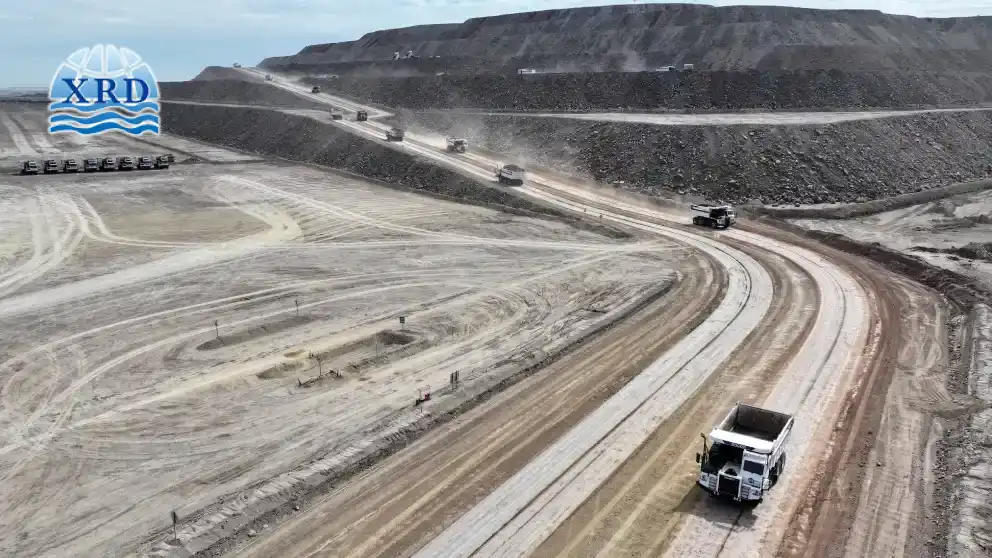
The Hidden “Moving Dust Storm” on Gravel Roads: Operational, Health, and Environmental Costs
Across mining haul roads, forestry access routes, rural unpaved roads, and temporary construction corridors, one familiar scene repeats itself: a vehicle passes, and a massive cloud of dust follows.
What appears to be a temporary nuisance is actually a persistent operational problem that silently increases maintenance costs, damages equipment, threatens worker health, and creates environmental compliance risks.
Dust control for gravel roads has become an increasingly important issue for operators seeking reliable and cost-effective road management solutions.
The Operational Cost of Uncontrolled Road Dust
Dust generation is not simply airborne material—it represents the gradual loss of valuable fine aggregates that stabilize the road structure.
As fine particles leave the road surface:
- Aggregate segregation accelerates
- Washboarding and corrugation develop
- Potholes appear more frequently
- Road grading intervals shorten
- Additional gravel replenishment becomes necessary
Reduced visibility also increases collision and equipment accident risks, particularly on high-traffic industrial roads.
Without intervention, maintenance evolves into a continuous and expensive cycle.
Health Risks and Regulatory Exposure
Respirable particulate matter (PM10) generated from gravel road dust can penetrate deep into the respiratory system.
Long-term exposure may contribute to:
- Respiratory irritation
- Reduced worker productivity
- Increased occupational safety concerns
- Community complaints near transportation corridors
At the same time, environmental agencies continue tightening enforcement around fugitive dust emissions. Non-compliance may lead to project delays, operational restrictions, penalties, or shutdown orders.
A Low-Cost Yet Highly Effective Solution: Calcium Chloride
Among available road dust suppression technologies, calcium chloride remains one of the most practical and economical solutions.
Unlike simple watering, calcium chloride changes the moisture behavior and structural stability of the road surface itself.
How Calcium Chloride Controls Dust: Moisture Retention, Water Preservation, and Particle Binding
Effective dust control requires more than temporarily wetting the road.
Calcium chloride works through three complementary physical mechanisms.
Hygroscopic Action: Pulling Moisture from the Air
Calcium chloride is highly hygroscopic and naturally absorbs moisture from surrounding air.
This property allows treated roads to maintain a thin moisture layer even during dry weather conditions.
Instead of allowing dust particles to become airborne, moisture holds them near the surface.
This process creates continuous dust suppression rather than short-lived surface wetting.
Water Retention: Extending Surface Moisture Duration
Traditional watering often evaporates rapidly.
Calcium chloride lowers vapor pressure and slows capillary moisture loss inside the road structure.
Benefits include:
- Longer-lasting moisture retention
- Fewer watering cycles
- Reduced water consumption
- Improved road stability
A single application can maintain effectiveness significantly longer than water alone.
Ionic Binding: Creating a Stable Road Crust
Calcium ions interact with clay and fine mineral particles within gravel roads.
Through ion exchange and particle aggregation:
- Fine particles bind together
- Dust mobility decreases
- Surface cohesion improves
- A denser crust develops
This transforms loose, dusty material into a more stable and durable road layer.
Dust suppression with calcium chloride is better described as surface moisture engineering and road crust stabilization.
The Business Case: Lowering Total Road Lifecycle Costs
The value of calcium chloride extends beyond visible dust reduction.
Its strongest impact often appears in long-term maintenance economics.
Preventing Fine Aggregate Loss
Untreated gravel roads may lose substantial amounts of fine material annually.
When fines disappear:
- Structural integrity weakens
- More imported aggregate becomes necessary
- Transportation costs increase
Dust suppression helps preserve the original road matrix and reduce replacement requirements dramatically.
Cutting Maintenance Frequency
Road operators commonly experience:
- Water truck operations reduced from multiple daily cycles to weekly intervals
- Grading extended from weekly schedules to monthly maintenance windows
Reduced equipment usage directly lowers labor and fuel costs.
Major Water Savings
In remote mines and dry regions, hauling water can cost more than the treatment material itself.
Calcium chloride significantly lowers watering frequency and can reduce water usage by as much as 80% under suitable conditions.
Extending Vehicle and Equipment Life
Improved surface quality generates additional savings through:
- Lower suspension wear
- Reduced tire damage
- Less undercarriage abrasion
- Longer engine air filter service life
Standard Application Practices: From Product Selection to Road Treatment
Correct application determines whether dust suppression lasts days or weeks.
Choosing the Right Calcium Chloride Form
Flake Calcium Chloride (77–80%)
Best for:
- On-site solution preparation
- Large-scale road treatment
- Lowest overall application cost
Advantages:
- Economical
- Easy storage
- Flexible concentration control
Granular Calcium Chloride (94–97%)
Best for:
- Direct road spreading
- Remote sites without mixing tanks
- Areas relying on dew or light watering activation
Advantages:
- Faster deployment
- Reduced equipment requirements
Recommended Application Guidelines
Initial Stabilization Treatment
Typical starting ranges:
- 1–2 kg/m² of solid product equivalent
- Apply after thorough pre-wetting
Objective:
Create deeper penetration and establish a stable dust-control layer.
Maintenance Applications
Typical maintenance programs include:
- Diluted calcium chloride solution
- Reapplication every 1–2 weeks depending on climate, traffic volume, and humidity
Timing and Equipment Selection
Optimal application occurs:
- After rainfall
- After full road pre-wetting
- When the surface reaches saturated surface-dry condition
Application equipment may include:
- Water trucks with spray bars
- Agricultural sprayers
- Standard liquid distribution systems
No specialized machinery is typically required.
Maximizing Performance While Maintaining Environmental Responsibility
Road Material and Drainage Matter
Calcium chloride performs best on gravel roads containing adequate fines.
Recommended condition:
- Approximately 10–20% fine material content
Roads composed entirely of coarse aggregate usually show limited response.
Proper drainage should also be maintained through:
- Mild road crown
- Functional side ditches
- Prevention of standing water
Seasonal Performance Considerations
In extremely dry environments (relative humidity below roughly 30%), calcium chloride eventually loses absorbed moisture and crystallizes.
Performance can be sustained through periodic retreatment.
Heavy rainy seasons may wash material away, requiring renewed application during dry periods.
Environmental and Equipment Considerations
When used responsibly:
- Road dust emissions are significantly reduced
- Soil migration remains limited
- Environmental impact is generally lower than persistent airborne dust generation
Operational precautions include:
- Washing vehicle undercarriages periodically
- Protecting exposed steel components
- Avoiding overapplication near sensitive water resources
Take Action: Start Solving Road Dust Problems Today
Calcium chloride is not a complex or expensive technology.
It is a practical operational lever that addresses four major challenges simultaneously:
- Road deterioration
- Equipment wear
- Worker exposure
- Environmental compliance
A simple next step is to establish a pilot section of approximately 500 meters to 1 kilometer and compare:
- Dust generation
- Water consumption
- Maintenance frequency
- Surface condition
Work with an industrial-grade calcium chloride supplier to optimize concentration and application schedules based on local climate and traffic conditions.
For larger road networks, consider developing a Road Dust Suppression Cost Comparison Calculator or implementing a Gravel Road Dust Control Best Practices Program to support long-term decision-making.