
The Softening Crisis Every Grower Faces
Fruit softening after harvest is relentless. One day the fruit is firm and marketable. A few days later, it's soft, bruised, and unsellable.
The financial impact is severe.
- The FAO reports that up to 14% of global food production is lost between harvest and retail.
- Fruits, being highly perishable, account for a disproportionate share of these losses.
- Softening is the primary quality defect that triggers rejection by retailers and consumers.
Why does fruit soften so quickly? The answer lies in the cell wall.
When fruit ripens, enzymes called polygalacturonases and pectin methylesterases begin dismantling pectin—the natural polysaccharide that cements plant cells together. The middle lamella, the glue layer between adjacent cells, dissolves. Tissue integrity collapses. The fruit goes from crisp to mushy.
Cold chain management slows this process. Controlled atmosphere storage helps. But these technologies require infrastructure and capital that not every operation can afford.
This is where calcium chloride enters the picture.
A simple postharvest dip—inexpensive, easy to apply, and backed by decades of research—can significantly delay softening and extend marketable shelf life.
The Science: How Calcium Reinforces Fruit Structure
Calcium chloride works by delivering calcium ions directly into fruit tissue. Once inside, these ions do three things simultaneously.
Calcium cross-links pectin chains.
Plant cell walls contain pectic acid, a polymer rich in negatively charged carboxyl groups. Calcium ions (Ca²⁺), being positively charged divalent cations, bind tightly to these sites.
When one calcium ion links two adjacent pectin chains, it creates a stable junction. Multiple cross-links form a three-dimensional network described as the "egg-box" model.
This network physically resists the action of softening enzymes. Polygalacturonase cannot access its cleavage sites when calcium has locked the pectin into this rigid conformation. The middle lamella stays intact longer. Cells stay connected. The fruit stays firm.
Calcium stabilizes cell membranes.
Cell membranes are made of phospholipid bilayers. Calcium ions bind to the phosphate head groups, reducing fluidity and preventing leakiness.
A stable membrane does two things for firmness:
- It prevents turgor loss by keeping water and solutes inside the cell. Turgor pressure is what makes fruit feel crisp.
- It compartmentalizes enzymes. Polyphenol oxidase and other browning enzymes stay safely inside their organelles, away from their substrates.
When membranes degrade, these enzymes mix with their substrates. Browning accelerates. Tissue structure collapses. Calcium slows this cascade.
Calcium suppresses ethylene and respiration.
Calcium-treated fruit shows measurably reduced respiration rates and delayed ethylene production. This is not a direct biochemical inhibition. It's a downstream consequence of membrane integrity. When membranes are stable, the signaling pathways that trigger ripening are dampened.
The overall effect is threefold:
- Slower softening
- Reduced browning
- Better resistance to fungal invasion
Proven Effectiveness Across Fruit Types
The evidence is not anecdotal. It's documented in decades of published research and commercial practice.
Stone fruits: Peaches, nectarines, and plums.
These fruits soften rapidly once ripening begins. A 1–2% calcium chloride dip, applied before cold storage, produces measurable firmness retention.
In peach trials, calcium-treated fruit maintained significantly higher flesh firmness after 14 days of cold storage compared to water-dipped controls. The mealiness associated with chill injury was also reduced.
For plums, the benefit extends beyond firmness. Calcium dips reduce internal breakdown and help preserve the sugar-acid balance that defines good eating quality.
Pome fruits: Apples and pears.
Fresh-cut apple slices present a perfect application for calcium chloride. Without treatment, cut surfaces brown within minutes and tissue softens within hours.
A dip combining 1% calcium chloride with 0.5% ascorbic acid achieves:
- Prevention of enzymatic browning
- Maintenance of slice crispness for 7–10 days under refrigeration
- Reduction of microbial growth on cut surfaces
Whole apples benefit as well. Pre-storage calcium dips reduce the incidence of senescent breakdown and help maintain skin texture during long-term controlled atmosphere storage.
Berries: Strawberries, blueberries, and raspberries.
Soft berries are the most challenging category. Their thin skins, high respiration rates, and extreme perishability leave almost no margin for error.
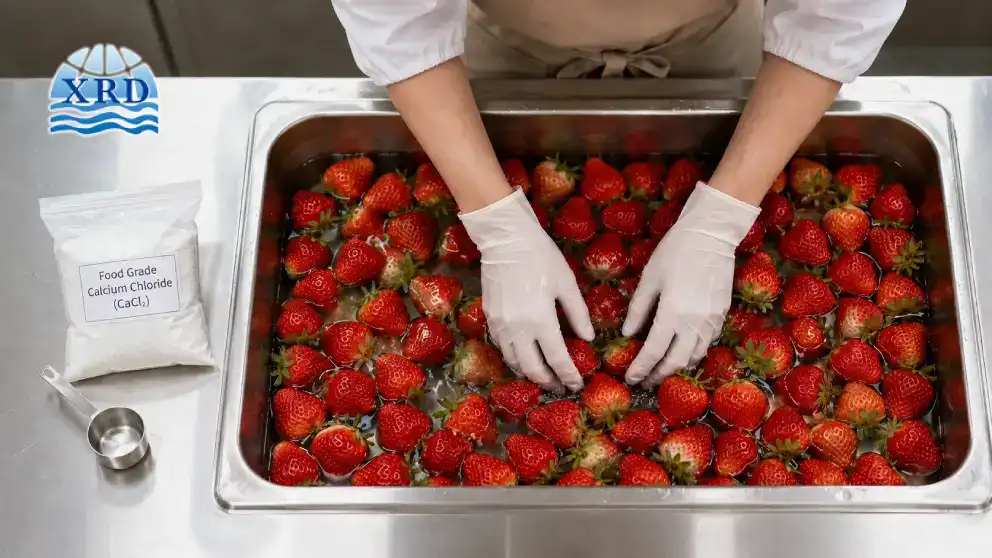
Strawberry trials consistently show that a 1–1.5% calcium chloride dip:
- Retains firmness through 7–10 days of refrigerated storage
- Reduces grey mold (Botrytis cinerea) incidence by up to 50%
- Extends marketable shelf life by 3–5 days
Blueberries respond similarly. Calcium treatment reduces postharvest cracking and helps maintain the waxy bloom that consumers associate with freshness.
Tropical fruits: Mangoes, papayas, and avocados.
Tropical fruits continue ripening aggressively after harvest. Calcium chloride cannot stop this process, but it can decelerate it.
In mangoes, a 2–3% calcium chloride dip with surfactant maintains peel integrity, delays internal flesh softening, and extends the export window by several days.
Avocados treated with calcium show delayed flesh softening and reduced internal browning during distribution. The key with avocados is timing—treatment must occur before the climacteric rise in respiration.
Citrus: Oranges and mandarins.
Citrus fruits lose firmness through rind senescence rather than flesh breakdown. Calcium dips help maintain rind texture and reduce the development of pitting and staining that downgrades fruit during long-distance transport.
Practical Application Guide
Calcium chloride treatment succeeds or fails based on execution details. Here is what matters.
Material quality.
Use only food-grade calcium chloride dihydrate (CaCl₂·2H₂O). Industrial grades contain heavy metals and other contaminants that make them unsuitable for food contact.
Concentration guidelines by fruit type.
| Fruit Type | CaCl₂ Concentration (% w/v) | Immersion Time | Critical Notes |
|---|---|---|---|
| Strawberries | 1.0 – 1.5% | 2–5 min | Gentle agitation; dry thoroughly before cold storage |
| Peaches/Nectarines | 1.0 – 2.0% | 3–10 min | Hydro-cooling preferred; avoid bruising before treatment |
| Fresh-cut apples | 0.5 – 1.0% | 1–3 min | Add 0.5% ascorbic acid for anti-browning synergy |
| Mangoes | 2.0 – 3.0% | 5–10 min | Add surfactant (0.01% Tween) for waxy skin penetration |
| Blueberries | 0.5 – 1.5% | 1–3 min | Minimal agitation to prevent skin damage |
| Avocados | 2.0 – 3.0% | 5–10 min | Treat before climacteric rise; drain completely |
| Cherries | 1.5 – 2.0% | 2–5 min | Ensure stem ends are submerged for full effect |
Solution temperature.
The dip solution should be maintained at 0.5–5°C. Cold temperature serves two purposes:
- It reduces fruit metabolic activity during treatment.
- It creates a partial vacuum in internal air spaces as the fruit cools, physically drawing the solution into the tissue.
Immersion time guidelines.
- Thin-skinned, delicate fruit: 1–3 minutes
- Medium-textured fruit: 2–5 minutes
- Thick-skinned, waxy fruit: 5–10 minutes
Longer is not always better. Over-immersion increases the risk of water-soaked tissue and does not significantly increase calcium uptake beyond the saturation point.
Surfactant addition for waxy fruit.
Fruits with waxy cuticles—mangoes, avocados, apples—benefit from a non-ionic surfactant in the dip solution. A concentration of 0.01–0.05% Tween-20 breaks surface tension and ensures uniform solution contact across the entire fruit surface.
Post-dip handling.
This step is as important as the dip itself.
- Drain fruit thoroughly after removal from the solution.
- Use gentle air circulation or absorbent surfaces to remove surface moisture.
- Transfer to cold storage promptly once surface-dry.
Surface moisture left on fruit creates ideal conditions for fungal spore germination. Skipping the drying step can cause more decay than no treatment at all.
Equipment by scale.
| Scale | Equipment Option |
|---|---|
| Home/smallholder | Food-grade plastic bin or basin |
| Small farm | Stainless steel or plastic dip tank with drainage rack |
| Commercial packhouse | Conveyor dip system or spray bar with dwell time control |
| Fresh-cut processor | Flume or submersion tank with automated residence time |
Common Mistakes and How to Avoid Them
Using too much calcium.
The dose-response relationship for calcium is not linear. It's an inverted U.
Concentrations above 3% risk:
- Salt toxicity to fruit tissue, causing surface pitting
- Bitter, metallic off-flavors
- Calcium residues visible as white dust on dried fruit
For most fruits, 1–2% is the practical optimum. Higher concentrations add risk without proportional benefit.
Treating fruit at the wrong maturity stage.
Calcium uptake is most efficient in fruit that is physiologically mature but not yet fully ripe. Once the climacteric respiration peak has passed and cell walls are already degrading, treatment effect diminishes sharply.
Pick firm. Treat early. Cool immediately.
Dipping damaged or diseased fruit.
One infected fruit in a dip tank can inoculate the entire batch. The solution becomes a pathogen vector.
Sort before dipping. Remove all fruit with visible damage, decay, or skin breaks. Discard diseased fruit—do not try to salvage it through treatment.
Treating calcium as a standalone solution.
Calcium chloride is a powerful tool. It is not a replacement for:
- Proper harvest maturity management
- Rapid cooling after harvest
- Cold chain maintenance throughout distribution
- Good sanitation practices in the packhouse
Calcium works best as part of an integrated postharvest program. Combined with these other elements, its effect is amplified.
Neglecting the drying step.
This is the most common and costly error. Fruit transferred directly from the dip tank to a cold room with surface moisture intact will develop water-soaked lesions and accelerated fungal decay.
Always drain. Always dry.
The Economic Logic
Calcium chloride treatment is one of the most cost-effective postharvest interventions available. The numbers make the case clearly.
Input costs are minimal.
- Food-grade calcium chloride: approximately USD 0.50–1.50 per kilogram at bulk pricing
- A 1% solution requires 10 grams per liter
- One ton of treated fruit requires roughly 100–200 liters of solution
- Total chemical cost per ton: USD 0.05–0.30
Returns are measurable.
- Shelf life extension of 3–5 days
- Reduced rejection rates at retail
- Lower incidence of quality-related returns
- Ability to access more distant markets with longer transit times
The comparison with alternatives.
| Technology | Approximate Capital Cost | Per-Ton Operating Cost |
|---|---|---|
| Controlled atmosphere storage | USD 500,000–2,000,000+ | USD 20–50 |
| Modified atmosphere packaging | USD 50,000–200,000 (equipment) | USD 15–40 |
| Calcium chloride dip | USD 100–5,000 (tank and rack) | USD 0.05–0.30 |
For smallholders and medium-scale operations, the accessibility of this technology is unmatched.
Consumer perception benefits.
Consumers judge fruit quality by touch first. A firm fruit signals freshness. A soft fruit signals age.
By delivering consistently firmer fruit, calcium treatment supports:
- Higher customer satisfaction
- Repeat purchasing behavior
- Premium pricing potential at quality-sensitive market segments
A Simple Solution with Deep Science
Postharvest fruit softening has been a problem for as long as humans have harvested fruit. The ancient practice of storing fruit in lime-rich caves worked, in retrospect, because the calcium in the stone environment was doing what we now understand at the molecular level.
Calcium chloride dipping is this same principle, refined and optimized. The science is clear. The protocols are established. The economics are compelling.
For growers, packers, and fresh-cut processors facing the daily pressure of perishability, this technique offers something rare: a genuinely effective intervention that is both inexpensive and practical.
The investment required is small. The potential return—in reduced waste, higher quality, and stronger market position—is substantial.
Try a small batch. Measure the difference in firmness. Let the results speak for themselves.