Industrial operators selecting between calcium chloride and potassium chloride face a decision that extends far beyond unit price. Both are chloride salts with established supply chains, yet their physical properties, performance envelopes, and primary industrial roles diverge sharply. Calcium chloride is safe when handled with appropriate personal protective equipment. The key risks are inhalation of dust, eye contact with solid or concentrated solutions, and skin irritation from prolonged exposure. Potassium chloride presents a different hazard profile, with ingestion of large quantities potentially affecting cardiac function. The more consequential distinction for industrial buyers, however, lies in what each chloride actually does in the field: one is a workhorse of deicing, dust control, and moisture management; the other is overwhelmingly an agricultural input with limited industrial crossover.
What This Article Covers
- Primary industrial applications of calcium chloride vs potassium chloride
- Performance differences in deicing and dust suppression
- Relative cost structures and supply chain considerations
- Handling and safety comparison for industrial environments
- Bottom line: Calcium chloride dominates performance-critical industrial applications; potassium chloride remains primarily an agricultural commodity with narrow industrial use.
What Is Calcium Chloride and What Makes It Industrially Versatile?
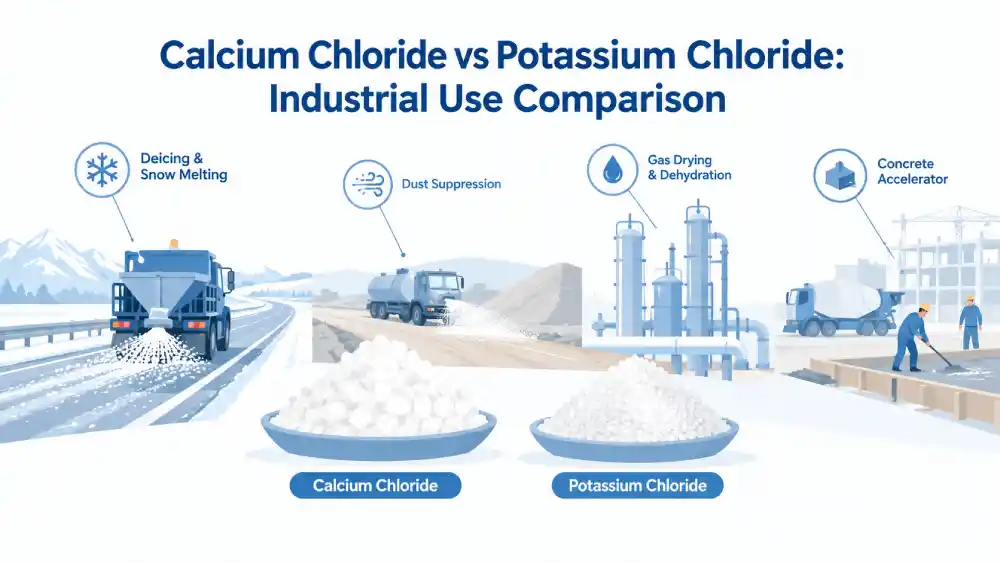
Calcium chloride (CaCl₂) is an inorganic salt comprising 36% calcium and 64% chlorine by weight . Its industrial value derives from three properties that few commodity chemicals combine: extreme hygroscopicity, a highly exothermic dissolution reaction, and the ability to depress the freezing point of water to as low as −52 °C . These characteristics underpin its use across deicing, dust suppression, desiccation, and concrete acceleration.
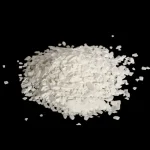
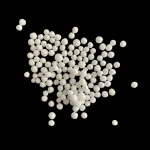
The salt is produced in several forms—anhydrous (94–97% purity), dihydrate (74–77%), and liquid brine—each suited to different handling and application requirements. Anhydrous calcium chloride is the most concentrated form, commanding higher per-tonne pricing, while liquid brine is preferred where dust control or pre-wetting is the objective.
The hygroscopic mechanism is central to several industrial uses. Calcium chloride absorbs moisture from the surrounding air until it dissolves into a brine solution, a process that begins at relative humidities as low as 20–30% depending on form and temperature. This deliquescent behavior makes it effective as a desiccant in gas drying and as a dust suppressant that maintains a moisture film on unpaved road surfaces.
How Does Calcium Chloride Perform in Deicing and Dust Control?
In winter road maintenance, calcium chloride’s performance advantage is most pronounced at low temperatures and short time intervals. A controlled study measuring ice-melt volume across a temperature range found that calcium chloride outperformed both sodium chloride and potassium chloride at every temperature tested, with the performance gap widening as temperatures decreased . At 25°F, calcium chloride produced 13.8 mL of melt after 10 minutes, compared to 3.8 mL for potassium chloride and 6.1 mL for sodium chloride . The same study ranked deicers by ice disbondment effectiveness as CaCl₂ > NaCl > KCl, with potassium chloride performing essentially as an inert material at the lower end of the temperature range .
For dust suppression on unpaved roads, calcium chloride is the leading chemical used in Canada, accounting for approximately 97% of that country’s total calcium chloride consumption in dust control applications . The mechanism is straightforward: the hygroscopic salt draws moisture from the air and retains it on the road surface, consolidating aggregate particles and reducing airborne particulate matter. Liquid calcium chloride is applied directly to gravel roads, while solid forms are used in pre-wetting salt and sand for winter maintenance .
Potassium chloride’s role in deicing is marginal by comparison. Canadian estimates place annual potassium chloride use for roadway deicing at between 2,000 and 3,300 tonnes, a figure dwarfed by calcium chloride’s hundreds of kilotonnes . Potash mine tailings containing only 0.5–2% potassium chloride have been applied to some roads, but this is a byproduct utilization strategy rather than a primary deicing application .
| Performance Metric | Calcium Chloride | Potassium Chloride |
|---|---|---|
| Effective temperature range | Down to −52 °C (solution) | Limited; essentially inert at low temperatures |
| Ice melt at 25°F, 10 min | 13.8 mL | 3.8 mL |
| Primary deicing role | Primary deicer and pre-wetting agent | Marginal; byproduct use only |
| Dust suppression | Leading chemical in Canada (~97% of use) | Not a significant application |
What Is Potassium Chloride Used For in Industrial Contexts?
Potassium chloride (KCl) is composed of 52% potassium and 48% chlorine by weight . Global production is overwhelmingly directed toward agriculture: the vast majority of potash produced worldwide is consumed as fertilizer, supplying potassium, one of the three primary plant macronutrients. Canadian production alone reached an estimated 13.6 million tonnes in 1999, with the potash industry operating at 61% of capacity .
Industrial applications outside agriculture are narrow and specialized. Potassium chloride serves as a flux agent in welding and metal casting, an electrolyte replenisher in pharmaceutical preparations, and a component in water softener units . In oil and gas completion fluids, potassium chloride brine has been evaluated for its ability to minimize formation damage. A comparative study of brine completion fluids found that potassium chloride solution resulted in a 38% reduction in sandstone core permeability, substantially less damaging than sodium chloride’s 80% reduction but still a measurable impairment .
The salt also appears in certain deicing product formulations, though typically as a minor component rather than the active agent. Its ice-melting performance is inherently limited by its eutectic temperature and the relatively low solubility-driven exothermic effect compared to calcium chloride.
Is Calcium Chloride Better Than Potassium Chloride for Industrial Applications?
The answer depends entirely on the application, but for most non-agricultural industrial uses, calcium chloride offers functional capabilities that potassium chloride cannot match. This is not a matter of product quality but of fundamental physical chemistry.
Choose calcium chloride when:
- The application requires moisture absorption or retention (dust control, desiccant drying, concrete curing acceleration)
- Deicing or anti-icing is needed at temperatures below 20°F, where potassium chloride loses effectiveness
- Exothermic heat release on dissolution is beneficial (melting ice, accelerating set in cold-weather concrete)
- A concentrated brine with a low freezing point is required for ballast or completion fluid applications
Choose potassium chloride when:
- The primary use is agricultural fertilizer, where potassium content is the valued attribute
- A chloride salt with lower hygroscopicity is preferred to avoid caking or moisture pickup in dry formulations
- The application specifically requires potassium ion delivery (pharmaceutical electrolytes, specialized completion fluids)
- Cost sensitivity is extreme and the performance requirements are modest
The cost differential reinforces this segmentation. Calcium chloride prices in the Chinese market have ranged from approximately 850 CNY/tonne for 74% dihydrate flake to 2,050 CNY/tonne for 94% anhydrous material in recent trading . Potassium chloride as an agricultural commodity has traded in a different band, with domestic 60% crystalline material quoted around 2,950–3,100 CNY/tonne in late 2026 . These prices reflect different value chains: calcium chloride is an industrial chemical sold on performance, while potassium chloride is an agricultural input sold on potassium content and governed by fertilizer market dynamics.
How Do Handling and Safety Profiles Compare?
Both salts are classified as relatively low-hazard materials in industrial settings, but their safety profiles differ in ways that matter for operational planning.
Calcium chloride’s primary hazards are physical and irritant in nature. NOAA’s chemical datasheet notes that inhalation causes irritation of the nose and throat, ingestion irritates the mouth and stomach, and eye contact with dust can cause irritation and possible transient corneal injury . Strong solutions can cause marked skin irritation, even superficial burns, upon prolonged contact. The exothermic dissolution reaction—which can rapidly raise solution temperatures to approximately 60 °C—presents a thermal hazard if water is added to anhydrous material in a confined space . Recommended protective equipment includes safety glasses or a face shield, dust respirator, and rubber gloves .
Potassium chloride’s hazard profile is shaped by its physiological activity. The International Labour Organization’s ICSC card identifies irritation to eyes and respiratory tract from dust exposure, and notes that ingestion of large amounts could affect the cardiovascular system, potentially resulting in cardiac dysrhythmia . This is consistent with potassium chloride’s pharmaceutical use as an electrolyte replenisher: the potassium ion is biologically active at concentrations that would be irrelevant for calcium chloride. For industrial handling, the practical implication is that dust suppression and ingestion prevention are more critical controls than for calcium chloride, particularly in environments where workers may be exposed to airborne particulate over extended periods.
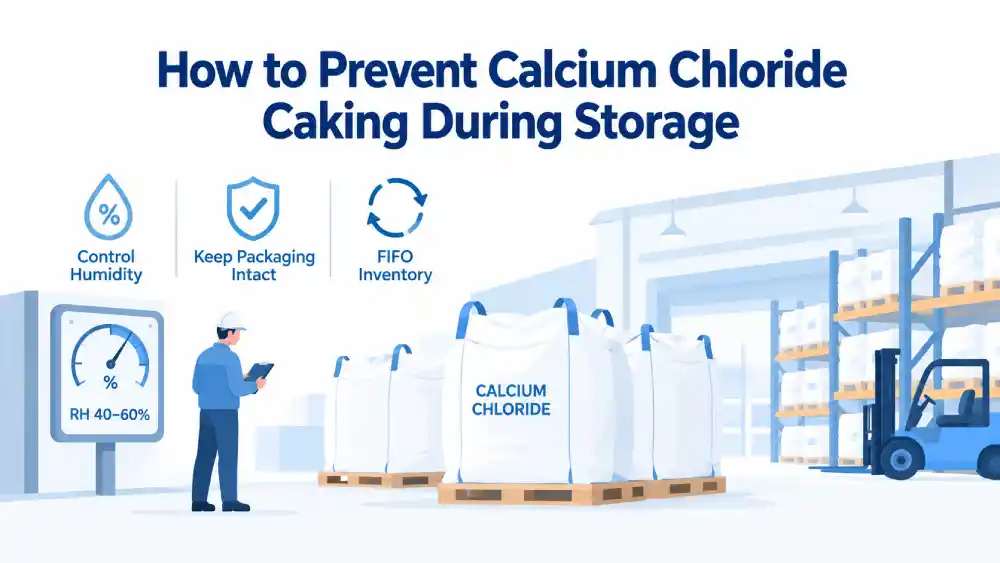
Neither material is combustible. Both should be stored in dry conditions to prevent caking—calcium chloride more so, given its deliquescent nature. Spill cleanup procedures are similar: sweep or vacuum solid material into containers and avoid uncontrolled dissolution that could create slippery surfaces or localized thermal effects.
What Should Industrial Buyers Prioritize When Choosing Between These Chlorides?
The selection framework for industrial buyers should begin with application requirements, not price per tonne. A lower-cost material that fails to perform at the required temperature or moisture condition creates downstream costs that dwarf any procurement savings.
Verify the performance specification against operating conditions. For deicing, confirm the lowest expected surface temperature and select a chloride with a demonstrated melt rate at that temperature. For dust control, assess the road surface material and traffic patterns; calcium chloride’s moisture retention may be excessive in humid climates or on certain aggregate types.
Confirm the appropriate form and purity for the handling system. Anhydrous calcium chloride (94–97%) requires protected storage to prevent premature hydration. Dihydrate (74–77%) is more forgiving but delivers less active material per tonne. Liquid brine eliminates dust and dissolution hazards but requires tanks, pumps, and freeze protection.
Audit the supplier’s quality documentation. Industrial-grade calcium chloride should be accompanied by a certificate of analysis confirming CaCl₂ content, alkalinity, and insoluble matter. Potassium chloride for non-agricultural use should specify KCl purity and identify any anti-caking agents added during production.
Calculate total applied cost, not unit price. A material that requires higher application rates, more frequent reapplication, or additional equipment investment may be more expensive in service than a higher-priced alternative that performs efficiently.
FAQs
What is the main industrial difference between calcium chloride and potassium chloride?
Calcium chloride is a multifunctional industrial chemical used primarily for deicing, dust suppression, and moisture control, while potassium chloride is overwhelmingly an agricultural fertilizer with limited industrial applications in welding fluxes, completion fluids, and pharmaceuticals.
How does calcium chloride perform compared to potassium chloride for melting ice?
Calcium chloride significantly outperforms potassium chloride at all tested temperatures. In controlled testing at 25°F, calcium chloride produced 13.8 mL of melt after 10 minutes versus 3.8 mL for potassium chloride, and the performance gap widened as temperatures decreased .
Is potassium chloride effective for road deicing?
Potassium chloride is marginally effective at best for road deicing and is essentially inert at lower temperatures. Its use in roadway deicing is limited to minor quantities, often as a component of potash mine tailings applied as a byproduct utilization strategy .
What are the primary industrial uses of potassium chloride outside agriculture?
Industrial applications of potassium chloride include flux agents in welding and metal casting, electrolyte replenishers in pharmaceutical preparations, components in water softener units, and completion fluids in oil and gas drilling .
Is calcium chloride safe to handle in industrial settings?
Calcium chloride is safe when handled with appropriate personal protective equipment. The key risks are inhalation of dust causing nose and throat irritation, eye contact causing irritation or transient corneal injury, and skin contact with strong solutions causing marked irritation .
What are the health risks of potassium chloride exposure?
Potassium chloride dust irritates the eyes and respiratory tract. Ingestion of large amounts can affect the cardiovascular system and may result in cardiac dysrhythmia, reflecting the biological activity of the potassium ion .
Which chloride is more cost-effective for dust suppression?
Calcium chloride is the established choice for dust suppression and is the leading chemical used for this purpose in Canada. Potassium chloride is not a significant dust suppression agent, and its cost structure as an agricultural commodity does not position it competitively for this application .
Can calcium chloride and potassium chloride be used together?
The two chlorides can be blended, and potassium chloride appears as a minor component in some deicing formulations. However, blending does not enhance performance beyond what calcium chloride alone provides in most applications, and the practice is more common in agricultural fertilizer blends than in industrial deicing products.
What form of calcium chloride is best for industrial applications?
The optimal form depends on the application: anhydrous (94–97%) for maximum concentration and moisture absorption, dihydrate (74–77%) for general-purpose use with easier handling, and liquid brine (typically 30–40% concentration) for dust control and pre-wetting applications where dust generation and dissolution heat are concerns.
How should industrial buyers evaluate suppliers of these chlorides?
Buyers should request certificates of analysis confirming specified content and purity, verify the supplier’s track record with industrial customers in the relevant application, confirm the availability of the required form and packaging, and assess logistical reliability for the volumes and delivery frequency needed.
Conclusion
Calcium chloride vs potassium chloride is ultimately a comparison between a performance-driven industrial chemical and an agricultural commodity with selective industrial niches. Calcium chloride’s hygroscopicity, exothermic dissolution, and low-temperature deicing capability make it the default choice for dust control, winter road maintenance, and moisture-sensitive applications. Potassium chloride’s value lies in its potassium content for agriculture and in specialized uses where the potassium ion itself is the active ingredient. Industrial buyers should begin with the operating conditions—temperature, moisture, material compatibility—and select the chloride whose physical properties match the job. For applications where performance at low temperature or under moisture stress is non-negotiable, the specification should prioritize demonstrated melt rates and hygroscopic capacity over headline price.