Water treatment operators and facility managers often face a deceptively complex question: how much calcium chloride should be added to achieve a specific water quality target? Unlike simple chemical additions where a fixed formula suffices, calcium chloride dosage depends on the starting water chemistry, the intended treatment objective, and the form of the product being used. A dosage that works for one source water may be ineffective or excessive for another. This guide explains the calculation methods, the variables that alter the result, and the practical steps for determining the right calcium chloride dosage for your specific application.
Calcium chloride is safe when handled properly. The key risks are eye and skin irritation from dust or concentrated solutions, and excessive dosage that can disrupt treatment processes or elevate chloride levels beyond acceptable discharge limits. The main causes of calculation errors are failing to account for product purity, ignoring the difference between calcium hardness and total hardness, and applying a dosage without jar testing or bench-scale verification.
What This Article Covers
- The core formula: How to convert a target calcium increase into a calcium chloride mass or volume.
- Product form adjustments: Why anhydrous, dihydrate, and liquid forms require different calculations.
- Treatment objectives: How dosage logic changes for softening, coagulation aid, and hardness adjustment.
- Verification steps: Bench testing and post-dosage monitoring to confirm results.
- Bottom line: Always calculate from tested water parameters and verify with a jar test before full-scale application.
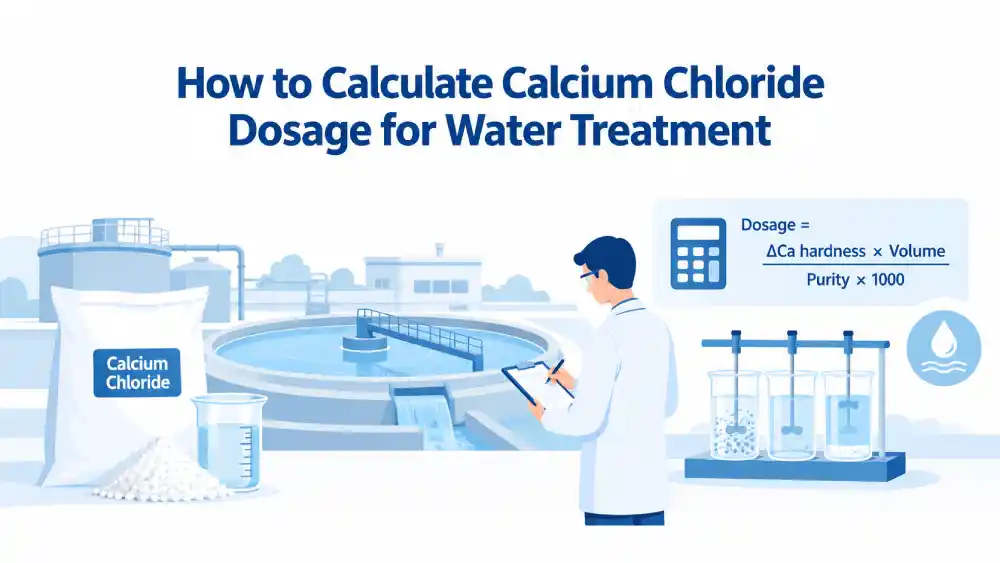
What Is the Basic Calcium Chloride Dosage Formula?
The foundational calculation for calcium chloride dosage starts with the desired increase in calcium concentration, expressed in milligrams per liter as calcium carbonate (mg/L as CaCO₃) or as calcium ion (Ca²⁺). Water treatment professionals typically work in mg/L as CaCO₃ because it provides a common basis for comparing hardness and alkalinity.
To raise calcium hardness by a specific amount, the required mass of calcium chloride depends on its calcium content. Pure calcium chloride (CaCl₂) has a molecular weight of approximately 110.98 g/mol, while calcium carbonate (CaCO₃) has a molecular weight of 100.09 g/mol . The calcium fraction in pure CaCl₂ is about 36.1% by weight.
A simplified formula for anhydrous calcium chloride is:
Mass of CaCl₂ (mg) = Desired Ca increase (mg/L as CaCO₃) × Volume (L) × 0.0111
This factor derives from the ratio of molecular weights and the calcium content of the salt. For a 1,000-liter tank requiring a 50 mg/L increase in calcium hardness as CaCO₃, the calculation yields approximately 555 grams of pure CaCl₂. The critical point is that this formula assumes 100% purity and anhydrous product; most commercial products are neither.
How Does Product Form Change the Calculation?
Calcium chloride is sold in multiple forms, and each contains a different percentage of actual CaCl₂. Using the anhydrous formula without adjusting for product form is one of the most common sources of dosage error.
| Product Form | Approximate CaCl₂ Content | Adjustment Factor (vs. anhydrous) |
|---|---|---|
| Anhydrous (powder/flake) | 94–97% | 1.00 (baseline) |
| Dihydrate (flake/pellet) | 74–78% | Divide required mass by 0.76 |
| Liquid (30–40% solution) | 30–40% | Divide required mass by solution concentration |
| Food-grade liquid | 32–40% | Verify certificate of analysis |
Typical market reference values; actual content varies by supplier and grade.
For a dihydrate product with 77% CaCl₂ content, the mass required increases by approximately 30% compared to the anhydrous calculation. Liquid products require an additional density correction: a 35% solution at typical ambient temperature has a density of approximately 1.35 g/mL, meaning one liter of solution contains about 472 grams of CaCl₂.
For drinking water applications, NSF/ANSI/CAN 60 certification is a baseline requirement. The standard establishes maximum use levels for treatment chemicals; calcium chloride products certified under this standard typically carry a maximum use level of 200 mg/L . Operators should verify that the specific product grade is listed for the intended application.
How Do You Calculate Dosage for Hardness Adjustment?
Hardness adjustment is the most straightforward application. The goal is to raise the calcium concentration to a target level, often to improve stability in distribution systems or to meet a specific process requirement.
The procedure follows a systematic sequence:
Step 1: Test the current calcium hardness. Use a titration method or an appropriate instrument to determine the existing calcium concentration in mg/L as CaCO₃. Do not rely on total hardness alone; magnesium contributes to total hardness but is unaffected by calcium chloride addition.
Step 2: Determine the target calcium level. The target depends on the application. For corrosion control in distribution systems, a common target range is 40–80 mg/L as CaCO₃. For process water requiring specific calcium levels, consult the treatment objective.
Step 3: Calculate the required calcium increase. Subtract the current level from the target: Target – Current = Required increase.
Step 4: Apply the adjusted formula. Use the product-specific calcium content rather than assuming pure CaCl₂.
Step 5: Verify with a bench test. Add the calculated dose to a one-liter sample, mix thoroughly, and retest. If the target is not reached, adjust the calculation factor and repeat. This empirical check accounts for any precipitation, complexation, or measurement variability.
A worked example: A facility needs to raise calcium hardness from 25 mg/L to 60 mg/L as CaCO₃ in a 5,000-liter system using a dihydrate product with 77% CaCl₂. The required increase is 35 mg/L. Using the anhydrous baseline factor of 0.0111 g per liter per mg/L, the baseline mass is 1.94 kg. Dividing by 0.77 gives 2.52 kg of the dihydrate product. A bench test on one liter would use approximately 0.50 grams of product.
Why Does Calcium Chloride Dosage Matter for Coagulation Aid?
In coagulation and flocculation processes, calcium chloride is not a primary coagulant. It functions as a coagulant aid, enhancing the performance of primary coagulants such as ferric salts or aluminum salts by contributing divalent cations that help destabilize particles and improve floc formation.
Research on coagulation with haematite as a primary coagulant found that calcium chloride addition enhanced dissolved organic carbon removal, with an optimum calcium chloride concentration of 90 mM at a haematite dose of 43 mg/L as Fe . The ratio of calcium chloride to primary coagulant matters more than the absolute calcium chloride dose. At dosages beyond the optimum, performance declined, indicating that overdosing is a real risk.
For coagulation aid applications, the calculation cannot be performed from a fixed formula. The appropriate approach is:
- Establish the primary coagulant dose through jar testing without calcium chloride.
- Run a series of jar tests with incremental calcium chloride additions (for example, 10, 25, 50, and 100 mg/L as CaCl₂).
- Measure the target parameter (turbidity, DOC, or particle count) for each dose.
- Select the lowest dose that achieves the treatment goal without causing pH depression or excessive chloride.
Calcium chloride solutions are mildly acidic (pH approximately 9–10.5 at 100 g/L concentration for the solid product, but solutions can depress pH depending on alkalinity) . In low-alkalinity waters, calcium chloride addition can reduce pH, which may require adjustment to maintain coagulation effectiveness.
What Equipment and Verification Steps Are Required?
Accurate dosage calculation is only useful if the product is delivered and mixed correctly. The following equipment and procedural steps support reliable dosing.
Required equipment for bench testing:
- One-liter beakers or jars (at least four for a series)
- Calibrated balance readable to 0.01 grams
- Calcium hardness test kit or titrator
- pH meter with calibration buffers
- Mixing apparatus capable of rapid mix (200–300 rpm) and slow mix (30–50 rpm)
Verification checklist before full-scale dosing:
- Confirm product purity from the certificate of analysis; do not use label values alone.
- Test the actual source water, not historical data; water quality changes seasonally.
- Run the bench test at the actual treatment temperature; calcium chloride solubility and reaction kinetics vary with temperature.
- Check compatibility with other treatment chemicals; calcium chloride is incompatible with sulfates and phosphates, which can precipitate.
- Calculate the chloride load; each mg/L of CaCl₂ adds approximately 0.64 mg/L of chloride. Verify that total chloride after dosing remains within discharge or receiving water limits.
- Document the verified dose and establish a monitoring schedule for post-dosage calcium and chloride levels.
Troubleshooting common issues:
| Symptom | Likely Cause | Solution |
|---|---|---|
| Calcium level lower than calculated | Product purity lower than assumed | Adjust factor using certificate of analysis |
| pH drops unexpectedly | Low alkalinity water + rapid CaCl₂ addition | Add alkalinity source or reduce dose rate |
| Cloudiness after addition | Sulfate or phosphate precipitation | Pre-test compatibility; consider alternative calcium source |
| Inconsistent results between batches | Water quality variation | Increase testing frequency; adjust dose based on current calcium |
What Are the Safety and Regulatory Limits for Calcium Chloride Dosage?
Calcium chloride is not a hazardous substance under normal handling conditions, but concentrated dust and solutions require basic precautions. The American Conference of Governmental Industrial Hygienists (ACGIH) has not established a threshold limit value for calcium chloride, though some jurisdictions list occupational exposure limits of 5–10 mg/m³ for dust . Appropriate controls include dust suppression during handling, eye protection when working with powders, and ventilation in storage areas.
For drinking water treatment, the regulatory framework centers on NSF/ANSI/CAN 60 certification. Products listed under this standard have been evaluated for maximum use levels; calcium chloride products are typically listed at a maximum of 200 mg/L . This is a health-based maximum, not a treatment target; actual doses are usually well below this level.
Discharge considerations are equally important. Many publicly owned treatment works impose chloride limits on industrial dischargers, often in the range of 250–500 mg/L. A calcium chloride dose that adds 100 mg/L of CaCl₂ contributes approximately 64 mg/L of chloride. Facilities with tight chloride limits may need to consider alternative calcium sources or pretreatment.
FAQs
What is the difference between calcium hardness and total hardness?
Calcium hardness measures only the calcium ion concentration, while total hardness includes both calcium and magnesium. When calculating calcium chloride dosage, you must work from the calcium component, not total hardness. If your test reports only total hardness, you need a separate calcium test to determine how much of the hardness is from calcium.
How do I convert from mg/L as CaCO₃ to mg/L as Ca²⁺?
Multiply the value in mg/L as CaCO₃ by 0.40 to obtain mg/L as calcium ion. This factor comes from the ratio of the equivalent weights: calcium (20.04) divided by calcium carbonate (50.04) equals approximately 0.40. Conversely, multiply mg/L as Ca²⁺ by 2.5 to express as CaCO₃.
Can I use calcium chloride in aluminum coagulation processes?
Yes, calcium chloride can be used as a coagulation aid with aluminum-based coagulants, but the interaction requires careful testing. Calcium can compete with aluminum for binding sites on organic matter. Jar testing across a range of calcium chloride doses is essential to identify whether the addition improves or hinders performance for your specific water.
How long does it take for calcium chloride to fully dissolve and equilibrate?
Anhydrous and dihydrate calcium chloride dissolve rapidly in water, typically within minutes under adequate mixing. However, the dissolution is endothermic for the anhydrous form (the solution cools) and exothermic for some hydrated forms (the solution warms). Allow 15–30 minutes of mixing before sampling for verification testing to ensure homogeneity.
Is it safe to store calcium chloride in contact with mild steel?
No. Calcium chloride solutions are corrosive to mild steel and many common metals. Storage tanks, piping, and dosing equipment should be constructed from compatible materials such as polyethylene, polypropylene, PVC, or fiberglass-reinforced plastic. Stainless steel may be acceptable depending on concentration and temperature, but verification with the product supplier is recommended.
What should I do if my calcium chloride dose causes cloudiness?
Cloudiness after addition typically indicates precipitation of calcium salts, most commonly calcium carbonate (if pH and alkalinity are high) or calcium sulfate (if sulfate is present). Stop dosing, test for the interfering ion, and consider reducing the dose, adjusting pH, or using a different calcium source. In some cases, the cloudiness is temporary and resolves with mixing, but precipitation represents wasted chemical and potential fouling.
How does temperature affect calcium chloride dosage calculations?
Temperature affects two things: the density of liquid calcium chloride solutions and the solubility of calcium salts that may precipitate. Liquid product calculations should use density at the actual storage temperature. For precipitation risk, colder water generally has higher calcium carbonate solubility but lower calcium sulfate solubility, so the risk profile depends on which anions are present. Bench testing at actual temperature is the most reliable approach.
Can I use calcium chloride to increase hardness in a pool or spa?
Calcium chloride is commonly used to raise calcium hardness in pools and spas, typically to a target of 200–400 mg/L as CaCO₃. The calculation follows the same principles described in this article, with adjustment for product form. However, pool and spa applications have specific water balance requirements (Langelier Saturation Index) that must be maintained to prevent scaling or corrosion, so calcium addition should be part of a complete water balance assessment.
What is the maximum allowable calcium chloride dose for drinking water?
Under NSF/ANSI/CAN 60 listings, calcium chloride products are typically certified for a maximum use level of 200 mg/L . This is a health-based maximum established by the standard, not a recommended treatment dose. Actual doses for hardness adjustment or coagulation aid are usually below 100 mg/L. Facilities should verify the specific product listing and consult local regulations for any additional limits.
How often should I verify my calcium chloride dosing calculation?
Verify the calculation whenever the source water calcium level changes significantly (typically a shift of more than 10 mg/L as CaCO₃), when switching product forms or suppliers, or when treatment performance deviates from expectations. At minimum, a quarterly bench-scale verification provides a reasonable check against drift in water quality or product characteristics.
Conclusion
Calculating calcium chloride dosage for water treatment requires more than plugging numbers into a formula. The core calculation converts a target calcium increase into a product mass, but the result is only as reliable as the inputs: current water testing, accurate product purity data, and adjustment for the specific form being used. For hardness adjustment, a straightforward mass calculation with a bench-scale check provides a defensible dose. For coagulation aid, the relationship between calcium chloride and the primary coagulant demands empirical optimization through jar testing rather than a fixed formula. The consistent theme across applications is verification—test the water, calculate with product-specific factors, and confirm the result before committing to full-scale dosing. Facilities that establish a routine of testing, calculating, and verifying maintain better control over treatment performance and avoid the twin pitfalls of underdosing and overdosing.