Calcium chloride procurement teams often discover supplier quality gaps only after a shipment fails incoming inspection or disrupts a production line. Traditional price-per-ton comparisons address the visible cost but not the root cause of supplier risk: inconsistent documentation, unverified testing claims, and application-specific purity requirements that vary dramatically across de-icing, dust control, food processing, and pharmaceutical excipient uses.
The way industrial buyers approach calcium chloride supplier comparison has shifted significantly. A commodity-first mindset is giving way to a technical qualification framework, driven by tighter regulatory expectations and the realization that a single off-spec batch can cost more than a year of unit-price savings . This guide provides a structured method for evaluating suppliers against verifiable criteria rather than sales claims.
Calcium chloride is safe when handled and sourced properly. The key risks in supplier comparison are not the material itself but documentation gaps, unverified Certificate of Analysis (CoA) claims, and application-grade mismatches. The main failure points are: relying on CoA without confirming the testing laboratory’s accreditation, accepting vague impurity limits, and comparing prices without normalizing for concentration and freight .
What This Article Covers
- The technical criteria that separate qualified suppliers from commodity traders
- How to verify purity claims and documentation integrity
- Application-specific grade requirements and their procurement implications
- A total cost framework that exposes hidden supplier risk
- Practical audit steps and red flags
What Makes Calcium Chloride Supplier Comparison Different From Commodity Buying?
Calcium chloride is not a single specification product. The same chemical formula (CaCl₂) covers dihydrate flakes at 74–77% purity, anhydrous pellets at 94–97%, and food-grade or USP-grade material with numerically defined heavy metal limits . A supplier competent in de-icing prills may lack the quality infrastructure for food or pharmaceutical applications. Technical comparison must begin with grade fitness, not price.
The global calcium chloride market remains moderately concentrated, with the top three producers holding approximately 32% of market share . However, the supplier landscape includes bulk producers, specialty distributors, and regional traders whose documentation capabilities differ substantially. A technically rigorous calcium chloride supplier comparison therefore evaluates the supply chain tier alongside the product specification.
How Should Procurement Teams Verify Purity and Impurity Claims?
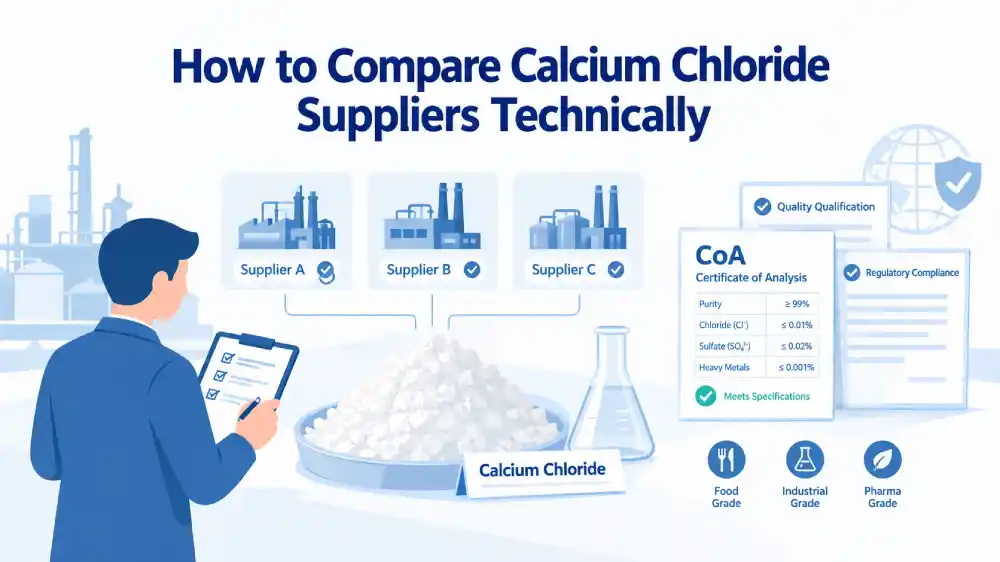
The Certificate of Analysis is the central document in any supplier qualification, but its value depends entirely on the laboratory that generated it. A CoA showing 94% CaCl₂ content carries no weight if the issuing lab lacks ISO 17025 accreditation or has not undergone recent proficiency testing . Ask directly: “Is this lab ISO 17025 accredited, and when was its last proficiency test?” A supplier unable to answer this has a quality infrastructure gap.
Beyond accreditation, the CoA must contain numerical maximum limits for relevant impurities. A specification stating “heavy metals: conforms” without numerical values is unacceptable for any regulated application. Food-grade calcium chloride requires defined limits: arsenic ≤3 mg/kg, lead ≤2 mg/kg, and mercury ≤1 mg/kg under FCC requirements . Industrial grades used in dust control or de-icing have less stringent limits, but the numbers should still appear on the specification sheet.
| Verification Item | What to Request | Red Flag |
|---|---|---|
| Testing laboratory | ISO 17025 accreditation certificate and last proficiency test date | No accreditation or test older than 24 months |
| CoA completeness | Identity, assay, impurity panel with numerical limits | “Conforms” without numbers |
| Batch traceability | Production lot and packing lot linkage | CoA not traceable to specific batch |
| Sampling method | Samples drawn from 3 random production batches | Supplier-selected samples only |
| Specification source | USP, FCC, Ph. Eur., or customer-defined internal spec | Vague “industrial grade” label |
Calcium chloride’s hygroscopic nature makes packaging integrity a quality variable, not merely a logistics concern. Material stored or shipped in compromised packaging absorbs moisture, altering concentration and flowability . Suppliers who cannot demonstrate moisture-barrier packaging protocols introduce a hidden quality risk.
Why Does Production Method Matter for Supplier Selection?
Calcium chloride is produced through three principal routes: brine concentration from natural sources, reaction of calcium carbonate with hydrochloric acid, and byproduct recovery from Solvay process or other chemical manufacturing streams. The production method influences impurity profile and consistency, though any route can produce acceptable material if process controls are adequate.
Bulk producers supplying pharmaceutical or food channels typically provide batch-specific CoAs aligned to USP or Ph. Eur. monographs, with controlled specifications for sulfate, heavy metals, magnesium, and alkalies . Distributors that source from multiple producers offer logistical flexibility but add a documentation layer that must be verified independently. A technically sound calcium chloride supplier comparison treats the production source as a quality variable, not a purchasing convenience.
Choose a bulk producer directly when: your application requires tight impurity control, you need change-control notification for source or process changes, and annual volume justifies direct qualification.
Choose a specialty distributor when: you need smaller quantities of pharmacopoeial-grade material with regional warehousing, and the distributor can demonstrate batch-level traceability to the original producer.
What Role Does Application Grade Play in Supplier Fitness?
The single most common technical error in calcium chloride supplier comparison is evaluating suppliers against a generic “calcium chloride” specification rather than the application-specific grade. A supplier excellent for winter road maintenance may be entirely unqualified for cheese-making or pharmaceutical excipient use.
For food processing applications, the FDA classifies calcium chloride as GRAS under 21 CFR 184.1193, but this status applies only to material meeting food-grade purity specifications . A supplier must provide CoAs demonstrating compliance with FCC heavy metal limits for every batch. Industrial-grade material without heavy metal testing is not interchangeable.
For pharmaceutical excipient use, the documentation burden expands to include pharmacopoeial compliance (USP/NF or Ph. Eur.), GMP manufacturer letters, quality agreements, and change-control notifications . Suppliers serving this channel typically provide standardized batch documentation packages and maintain validated supply programs.
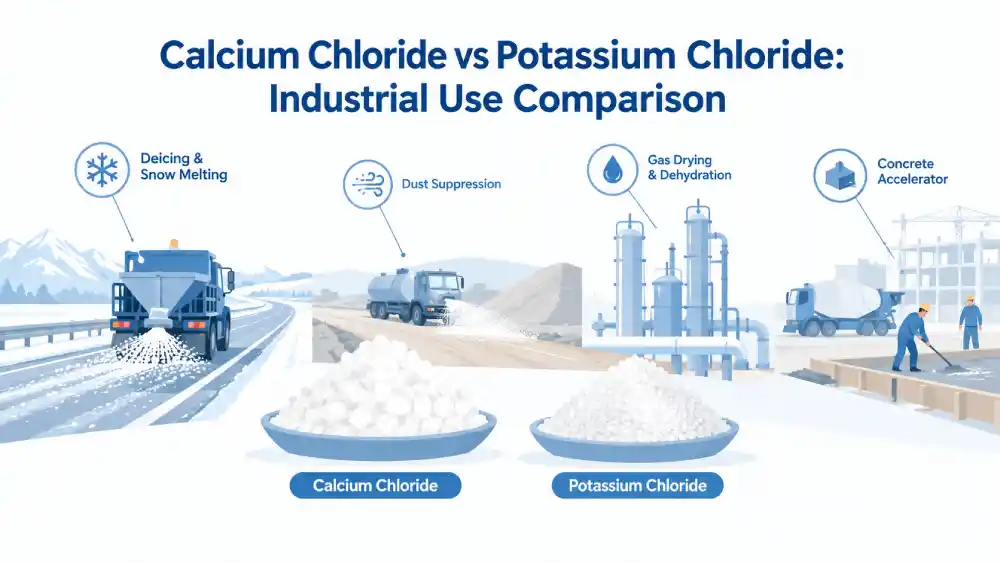
For de-icing and dust control, the relevant specifications emphasize concentration (94–97% anhydrous or 74–77% dihydrate), particle form (prill, pellet, flake), and caking resistance. Documentation requirements are lighter, but packaging integrity and seasonal availability become critical.
Is a Lower Price Ever the Technically Correct Choice?
Price comparison without normalization is the most reliable way to select the wrong supplier. A quotation of $900/MT for 90% material is more expensive per unit of active CaCl₂ than $1,000/MT for 94% material. The correct comparison basis is cost per unit of delivered, specification-compliant CaCl₂.
Total cost of ownership (TCO) modeling reveals that quality-related costs dominate supplier economics in critical applications. A single rejected shipment can halt production, trigger re-inspection costs, and require emergency sourcing at premium prices. For applications where downtime costs exceed the potential unit-price savings, the lowest-price supplier is almost never the lowest-cost supplier .
| Cost Component | Low-Price Supplier Risk | Qualified Supplier Advantage |
|---|---|---|
| Unit price | Lower quoted price | Higher but stable |
| Incoming inspection | Full batch testing required | Reduced sampling based on history |
| Rejection handling | Return freight, production delay | Documented batch history reduces risk |
| Emergency sourcing | Premium pricing when primary fails | Backup qualification maintained |
| Documentation labor | Manual verification per batch | Standardized digital CoA packages |
Choose the higher-priced qualified supplier when: your application is a critical process step, the material’s quality directly affects final product compliance, or your internal quality team’s time is better spent on supplier development than batch-by-batch firefighting.
What Should a Technical Supplier Audit Cover?
A virtual or on-site audit should follow material flow from raw material receipt to finished goods release. The highest-value audit observations are often procedural rather than equipment-related. Calibration stickers on critical instruments, raw material segregation practices, and packaging line discipline reveal more about quality culture than a polished brochure .
A practical audit checklist for calcium chloride supplier comparison includes:
- Verify that the CoA testing laboratory holds current ISO 17025 accreditation with a proficiency test within the last 24 months
- Request samples drawn from three randomly selected production batches, not supplier-chosen samples
- Confirm that impurity specifications include numerical maximum limits for arsenic, lead, mercury, and cadmium where applicable
- Review packaging specifications for moisture-barrier performance and container integrity protocols
- Ask for the supplier’s last 12 months of on-time-in-full delivery rate and any batch rejection records
- Obtain a written change-control commitment covering source, process, and specification modifications
- Inspect warehouse conditions for humidity control and cross-contamination prevention
- Request a virtual plant tour showing raw material segregation and finished goods labeling
Third-party inspections, typically costing $1,500 to $4,000, are a rational investment when the cost of a rejected shipment or production disruption exceeds that range . For suppliers passing document review and sample testing, an independent inspection provides objective confirmation of stated capabilities.
What Documentation Red Flags Should Trigger Supplier Rejection?
Certain supplier responses should end the qualification process immediately. A CoA without numerical impurity limits indicates either a template document or a specification that has not been technically reviewed. A testing laboratory without ISO 17025 accreditation means the reported values have no independent verification. A supplier who cannot trace a CoA to a specific production batch has a documentation system incapable of supporting regulated applications.
A less obvious red flag is reluctance to provide batch-specific data before purchase. Suppliers confident in their quality systems routinely share recent CoAs and specification sheets with prospective buyers. Resistance to this request suggests either inconsistent quality or a trading layer that obscures the original producer.
The calcium chloride supplier comparison process should also flag seasonal capacity constraints. Demand for de-icing applications peaks in winter months, and suppliers prioritizing seasonal customers may deprioritize industrial contract volumes during peak periods. Confirming covered warehouse capacity and off-season availability protects against allocation surprises .
Conclusion
A technically rigorous calcium chloride supplier comparison begins with grade fitness and ends with verifiable documentation, not with the lowest quoted price. The core insight is that calcium chloride quality is defined by batch-level evidence, not by the supplier’s stated specification. Prioritize suppliers who proactively provide ISO 17025-accredited CoAs with numerical impurity limits, who draw samples from random production batches, and who document change control for source and process modifications.
For procurement teams managing critical applications, the next step is to map your current supplier list against the verification criteria in this guide. Start by requesting the last three batch CoAs and the testing laboratory’s accreditation certificate from your top two suppliers. The gaps revealed in that exercise will indicate where deeper qualification effort is warranted.
FAQs
What is the minimum documentation required for a calcium chloride supplier comparison?
At minimum, request the current specification sheet with numerical impurity limits, a batch-specific CoA, the testing laboratory’s ISO 17025 accreditation status, and the Safety Data Sheet. For regulated applications, add pharmacopoeial compliance statements and change-control commitments.
How long does a technical supplier qualification typically take?
Document review and sample testing can be completed in 2 to 4 weeks for industrial grades. Food and pharmaceutical grade qualification may extend to 8 to 12 weeks due to additional documentation requirements, sample analysis, and audit scheduling.
Is calcium chloride from different production methods interchangeable?
Not always. Brine-derived, synthetic, and byproduct calcium chloride may differ in trace impurity profiles. The CoA is the controlling document: if the impurity limits meet your specification, the production method is secondary. However, source changes should trigger re-qualification.
What purity grade is required for dust control applications?
Dust control typically uses 94–97% anhydrous prills or pellets, or 74–77% dihydrate flakes. The critical performance attributes are hygroscopicity and dissolution behavior rather than high purity. Impurity limits are less stringent than food or pharmaceutical grades.
How should I verify that a CoA is authentic?
Confirm that the testing laboratory named on the CoA holds current ISO 17025 accreditation for the relevant test methods. Request the accreditation certificate and verify its validity through the issuing accreditation body. A CoA without a verifiable laboratory source has no technical standing.
What are the most common impurity concerns in industrial calcium chloride?
Common specification concerns include magnesium chloride, water-insoluble matter, sulfate, and alkalinity. Heavy metals are the primary concern for food and pharmaceutical applications. The acceptable limits depend entirely on the end-use specification.
Can I compare suppliers using only the purity percentage on the label?
No. Purity percentage must be evaluated alongside impurity limits, testing methodology, and batch consistency. A 94% material with uncontrolled heavy metals may be unsuitable for an application where a well-documented 90% material would perform adequately.
What is the typical lead time for bulk calcium chloride delivery?
Lead times vary by region and season, typically ranging from 1 to 3 weeks for standard grades from stock. Seasonal demand peaks for de-icing products can extend lead times. Confirm current lead time and available inventory before committing to production schedules.
How does packaging affect calcium chloride quality during transit?
Calcium chloride is highly hygroscopic. Packaging must provide an effective moisture barrier. Damaged or compromised bags or supersacks allow moisture ingress, which can cause caking, weight gain, and concentration changes. Inspect packaging integrity upon receipt and document any issues.
What is the difference between USP and FCC grade calcium chloride?
USP grade is intended for pharmaceutical applications and must meet United States Pharmacopeia monograph requirements. FCC grade is intended for food processing and meets Food Chemicals Codex specifications. Both have defined heavy metal limits, but the specific monographs and acceptance criteria differ.