Calcium chloride has been used as a set accelerator in concrete for decades, primarily to shorten curing times in cold weather or accelerate early strength gain. Its appeal is practical: it is inexpensive, widely available, and effective at speeding up hydration. Yet the same chloride ions that provide this acceleration can introduce serious durability concerns, particularly in reinforced and prestressed concrete elements. Engineers and specifiers often face a difficult trade-off between schedule pressure and long-term performance, and the risks associated with calcium chloride concrete are not always fully understood at the field level.
Calcium chloride is safe when handled properly and used within recognized limits. The key risks are chloride-induced corrosion of embedded steel, accelerated deterioration of concrete exposed to sulfates or alkali-reactive aggregates, and unintended consequences in specialized applications such as prestressed members or slabs with metallic hardeners. Understanding these risks requires separating the legitimate uses of calcium chloride from conditions where its presence is either prohibited or strongly discouraged by industry standards.
Conditional Bottom Line: Calcium chloride can be used as an accelerator in plain, non-reinforced concrete at dosages not exceeding 2% by mass of cementitious material, preferably 1%, and only in dissolved form. It should not be used in reinforced concrete where steel is present, in prestressed concrete, or in concrete exposed to sulfates or alkali-silica reaction. The primary risks are corrosion of reinforcement, sulfate attack amplification, and chemical incompatibility with certain aggregates and embedded metals.
What This Article Covers
- The mechanism by which chloride ions from calcium chloride initiate steel corrosion
- Conditions under which calcium chloride is prohibited or restricted by concrete standards
- Specific durability risks: sulfate attack, alkali-silica reaction, and deicing salt interactions
- Practical guidance for engineers evaluating whether calcium chloride is appropriate for a given application
- Bottom line: The risks of calcium chloride concrete are manageable only when its use is confined to plain, non-critical concrete at controlled dosages; in reinforced or aggressive environments, non-chloride alternatives should be specified.
Why Does Calcium Chloride Accelerate Concrete Set?
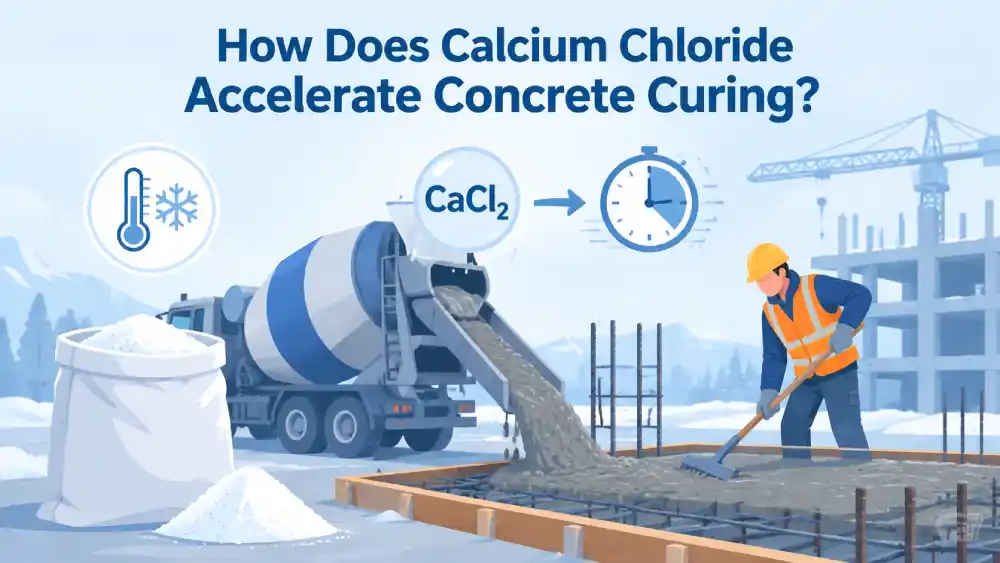
Calcium chloride functions as an accelerating admixture by increasing the rate of tricalcium silicate hydration, the primary compound responsible for early strength development in portland cement. When added to the mix, calcium chloride ions participate in the hydration reactions and effectively shorten both initial and final set times. This effect is most pronounced at lower temperatures, which explains the historical use of calcium chloride in cold-weather construction to allow finishing operations to proceed before frost damage occurs.
The acceleration mechanism is not selective. Calcium chloride does not simply speed up beneficial hydration reactions while leaving other processes untouched. The chloride ions remain in the pore solution of the hardened concrete, where they can participate in further chemical reactions over the service life of the structure. This persistence is the root of most calcium chloride concrete risks: the very ion that provides early schedule benefits remains mobile and reactive long after the concrete has hardened.
How Do Chloride Ions from Calcium Chloride Cause Steel Corrosion?
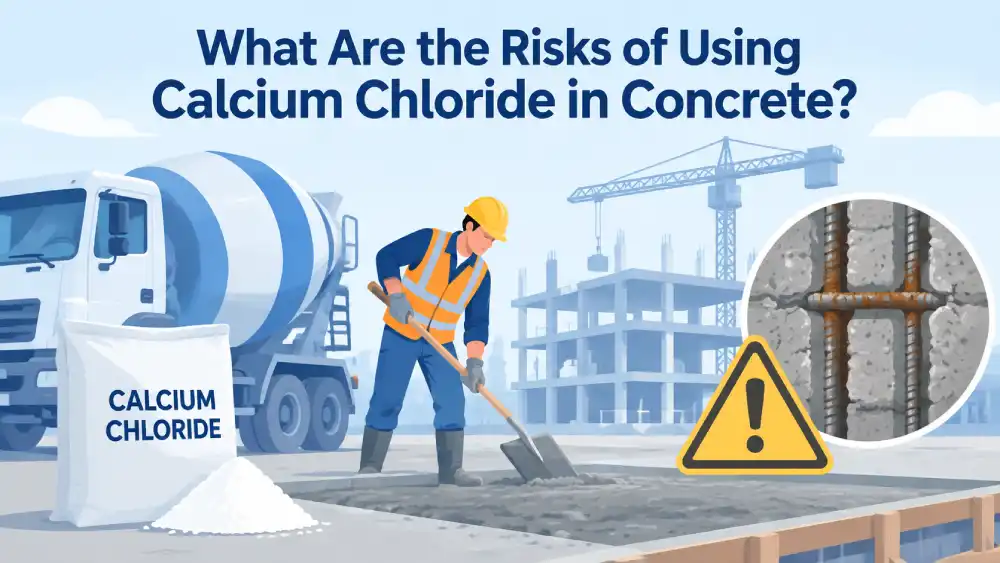
The most significant risk associated with calcium chloride in concrete is chloride-induced corrosion of reinforcing steel. Steel embedded in concrete is normally protected by a passive oxide film that forms in the highly alkaline pore solution of concrete, typically with a pH above 12.5. Chloride ions disrupt this passive film, and once the film is broken at a localized point, corrosion can initiate and propagate.
The American Concrete Institute is explicit on this point. ACI states that to minimize corrosion, calcium chloride should not be used in any steel-reinforced concrete or where aluminum conduit is embedded in the concrete . Uncoated prestressing strands are particularly vulnerable, as stress corrosion cracking under tension can lead to sudden, catastrophic failure with little visible warning.
The threshold chloride concentration required to initiate corrosion depends on the alkalinity of the pore solution and the quality of the concrete. Research cited by the National Institute of Standards and Technology indicates that at a pH of 13.2, more than 8,000 ppm of chloride ions may be required to induce corrosion, but at a pH of 11.6, as little as 71 ppm can be sufficient . This means that any condition that reduces concrete alkalinity—carbonation, leaching, or the use of pozzolans that consume calcium hydroxide—dramatically increases the risk posed by calcium chloride.
What Concrete Standards Say About Calcium Chloride Limits
Industry standards provide a clear framework for where calcium chloride may and may not be used, though the limits vary by jurisdiction and application. ACI Committee 212 recommends that calcium chloride not exceed 2% by mass of cementitious material, and preferably be limited to 1% . The admixture should be introduced in liquid form through the mix water to avoid direct contact with cement, which can cause flash set and undissolved particles that produce dark surface blemishes .
The restrictions are more consequential than the dosage limits. Calcium chloride is absolutely prohibited in several categories of concrete, according to international guidance summarized in technical literature:
- Prestressed concrete, where stress corrosion cracking of tensioned strands creates structural failure risk
- Concrete for parking structures, which are exposed to deicing salts and moisture
- Concrete containing aluminum components, due to galvanic corrosion between dissimilar metals
- Mass concrete, where heat of hydration concerns already require careful management
- Concrete made with potentially reactive aggregates, where calcium chloride can exacerbate alkali-silica reaction
- Concrete exposed to sulfates, except when sulfate-resisting cement is used
In Canada, calcium chloride is permitted up to 2% in non-reinforced concrete only . The European Union specifications effectively prevent the use of any additives containing chloride or calcium chloride in reinforced or prestressed concrete . These prohibitions reflect accumulated field experience and laboratory evidence linking calcium chloride to premature deterioration in conditions where the ion cannot be effectively immobilized.
Is Calcium Chloride Concrete Safe in Sulfate or Alkali-Reactive Environments?
Calcium chloride interacts adversely with two additional deterioration mechanisms that engineers must consider: sulfate attack and alkali-silica reaction. ACI notes that calcium chloride decreases resistance to sulfates except when Type V sulfate-resisting cement is used . In concrete exposed to sulfate-bearing soils or groundwater, the presence of calcium chloride can accelerate the formation of expansive reaction products, leading to cracking and loss of serviceability.
The relationship with alkali-silica reaction is similarly problematic. ACI states that calcium chloride increases the expansion due to alkali-silica reaction . When reactive silica minerals are present in the aggregate and sufficient alkali and moisture are available, the reaction produces a hygroscopic gel that swells and cracks the concrete. Calcium chloride does not cause ASR on its own, but it can intensify the expansion when other conditions for the reaction are met. For this reason, the use of calcium chloride with potentially reactive aggregates is among the prohibited applications identified in international guidance .
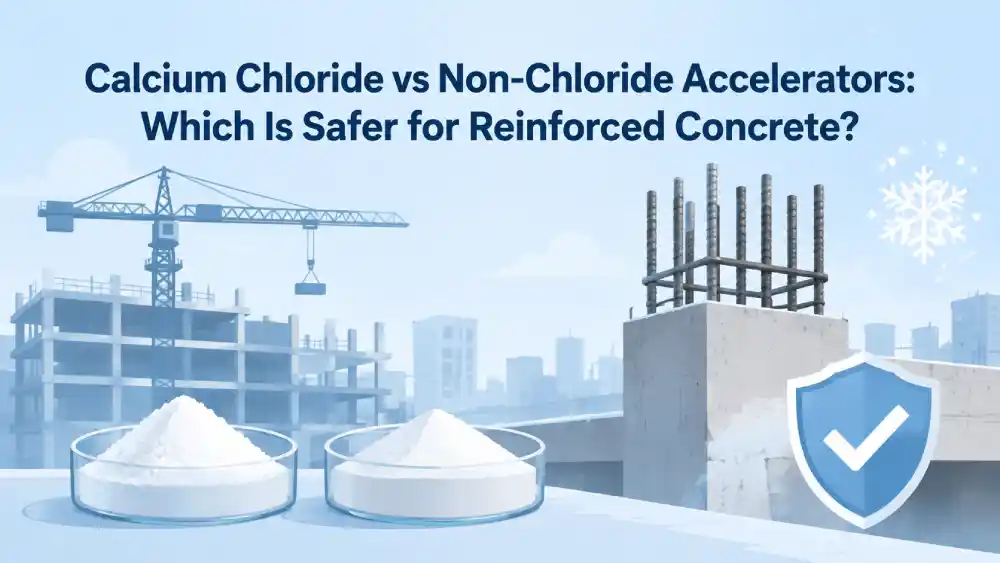
Calcium Chloride vs Non-Chloride Accelerators: What Is the Difference?
The availability of non-chloride accelerating admixtures has expanded significantly, and for reinforced concrete applications, these alternatives eliminate the corrosion risk entirely. Non-chloride accelerators typically rely on calcium formate, calcium nitrate, or triethanolamine-based chemistry, and while they may have different cost profiles and performance characteristics, they do not introduce chloride ions into the concrete.
| Dimension | Calcium Chloride | Non-Chloride Accelerators |
|---|---|---|
| Corrosion risk to steel | High; prohibited in reinforced concrete by ACI | Negligible chloride contribution |
| Typical dosage | 1–2% by mass of cement | Varies by product; often 1–3% |
| Performance in cold weather | Effective; historically the standard choice | Effective, with product-specific temperature limits |
| Sulfate resistance | Reduces resistance unless Type V cement used | No adverse effect on sulfate resistance |
| ASR contribution | Increases expansion when reactive aggregates present | Generally neutral |
| Cost | Low | Higher than calcium chloride |
| Availability | Universal | Widely available from admixture suppliers |
The decision between calcium chloride and a non-chloride alternative is not purely technical. For plain concrete in cold weather where no embedded metal is present, calcium chloride remains a cost-effective and code-compliant option. For any element containing reinforcing steel, prestressing strands, or aluminum conduits, the specification of a non-chloride accelerator is the only appropriate choice under ACI guidance .
When Should Engineers Specify Calcium Chloride?
The conditions under which calcium chloride may be specified are narrow but well-defined. The decision should be based on the presence or absence of embedded metals, the exposure environment, and the consequences of premature deterioration.
Choose calcium chloride when:
- The concrete is plain, unreinforced concrete with no embedded steel, aluminum, or dissimilar metals
- The application requires accelerated early strength in cold weather and no non-chloride alternative is available or cost-prohibitive
- The dosage does not exceed 1% by mass of cementitious material, introduced in dissolved form through the mix water
- The concrete will not be exposed to sulfates, reactive aggregates, or deicing salts in service
Choose a non-chloride accelerator when:
- Any reinforcing steel, prestressing strand, or galvanized metal is embedded in the concrete
- The structure is a parking garage, bridge deck, marine structure, or water-retaining element
- Alkali-silica reaction or sulfate attack is a concern based on aggregate testing or environmental exposure
- The concrete will receive metallic hardeners or dry-shake floor hardeners that may react with chlorides
What Are the Common Mistakes with Calcium Chloride in Concrete?
Misapplication of calcium chloride often stems from incomplete understanding of its limitations rather than disregard for standards. Several recurring errors appear in field practice and specification documents.
Assuming that low dosage eliminates corrosion risk. Even at dosages below 1%, calcium chloride introduces chloride ions that remain in the pore solution. The threshold for corrosion initiation depends on concrete quality, cover depth, and exposure conditions, but no dosage of calcium chloride can be considered safe for reinforced concrete in aggressive environments.
Adding calcium chloride in dry flake or granular form. ACI recommends introducing calcium chloride in solution form through the mix water. Undissolved flakes or granules may not fully disperse during mixing, producing localized concentrations that cause flash set, dark surface spots, and uneven acceleration .
Using calcium chloride with Type I cement in sulfate exposures. The reduction in sulfate resistance is not offset by the acceleration benefit. If acceleration is needed in a sulfate environment, Type V cement and a non-chloride accelerator should be evaluated together.
Overlooking galvanized metal forms or decking. The interaction between chlorides and galvanized steel is a recognized corrosion concern. Even if the primary reinforcement is non-metallic or absent, galvanized forms or decking can be affected.
How Does Calcium Chloride Affect Concrete Durability Beyond Corrosion?
The durability impacts of calcium chloride extend beyond the corrosion of embedded steel. Research on calcium chloride exposure in cementitious systems has identified the formation of calcium oxychloride, a reaction product between calcium chloride and calcium hydroxide that is expansive and can cause internal pressure and cracking even in the absence of freeze-thaw cycles . This reaction is temperature-dependent and occurs above the freezing point of water, meaning it is a concern in climates where calcium chloride is present in the pore solution and the concrete is exposed to moisture.
Studies of deicing chemicals have also shown that calcium chloride solutions caused the most severe damage among the chemicals tested under both wetting-drying and freezing-thawing conditions, with damage associated with salt crystallization, leaching of cement hydration products, and chemical alteration of the paste microstructure . While these studies address external calcium chloride exposure rather than integral admixture use, the chemical mechanisms are relevant to any concrete containing residual chloride ions.
The long-term consequence is that calcium chloride concrete may exhibit reduced service life in environments where moisture and temperature fluctuations occur, even if the initial strength gain and workability benefits are satisfactory.
Conclusion
Calcium chloride concrete risks are not hypothetical. The chloride ion that accelerates set remains in the hardened matrix and can initiate steel corrosion, exacerbate sulfate attack, and intensify alkali-silica expansion when conditions permit. The central principle is that calcium chloride belongs only in plain, unreinforced concrete at controlled dosages, and never in elements containing steel, prestressing strand, or aluminum. For reinforced structures, non-chloride accelerators provide comparable early strength development without the durability liability. When evaluating a proposed use of calcium chloride, prioritize the long-term exposure conditions and embedded metal profile over short-term schedule benefits. For specific project applications, consult the governing concrete code and a qualified materials engineer who can assess the interaction between admixture selection, aggregate reactivity, and service environment.
FAQs
What is the maximum dosage of calcium chloride allowed in concrete?
ACI Committee 212 recommends a maximum of 2% calcium chloride by mass of cementitious material, with a preferred limit of 1% . The admixture should be introduced in solution form through the mix water rather than as dry flakes or granules. Dosages above 2% are not recognized as safe even for plain concrete, and any dosage in reinforced concrete is discouraged by ACI guidance.
Is calcium chloride safe for use in prestressed concrete?
No. Calcium chloride should not be used in prestressed concrete under any circumstances. Uncoated prestressing strands under tension are highly vulnerable to stress corrosion cracking, and the consequences of strand failure are sudden and potentially catastrophic. ACI explicitly states that calcium chloride should not be used in any steel-reinforced concrete, and prestressed elements represent an even higher-risk category .
How does calcium chloride cause corrosion in reinforced concrete?
Chloride ions from calcium chloride penetrate the passive oxide film that normally protects steel in concrete’s alkaline environment. Once the film is disrupted at a localized point, corrosion initiates and produces rust that occupies a larger volume than the original steel, generating expansive pressure that cracks the concrete cover and accelerates deterioration. The chloride threshold for corrosion depends on pore solution pH: at pH 11.6, as little as 71 ppm of chloride can initiate corrosion, compared to over 8,000 ppm at pH 13.2 .
Can calcium chloride be used in concrete exposed to sulfates?
Generally no, unless Type V sulfate-resisting cement is used. ACI notes that calcium chloride decreases resistance to sulfates, and its use with potentially sulfate-reactive aggregates or in sulfate-bearing soils is among the prohibited applications identified in international guidance . The acceleration benefit does not justify the increased risk of expansive sulfate reactions.
Does calcium chloride increase the risk of alkali-silica reaction?
Yes. ACI states that calcium chloride increases the expansion due to alkali-silica reaction . When reactive silica is present in the aggregate and sufficient moisture and alkali are available, the reaction produces a swelling gel that cracks the concrete. Calcium chloride does not initiate ASR, but it can intensify the expansion, which is why its use with potentially reactive aggregates is prohibited in several jurisdictions .
What is the difference between calcium chloride and non-chloride accelerators?
Calcium chloride accelerates set through chloride-based chemistry that leaves residual chloride ions in the concrete, creating corrosion risk. Non-chloride accelerators use chemistries such as calcium formate or calcium nitrate that provide early strength gain without introducing chloride. For any reinforced concrete application, ACI recommends non-chloride accelerators . The trade-off is cost: calcium chloride is significantly less expensive per unit of acceleration.
Is calcium chloride permitted in parking structure concrete?
No. Concrete for parking structures is among the applications where calcium chloride use is absolutely prohibited according to international guidance . Parking structures are exposed to deicing salts, moisture, and freeze-thaw cycles, all of which compound the corrosion risk from integral chlorides. Even trace chloride contributions from admixtures are avoided in these structures.
How should calcium chloride be added to a concrete mix?
Calcium chloride should be dissolved in the mix water before introduction to the concrete. ACI recommends introducing liquid calcium chloride through the water line to avoid direct contact between concentrated calcium chloride and cement, which can cause flash set . Dry flakes or granules added directly to the mixer may not fully dissolve during mixing, producing localized high-chloride zones and surface defects.
What are the risks of calcium chloride in cold weather concreting?
The primary risk in cold weather is that calcium chloride provides acceleration without addressing the underlying vulnerability of fresh concrete to freezing. While calcium chloride shortens set time and allows finishing to proceed, it does not prevent frost damage if the concrete temperature drops below freezing before adequate strength develops. Additionally, the corrosion risk from calcium chloride is present regardless of the temperature at placing, so cold weather does not justify its use in reinforced concrete.
Are there alternatives to calcium chloride for accelerating concrete?
Yes. Non-chloride accelerators based on calcium formate, calcium nitrate, and other chemistries are widely available and provide early strength development without chloride-induced corrosion risk. These products are recommended by ACI for use in steel-reinforced concrete . Other options include the use of Type III high-early-strength cement, additional cementitious content, or insulated curing blankets, depending on the project requirements and ambient conditions.