Calcium chloride is one of the most versatile and widely used inorganic salts in engineering practice, yet its technical behavior often generates more questions than clear answers. Engineers across deicing, dust control, concrete, and industrial processing sectors frequently encounter the same recurring uncertainties: How does its exothermic dissolution affect handling procedures? Why does performance diverge so sharply from sodium chloride at low temperatures? What are the actual corrosion implications for storage and application equipment? These questions rarely appear in product datasheets, which tend to present specifications without addressing the operational realities that determine success or failure in the field.
Calcium chloride is safe when handled properly. The key risks are thermal burns from exothermic dissolution, dust irritation to eyes and respiratory passages, and mild skin irritation from prolonged contact with concentrated solutions. The material itself carries low systemic toxicity, and food-grade calcium chloride is generally recognized as safe by the U.S. Food and Drug Administration . The engineering challenges lie not in inherent hazard but in managing its hygroscopic nature, heat release, and chloride-induced corrosion in surrounding infrastructure.
This technical FAQ compiles thirty questions that engineers most commonly raise about calcium chloride, organized across six domains: fundamental properties, deicing performance, industrial applications, handling and storage, safety and corrosion, and specification compliance. Each answer draws on published standards, peer-reviewed research, and established industry practice to provide the operational clarity that datasheets omit.
Key Takeaways
- Calcium chloride dissolves exothermically, and a 30% solution prepared from 83–87% flake can raise water temperature by nearly 84°F, requiring controlled addition to avoid violent boiling .
- At pavement temperatures below 15°F, calcium chloride melts substantially more ice per pound than sodium chloride, with the performance gap widening as temperatures decline .
- ASTM D98 defines technical-grade calcium chloride specifications for dust control, stabilization, ice removal, and concrete acceleration, though the standard was superseded in 2022 and users should verify current editions .
- Solid calcium chloride is hygroscopic and deliquescent; properly stored product retains a 36-month shelf life, but moisture intrusion causes caking that may render the material unusable .
- Common stainless steels are unsuitable for liquid calcium chloride storage due to chloride stress corrosion cracking at temperatures as low as 100°F .

What Is Calcium Chloride and How Does Its Chemistry Govern Engineering Use?
Calcium chloride is a white, crystalline salt with the formula CaCl₂, available in anhydrous form (94–97% concentration) or as hydrates including dihydrate (approximately 75.5% CaCl₂) . Its engineering significance derives from three intrinsic properties: high water solubility, strong hygroscopicity, and a highly exothermic heat of solution. Commercial solutions typically range from 30–45% CaCl₂ by weight .
The hygroscopic behavior means solid calcium chloride absorbs moisture from ambient air until it dissolves into brine—a property termed deliquescence. This characteristic underlies its effectiveness as a dust palliative and deicing agent, but it also creates storage challenges: unprotected solid material will gradually convert to liquid if exposed to humid conditions. The exothermic dissolution is equally consequential. When 83–87% flake is dissolved to make a 30% solution, the temperature rise approaches 84°F, and adding solid to hot water has caused violent boiling in documented incidents .
Pure calcium chloride contains 36.1% calcium by weight, a figure engineers use to calculate calcium contribution in applications ranging from water hardness adjustment to concrete admixtures . The commercial product may include minor impurities, notably calcium hydroxide, which imparts a mildly alkaline pH of approximately 9 in undiluted 35% solution .
Why Does Calcium Chloride Generate Heat When Dissolved?
The heat release is a thermodynamic consequence of ion hydration. When CaCl₂ dissolves, calcium and chloride ions become surrounded by water molecules in a hydration shell, and the energy released from these ion-dipole interactions exceeds the energy required to break the ionic lattice. The practical implication is that dissolution must be controlled: add solid slowly to cool water with continuous agitation, rather than adding water to solid or allowing undissolved material to sit motionless, which produces a hard, slow-dissolving cake .
How Does Calcium Chloride Perform as a Deicing Agent?
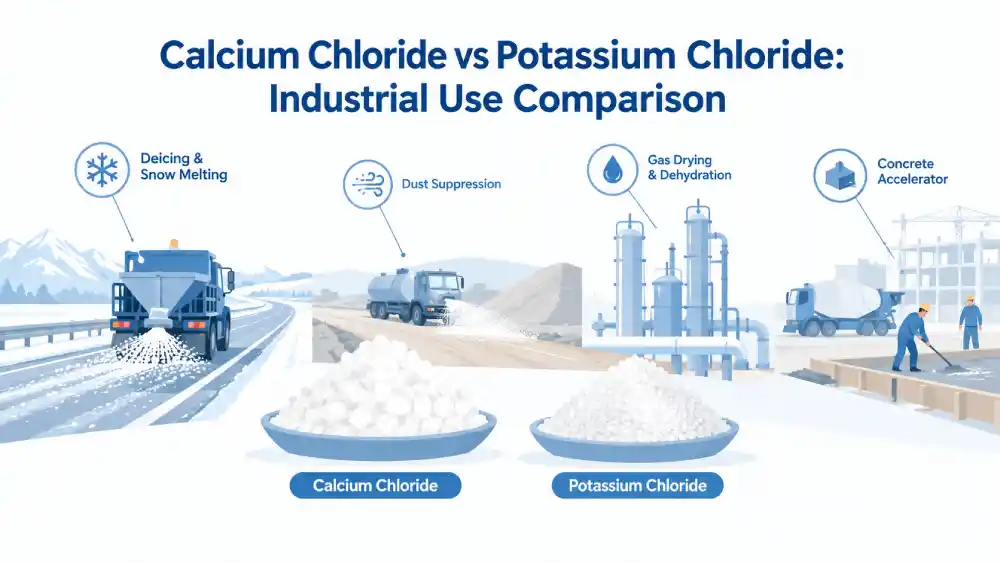
Calcium chloride’s deicing performance is distinguished by two factors: a lower eutectic temperature than sodium chloride and faster initial melting due to its moisture-attracting capacity. The practical consequence is superior performance at low pavement temperatures, where sodium chloride becomes largely ineffective. At temperatures below approximately 15°F, sodium chloride’s melting rate declines sharply, while calcium chloride continues to function .
Quantitative comparison from controlled studies illustrates the divergence. At 0°F, 77% flake calcium chloride melts approximately 3.5 pounds of ice per pound of chemical, while sodium chloride achieves no measurable melt in comparable test conditions . At 25°F, the two materials perform more similarly—10.4 pounds of ice per pound of calcium chloride versus 14.4 pounds per pound of sodium chloride—but the practical application rate depends on time constraints: calcium chloride’s faster initial action often permits lower total application rates when rapid results are required .
The moisture-attracting mechanism explains this kinetic advantage. Calcium chloride begins attracting moisture at relative humidities of 46–60% and temperatures of 15–32°F, initiating brine formation that accelerates ice melting . This same hygroscopicity, however, means that stored calcium chloride must be protected from atmospheric moisture, and application equipment should be designed for brine handling rather than dry-solid delivery in humid conditions.
Is Calcium Chloride More Corrosive Than Sodium Chloride to Concrete?
The evidence is mixed and depends on context. Calcium chloride does not cause the same freeze-thaw scaling damage associated with sodium chloride in some concrete applications, and it is used as a concrete accelerator at dosages not exceeding 2% by weight of cement . However, chloride-induced corrosion of embedded steel reinforcement remains a concern, and the American Concrete Institute provides guidance in ACI 201, ACI 222, and ACI 318 regarding exposure conditions and chloride limits . Engineers specifying calcium chloride for concrete acceleration should verify compliance with project-specific reinforcement protection requirements.
Where Is Calcium Chloride Used in Industrial and Process Applications?
Beyond deicing and dust control, calcium chloride serves as a process chemical across several industries. In oil and gas well drilling, calcium chloride brines are used as completion fluids and as the brine phase in invert emulsion muds, where density and shale inhibition are required . The ready-mix concrete industry uses calcium chloride as an accelerating admixture for cold-weather placement, typically at dosages below 2% of cement weight .
In food processing, food-grade calcium chloride aids rennet coagulation in cheese making, firms the skin of canned vegetables such as tomatoes and cucumbers, and serves as a basic component in certain beer styles . The U.S. Food and Drug Administration has designated calcium chloride as generally recognized as safe for these applications .
Additional industrial uses include as a solidifying agent in paint production, a coagulant in rubber manufacture, a chloridizing agent in metallurgy, and an additive in paper deinking and dye production . These applications exploit calcium chloride’s ionic strength, dehydrating capacity, or calcium ion availability rather than its thermal properties.
How Should Calcium Chloride Be Dissolved and Stored?
Dissolution Protocol
The exothermic nature of calcium chloride dissolution demands a specific procedure: start with cool water and add solid material slowly while maintaining continuous agitation . Adding solid to hot water has caused violent boiling, and allowing undissolved solids to remain motionless produces a hard cake that dissolves very slowly . For large-volume solution preparation, metering the solid into a well-circulated tank with temperature monitoring is standard practice.
Storage Requirements
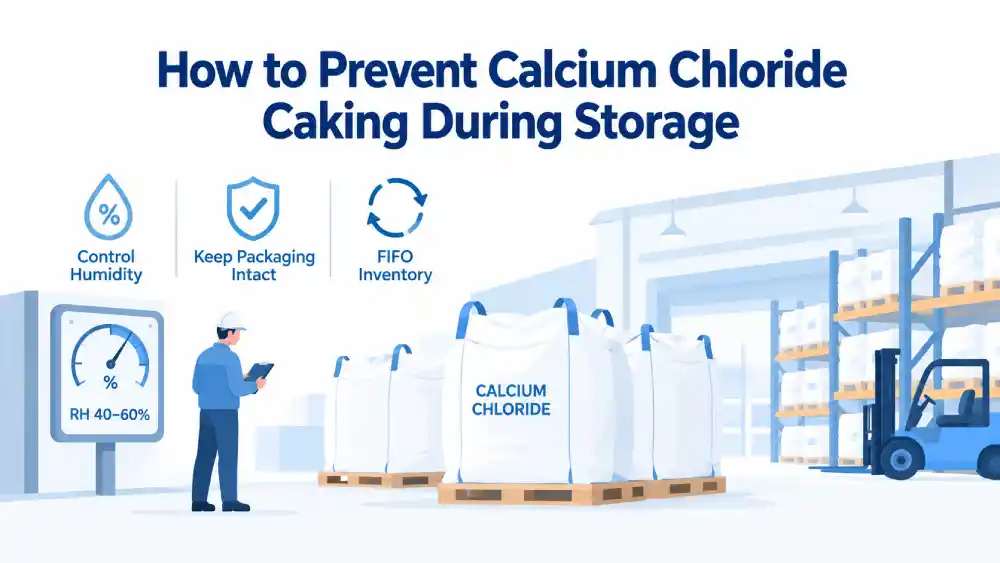
Solid calcium chloride must be protected from moisture to maintain usability. The expected shelf life under proper storage is 36 months from manufacture; the material does not degrade chemically, but moisture intrusion causes clumping and eventual conversion to brine . Pallets with intact plastic shrouds may be stored outdoors on well-drained surfaces; if the shroud is torn or removed, indoor storage or waterproof covering is required .
Material Selection for Storage and Handling
Common stainless steels are not recommended for liquid calcium chloride service due to chloride stress corrosion cracking, which can occur at temperatures as low as 100°F (38°C) . Carbon steel with an epoxy-based interior coating is the preferred material for large liquid storage tanks. Fiberglass and plastic are suitable for smaller ambient-temperature tanks but lose strength at elevated temperatures .
What Are the Safety and Corrosion Risks of Calcium Chloride?
Calcium chloride presents low systemic toxicity by ingestion or dermal absorption, but its physical and irritant properties require management. Inhalation of dust causes irritation of the nose and throat; ingestion irritates the mouth and stomach; eye contact with dust may cause transient corneal injury; and strong solutions can cause marked skin irritation or superficial burns . Personal protective equipment for handling solid material includes safety glasses or face shield, dust-type respirator, and rubber gloves .
The more significant engineering concern is corrosion of metallic infrastructure. Chloride ions promote pitting and stress corrosion cracking in susceptible alloys, and calcium chloride solutions are no exception. Beyond stainless steel limitations noted above, galvanized iron vessels have experienced hydrogen evolution and ignition upon long-term exposure to calcium chloride solution . For application equipment, tanks, pumps, and spray systems, material compatibility should be verified for the specific concentration and temperature of service.
Environmental considerations center on chloride loading to soils and water. While calcium chloride is not classified as a persistent bioaccumulative toxin, its chloride component contributes to freshwater salinization, and runoff management should account for total chloride loading when applied at scale.
What Specifications and Grades Apply to Calcium Chloride?
ASTM D98 historically defined the standard specification for technical-grade calcium chloride used in dust control, stabilization, ice and snow removal, concrete acceleration, and desiccant applications . The 2015 edition was superseded in May 2022, and engineers should verify whether a current replacement edition exists or whether project specifications reference the superseded standard by date.
Commercial calcium chloride is available in multiple grades distinguished by concentration and intended use. Anhydrous material typically contains 94–97% CaCl₂; flake products range from 77–87%; and dihydrate contains approximately 75.5% . Food-grade material must meet purity requirements for incidental food contact and is available in anhydrous pellet and liquid solution forms .
AWWA B550 addresses calcium chloride for water treatment applications, and NSF maintains a drinking water treatment chemical listing category for the material . For deicing applications, procurement specifications should reference the appropriate ASTM grade and verify certification of analysis for concentration, alkalinity, and insoluble matter.
Why Does Calcium Chloride Concentration Matter for Application Rate Calculations?
Because commercial products vary in CaCl₂ content from approximately 75% to 97%, application rates expressed as “pounds of product” without specifying concentration are meaningless for comparison or specification. A rate of 100 pounds per lane-mile of 77% flake delivers 77 pounds of active CaCl₂, whereas the same product weight of 94% anhydrous delivers 94 pounds. Engineers should normalize rates to active ingredient and verify the concentration basis when reviewing supplier recommendations or comparing trial results.
FAQs
What is the difference between anhydrous and dihydrate calcium chloride?
Anhydrous calcium chloride contains 94–97% CaCl₂ with minimal water of crystallization, while dihydrate contains two water molecules per CaCl₂ molecule, yielding approximately 75.5% concentration . Anhydrous material delivers more active ingredient per unit weight but generates more heat upon dissolution and requires more careful moisture protection. Dihydrate is less concentrated but may be preferred where lower exothermicity or different handling characteristics are advantageous. Both forms are commercially available, and selection depends on application economics and handling constraints.
How long does calcium chloride remain effective after application for dust control?
Calcium chloride’s dust control effectiveness derives from its hygroscopicity: it absorbs atmospheric moisture to maintain a damp, non-dusting surface. Duration depends on ambient humidity, temperature, traffic loading, and application rate. Under favorable conditions, a single application may remain effective for weeks to months, but in arid climates or high-traffic situations, reapplication is necessary. The material does not degrade; it is lost through dispersion, dilution by precipitation, or absorption into the road base. Monitoring surface condition and reapplication when dust re-emerges is standard practice.
Is calcium chloride safe for use around pets and wildlife?
Calcium chloride is not classified as a restricted-use pesticide or a persistent environmental toxin, but direct contact with concentrated solid or solution can cause irritation. Pets walking on treated surfaces may experience paw irritation, and ingestion of solid material can cause gastrointestinal upset. For deicing applications, allowing surfaces to drain before pet access and avoiding application to areas where animals forage reduces exposure. The material’s primary environmental concern is chloride loading to water bodies rather than direct toxicity to terrestrial organisms.
Why does my stored calcium chloride turn hard or liquid?
Solid calcium chloride is hygroscopic and deliquescent: it absorbs moisture from the air, first becoming sticky and caked, then eventually converting to liquid brine . Caking occurs when moisture is absorbed and the material partially dissolves then recrystallizes into a hard mass. Prevention requires moisture-barrier packaging, dry storage, and resealing after partial use. Lightly caked material may be broken up by knocking the package against a hard surface, but hard-caked product that cannot be broken apart should be discarded .
How does calcium chloride compare to magnesium chloride for deicing?
Both are chloride salts with lower eutectic temperatures than sodium chloride, and both are hygroscopic. Calcium chloride typically exhibits a more exothermic dissolution and somewhat faster initial melting, while magnesium chloride is often marketed as less corrosive to certain metals, though evidence is mixed and application-specific. Cost and local availability frequently determine selection. Neither should be assumed universally superior: pavement temperature, application timing, and equipment compatibility should guide the choice. Published comparisons generally show both outperforming sodium chloride at low temperatures .
What concentration of calcium chloride solution should I use for dust control?
Dust control solution concentrations typically range from 30–38% CaCl₂ by weight, depending on application method and desired persistence. Higher concentrations deliver more active ingredient per gallon but are more viscous and may require heated storage in cold weather. The appropriate rate also depends on road surface type, traffic volume, and climate. Suppliers provide application rate guidance, but engineers should verify rates on an active-ingredient basis and conduct field trials to optimize for local conditions.
Does calcium chloride accelerate concrete set, and at what dosage?
Yes. Calcium chloride is used as a set accelerator in ready-mix concrete, typically at dosages not exceeding 2% by weight of cement . It accelerates the hydration of tricalcium silicate, reducing initial and final set times and increasing early strength development. However, chloride ions promote corrosion of embedded steel reinforcement, and ACI 318 and related documents restrict or prohibit its use in reinforced concrete under certain exposure conditions. Prestressed concrete and concrete with galvanized or aluminum embedments should not contain calcium chloride .
What personal protective equipment is required when handling calcium chloride?
For solid material, safety glasses or a face shield, dust-type respirator, and rubber gloves are recommended . For solution handling, chemical-resistant gloves and eye protection are appropriate. Dust generation during solid handling is the primary inhalation and eye-irritation concern; in well-ventilated areas with careful material transfer, respiratory protection may be omitted. Personnel should be trained to flush eyes for at least 15 minutes if dust contact occurs and to seek medical attention if irritation persists.
Can calcium chloride be stored in stainless steel tanks?
Common stainless steels are not recommended for liquid calcium chloride storage due to chloride stress corrosion cracking, which can occur at temperatures as low as 100°F (38°C) . Carbon steel with epoxy coating is the preferred material for large tanks; fiberglass and plastic are suitable for smaller ambient-temperature applications. Stainless steel grades with higher molybdenum content (such as 316L) may offer improved resistance but should be evaluated for the specific concentration and temperature of service rather than assumed suitable.
What is the shelf life of calcium chloride, and how should it be stored?
Properly stored solid calcium chloride has an expected shelf life of 36 months from manufacture . The material does not chemically degrade, but moisture intrusion causes caking and eventual brine formation. Store in a dry area, keep packaging tightly sealed after opening, and protect pallets with intact moisture barriers if stored outdoors. Liquid solutions have effectively indefinite shelf life if protected from evaporation and contamination, though concentration should be verified periodically if dilution is a concern.
What is calcium chloride used for in oil and gas drilling?
Calcium chloride brines serve as completion fluids and as the brine phase in invert emulsion drilling muds . In completion operations, clear brine fluids based on calcium chloride provide density without suspended solids that could damage formations. In drilling muds, the brine phase contributes density and helps inhibit shale hydration. Concentrations are selected to achieve the required density and to remain free of crystallization at downhole temperatures. Material selection for surface handling equipment must account for chloride corrosion, as with any calcium chloride service.
How does calcium chloride affect vegetation when used for dust control or deicing?
Calcium chloride is a salt, and at application rates used for dust control or deicing, it can damage sensitive vegetation through osmotic stress and chloride toxicity. Roadside grasses and shrubs adjacent to treated surfaces may show browning or dieback, particularly with repeated applications or in poorly drained soils. Buffering with vegetation-free zones, reducing application rates near sensitive areas, and avoiding application immediately before rain that would carry runoff to planted areas are practical mitigations. Calcium chloride is not a selective herbicide and should not be applied for that purpose.
What is the pH of calcium chloride solutions, and does it matter?
Undiluted 35% calcium chloride solution has a pH of approximately 9, reflecting the presence of a slight calcium hydroxide impurity . This alkalinity is mild and not typically a handling concern, but it can affect pH-sensitive processes or solutions being prepared with calcium chloride. Accurate pH measurement in concentrated salt solutions is difficult and varies with probe type and dilution . For applications requiring pH control, the calcium chloride contribution should be included in the pH adjustment calculation.
Can calcium chloride be used to melt ice on new concrete?
Calcium chloride is less damaging to concrete than sodium chloride in many freeze-thaw scenarios because it does not cause the same osmotic scaling, but it still introduces chloride ions that can migrate to reinforcement. The American Concrete Institute provides guidance on deicer application to new concrete, and common practice is to avoid chloride deicers on concrete less than one year old and to use them sparingly thereafter. For reinforced concrete, the corrosion risk to embedded steel is the controlling concern, and alternative deicers may be warranted for critical structures.
What is the difference between technical grade and food grade calcium chloride?
Food-grade calcium chloride must meet purity requirements for incidental food contact, including limits on heavy metals and insoluble matter, and is produced under conditions that prevent contamination. Technical grade is suitable for deicing, dust control, and most industrial applications where food contact is not a concern. The chemical formula is the same, but the quality assurance and documentation differ. Using technical grade in food applications is not appropriate; using food grade in technical applications is acceptable but may not be economically justified.
How does calcium chloride work as a dust suppressant on unpaved roads?
Calcium chloride absorbs moisture from the air and retains it on the road surface, keeping fine particles damp and preventing them from becoming airborne under traffic or wind . The hygroscopic mechanism is most effective in humid climates; in arid conditions, the material’s ability to attract moisture is limited, and performance may be reduced or require higher application rates. The retained moisture also aids compaction of the road surface, which contributes to dust reduction. Application rates and solution concentrations are selected based on climate, traffic, and road material.
Is calcium chloride compatible with galvanized steel equipment?
Galvanized steel is not recommended for prolonged contact with calcium chloride solutions. Documented incidents include hydrogen evolution and ignition when calcium chloride solution contacted zinc-coated iron over extended periods . For application equipment, avoid galvanized components in tanks, pumps, and plumbing that contact the solution. Plastic, fiberglass, and epoxy-coated carbon steel are preferred alternatives. If galvanized components are unavoidable for intermittent contact, inspect for corrosion and hydrogen accumulation in enclosed spaces.
What are the environmental regulations for calcium chloride storage and spills?
Calcium chloride is not a CERCLA hazardous substance and is not regulated as a hazardous waste under RCRA. However, large spills should be contained to prevent chloride loading to surface waters and soils, and local regulations may impose reporting thresholds. Storage areas should have secondary containment for liquid solutions. Spilled solid material can be swept up and reused if uncontaminated, or dissolved and properly disposed. For large-scale storage, verify compliance with applicable state and local environmental regulations regarding chloride discharge.
Why does calcium chloride sometimes cause skin irritation when other salts do not?
Calcium chloride’s hygroscopicity draws moisture from the skin, and the exothermic dissolution that occurs when solid contacts moist skin can produce localized heating. Strong solutions can cause marked irritation or superficial burns with prolonged contact . The irritant effect is primarily physical and concentration-dependent, distinct from allergic sensitization. Workers handling concentrated solutions or solid material should wear gloves and wash exposed skin promptly. Barrier creams may provide additional protection for prolonged contact but are not a substitute for appropriate gloves.
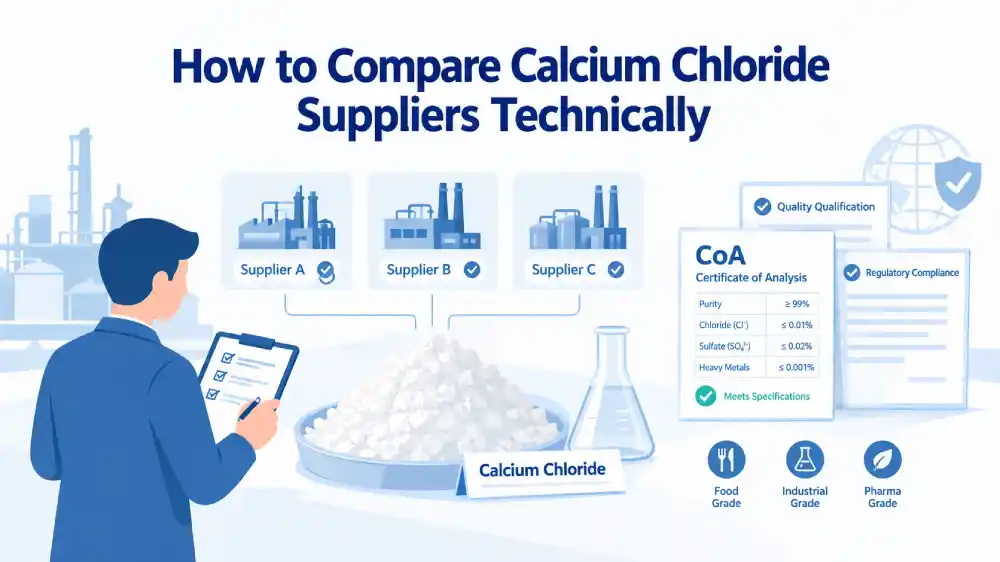
What documentation should accompany a calcium chloride shipment for engineering applications?
A certificate of analysis (CoA) reporting CaCl₂ concentration, alkalinity as Ca(OH)₂, and insoluble matter is standard for technical-grade material. For food-grade or water-treatment applications, additional documentation may include heavy metals analysis, NSF certification, or compliance with AWWA B550 or applicable FDA regulations. The ASTM D98 specification, while superseded, provides a historical reference for test methods and reporting conventions . Engineers should specify the required documentation in purchase orders and verify that it accompanies each shipment rather than relying on generic product datasheets.