Calcium chloride distributors face a packaging decision that directly affects landed cost, handling efficiency, and product integrity. The compound is highly hygroscopic, meaning it absorbs moisture from the air until it dissolves into a liquid brine . A packaging format that performs well in a dry warehouse may fail catastrophically during a humid sea voyage or in a customer’s poorly ventilated storage area. Traditional approaches often default to the lowest-cost bag without accounting for the total cost of moisture damage, palletization inefficiencies, and end-user handling constraints.
Calcium chloride is safe when handled properly. The key risks are moisture absorption, caking, and corrosion of metallic containers, all of which are manageable through appropriate packaging selection. The main causes of packaging failure are inadequate moisture barriers, insufficient bag strength for stacking loads, and incompatibility between the container type and the destination climate. For distributors, the packaging decision is not merely a line item in a quote—it determines whether the product arrives as free-flowing flakes or pellets, or as a solidified mass that generates claims and returns.
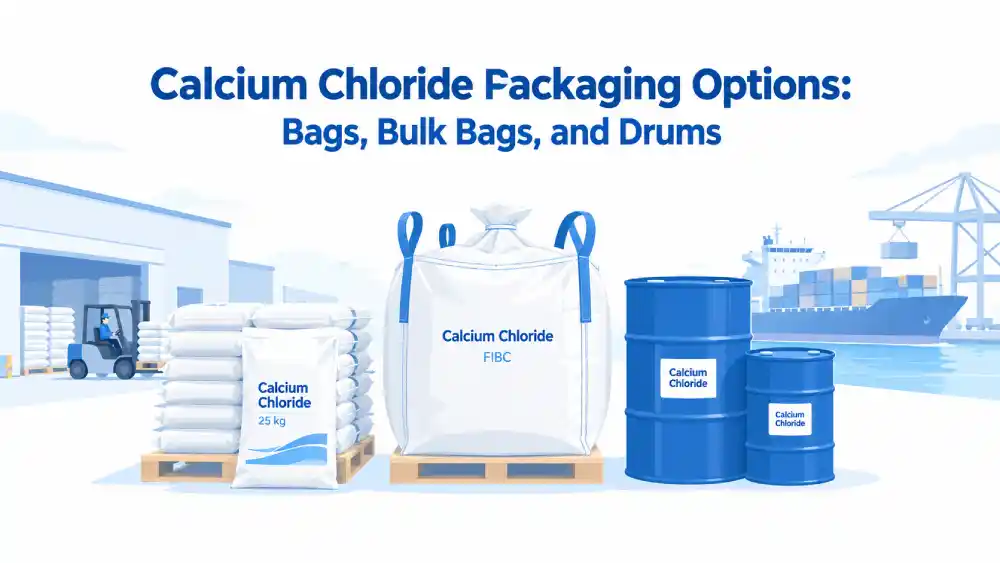
This guide examines the three primary packaging formats used in calcium chloride distribution: bags, bulk bags, and drums. It covers material specifications, application fit, export compliance considerations, and a decision framework for matching packaging to end-user requirements.
Key Takeaways
- 25 kg bags with PE inner liners are the standard export format, typically palletized at 40 bags per pallet for a one-tonne unit .
- Bulk bags (FIBCs) reduce handling labor by up to 90% for industrial users but require forklift infrastructure at the destination.
- Fiber drums and plastic pails protect small-volume, high-value grades from moisture and contamination, with typical capacities from 25 kg to 200 L .
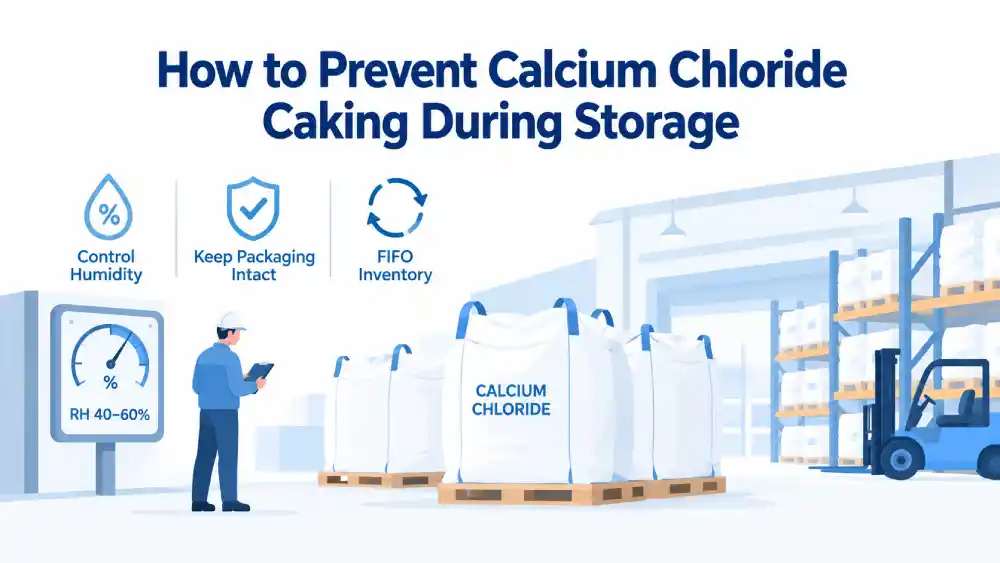
- Moisture barrier integrity is the single most important specification; without a PE liner, calcium chloride will absorb ambient humidity and begin to cake within days.
- Destination climate and handling infrastructure should drive packaging selection, not upfront container cost alone.
What Is Calcium Chloride Packaging and Why Does It Matter?
Calcium chloride packaging refers to the container systems used to protect, transport, and dispense the compound in its solid forms—flake, pellet, granular, or powder. Because the material is deliquescent, it will absorb moisture from ambient air until it dissolves. A 25 kg bag left open in a humid environment can become unusable within 24 to 48 hours. The packaging is therefore not passive containment; it is an active barrier that determines shelf life.
The stakes are particularly high for distributors. A shipment that arrives caked or liquified generates rejection costs, return freight, and reputational damage. Moisture-barrier integrity, mechanical strength, and compatibility with the destination’s handling equipment are the three pillars of packaging selection.
How Do Bags Protect Calcium Chloride During Storage and Transport?
Bags are the most common packaging format for calcium chloride sold through distribution channels. The standard construction is a PP (polypropylene) woven outer bag with a PE (polyethylene) inner liner. The outer woven layer provides tensile strength for stacking and handling, while the inner liner serves as the moisture barrier. Without the PE liner, the woven bag alone is permeable to water vapor.
Typical bag specifications for calcium chloride distribution include:
| Parameter | Standard Specification | Notes |
|---|---|---|
| Net weight | 25 kg | Most common; 40 kg and 50 kg also available |
| Outer material | PP woven fabric | 100–120 g/m² typical |
| Inner liner | PE film, 0.05–0.1 mm | Critical moisture barrier |
| Palletization | 40 bags/pallet, 1 tonne/pallet | Stretch-wrapped, often with corner boards |
| Container load | 25 tonnes per 20’FCL (palletized) | Up to 26–27 tonnes floor-loaded |
For export shipments, the pallet configuration matters as much as the bag itself. A standard 20-foot container holds 20 pallets of 40 bags each when palletized, totaling 25 tonnes . Floor-loading without pallets can increase payload to 26–27 tonnes but shifts labor to the destination warehouse and increases the risk of bag damage during unloading.
The PE liner thickness is a specification distributors should verify, not assume. A 0.05 mm liner provides adequate protection for short sea voyages and dry climates. For destinations with high ambient humidity or long transit times—such as Southeast Asia or the Middle East—a 0.1 mm liner or an additional aluminum foil layer is warranted. Chinese exporters specifically note that moisture protection must be addressed for sea freight, where humidity levels in containers can reach damaging levels .
Bag packaging suits distributors serving small to medium-volume end users: water treatment operators, de-icing contractors, and concrete admixture formulators who consume calcium chloride in 25 kg increments and have standard pallet-handling equipment.
When Should Distributors Specify Bulk Bags for Calcium Chloride?
Bulk bags—also called FIBCs (Flexible Intermediate Bulk Containers) or jumbo bags—are the format of choice when the end user consumes calcium chloride in tonne quantities and has the material-handling infrastructure to receive it. Standard FIBC capacities for calcium chloride are 500 kg and 1,000 kg.
The operational advantage is labor reduction. A 1,000 kg bulk bag replaces 40 individual 25 kg bags. For a concrete producer or a large-scale dust-control operation, the labor savings in receiving, moving, and dispensing are substantial. The trade-off is that the destination must have a forklift or overhead crane capable of lifting one tonne, and the discharge method must accommodate the bag’s bottom spout or top-fill configuration.
Bulk bag specifications require attention to two factors beyond those of small bags:
Safety factor and lifting loops. FIBCs are rated by a safety factor (SF), typically 5:1 or 6:1 for single-trip bags. A 1,000 kg bag with a 5:1 safety factor is designed to withstand a 5,000 kg load. For calcium chloride, which is dense (bulk density approximately 1.0–1.2 g/cm³), the bag’s SWL (safe working load) must be clearly marked and matched to the destination’s lifting equipment.
Discharge design. A duffel-top, flat-bottom bag requires the user to cut the bag open, which creates dust and makes partial use difficult. A spout-bottom bag with a iris or pinch closure allows controlled discharge and resealing, which is preferable for users who do not consume the full tonne in a single batch.
Bulk bags are not a universal upgrade from 25 kg bags. Distributors should specify FIBCs only when the customer’s facility can handle them safely and when the volume justifies the reduced handling labor.
Why Do Drums and Pails Matter for Specialty and Small-Batch Applications?
Drums and pails serve a narrower but important segment of the calcium chloride market: small-volume users, specialty grades, and applications where contamination avoidance is critical. A 200 L fiber drum or a 25 kg plastic pail allows a formulator to dispense precise quantities without opening a 25 kg bag that will then sit partially used and exposed to moisture.
Fiber drums with plastic liners are common for technical-grade calcium chloride in flake or granular form . The fiber construction provides structural strength, while the internal liner—typically PE or a coated paper/PE laminate—serves as the moisture barrier. Plastic pails offer a fully molded HDPE construction with a gasketed lid, providing a more robust moisture seal than a fiber drum but at a higher unit cost.
The application fit is specific:
- Water treatment pilot testing: A 25 kg pail allows incremental dosing without committing to a full bag.
- Food-grade or pharmaceutical-adjacent uses: Drums with traceable liners and lot documentation support quality audits.
- Laboratory and analytical applications: Small pails (5–10 kg) reduce waste and contamination risk.
- Export sample shipments: Drums are more resistant to handling damage than bags during LCL (less-than-container-load) consolidation.
For distributors, drums and pails are a margin opportunity rather than a volume driver. The per-kilogram packaging cost is significantly higher than bags or bulk bags, but the end users who require them are typically less price-sensitive and more focused on convenience and contamination control.
Is One Packaging Format Better Than Another for Export Compliance?
Export compliance for calcium chloride centers on two requirements: MSDS documentation and moisture-proof packaging suitable for sea transport. Calcium chloride is not classified as dangerous goods under UN transport regulations, but shipping lines require an MSDS to confirm non-hazardous status .
From a compliance standpoint, the packaging format itself does not change the regulatory classification. However, the labeling and marking requirements differ by format. Export bags must carry product name, CaCl₂ content, net weight, country of origin, and manufacturer identification in English . Missing or illegible markings can result in customs holds at the destination port. Bulk bags require the same information plus SWL markings and lifting instructions. Drums require durable labels that survive handling and, for some destinations, lot numbers traceable to the COA.
A practical comparison of the three formats across export-relevant dimensions:
| Dimension | 25 kg Bags | Bulk Bags (FIBC) | Drums / Pails |
|---|---|---|---|
| Moisture barrier | Good (with PE liner) | Good (with PE liner) | Excellent (molded or lined) |
| Handling labor | High | Low | Medium |
| Pallet utilization | Standard | One bag per pallet position | Multiple units per pallet |
| Container payload | 25–27 t | 20–24 t (weight-limited) | 18–22 t |
| Destination equipment needed | Pallet jack | Forklift / crane | Pallet jack |
| Best fit | General distribution | Industrial bulk users | Specialty / small-batch |
The payload difference is significant for distributors calculating freight economics. A 20-foot container can carry approximately 25 tonnes of palletized 25 kg bags, but bulk bags are typically limited to 20 bags of 1,000 kg each—also 20 tonnes—because the bags cannot be stacked as densely. Drums occupy more cubic space per tonne, reducing effective payload further. The lowest freight cost per tonne does not always correspond to the lowest packaging cost per tonne.
How Should Distributors Evaluate Packaging Suppliers and Specifications?
A checklist approach prevents costly specification gaps. Before placing an order, verify the following for each packaging format:
- Confirm PE liner thickness and resin grade. A 0.05 mm liner is not equivalent across suppliers; virgin resin liners outperform recycled-content liners for moisture barrier.
- Verify bag weight and weave density. A 25 kg bag that uses 90 g/m² fabric may handle the static load but fail during pallet compression in a stacked container.
- Request a pallet pattern drawing. The arrangement of bags on the pallet—interlocking or column-stacked—affects stability during transit.
- Confirm FIBC safety factor and lifting loop configuration against the destination’s forklift or crane setup.
- Check drum liner compatibility with the specific calcium chloride grade (food, technical, or industrial) to avoid contamination.
- Obtain a pre-shipment sample of the exact packaging format and test it under local humidity conditions if the destination climate differs significantly from the origin.
- Verify labeling compliance for the destination country’s import requirements, including language and content declarations.
For distributors building private-label programs, the packaging supplier’s ability to accommodate custom bag printing, variable fill weights, and liner customization becomes part of the evaluation. A supplier that can only offer standard 25 kg unprinted bags limits the distributor’s ability to serve branded accounts.
Conclusion
Calcium chloride packaging is a specification decision, not a commodity purchase. The right format depends on the destination’s climate, the end user’s handling equipment, and the acceptable trade-off between packaging cost per tonne and total landed cost. Bags remain the workhorse format for general distribution, offering a balance of protection, pallet efficiency, and compatibility with standard warehouse equipment. Bulk bags reduce labor for industrial accounts but demand infrastructure that many smaller users lack. Drums and pails serve the specialty segment where contamination control and dispensing convenience justify a higher unit cost.
Distributors evaluating packaging options should start by mapping their customer base: what volumes do they consume, what equipment do they have, and what failure modes have they experienced with current packaging? The answers will narrow the decision more effectively than comparing per-unit prices in isolation. For teams sourcing calcium chloride packaging at distribution scale, prioritizing suppliers who can document liner specifications, pallet patterns, and export labeling compliance is a more reliable path to consistent product quality than selecting on container price alone.
FAQs
What is the most common packaging for calcium chloride?
The most common format is a 25 kg PP woven bag with a PE inner liner, palletized at 40 bags per tonne. This configuration balances moisture protection, handling convenience, and freight efficiency for distributors serving general industrial and municipal accounts .
How long does calcium chloride last in storage?
Shelf life depends entirely on moisture exposure. In an intact PE-lined bag stored in a dry warehouse, calcium chloride remains free-flowing for 12 to 24 months. Once the liner is opened or damaged, the product can begin absorbing moisture within hours and may cake within days.
Is calcium chloride dangerous goods for shipping?
No. Calcium chloride is not classified as dangerous goods under UN transport regulations. Shipping lines require an MSDS to confirm non-hazardous status, but the material moves as general cargo in bags, bulk bags, or drums .
What is the difference between a bulk bag and a jumbo bag?
They refer to the same packaging type: a Flexible Intermediate Bulk Container (FIBC) with lifting loops, typically holding 500 kg to 1,000 kg. “Bulk bag” and “jumbo bag” are used interchangeably in the calcium chloride trade.
Can calcium chloride be shipped in fiber drums?
Yes. Fiber drums with internal liners are used for technical-grade and specialty calcium chloride, particularly for small-volume shipments or applications requiring contamination control. They offer better moisture protection than bags but at a higher cost per kilogram .
How many 25 kg bags fit in a 20-foot container?
A palletized load typically accommodates 20 pallets of 40 bags each, totaling 800 bags or 20 tonnes. Floor-loaded configurations can reach 25 to 27 tonnes, but this increases unloading labor at the destination and may require additional bag strength specifications.
What liner thickness is required for export shipments?
A 0.05 mm PE liner is adequate for short voyages and dry climates. For humid destinations or transit times exceeding 30 days, a 0.1 mm liner or an aluminum-foil laminated liner is recommended. Distributors should specify liner thickness explicitly in purchase orders.
Is bulk bag packaging cheaper than bags?
The packaging cost per tonne for bulk bags is often lower than for 25 kg bags, but total cost depends on freight payload and destination handling. Bulk bags typically reduce container payload by 3 to 5 tonnes compared to floor-loaded bags, which can offset the packaging savings.
What labeling is required on export bags?
Export bags must display the product name, CaCl₂ content percentage, net weight, country of origin, and manufacturer name in English. Some destinations also require lot numbers and production dates. Missing markings can result in customs holds .
Do drums or pails work for food-grade calcium chloride?
Yes, provided the drum or pail liner is food-grade certified and the container is dedicated to food-contact use. Food-grade calcium chloride requires packaging that prevents contamination from previous cargo or ambient contaminants, making new or dedicated food-grade liners essential.