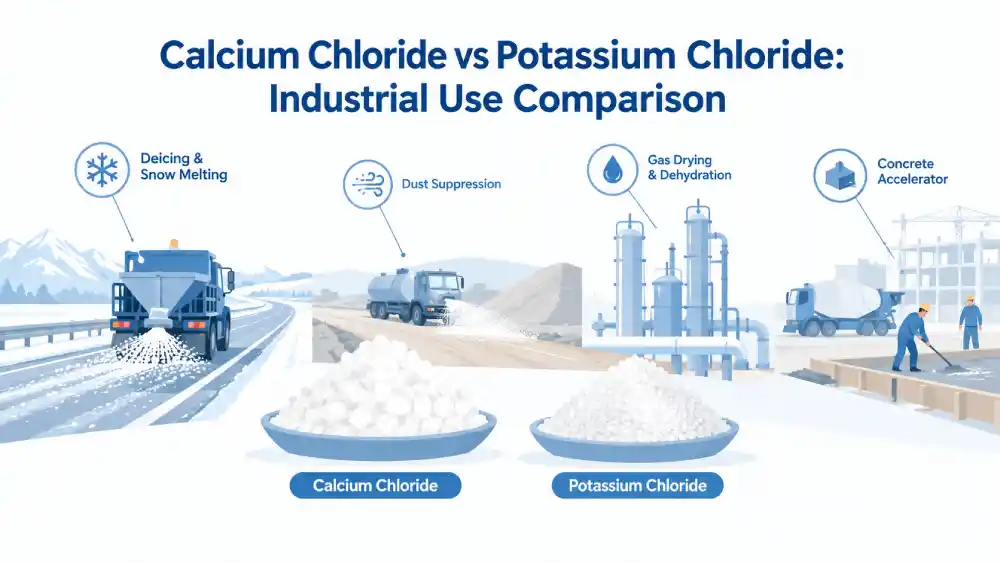
Construction teams working with tight schedules and unpredictable weather often face a familiar problem: concrete that sets too slowly, gravel roads that generate fugitive dust, or subgrade soils that refuse to compact properly. Traditional responses—waiting for favorable temperatures, watering roads repeatedly, or importing expensive fill material—address symptoms without solving the underlying issue. Calcium chloride, a versatile and well-established chemical compound, offers a practical answer to each of these challenges when applied with a clear understanding of its capabilities and limits.
Calcium chloride (CaCl₂) is an inorganic salt with a strong affinity for moisture and a well-documented ability to accelerate cement hydration. In construction, its primary roles include accelerating concrete set in cold weather, suppressing dust on unpaved surfaces, and stabilizing problematic soils. Understanding what calcium chloride does, where it works best, and when it should be avoided is essential for any construction professional specifying materials or managing site conditions. This guide examines the science, applications, and practical boundaries of calcium chloride in construction, providing a complete reference for engineers, contractors, and procurement teams.
Calcium chloride is safe when handled properly. The key risks are thermal burns from direct contact with dry flakes or granules and skin irritation from prolonged exposure. For concrete applications, the critical safety boundary is reinforcement: calcium chloride should not be used in steel-reinforced concrete due to corrosion risk .

What Makes Calcium Chloride Effective in Construction?
Calcium chloride works through two fundamental properties: hygroscopicity (the ability to absorb moisture from the air) and its catalytic effect on cement hydration. These properties explain nearly every construction application of the material, from dust suppression to cold-weather concreting.
The hygroscopic nature of calcium chloride allows it to draw moisture from ambient air and retain it in a dissolved state. When applied to unpaved roads or gravel surfaces, the resulting brine film binds fine particles together and keeps them from becoming airborne. This mechanism is most effective in humid conditions, where atmospheric moisture is available for absorption. In arid environments, the material may require supplemental water during application to achieve the same binding effect.
In concrete, calcium chloride acts as an accelerator by catalyzing the hydration of tricalcium silicate (C₃S) and dicalcium silicate (C₂S), the primary strength-giving compounds in portland cement. Research consensus indicates that calcium chloride promotes the formation of calcium silicate hydrate (C-S-H) gel with a more permeable structure at early ages, allowing faster ion diffusion and accelerated strength gain . This effect has been documented since the late 19th century, with calcium chloride remaining the most efficient and least expensive accelerator available for non-reinforced concrete .
Key Takeaways
- Calcium chloride accelerates concrete set primarily through catalysis of cement hydration, not by lowering the freezing point of water in the mix
- AASHTO M 144 covers technical-grade calcium chloride for road pretreatment, dust control, soil stabilization, and accelerating the set of concrete not reinforced with steel
- ACI 318 permits a maximum water-soluble chloride ion content of 1% by mass of cement, roughly corresponding to 2% calcium chloride dihydrate by mass of cement
- Calcium chloride is absolutely prohibited in prestressed concrete, parking structures, and concrete containing aluminum embedments
- Typical application rates for dust control range from 0.27 to 0.36 gallons per square yard for a 38% calcium chloride brine solution
How Does Calcium Chloride Accelerate Concrete Set?
Calcium chloride accelerates the setting and early strength gain of concrete through a mechanism that remains partially understood despite more than a century of use. The practical outcome, however, is consistent and well-documented: concrete containing calcium chloride reaches initial set faster, develops early-age strength more rapidly, and can be finished sooner than comparable mixtures without the admixture.
The primary application is cold-weather concreting. At temperatures around 50°F (10°C), the setting time of a typical concrete mixture can double compared to behavior at 73°F (23°C) . Calcium chloride compensates for this retardation, allowing finishing operations and form stripping to proceed on a schedule closer to what would be expected under moderate conditions. Importantly, calcium chloride is not an antifreeze in the sense of significantly lowering the freezing point of water in the mix; standard cold-weather protection procedures remain necessary even when the accelerator is used .
Dosage rules are well established. The American Concrete Institute recommends that calcium chloride not exceed 2% of the mass of cementitious material, with 1% preferred in most situations . ACI 318 permits up to 1% water-soluble chloride ion by mass of cement for reinforced concrete, which corresponds to approximately 2% calcium chloride dihydrate . For non-reinforced concrete, higher doses may be used, but the diminishing returns and potential for set-related problems make excessive dosage inadvisable.
The form of calcium chloride matters for batching. Commercial product is available as flakes (77–80% CaCl₂), granules (94% CaCl₂), or liquid solution (typically 30–42% concentration) . Liquid addition to the mix water is preferred to avoid direct contact between concentrated calcium chloride and cement, which can cause flash set. When dry flakes or granules are added directly to the mixer, they may not fully dissolve during the mixing period, potentially leaving dark spots on finished concrete surfaces .
What Are the Limits of Calcium Chloride in Reinforced Concrete?
The most important restriction on calcium chloride in construction is its incompatibility with steel reinforcement. Chloride ions initiate and accelerate the corrosion of embedded steel by disrupting the passive oxide layer that normally protects reinforcement in the alkaline environment of concrete. This is not a minor concern—it is a fundamental durability issue that has driven the development of non-chloride accelerators for reinforced concrete applications.
ACI 306R explicitly states that calcium chloride should not be used in any steel-reinforced concrete or where aluminum conduit is present . The restriction extends to several specific conditions where the risk is particularly severe. Calcium chloride is absolutely prohibited in the following applications: prestressed concrete (uncoated strands under tension are highly vulnerable to corrosion with serious consequences), parking structures, concrete containing aluminum embedments, concrete made with potentially reactive aggregates, mass concrete, hot weather concreting, and nuclear power plant construction .
Canadian standards allow up to 2% calcium chloride in non-reinforced concrete, reflecting a regulatory approach that accommodates the material where corrosion risk is absent . For reinforced concrete projects, non-chloride accelerators such as calcium formate or calcium nitrate are available and should be specified instead. The cost premium of these alternatives is justified by the long-term durability of the structure.
Choosing Between Accelerator Options for Reinforced Concrete
| Accelerator Type | Chloride Content | Reinforced Concrete Suitability | Typical Use Case |
|---|---|---|---|
| Calcium chloride | High | Not permitted | Non-reinforced flatwork, cold-weather repairs |
| Calcium formate | None | Suitable | Precast, reinforced structural elements |
| Calcium nitrate | None | Suitable | Parking structures, bridges, marine exposure |
| Triethanolamine | None | Suitable (limited data) | Specialty applications with low dosage |
How Is Calcium Chloride Used for Dust Control on Unpaved Roads?
Dust suppression is one of the highest-volume construction-related uses of calcium chloride, particularly for temporary haul roads, staging areas, and unpaved access routes on large projects. Fugitive dust from vehicle traffic creates safety hazards, respiratory concerns, and maintenance burdens; calcium chloride offers a cost-effective method for suppressing it without the need for continuous water spraying.
The mechanism is straightforward: calcium chloride absorbs moisture from the air and from the road subgrade, maintaining a persistent brine film on the surface. This film agglomerates fine particles and increases their effective weight, preventing them from becoming airborne under traffic loading. Field demonstrations have shown that a 38% calcium chloride brine applied at 0.27 to 0.36 gallons per square yard penetrates crushed limestone roads effectively, with performance comparable to magnesium chloride over a 2.5-month evaluation period .
Performance varies with soil composition and climate. Calcium chloride is most effective on granular surfaces with sufficient fines content to bind together. On poorly graded soils with excessive fine material, results may be marginal . In humid climates, the hygroscopic effect is largely self-sustaining; in arid conditions, periodic reapplication or supplemental watering may be required. A Swedish road administration assessment considered magnesium chloride inferior to calcium chloride for dust abatement purposes, though both materials share the disadvantage of causing corrosion on vehicles .
Application logistics favor liquid brine for large-area treatment. Mechanized spraying achieves more uniform coverage and higher output than manual methods . Flake and pellet forms are available for smaller-scale applications or where transportation of liquid is impractical.
Why Does Calcium Chloride Improve Soil Stabilization?
Calcium chloride contributes to soil stabilization through multiple mechanisms that alter the engineering properties of fine-grained soils. For construction projects encountering expansive clays or marginal subgrade materials, chemical stabilization with calcium chloride can reduce plasticity, control swelling, and increase bearing capacity without the expense of excavation and replacement.
Laboratory studies on expansive soils demonstrate measurable improvements. Treatment with 5% calcium chloride increased unconfined compressive strength by approximately 50% compared to virgin soil, while decreasing the liquid limit, plasticity index, and free swell index . The mechanism involves cation exchange—calcium ions replace sodium and other monovalent cations on clay particle surfaces, reducing the double-layer thickness and the water-holding capacity that drives swelling. The hygroscopic property of calcium chloride also helps maintain consistent moisture content in the treated layer, reducing seasonal volume change.
Optimal dosage varies with soil type. Research on black cotton soil, a highly plastic clay common in tropical regions, found that a combination of 18% metakaolin and 2% calcium chloride produced optimal strength improvements as measured by California Bearing Ratio and unconfined compressive strength . For simpler stabilization programs without supplementary pozzolans, calcium chloride alone at 2–5% by dry weight of soil is typical, though site-specific testing is essential to confirm the appropriate rate.
Stabilization with calcium chloride is not a universal solution. Soils with high sulfate content may experience deleterious reactions, and the chloride content of treated soil can raise concerns for adjacent concrete or steel elements. The treated layer should be separated from reinforced concrete foundations or utilities by adequate cover, or alternative stabilizers should be considered.
Calcium Chloride Construction Applications: Quick Comparison
| Application | Primary Mechanism | Typical Rate | Key Restriction |
|---|---|---|---|
| Concrete acceleration | Hydration catalysis | 1–2% by cement mass | Prohibited in reinforced concrete |
| Dust control | Hygroscopic moisture retention | 0.27–0.36 gal/sq yd (38% brine) | Less effective on poorly graded soils |
| Soil stabilization | Cation exchange, moisture regulation | 2–5% by dry soil weight | Sulfate-bearing soils require caution |
Where Is Calcium Chloride Used in Road Maintenance?
Beyond dust control, calcium chloride serves road maintenance programs in winter weather management and base stabilization. These applications leverage the same fundamental properties—moisture affinity and freezing point depression—but in different operational contexts than concrete admixture or unpaved road treatment.
As a deicing and anti-icing agent, calcium chloride is particularly effective at low temperatures where sodium chloride loses efficacy. Liquid calcium chloride can be applied before snowfall to prevent ice bonding, or during storms to melt existing ice. The material’s exothermic heat of solution provides an additional advantage: when dry calcium chloride contacts ice, it releases heat as it dissolves, accelerating the melting process. Market data indicate that deicing remains the largest single application segment for calcium chloride, with liquid forms holding the largest share due to ease of application and rapid action .
For gravel road maintenance, calcium chloride serves a dual purpose as a dust suppressant and a binder that helps maintain the compacted surface course. The hygroscopic film reduces the loss of fines that occurs when dry gravel roads are subjected to traffic, extending the interval between regrading operations. Road maintenance authorities represent a growing segment of calcium chloride demand, with projected growth of 6% annually through 2034, supported by infrastructure maintenance activities .
AASHTO M 144 explicitly covers technical-grade calcium chloride for “pretreatment of and deicing road surfaces, dust control, stabilizing, and conditioning road surfaces” . This standard specification provides a basis for procurement and quality verification for road maintenance applications, ensuring that material meets minimum purity and performance requirements.
Choose calcium chloride for road maintenance when:
- Winter temperatures regularly fall below 20°F (-7°C), where sodium chloride becomes ineffective
- Unpaved roads generate persistent fugitive dust that creates safety or environmental concerns
- A liquid application system is available for efficient large-area coverage
- Vehicle corrosion is managed through washing protocols or inhibited formulations
Avoid calcium chloride for road maintenance when:
- Application areas drain directly to sensitive freshwater ecosystems without buffer zones
- Adjacent infrastructure includes unprotected steel elements that cannot tolerate chloride exposure
- The road surface is poorly graded with excessive fines that resist penetration
What Forms of Calcium Chloride Are Available for Construction?
Calcium chloride is supplied in three primary physical forms for construction use, each with distinct handling characteristics and appropriate applications. Selecting the right form affects batching accuracy, dissolution speed, storage requirements, and application logistics.
Flakes contain 77–80% calcium chloride and are the most common solid form for construction applications. They dissolve relatively quickly and are suitable for dust control, soil stabilization, and concrete batching where granule form is not required. Flakes are hygroscopic and will absorb moisture from the air if stored improperly, leading to caking and loss of flowability. Storage in sealed containers or lined bulk bags is essential .
Granules contain approximately 94% calcium chloride and offer higher purity per unit weight than flakes. The granular form flows more freely than flakes and is preferred for precision batching in concrete admixture applications. Research-grade studies have used granular calcium chloride dihydrate with assay greater than 99% for controlled experimental work, though construction-grade material is typically 94–97% pure .
Liquid solution is supplied at concentrations of 30–42% and is the preferred form for large-scale dust control and deicing applications. Liquid eliminates the dissolution step, provides immediate availability of the active ingredient, and allows accurate metering into mix water or spray systems. ACI guidelines recommend adding calcium chloride in liquid form to the mix water rather than introducing dry material directly to the mixer, as this avoids flash set and ensures complete dispersion .
Powder forms exist for specialty applications requiring rapid dissolution or fine distribution, but are less common in general construction due to dust and handling concerns.
Is Calcium Chloride Safe for Construction Workers and the Environment?
Calcium chloride presents manageable hazards when standard industrial hygiene practices are followed. The material is not flammable and is not acutely toxic by inhalation in typical construction exposure scenarios. However, direct contact with dry calcium chloride can cause thermal burns as the material dissolves in moisture on skin, and prolonged contact may produce erythema and irritation .
Personal protective equipment for handling dry calcium chloride includes gloves, eye protection, and long sleeves to prevent skin contact. Dust masks may be appropriate when handling powdered or fine flake material in enclosed spaces. In case of eye contact, immediate flushing with water for at least 15 minutes is recommended, followed by medical evaluation if irritation persists. Ingestion of solid calcium chloride or concentrated solution causes nausea, vomiting, and thirst; the thermal effect of dissolution can burn mucous membranes .
Environmental considerations center on chloride loading in receiving waters. Runoff from treated roads or dust-controlled areas carries dissolved chloride that can affect aquatic ecosystems at sufficient concentrations. The U.S. Environmental Protection Agency’s salt-management resources address chloride loading concerns for municipal procurement decisions . Storage and handling practices should include containment for spills and prevention of direct discharge to drains or watercourses .
For soil stabilization applications, the chloride introduced into the treated layer can migrate over time. Separation from reinforced concrete elements and proper drainage design mitigate corrosion risk to adjacent infrastructure. Vegetation tolerance varies by species; calcium chloride is generally less phytotoxic than sodium chloride but can still damage sensitive plants if applied at excessive rates.
Best Practices for Safe Calcium Chloride Handling
- Store dry calcium chloride in sealed containers in a cool, dry location to prevent moisture absorption and caking.
- Wear gloves and eye protection whenever handling flakes, granules, or powder.
- Add calcium chloride to mix water rather than directly to dry cement to avoid flash set and ensure dispersion.
- Contain spills with inert absorbent material and dispose according to local regulations; do not wash to drains.
- Maintain separation between calcium chloride-treated soil and reinforced concrete or unprotected steel elements.
- Use liquid application systems with calibrated spray equipment for dust control to avoid over-application.
FAQs
What is calcium chloride used for in concrete?
Calcium chloride is used as an accelerating admixture to speed the setting time and early strength gain of concrete, particularly in cold weather. It is permitted only in non-reinforced concrete because chloride ions promote corrosion of steel reinforcement. Typical dosage ranges from 1% to 2% by mass of cement, with liquid addition to mix water preferred for uniform dispersion.
How much calcium chloride should be added to concrete?
ACI guidelines recommend a maximum of 2% calcium chloride by mass of cementitious material, with 1% preferred for most applications. For reinforced concrete, ACI 318 limits water-soluble chloride ion to 1% by mass of cement, roughly corresponding to 2% calcium chloride dihydrate. Higher doses increase early strength but also raise the risk of set-related defects and dimensional instability.
Is calcium chloride the same as road salt?
Calcium chloride and sodium chloride (common road salt) are different materials with different performance characteristics. Calcium chloride is more effective at lower temperatures, works exothermically to melt ice faster, and is more hygroscopic. Sodium chloride is less expensive and more widely available but loses effectiveness below approximately 20°F. Both materials share the potential to corrode vehicles and infrastructure.
Can calcium chloride be used in prestressed concrete?
No. Calcium chloride is absolutely prohibited in prestressed concrete. Uncoated prestressing strands under tension are highly vulnerable to chloride-induced corrosion, which can lead to catastrophic failure. Non-chloride accelerators should be specified for all prestressed and post-tensioned concrete applications.
How long does calcium chloride dust control last?
Dust control performance from a single calcium chloride application typically persists for several weeks to several months, depending on traffic volume, climate, and soil type. In humid conditions, the hygroscopic effect is largely self-sustaining. In arid climates or under heavy traffic, reapplication may be needed at 4–8 week intervals. Field evaluations have documented effective performance over 2.5-month periods on crushed limestone roads.
Does calcium chloride work in freezing temperatures?
Calcium chloride remains effective as a deicing agent at temperatures well below the range where sodium chloride fails. The practical limit for calcium chloride deicing is approximately -20°F (-29°C), though effectiveness diminishes as temperatures approach this extreme. The exothermic heat released when calcium chloride dissolves provides an initial melting boost that is particularly valuable in cold conditions.
What are the alternatives to calcium chloride for cold-weather concreting?
Non-chloride accelerators include calcium formate, calcium nitrate, and various proprietary amine-based formulations. These materials cost more than calcium chloride but are suitable for reinforced concrete and prestressed applications where chlorides are prohibited. Calcium formate is widely used in precast operations, while calcium nitrate is preferred for structures exposed to chlorides or sulfates.
Is calcium chloride corrosive to construction equipment?
Dry calcium chloride is less corrosive than its dissolved brine, but the material is hygroscopic and will form corrosive solutions upon contact with atmospheric moisture or water. Equipment used for handling or applying calcium chloride should be washed after use to prevent chloride-induced corrosion. Stainless steel and plastic components resist attack better than carbon steel or aluminum.
How is calcium chloride applied for soil stabilization?
Calcium chloride for soil stabilization is typically applied as a solution sprayed onto the soil during mixing, or as dry flakes/granules blended into the soil with a rotary mixer. Dosage ranges from 2% to 5% by dry weight of soil, depending on soil type and performance requirements. Laboratory testing is recommended to confirm the optimal rate before field application.
What certifications should calcium chloride suppliers provide?
For construction applications, calcium chloride should meet AASHTO M 144 for road maintenance and concrete acceleration uses. Suppliers should provide a certificate of analysis documenting CaCl₂ concentration and impurity levels. For projects with environmental or corrosion-sensitive requirements, request documentation of chloride content and any inhibitor additives present in the formulation.
Conclusion
Calcium chloride is a well-established construction material with three primary applications: accelerating concrete set in non-reinforced applications, suppressing dust on unpaved surfaces, and stabilizing problematic soils. Its effectiveness stems from two fundamental properties—hygroscopic moisture absorption and catalytic acceleration of cement hydration—that have been documented and refined over more than a century of field use. The material is most valuable when specified within its established boundaries: calcium chloride should never be used in steel-reinforced or prestressed concrete, and its environmental fate requires consideration in runoff-sensitive locations.
The key to successful use lies in matching the material to the application. For cold-weather concrete work, liquid calcium chloride added to mix water at 1–2% dosage provides reliable acceleration and earlier finishing. For dust control on haul roads and staging areas, a 38% brine applied at 0.27–0.36 gallons per square yard offers weeks to months of suppression. For soil stabilization, 2–5% calcium chloride reduces plasticity and swelling while increasing bearing capacity. When evaluating calcium chloride for a specific project, prioritize compliance with AASHTO M 144 and verify that reinforcement conditions permit chloride use before selecting dosage rates.