
Dust is more than a visibility issue. For industrial roads, mining areas, construction sites, logistics yards, and unpaved transportation networks, airborne particulate matter directly impacts operating costs, environmental compliance, equipment life, and worker safety.
Among available dust suppression technologies, calcium chloride dust control has become one of the most widely adopted approaches because of its long residual effect, relatively low application frequency, and ability to stabilize loose surfaces through moisture regulation.
Traditional watering methods often provide only short-term relief—sometimes lasting only several hours under hot or windy conditions. In contrast, calcium chloride can extend dust suppression performance for days or even weeks depending on climate, traffic load, and surface conditions.
This guide explains how calcium chloride dust control works, where it performs best, how to apply it correctly, and how to select an effective implementation strategy for industrial operations.
Quick Answer
Calcium chloride dust control is a road and surface dust suppression method that uses calcium chloride’s hygroscopic properties to attract and retain atmospheric moisture. Unlike water-only suppression, calcium chloride forms a moisture reservoir within the surface layer, reducing airborne dust, improving particle cohesion, and extending control duration while lowering water consumption and maintenance frequency.
Why Calcium Chloride Dust Control Works
Dust forms when fine particles become detached from a dry surface and are lifted by traffic, wind, or equipment movement.
Calcium chloride controls this process through multiple mechanisms.
1. Hygroscopic Moisture Absorption: Continuous Surface Moisture Retention
Calcium chloride naturally absorbs moisture from surrounding air.
When applied to roads or exposed surfaces:
- Moisture is pulled into the treated layer
- Surface particles remain slightly damp
- Dust generation thresholds increase
- Wind erosion decreases
Even when ambient humidity drops below visible condensation levels, calcium chloride continues retaining usable moisture.
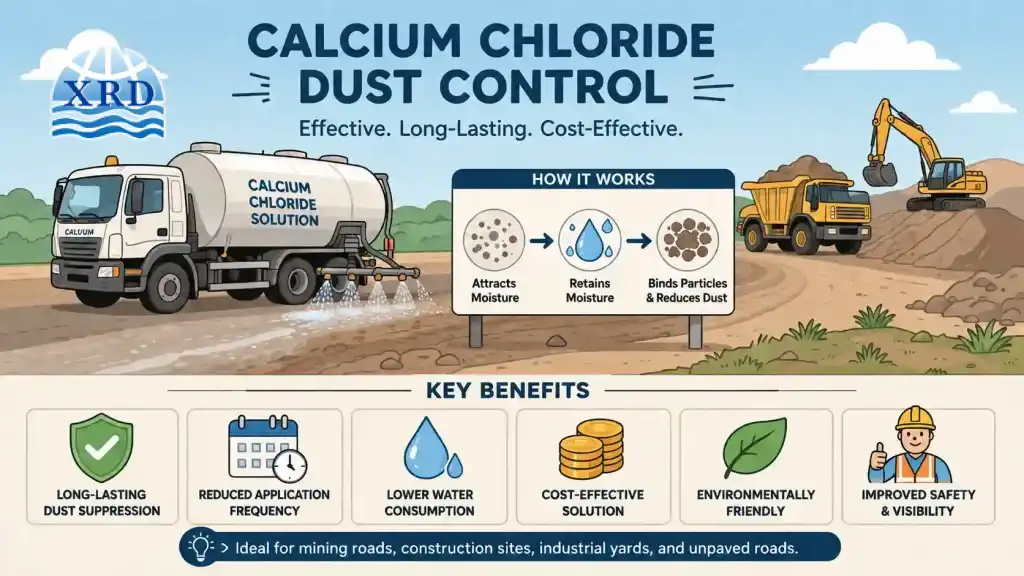
This allows treated surfaces to remain effective substantially longer than water spraying alone.
2. Particle Binding: Reducing Loose Surface Mobility
Once dissolved, calcium chloride creates a brine film between particles.
Effects include:
- Increased aggregate cohesion
- Reduced fine particle separation
- Improved road stability
- Lower airborne particulate emissions
This mechanism is particularly valuable for:
- Mining haul roads
- Quarry operations
- Construction access roads
- Bulk material storage yards
3. Surface Densification: Lower Maintenance Frequency
Repeated treatment cycles gradually densify road surfaces.
Benefits include:
- Reduced grading requirements
- Lower aggregate replacement
- Improved traffic performance
Calcium Chloride Dust Control Applications Across Industries
Different operating environments require different application strategies.
| Application Area | Typical Surface | Recommended Concentration | Typical Reapplication Interval | Primary Objective |
|---|---|---|---|---|
| Mining Roads | Gravel | 30–35% solution | 2–6 weeks | Reduce haul road dust |
| Construction Sites | Soil | 25–35% solution | 1–3 weeks | Improve air quality |
| Logistics Yards | Aggregate | 30% solution | 3–5 weeks | Surface stabilization |
| Agricultural Roads | Unpaved | 25–30% solution | 4–8 weeks | Reduce maintenance |
| Bulk Storage Areas | Fine materials | 30–38% solution | Site dependent | Material loss reduction |
1. Mining Operations: Managing Heavy Traffic Dust
Mining roads can experience traffic loads exceeding hundreds of vehicle passes per day.
Calcium chloride helps:
- Lower visibility interruptions
- Improve operator safety
- Reduce equipment cleaning frequency
2. Construction Sites: Temporary Yet Effective Dust Suppression
Construction environments require flexible deployment.
Typical application methods include:
- Spray trucks
- Tank systems
- Automated dust suppression lines
3. Industrial Logistics Areas
Distribution centers and outdoor storage areas benefit from:
- Cleaner loading operations
- Reduced airborne contamination
- Better environmental control
Calcium Chloride vs Water Dust Suppression: Which Performs Better?
Many operations still rely solely on watering.
However, performance differs significantly.
| Factor | Calcium Chloride Dust Control | Water Spraying |
| Dust Suppression Duration | 7–30 days | 2–12 hours |
| Water Consumption | Lower | High |
| Application Frequency | Weekly to monthly | Daily |
| Surface Stabilization | Yes | No |
| Operating Labor | Moderate | High |
| Weather Resistance | Better | Limited |
Choose calcium chloride when:
- Roads exceed 500 meters
- Water access is limited
- Vehicle traffic is continuous
- Dust regulations require sustained control
Choose water spraying when:
- Temporary suppression is sufficient
- Rainfall is frequent
- Surface disturbance is minimal
How to Apply Calcium Chloride for Dust Control
Correct application determines whether performance lasts days or weeks.
Dust Control Preparation Checklist
Before application:
- Inspect road moisture condition
- Grade loose materials
- Remove standing water
- Measure surface width
- Calculate target coverage
- Verify application equipment
- Confirm weather forecast
- Schedule traffic restrictions
Step 1: Prepare the Surface
Operation:
Level and loosen compacted areas.
Purpose:
Improve penetration.
Expected Result:
Uniform chemical distribution.
Step 2: Determine Application Rate
Typical guidelines:
- Light-duty roads: 0.9–1.4 L/m²
- Medium traffic: 1.4–2.0 L/m²
- Heavy industrial use: 2.0–3.0 L/m²
Purpose:
Prevent under-application.
Expected Result:
Stable moisture profile.
Step 3: Spray Evenly
Operation:
Use calibrated spray bars.
Purpose:
Avoid concentration differences.
Expected Result:
Consistent dust reduction.
Step 4: Compact the Surface
Operation:
Use rollers or controlled traffic.
Purpose:
Improve penetration.
Expected Result:
Longer treatment life.
Step 5: Monitor Performance
Operation:
Inspect every 3–7 days.
Purpose:
Optimize reapplication timing.
Expected Result:
Lower total operating cost.
→ Proper compaction after application often improves treatment longevity.
Common Mistakes in Calcium Chloride Dust Control and How to Avoid Them
Mistake 1: Applying to Excessively Dry Surfaces
Why it fails:
Penetration becomes uneven.
Correct method:
Pre-condition surfaces if moisture is extremely low.
Mistake 2: Overapplication
Why it fails:
Excess residual salt may reduce driving comfort.
Correct method:
Stay within designed dosage.
Mistake 3: Ignoring Traffic Patterns
Why it fails:
Heavy lanes deteriorate first.
Correct method:
Treat high-load zones separately.
Mistake 4: Treating During Rain Events
Why it fails:
Chemical dilution lowers efficiency.
Correct method:
Apply during stable weather windows.
Where XRD Chemical Fits Into Calcium Chloride Dust Control
While calcium chloride itself is a proven dust control technology, performance consistency depends heavily on raw material quality, concentration control, logistics capability, and application support.
XRD Chemical supports industrial dust suppression programs through:
- Stable calcium chloride supply
- Industrial-grade concentration options
- Bulk delivery capability
- Technical guidance for deployment
- Flexible packaging for regional distribution
Typical customer scenarios include:
- Mining contractors
- Construction material suppliers
- Road maintenance operators
- International chemical distributors
XRD Chemical and Long-Term Dust Management
For large-scale operations, selecting a supplier is not only about product cost.
Evaluation factors should include:
| Selection Factor | Why It Matters |
| Concentration Consistency | Predictable performance |
| Packaging Options | Easier deployment |
| Logistics Capability | Reduced delays |
| Technical Support | Better application outcomes |
| Documentation | Procurement compliance |
The most effective calcium chloride dust control programs combine proper chemistry, correct application, and reliable supply continuity.
Best Practices for Improving Calcium Chloride Dust Control Results
- Apply before severe dust appears to maintain surface integrity.
- Match dosage to traffic intensity rather than applying uniformly.
- Monitor humidity trends for optimal scheduling.
- Combine with grading programs to improve treatment life.
- Track reapplication intervals using operational records.
- Evaluate total cost per controlled day instead of cost per application.
Conclusion
Calcium chloride dust control remains one of the most effective solutions for controlling dust on unpaved roads and industrial surfaces because it combines moisture retention, particle binding, and operational efficiency.
Compared with water-only approaches, calcium chloride can extend suppression duration, reduce maintenance frequency, and improve environmental performance across multiple industries.
If your organization is evaluating a long-term dust management strategy, consider suppliers that provide not only material availability but also application guidance and operational consistency. Explore how XRD Chemical supports industrial dust control programs with scalable supply and technical support.
FAQ
What is calcium chloride dust control?
Calcium chloride dust control is a proven method of suppressing airborne dust on unpaved roads, construction sites, mining haul roads, and industrial yards. It works by attracting moisture from the surrounding air and retaining it within the surface layer, helping bind fine particles together and reducing dust generation for a much longer period than water alone.
How long does calcium chloride dust suppression last?
The performance of calcium chloride dust control typically lasts between 7 and 30 days, depending on traffic volume, road material, weather conditions, application rate, and humidity. Well-prepared surfaces with proper compaction generally retain moisture longer, reducing the need for frequent reapplication and lowering overall maintenance costs.
Is calcium chloride better than water for dust control?
For long-term dust suppression, calcium chloride generally outperforms water because it continuously attracts and retains atmospheric moisture after application. While water often evaporates within hours, calcium chloride helps maintain surface moisture for days or weeks, reducing application frequency, labor requirements, and total water consumption.
When should calcium chloride be applied?
Calcium chloride should ideally be applied before dust becomes severe and during periods of stable weather without heavy rainfall. Preparing the road surface through grading and compaction before treatment improves penetration and allows the material to deliver more consistent dust suppression over an extended service period.
Is calcium chloride safe for industrial dust control?
Yes. When applied according to recommended engineering practices and dosage guidelines, calcium chloride is widely used for industrial dust control on roads, mines, quarries, and construction sites. Proper application minimizes environmental impact while improving visibility, reducing airborne particles, and enhancing workplace safety.
Can calcium chloride reduce road maintenance costs?
Yes. By binding fine particles and stabilizing the road surface, calcium chloride helps reduce erosion, aggregate loss, washboarding, and grading frequency. Many operators experience lower maintenance expenses, reduced equipment wear, and improved road performance compared with relying solely on routine watering.
What concentration of calcium chloride is used for dust control?
Typical calcium chloride solutions used for dust control range from 25% to 38%, depending on road conditions, climate, traffic intensity, and application equipment. Selecting the appropriate concentration helps maximize moisture retention while ensuring efficient chemical use and consistent dust suppression performance.
Calcium chloride vs magnesium chloride: which is better?
Both products are effective dust suppressants, but calcium chloride generally performs better in lower-humidity environments because of its stronger hygroscopic properties. Magnesium chloride may be suitable in certain climates, so the best choice depends on local weather, road conditions, maintenance objectives, and project budget.
Can calcium chloride be used on construction sites?
Yes. Calcium chloride is commonly applied to temporary access roads, equipment staging areas, soil stockpiles, and heavy-traffic construction zones. It improves air quality, reduces dust emissions, enhances visibility for operators, and helps projects comply with environmental and occupational dust control requirements.
Who should use calcium chloride dust suppression?
Calcium chloride dust suppression is suitable for mining companies, road maintenance contractors, construction firms, agricultural operations, ports, logistics centers, and industrial facilities. Organizations seeking longer-lasting dust control, reduced water usage, and lower maintenance costs often choose this solution as part of their surface management strategy.