Modern road maintenance and civil engineering face a persistent challenge: fugitive dust emissions from unpaved surfaces. Traditional watering methods are no longer enough to maintain structural integrity and air quality. This article explains how precisely calculating the calcium chloride application rate addresses surface degradation through hygroscopic moisture absorption.
Relying on estimation or visual guesswork for chemical dust suppressants often leads to material waste or structural failure. Engineers require a methodical approach to determine exact volumetric needs based on soil mechanics, traffic patterns, and chemical concentrations.
Calcium chloride is highly effective for dust suppression if the application rate matches the specific soil composition and traffic volume. The main causes of failure are under-application leading to rapid evaporation and dust release, or over-application causing surface slickness and chemical runoff into nearby water systems.
Essential Data and Tools Before Calculation
Before executing any mathematical formulas for dust control, engineers must establish a baseline of site-specific variables. Missing or inaccurate field data will skew the final volume requirements. Gather the following prerequisites:
- Soil sieve analysis report: Specifically identifying the percentage of fines passing a No. 200 sieve (silt and clay).
- Average Daily Traffic (ADT): Measured in vehicle passes per day, including weight classifications (e.g., heavy mining trucks vs. passenger vehicles).
- Chemical specification sheet: Documenting the exact concentration of the CaCl₂ product (typically 35% or 38% for liquids, 77% to 94% for dry flakes).
- Surface area measurements: Total square yards or square meters of the unpaved area requiring treatment.
- Compaction equipment specifications: To ensure the surface can be properly prepared before application.
Calculation Workflow for Dust Suppression
Determining the precise calcium chloride application rate requires a systematic breakdown of environmental and chemical variables.
Step 1: Assessing Soil Fines and Plasticity Index
Analyze the unpaved surface's aggregate matrix. Calcium chloride relies on fine particles to bind the larger aggregate. An optimal unpaved road surface should contain between 10% and 20% fines. If the soil lacks sufficient fines, the chemical will leach through the aggregate without binding. Conversely, clay-heavy soils (over 25% fines) become dangerously slippery when treated with hygroscopic chlorides. The Federal Highway Administration (FHWA) requires that "unpaved roads must possess adequate plasticity and a minimum of 8% fines for chloride treatments to maintain structural integrity."
Step 2: Determining the Base Volume for Initial Treatment
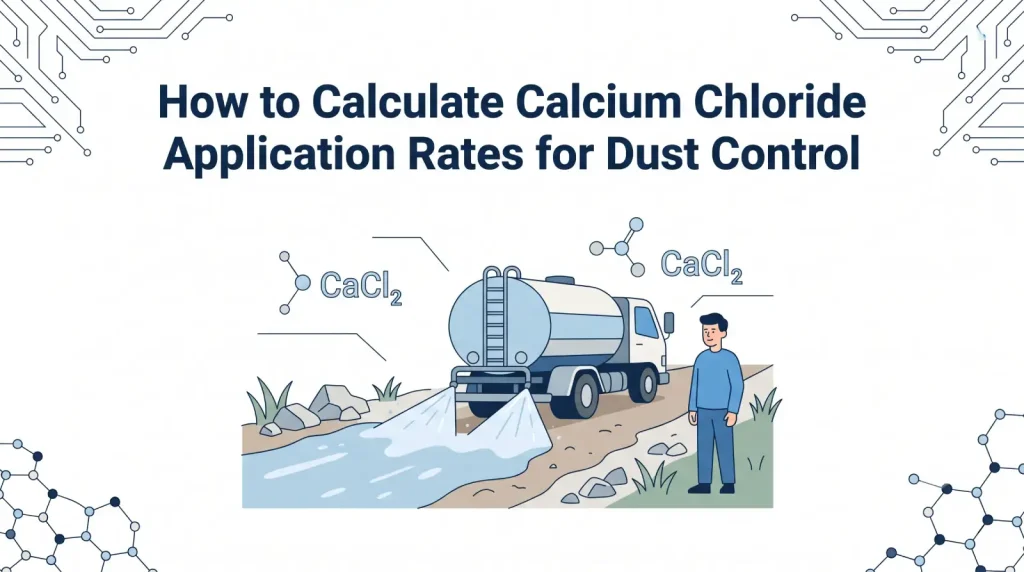
Establish the baseline liquid volume required for the first treatment of the season. For standard applications, the industry benchmark relies on square yardage. The table below outlines typical market reference values for base application rates using a standard 38% liquid solution.
| Surface Condition | Traffic Level (ADT) | Base Application Rate (Gallons per Square Yard) |
| Well-graded aggregate (10-15% fines) | Low (< 100) | 0.35 - 0.40 gal/yd² |
| Dry, dusty aggregate | Medium (100 - 250) | 0.45 - 0.50 gal/yd² |
| Heavy industrial / Mining haul roads | High (> 250) | 0.50 - 0.60 gal/yd² |
| Dense clay base | Variable | 0.30 - 0.35 gal/yd² (to prevent slickness) |
Step 3: Adjusting for Solution Concentration Levels
Adjust the base volume based on the actual chemical concentration delivered to the site. If the base rate assumes a 38% CaCl₂ solution, but a 35% solution is procured, the volume must increase to achieve the same active chemical deposition. Use the formula: (Target Concentration / Actual Concentration) x Base Rate. For example, replacing a 38% solution with a 35% solution at a 0.50 gal/yd² base rate requires an adjusted rate of approximately 0.54 gal/yd².
Step 4: Calculating Total Material Requirements
Multiply the final adjusted rate by the total surface area. For a road that is 24 feet wide (8 yards) and 1 mile long (1,760 yards), the total area is 14,080 square yards. At an application rate of 0.50 gal/yd², the project requires exactly 7,040 gallons of liquid calcium chloride. Always factor in a 5% contingency for overlapping spray patterns during distributor truck application.
Troubleshooting Common Dust Suppression Failures
Even with accurate calculations, environmental variables can impact the performance of chloride-based treatments.
-
Symptom: The road surface becomes excessively dusty within two weeks of application.
Solution: The calcium chloride application rate was likely calculated for a maintenance dose rather than an initial treatment. Re-apply a 0.25 gal/yd² booster dose and ensure the road is pre-wetted to break surface tension before spraying. -
Symptom: Vehicles experience severe traction loss and mud buildup during light rain.
Solution: This indicates over-application on soils with high clay content. The application rate must be reduced by at least 30% for future treatments, and dry aggregate should be graded into the current surface to absorb excess moisture. -
Symptom: The chemical forms runoff channels instead of penetrating the road base.
Solution: The surface was over-compacted or lacked pre-wetting. Scarify the top 1 to 2 inches of the road surface, apply the calculated chemical volume, and re-compact.
Liquid vs Flake Calcium Chloride: Application Variations
When engineers evaluate calcium chloride options, the physical state of the chemical dramatically alters the calculation metrics. Liquid solutions (35% to 38%) provide immediate dust suppression and uniform penetration. The application rate is measured in gallons or liters per square unit.
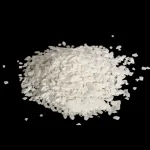
Flake or pellet forms (77% to 94% active CaCl₂) require ambient moisture to dissolve and activate. The application rate for dry flakes is typically calculated at 1.5 to 2.0 pounds per square yard for initial treatments. While flakes reduce shipping weights compared to liquids, they demand higher ambient humidity to function efficiently. For arid environments with less than 30% relative humidity, liquid applications are objectively superior because they introduce their own moisture matrix into the dry soil.
Conclusion
Determining the exact calcium chloride application rate is the fundamental pillar of a successful and enduring dust control program. By accurately assessing soil composition, adjusting for chemical concentration, and factoring in traffic volume, engineers can prevent both material waste and surface degradation. Apply these calculation steps to your next unpaved road project and measure the reduction in airborne particulates against standard environmental baseline metrics.
FAQs
What is the standard calcium chloride application rate for a new road?
For an initial seasonal treatment on a standard unpaved road, the typical application rate is 0.50 gallons of 38% liquid solution per square yard. Subsequent maintenance applications later in the season usually require half that amount, roughly 0.25 gallons per square yard.
How does soil type affect dust control chemical calculations?
Soil type dictates the porosity and binding capacity of the surface. Soils with adequate fines (10-20%) hold the hygroscopic chemical in the top layer. Sandy soils without fines allow the chemical to leach away, requiring a higher initial application rate or a different stabilization method entirely.
How long does a standard calcium chloride treatment last?
When applied at the correct rate, an initial treatment typically controls dust for 60 to 90 days. The longevity depends heavily on traffic volume, rainfall, and the implementation of a secondary maintenance dose midway through the dry season.
Is calcium chloride better than magnesium chloride for dust suppression?
Calcium chloride generally absorbs moisture at a lower relative humidity threshold than magnesium chloride. This makes it slightly more effective in highly arid environments. However, both require precise application rates calculated against specific soil plasticity indexes to function optimally.
When should dry flake calcium chloride be used instead of liquid?
Dry flakes are best used in remote locations where transporting heavy liquid solutions is cost-prohibitive. They are also ideal for small-scale applications, such as narrow driveways or paths, where operating a large liquid distributor truck is physically impossible.
Who should calculate the application rates for heavy haul mining roads?
Geotechnical engineers or specialized dust control contractors should calculate rates for heavy industrial sites. Mining roads face extreme shear forces from 300-ton haul trucks, requiring deeper chemical penetration and often much higher total volume rates than standard municipal roads.
Where is the most critical zone to apply dust suppressants?
The most critical application zones are curves, intersections, and braking zones. These areas experience the highest horizontal shear forces from vehicle tires, which rapidly degrade the aggregate matrix and generate the highest volumes of fugitive dust.
Is it safe to apply dust control chemicals near agricultural areas?
Yes, calcium chloride is generally safe near agriculture when applied strictly according to calculated rates. Precise calculation prevents runoff. However, a buffer zone of at least 10 to 15 feet should be maintained from open waterways to prevent localized salinity spikes.
What are the risks of under-applying calcium chloride?
Under-applying the chemical fails to create a continuous moisture barrier in the road surface. This allows traffic to easily break the weak bonds, leading to rapid dust generation, loss of road base material, and the economic waste of the chemical that was applied.
How effective is pre-wetting the road before applying suppressants?
Pre-wetting is highly effective and often mandatory. Applying a light layer of water breaks the surface tension of dry dust, allowing the calcium chloride solution to penetrate deeper into the aggregate base rather than pooling and running off the immediate surface.