
Industrial procurement processes require rigorous evaluation of raw materials to maximize operational efficiency and manage bottom-line expenses. When it comes to chemical compounds used in dust control, de-icing, wastewater treatment, and concrete acceleration, evaluating liquid vs dry calcium chloride is a fundamental decision for facility managers. Choosing between these physical states involves balancing immediate utility against long-term logistical constraints, directly affecting both handling overhead and processing speed.
Dry calcium chloride, typically sold as flakes, pellets, or granules with purities ranging from 77% to 94%, offers stable storage and high concentration per volume. Conversely, liquid calcium chloride solutions, usually available at concentrations between 28% and 42%, eliminate the need for on-site mixing and dissolution equipment. Understanding the specific functional trade-offs between these two formats helps procurement engineers minimize chemical waste and eliminate operational bottlenecks.
This comprehensive guide analyzes the critical metrics driving the choice between liquid and solid forms of calcium chloride. By examining thermodynamic behaviors, storage demands, life-cycle costs, and regulatory compliance standards, industrial operators can select the optimal chemical format tailored to their specific system configurations and climate limitations.
Understanding the Fundamentals of Liquid vs Dry Calcium Chloride
To make an informed procurement decision, engineers must first understand the fundamental physical and chemical distinctions between liquid vs dry calcium chloride. Calcium chloride (CaCl₂) is a highly hygroscopic salt, meaning it actively absorbs moisture from its surroundings. This characteristic governs how both the solid forms and the pre-dissolved aqueous solutions behave during extended storage and within industrial manufacturing processes.
Chemical Composition and Moisture Absorption: The Hydration Mechanism
Dry calcium chloride is manufactured in various solid states, primarily categorized by purity and form factor, such as flakes, pellets, or anhydrous briquettes. Standard commercial solid grades typically include 77% to 80% flake configurations or high-purity 90% to 94% pellet configurations. The remaining percentage consists primarily of bound water molecules (known as water of hydration) and trace amounts of alkali metal chlorides.
Liquid calcium chloride, on the other hand, is a fully saturated or pre-diluted brine solution. Industrial facilities typically procure liquid solutions at standardized concentrations of 32%, 35%, or 42%. At these concentrations, the salt is completely ionized into calcium (Ca²⁺) and chloride (Cl⁻) ions, allowing the solution to be introduced directly into industrial processes without any mechanical agitation or phase-change waiting periods.
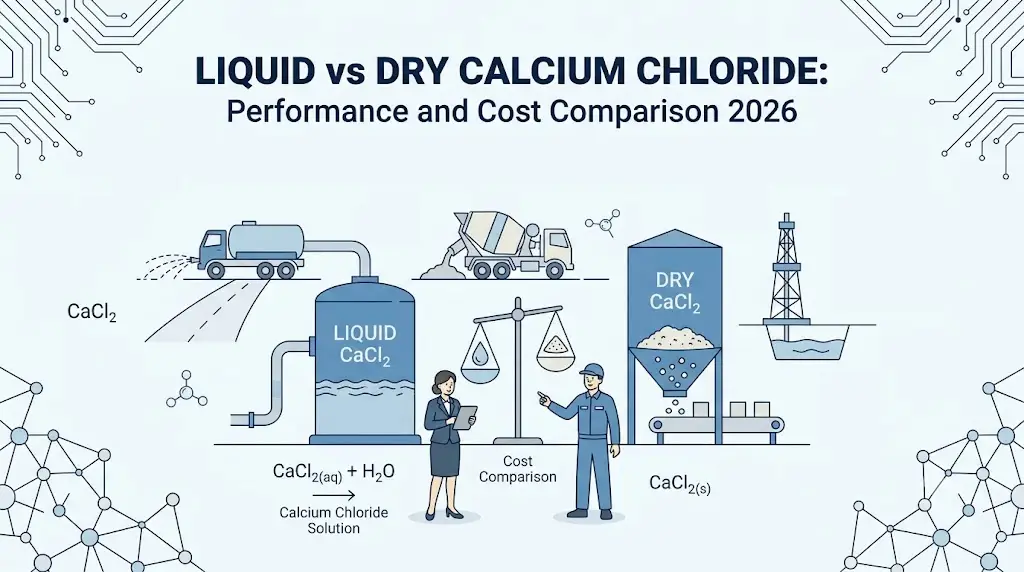
Core Performance Factors for Liquid vs Dry Calcium Chloride
The operational efficacy of liquid vs dry calcium chloride depends heavily on the specific application environment and thermal requirements. Because the two states interact differently with moisture and ambient air, their performance profiles diverge across several critical parameters, including thermodynamic response times, environmental moisture thresholds, and immediate chemical availability.
Dissolution Thermodynamics: Exothermic Reactions and Heat Generation
One of the most significant differences between solid and liquid forms is the release of thermal energy during dissolution. Solid calcium chloride exhibits a strong exothermic reaction when exposed to water. As dry pellets or flakes dissolve, the breaking of the crystal lattice and subsequent hydration of the calcium ions releases approximately 170 kcal/kg of heat energy for anhydrous grades.
This exothermic property is highly advantageous in cold-weather industrial operations, such as low-temperature concrete curing or rapid oilfield drilling fluid preparation. However, in applications where temperature spikes can damage equipment or alter chemical reaction kinetics, utilizing pre-dissolved liquid calcium chloride is preferred. Because the liquid format is already fully dissolved, its introduction into a process yields zero heat of dissolution, ensuring strict thermal stability across mixing systems.
Application Speed: Immediate Action vs Activation Delay
In processes where time-to-delivery is critical, liquid calcium chloride provides an immediate performance advantage. Because it is already in an aqueous state, the chemical ions are immediately active upon application. For instance, in industrial wastewater treatment operations, liquid solutions can be metered directly into flocculation tanks to accelerate the precipitation of suspended solids and heavy metals without any delay.
Conversely, dry calcium chloride requires an activation phase during which it must absorb ambient moisture or be blended with a process liquid to dissolve. In dust suppression applications on industrial haul roads, dry flakes rely on their hygroscopic nature to draw moisture from the air to form a stabilizing brine. If the ambient relative humidity falls below ASTM standards for moisture absorption, the dry material will remain inactive on the surface, increasing dust generation and risking material loss due to wind displacement.
Operational and Logistics Comparison of Calcium Chloride States
Evaluating the logistics chain of liquid vs dry calcium chloride reveals distinct differences in transportation efficiency, labor overhead, and capital expenditure for storage infrastructure. Procurement teams must look beyond the initial purchase price per ton to evaluate the total cost of ownership associated with managing each material state within their facility lines.
Storage Infrastructure: Tanks vs Warehouse Space
Storage requirements represent a major point of divergence between liquid and solid chemical configurations. Dry calcium chloride is highly sensitive to atmospheric moisture. If exposed to ambient air, dry flakes and pellets will undergo deliquescence, liquefying into an uncontrollable brine that can corrode storage structures and foul conveying equipment. Therefore, dry forms must be stored in climate-controlled warehouses, sealed silos with desiccant breathers, or heavy-duty moisture-proof bags stacked on pallets.
| Dry Storage Requirements | Liquid Storage Requirements |
| - Climate-controlled warehouse environments | - Insulated fiberglass or steel bulk tanks |
| - Sealed moisture-proof storage silos | - Recirculation pumping and plumbing lines |
| - Desiccant air filtration systems | - Secondary containment dikes for spill safety |
| - Complete protection from ground-level moisture | - Internal heating coils for cold-climate storage |
Liquid calcium chloride avoids the risks of deliquescence but demands a completely different set of infrastructure investments. Bulk liquid shipments require dedicated, insulated storage tanks manufactured from cross-linked polyethylene (XLPE), fiberglass reinforced plastic (FRP), or lined carbon steel. Additionally, because high-concentration liquid brines can crystallize at low temperatures—for example, a 32% solution has a crystallization point of approximately -17°C—liquid storage systems operating in colder regions must incorporate heating coils and insulation to prevent line freezing.
Handling Equipment: Pumps and Piping vs Conveyors and Hoppers
The mechanical systems required to transport liquid vs dry calcium chloride through a plant facility dictate ongoing maintenance costs and labor allocations. Solid handling requires mechanical conveyors, bucket elevators, hopper systems, and manual labor for bag splitting. These mechanical systems contain numerous moving components that are highly susceptible to abrasive wear and accelerated chemical corrosion from salt dust.
Liquid handling simplifies plant logistics by replacing complex mechanical conveyors with closed-loop piping systems, centrifugal pumps, and automated flow meters. Liquid dosing can be fully integrated into a facility's distributed control system (DCS), enabling precise, real-time adjustments to flow rates based on processing demand. This automation minimizes operator exposure to chemical dust and drastically reduces the maintenance downtime typically associated with cleaning and repairing clogged solid-feeding machinery.
Environmental and Safety Guidelines for Calcium Chloride Handling
Occupational safety and environmental compliance represent critical pillars in industrial chemical management. Comparing liquid vs dry calcium chloride involves evaluating different workplace hazard profiles, ranging from airborne respiratory irritants to localized thermal burn risks during bulk mixing stages.
Respiratory Protection and Dust Management Standards
Dry forms of calcium chloride pose a persistent dust hazard during handling, unloading, and mixing processes. When workers open bulk bags or dump pellets into hoppers, fine chemical dust can become airborne. According to safety regulations, exposure to calcium chloride dust can cause severe irritation to the mucous membranes of the respiratory tract, coughing, and skin irritation due to the rapid absorption of localized moisture. Facilities utilizing dry formats must install robust dust extraction systems and enforce the mandatory use of personal protective equipment (PPE), including N95 or HEPA-filtered respirators and tight-fitting safety goggles.
Liquid calcium chloride eliminates airborne dust hazards completely, making it an inherently cleaner choice for indoor processing facilities. However, it introduces risks related to pressurized liquid line leaks and hydraulic spraying hazards. Workers managing liquid systems must wear chemical-resistant aprons, splash goggles, and PVC gloves to protect against skin contact, which can cause dermal irritation if left untreated.
Material Compatibility and Corrosion Control
Both liquid and dry forms of calcium chloride are highly corrosive to certain industrial metals due to the presence of chloride ions, which accelerate galvanic corrosion. ISO 9223 corrosion classification guidelines highlight that chloride-rich environments pose severe risks to standard carbon steel, aluminum, and yellow metals like brass and copper.
To maintain system integrity, industrial facilities must construct handling equipment from corrosion-resistant materials. For piping, valves, and fittings, non-metallic materials such as PVC, CPVC, or polyvinylidene fluoride (PVDF) are ideal for lower-temperature operations. When metallic components are structurally necessary, high-grade alloys such as 316-grade stainless steel or titanium must be utilized, and rigorous washdown protocols should be enforced to prevent the accumulation of corrosive salt residues on structural surfaces.
Comprehensive Comparison Table of Calcium Chloride Forms
The following table provides an analytical breakdown of the technical specifications, logistical parameters, and operational impacts of selecting liquid vs dry calcium chloride for heavy industrial processes. This cross-reference allows procurement engineers to easily evaluate which format aligns with their current plant infrastructure.
| Evaluation Metric | Dry Calcium Chloride (Flakes/Pellets) | Liquid Calcium Chloride (Brine Solutions) |
| Chemical Purity / Concentration | 77% – 94% active CaCl₂ solids | 28% – 42% aqueous solution concentrations |
| Thermodynamic Behavior | High exothermic heat release upon hydration | Thermally neutral with no heat of dissolution |
| Dust Generation Risk | High; requires active dust mitigation and PPE | Zero; fully enclosed liquid management |
| Primary Infrastructure Needs | Dry warehouse space, moisture barriers, hoppers | Storage tanks, transfer pumps, heated piping |
| Transportation Profile | Low weight, high density; pay only for active product | High weight; includes transport costs for water weight |
| Automation Integration | Complex; requires bulk solids feeders and scales | Simple; easily controlled with automated flow meters |
| Shelf Life Stability | Finite if exposed to air; subject to hard caking | Indefinite; requires agitation to prevent stratification |
Operational Decision Matrix for Industrial Procurement
Navigating the choice between liquid vs dry calcium chloride requires a systematic evaluation framework based on your facility's geographic location, existing capital infrastructure, and production volumes. Use the following decision matrix to align your purchasing strategy with your facility's physical constraints.
Choose dry calcium chloride when:
- Your facility has limited bulk liquid tank infrastructure but possesses ample dry, climate-controlled warehouse space.
- The logistical shipping distance from the chemical manufacturer is significant, making it more cost-effective to avoid paying for the transportation of water weight.
- Your industrial process actively requires the exothermic heat generated during the solid dissolution phase to maintain specific process temperatures.
- The chemical consumption rate is highly seasonal or intermittent, requiring a product that can be stored indefinitely in sealed packaging without risk of settling.
Choose liquid calcium chloride when:
- Your production lines require precise, continuous chemical dosing that can be easily regulated via automated flow meters and control loops.
- Eliminating workplace dust and minimizing worker exposure to chemical handling hazards is a primary safety objective for your plant.
- Your facility lacks the mechanical mixing infrastructure, high-shear agitation tanks, or labor required to consistently dissolve solids into uniform brines.
- The processing facility is located close to a regional brine production well or distribution terminal, minimizing liquid freight surcharges.
FAQs
What is the concentration equivalent when comparing liquid vs dry calcium chloride?
Generally, one ton of high-purity 94% dry calcium chloride pellets can be dissolved with water to create approximately 2.25 tons of standard 42% industrial liquid calcium chloride solution. Procurement teams must calculate these mass equivalents when comparing unit prices to ensure accurate bulk chemical cost evaluations.
How does ambient temperature affect the storage of liquid vs dry calcium chloride?
Dry calcium chloride is unaffected by low temperatures but degrades quickly in high-humidity environments due to deliquescence. Conversely, liquid calcium chloride solutions will not absorb extra moisture but can freeze or crystallize if ambient temperatures drop below their specific saturation thresholds, requiring insulated tanks.
Is liquid calcium chloride more corrosive than dry calcium chloride to plant equipment?
Both forms exhibit identical corrosive properties upon contact with metals because corrosion is driven by the chloride ions present in solution. However, liquid forms present an immediate corrosive risk because they are already dissolved, whereas dry forms only become corrosive after absorbing moisture.
Which format is more cost-effective for long-distance shipping?
Dry calcium chloride is significantly more economical for long-distance transport. Because liquid calcium chloride contains between 58% and 72% water weight depending on concentration, shipping liquid over long distances means paying substantial freight fees to transport water rather than active chemical solids.
What are the mixing hazards when converting dry calcium chloride into liquid on-site?
The primary hazard is the substantial exothermic heat released during the dissolution of dry solids. If dry calcium chloride is added to water too quickly without adequate agitation or cooling systems, the solution temperature can rapidly exceed 100°C, causing localized boiling, dangerous splashing, and equipment damage.
Can liquid calcium chloride be used directly for industrial dust suppression?
Yes, liquid calcium chloride solutions at concentrations of 35% to 38% are ideal for direct application to industrial haul roads and mining sites. The liquid solution provides immediate surface wetting and binding, eliminating the activation delay that occurs when using dry solid flakes.
How should a facility handle hard caking in dry calcium chloride storage?
Hard caking occurs when dry calcium chloride absorbs ambient moisture and undergoes partial recrystallization. To prevent this, bags must remain sealed on pallets with intact plastic shrink-wrap, and bulk silos must use dry nitrogen blankets or desiccant air dryers to keep humidity levels near zero.
What pipe materials are recommended for transporting liquid calcium chloride solutions?
Non-metallic piping materials such as schedule 80 PVC, CPVC, and high-density polyethylene (HDPE) are highly recommended due to their complete resistance to chloride-driven corrosion. For high-pressure or high-temperature lines where metals are required, 316 stainless steel or specialized lined pipe must be used.
Does liquid calcium chloride require constant agitation during long-term storage?
High-concentration liquid calcium chloride solutions (such as 42%) can experience salt stratification or minor crystallization over extended static storage periods, especially during temperature drops. Installing a small recirculation pump or mechanical agitator ensures a completely homogeneous solution profile throughout the storage cycle.
What environmental regulations govern spills of liquid vs dry calcium chloride?
Both forms are subject to similar environmental oversight, as excessive chloride runoff can impact local soil salinity and aquatic ecosystems. Dry spills are easier to contain using mechanical sweeping and recovery, whereas liquid spills require immediate containment berms and neutralizing absorption materials to prevent runoff.
Conclusion
Selecting the optimal state in the liquid vs dry calcium chloride comparison requires a balanced evaluation of your industrial plant's infrastructure, shipping logistics, and safety protocols. Solid flakes and pellets provide unmatched concentration density and lower long-distance freight costs, making them ideal for facilities equipped with dry storage and mixing systems. Meanwhile, pre-dissolved liquid brine solutions optimize process automation, eliminate airborne dust management hazards, and reduce on-site mixing labor, providing immediate operational utility for continuous industrial systems.
Ultimately, the right choice depends on your specific volume demands, plant layout, and capital equipment capabilities. Start by assessing your storage infrastructure and thermal process constraints before comparing chemical options. For specific application recommendations, consult a qualified industrial chemical engineer who can accurately assess your operational requirements and ensure long-term process compatibility.