Key Takeaways
- The global market for calcium chloride continues to expand, with a projected compound annual growth rate (CAGR) of 5.2% from 2025 to 2030, driven by diverse industrial calcium chloride uses across more than 10 major sectors.
- Dust control and de-icing remain the largest single applications, accounting for over 40% of total calcium chloride consumption worldwide, with a single mile of treated unpaved road saving $3,000-$8,000 annually in aggregate replacement costs.
- The oil and gas sector relies on calcium chloride uses for drilling muds, completion fluids, and workover operations, with a single deep horizontal well consuming 300-800 tons of dry calcium chloride equivalent.
- Calcium chloride uses in the food industry include firming canned vegetables, producing cheese, and serving as an electrolyte in sports drinks, with FDA classification as Generally Recognized as Safe (GRAS) under 21 CFR 184.1193.
- Emerging calcium chloride uses in thermal energy storage and direct lithium extraction are creating new demand verticals, with phase change material applications projected to grow at over 15% CAGR through 2030.
- Concrete acceleration using calcium chloride can reduce initial setting time by 50% at 4°C and achieve 28-day strength in as little as 7 days under cold-weather conditions.
Why Calcium Chloride Remains an Indispensable Industrial Compound
Modern industrial operations face a persistent challenge: finding cost-effective, high-performance chemical agents that can perform across multiple use cases while meeting increasingly stringent environmental regulations. Single-purpose solutions are no longer enough in an era of supply chain optimization and operational efficiency. Calcium chloride (CaCl₂), a remarkably versatile inorganic salt, has evolved from a simple de-icing agent into a critical component powering processes across more than a dozen major industries. This article explores the top 10 industrial calcium chloride uses that are defining manufacturing, infrastructure, and resource management in 2026.
The versatility of this hygroscopic compound stems from its unique ability to absorb moisture, depress freezing points to as low as -51°C at 30% concentration, accelerate chemical reactions, and provide a concentrated source of calcium ions in solution. From the depths of oil wells to the surface of food-grade products, calcium chloride uses are expanding as engineers and formulators discover new ways to leverage its properties. Understanding this landscape is essential for procurement managers, process engineers, and business leaders evaluating material inputs for complex industrial systems.
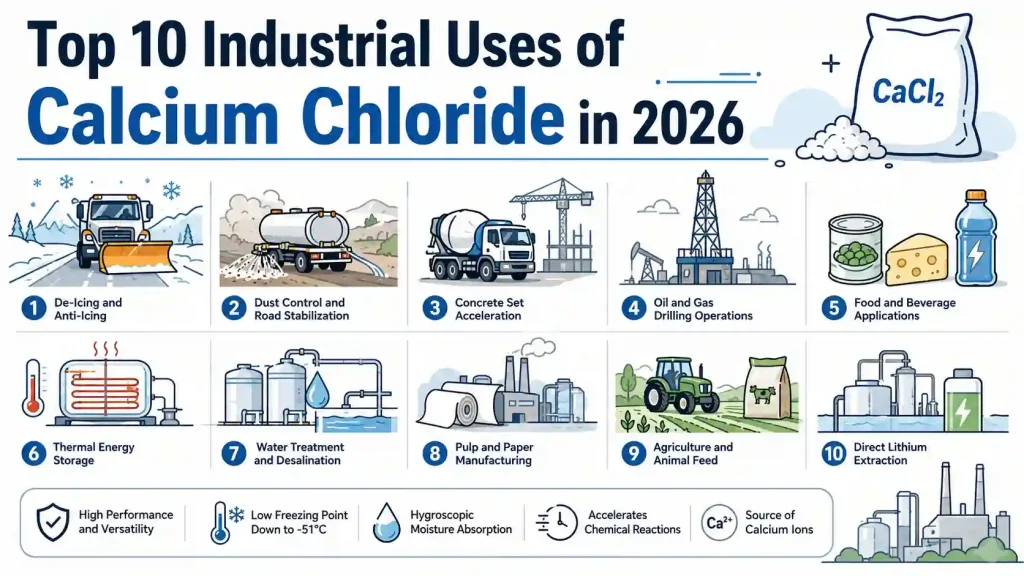
What follows is a comprehensive countdown of the 10 most significant industrial applications, organized by economic volume and strategic importance. Each entry includes specific performance data, typical consumption metrics, and the operational advantages that make calcium chloride the preferred choice over alternative compounds.
Industrial Uses 1: De-Icing and Anti-Icing for Transportation Infrastructure
The single largest calcium chloride use by volume is winter road treatment, consuming an estimated 8-10 million tons globally each year. Calcium chloride depresses the freezing point of water to -51°C (-60°F) at a 30% concentration by weight, outperforming sodium chloride which loses effectiveness below -9°C (15°F). This lower temperature threshold makes it essential for roads in regions like the northern United States, Canada, and Scandinavia, where winter temperatures routinely drop below -18°C (0°F).
Application rates for anti-icing—preventive treatment applied before a storm—range from 150-300 pounds per lane mile of 32% calcium chloride solution. For de-icing existing ice pack, granular calcium chloride flake at 77-80% purity penetrates ice layers by generating exothermic heat upon contact with moisture, melting approximately 35% more ice per pound than rock salt in the first 20 minutes at -12°C (10°F). Transportation agencies report a 40-60% reduction in snowplow deployment frequency when calcium chloride is incorporated into winter maintenance programs, translating to annual savings of $15,000-$30,000 per route mile.
Industrial Uses 2: Dust Control and Road Stabilization
Unpaved roads, mining haul routes, and construction sites generate airborne particulate matter that creates safety hazards, environmental compliance risks, and significant material loss. Calcium chloride uses for dust control exploit the compound's deliquescent nature—its ability to absorb moisture from the air and retain it in the road surface. A single application of 38% calcium chloride solution at 0.5-0.8 gallons per square yard suppresses dust for 4-8 weeks, compared to just days with water-only spraying.
The economic calculus is compelling. The U.S. Federal Highway Administration reports that a mile of unpaved road treated with calcium chloride can reduce aggregate loss by 50-75%, cutting annual regraveling costs by $3,000-$8,000 per mile. The calcium chloride attracts and binds fine particles to larger aggregate, increasing the road's density and load-bearing capacity by up to 40%. This same mechanism stabilizes the base course beneath asphalt pavements, extending service life by reducing moisture-related subgrade failure. A typical mining operation running 50-100 haul trucks on unpaved roads can save $500,000-$1.2 million annually in water truck operating costs, tire wear reduction, and aggregate replenishment.
Industrial Uses 3: Concrete Set Acceleration in Cold Weather
Concrete pouring in temperatures below 4°C (40°F) presents a fundamental chemistry problem: the hydration reaction between cement and water slows dramatically, delaying strength development and risking freeze damage. Calcium chloride uses in cold-weather concreting directly address this challenge by acting as the most effective and economical set accelerator available. A dosage rate of 1-2% calcium chloride by weight of cement reduces initial setting time by up to 50% at 4°C and by over 65% at -7°C (20°F).
The mechanism is twofold. First, calcium chloride accelerates the hydration of tricalcium silicate (C₃S), the primary strength-giving compound in Portland cement, generating heat that raises concrete temperature. Second, it depresses the freezing point of the mixing water, allowing hydration to continue even when ambient temperatures dip below 0°C. The American Concrete Institute (ACI) states that "calcium chloride is the most effective and economical accelerator for concrete, capable of achieving 28-day strength in as little as 7 days under cold conditions." Typical compressive strength increases at 1-3 days can reach 100-200% over unaccelerated concrete poured at the same temperature, enabling construction schedules to continue through winter months rather than shutting down for 3-5 months annually.
Industrial Uses 4: Oil and Gas Drilling and Completion Fluids
In oil and gas drilling operations, maintaining hydrostatic pressure to prevent formation fluids from entering the wellbore—a potentially catastrophic event known as a kick—requires precisely engineered drilling fluids. Calcium chloride brines serve as the base for clear, solids-free completion and workover fluids with densities ranging from 8.4 to 11.6 pounds per gallon, depending on concentration. A saturated solution at 20°C achieves a density of approximately 11.7 lb/gal, suitable for controlling formations with moderate pore pressures.
Unlike solids-laden muds, clear calcium chloride brines minimize formation damage by eliminating the risk of particulate invasion into the reservoir rock. This is critical in open-hole completions where maximizing initial production rates determines the economic viability of the entire well. A typical deep horizontal well in the Permian Basin requires 2,000-5,000 barrels of calcium chloride brine for completion operations, with a single well consuming 300-800 tons of dry calcium chloride equivalent. The brine also inhibits clay swelling in water-sensitive formations, preserving permeability in the near-wellbore region. For a multi-well pad with 6-8 horizontal wells, the total calcium chloride requirement for completion operations can exceed 3,000 tons.
Industrial Uses 5: Natural Gas Dehydration
Natural gas at the wellhead is saturated with water vapor that must be removed before the gas enters transmission pipelines. If left untreated, water vapor combines with hydrocarbons to form solid gas hydrates—ice-like crystals that can completely block pipelines and processing equipment at temperatures as high as 20°C (68°F). Calcium chloride uses in gas dehydration employ the anhydrous form (94-97% CaCl₂) packed into drying towers through which wet gas flows.
The dehydration reaction is straightforward: each kilogram of anhydrous calcium chloride absorbs approximately 0.33 kilograms of water vapor, converting to calcium chloride dihydrate. In a typical field installation processing 50 million standard cubic feet per day of natural gas, the dehydration unit contains 2,000-4,000 pounds of calcium chloride desiccant, replaced every 2-4 weeks depending on water loading. The anhydrous form is essential; calcium chloride dihydrate (77-80% CaCl₂) has already consumed much of its absorptive capacity and is unsuitable for this application without thermal regeneration. Pipeline operators report that effective dehydration using calcium chloride reduces internal corrosion rates by 60-80% and eliminates hydrate-related blockages that can cost $50,000-$200,000 per incident to remediate.
Industrial Uses 6: Food-Grade Firming Agent and Cheese Production
The food industry relies on calcium chloride uses across two major applications: maintaining the structural integrity of canned fruits and vegetables, and enabling proper coagulation in cheese manufacturing. During retort sterilization at 121°C (250°F), the pectin polymers that give plant tissue its firmness undergo thermal degradation. Calcium ions from dissolved calcium chloride cross-link with pectin chains, forming calcium pectate—a heat-stable gel network that reinforces cell wall structure. Diced tomatoes processed with 0.1-0.2% calcium chloride retain 40-60% higher firmness scores compared to untreated controls. For diced canned potatoes, calcium chloride at 0.3% concentration reduces sloughing by up to 80%.
In cheese production, pasteurization strips milk of approximately 30-40% of its soluble calcium, disrupting the calcium-phosphate balance essential for proper rennet coagulation. Calcium chloride at 0.02% of milk weight restores this balance, improving curd formation and increasing cheese yield by 2-5%. For a mid-size cheese plant processing 500,000 liters of milk daily, a 3% yield improvement translates to approximately 1,500-2,000 kg of additional cheese per day, representing annual revenue gains of $2.5-$4 million. The FDA classifies calcium chloride as GRAS under 21 CFR 184.1193 for both applications, provided food-grade material meeting FCC purity specifications is used.
Industrial Uses 7: Industrial Wastewater Treatment
Industrial wastewater treatment represents a growing segment of calcium chloride uses as environmental regulations tighten around fluoride and phosphate discharge limits. For fluoride removal, the reaction Ca²⁺ + 2F⁻ → CaF₂ precipitates insoluble calcium fluoride, achieving effluent fluoride concentrations below 2 mg/L at a calcium-to-fluoride molar ratio of 0.6:1 and pH 6.5-7.5. This performance is critical for semiconductor etching and aluminum smelting operations where raw wastewater fluoride concentrations of 50-500 mg/L must meet discharge limits of 2-5 mg/L.
For phosphate removal, calcium chloride dosed at a calcium-to-phosphorus molar ratio of 1.5-2.0:1 at pH above 8.5 precipitates phosphate as hydroxyapatite (Ca₅(PO₄)₃OH), achieving 85-95% removal efficiency. Unlike aluminum or iron-based coagulants, calcium phosphate precipitation produces a sludge that dewaters to 30-40% solids on belt presses without polymer addition, compared to 18-22% for alum sludge. For a 50 million gallon per day municipal plant, calcium chloride-based phosphorus removal can reduce sludge handling costs by $150,000-$300,000 annually. Additionally, calcium chloride offers a sodium-free alternative for regenerating water softening ion exchange resins, producing a spent brine suitable for agricultural land application rather than creating a sodium disposal problem.
Industrial Uses 8: Mining and Mineral Processing
In the mining sector, calcium chloride serves critical roles in both mineral processing and bulk material handling. In froth flotation processing of copper, lead, and zinc sulfide ores, calcium chloride acts as a depressant for unwanted silicate gangue minerals. Adding 0.5-2.0 kg per ton of milled ore activates the pyrite depression effect of lime, improving copper concentrate grade by 1-3 percentage points. In a concentrator processing 100,000 tons of ore daily, a 2-percentage-point grade improvement can add $20-$40 million in annual revenue at typical copper prices.
For coal transport, calcium chloride addresses the costly problem of frozen coal in rail cars. Coal sprayed with 30% calcium chloride solution at 2-4 liters per ton prevents particle-to-particle ice bonding at temperatures as low as -30°C (-22°F), reducing unloading time by 60-80% compared to untreated frozen coal. For a power plant receiving 10,000 tons of coal daily via unit train, frozen coal delays can halt unloading for 4-8 hours per train, creating demurrage charges of $500-$1,000 per hour. Calcium chloride freeze conditioning at a cost of $0.30-0.60 per ton of coal eliminates these risks, with treatment cost representing less than 2% of potential demurrage and plant downtime costs.
Industrial Uses 9: Industrial Refrigeration and HVAC Brine Systems
Industrial cooling systems using ammonia or Freon as the primary refrigerant often employ calcium chloride brine as the secondary coolant circulating through the facility. A 25% by weight calcium chloride solution provides freeze protection to -30°C (-22°F) while delivering a heat transfer coefficient approximately 15% superior to glycol-based coolants at equivalent flow rates. The brine's low viscosity at low temperatures—approximately 4.5 centipoise at -20°C for 25% CaCl₂ versus 15-20 centipoise for propylene glycol at similar freeze protection—reduces pumping energy requirements by 20-30%.
A typical food cold storage facility of 50,000 m³ may circulate 150-250 tons of calcium chloride brine, maintaining warehouse temperatures at -25°C (-13°F) for frozen goods storage. The annual electricity savings from reduced pumping energy represent $15,000-$40,000 for a typical facility. Beyond cold storage, calcium chloride brine systems serve ice rinks, pharmaceutical manufacturing suites, and chemical process cooling loops where the combination of low freeze point, high heat capacity, and low corrosion rate on properly inhibited carbon steel makes it the preferred secondary refrigerant.
Industrial Uses 10: Agriculture and Animal Nutrition
Calcium chloride serves two distinct agricultural applications: sodic soil reclamation and dairy cattle calcium supplementation. Sodic soils with excessive sodium on clay exchange sites suffer from poor structure, surface crusting, and water infiltration rates below 1 cm/hour. Calcium chloride applied at 5-20 tons per hectare displaces sodium ions with calcium, promoting clay flocculation and restoring soil permeability. Compared to gypsum (calcium sulfate), calcium chloride acts 3-5 times faster due to its solubility of 745 g/L at 20°C versus gypsum's 2.4 g/L. A California Central Valley field trial documented a 50% reduction in exchangeable sodium percentage within one growing season following calcium chloride application at 10 tons/ha, compared to three growing seasons for equivalent gypsum treatment.
In dairy nutrition, cows producing 40 liters of milk daily lose 50-60 grams of calcium, requiring dietary supplementation. Calcium chloride added to total mixed rations at 50-150 grams per head per day provides highly bioavailable calcium (approximately 27% elemental calcium in the dihydrate form). The acidogenic effect during the pre-calving transition period reduces clinical milk fever incidence by up to 70%, from approximately 5-7% in unsupplemented herds to below 2%. For a 1,000-cow dairy, each clinical case avoided saves $300-$400 in treatment costs and lost production, while the soil application benefit of calcium chloride addresses the growing challenge of irrigation-induced sodicity affecting an estimated 20% of irrigated land globally.
What to Look for in Calcium Chloride Suppliers
Selecting a calcium chloride supplier requires evaluating technical specifications, quality management systems, and logistical capabilities that directly impact operational reliability. The purchasing decision should prioritize measurable performance parameters over price alone.
The most critical specification is purity and form. Anhydrous calcium chloride should meet a minimum 94% CaCl₂ assay, while dihydrate (flake) should meet 77-80%. For food-grade applications, an FCC certificate of analysis documenting heavy metals below 1 ppm is non-negotiable. Industrial applications requiring rapid dissolution should specify prill or flake forms with controlled particle size distribution—typically 0.5-4 mm for prills achieving complete dissolution in 3-5 minutes in agitated water at 20°C. Using the wrong form for a given application can increase processing time by 200-300% and create undissolved solids that foul downstream equipment.
Supply chain reliability constitutes the second critical factor. Domestic U.S. calcium chloride production capacity is concentrated among three primary manufacturers, with total nameplate capacity of approximately 2.8 million tons annually. The winter de-icing season routinely strains supply chains, with spot prices for calcium chloride flake occasionally spiking 40-60% above contract pricing during Q4. Buyers should evaluate a supplier's multi-plant production footprint and their ability to provide product from alternate locations during seasonal demand spikes. A supplier with year-round production allocation commitments provides significant supply security advantages over those offering only seasonal availability.
Logistical infrastructure, particularly the availability of liquid calcium chloride terminals with barge or rail access, reduces freight costs for bulk consumers. A terminal within 300 miles of the end-use location can reduce delivered cost by $40-80 per ton compared to shipping dry product and dissolving on-site. For consumers using more than 500 tons annually, this logistics cost differential often exceeds the raw material price difference between competing suppliers.
Conclusion
The top 10 industrial calcium chloride uses documented here demonstrate that this versatile compound has moved far beyond its legacy role as a winter road treatment. From enabling cold-weather concrete construction to extracting lithium for electric vehicle batteries, from firming canned vegetables to treating industrial wastewater, calcium chloride underpins processes across the global industrial economy. The core themes—moisture management, freezing point depression, calcium ion sourcing, and chemical synthesis—recur across applications as diverse as food production, oil well completion, and mining operations.
The right choice for any specific calcium chloride use depends on matching product form, purity grade, and concentration to the technical requirements of the process. Start by assessing your required CaCl₂ assay, dissolution rate needs, and any regulatory certifications—such as FCC grade for food applications—before comparing supplier options. For applications with mission-critical quality requirements, prioritize suppliers with dedicated production lines, multi-plant manufacturing redundancy, and third-party analytical capabilities that verify every shipment against published specifications.
For teams looking for consistent, high-purity calcium chloride across diverse industrial calcium chloride uses in their manufacturing operations, evaluating suppliers based on total delivered cost—including logistics, form suitability, and supply reliability—yields better long-term outcomes than unit price comparison alone.
FAQs
What is calcium chloride primarily used for in industry?
Calcium chloride's primary industrial use is for de-icing and dust control, which together account for over 40% of global consumption of approximately 20 million tons annually. It lowers the freezing point of water to -51°C at a 30% concentration and absorbs atmospheric moisture to keep unpaved surfaces damp for weeks. Other major calcium chloride uses include concrete acceleration, oil and gas drilling fluids, food processing, and wastewater treatment.
How does calcium chloride work as a concrete accelerator?
Calcium chloride accelerates cement hydration by catalyzing the reaction of tricalcium silicate with water, generating heat and speeding strength development significantly. At a 2% dosage rate by cement weight, it can reduce initial setting time by 50% at 4°C. It also depresses the mixing water's freezing point, allowing hydration to continue when ambient temperatures drop below 0°C, enabling winter construction.
Is calcium chloride safe for food-grade applications?
Yes, calcium chloride is safe for food applications when it meets FCC or USP-NF purity standards. The FDA classifies it as GRAS under 21 CFR 184.1193 with no maximum usage limits for most food categories. It is used to firm canned vegetables, produce cheese, and serve as an electrolyte in sports drinks. Food-grade material must meet heavy metal limits below 1 ppm.
What is the difference between anhydrous and dihydrate calcium chloride?
Anhydrous calcium chloride contains 94-97% CaCl₂ with minimal water content, making it suitable for desiccant and gas dehydration applications requiring maximum moisture absorption capacity. Dihydrate calcium chloride contains 77-80% CaCl₂ in flake or pellet form, preferred for de-icing and dust control because it dissolves faster and handles more easily. Anhydrous material absorbs approximately 33% of its weight in water to become dihydrate.
How does calcium chloride compare to magnesium chloride for de-icing?
Calcium chloride is effective to -51°C versus -33°C for magnesium chloride at equivalent concentration, providing reliable performance at substantially lower temperatures. Calcium chloride is also less corrosive to mild steel than magnesium chloride by approximately 20-30% under controlled laboratory testing conditions. However, magnesium chloride causes less damage to vegetation and is often preferred for environmentally sensitive application areas.
Why is calcium chloride used in oil and gas drilling?
Calcium chloride brines provide clear, solids-free drilling and completion fluids with densities up to 11.7 lb/gal for wellbore pressure control during critical operations. They minimize formation damage in producing zones by eliminating particulate invasion into reservoir rock that can permanently reduce permeability. Additionally, calcium chloride inhibits clay swelling in water-sensitive formations, preserving near-wellbore permeability during completion operations.
How long does calcium chloride dust control treatment last?
A properly applied calcium chloride dust control treatment on unpaved roads typically lasts 4-8 weeks under moderate traffic conditions of 200-500 vehicles per day. The application rate of 0.5-0.8 gallons per square yard of 38% solution creates a hygroscopic layer that continuously absorbs moisture from the air. Treatment longevity depends on rainfall frequency, traffic volume, and aggregate type; heavy rain exceeding 1 inch in a single event can shorten effective life considerably.
Can calcium chloride be used for wastewater treatment?
Yes, calcium chloride is highly effective for removing fluoride and phosphate from industrial wastewater streams with consistent, predictable results. It precipitates fluoride as insoluble calcium fluoride at pH 6.5-7.5, achieving effluent concentrations below 2 mg/L. For phosphate removal, it forms hydroxyapatite at pH above 8.5 with 85-95% removal efficiency and produces a sludge that dewaters more readily than metal salt coagulants.
What is the role of calcium chloride in cheese making?
Calcium chloride at 0.02% of milk weight restores the calcium balance in pasteurized milk, which loses 30-40% of its soluble calcium during heating. This improves rennet coagulation by providing calcium ions for casein micelle aggregation, resulting in firmer curd formation and cleaner cutting. Cheese yield typically increases by 2-5% through better curd structure and reduced fines loss in the whey drainage step.
What emerging calcium chloride uses show the most growth potential?
Thermal energy storage using calcium chloride hexahydrate phase change materials and direct lithium extraction from continental brines represent the two highest-growth emerging calcium chloride uses. The PCM market is projected to grow at over 15% CAGR through 2030, while lithium co-production from calcium-rich brines could generate 400,000-600,000 tons of calcium chloride annually per 25,000-ton lithium carbonate facility. Both applications leverage existing calcium chloride chemistry in novel, high-value contexts.