
Dust generated from unpaved roads is more than a visibility issue. For mines, quarries, construction sites, forestry roads, and rural highways, excessive dust can reduce driving safety, accelerate road deterioration, increase maintenance costs, and create environmental concerns. Effective calcium chloride dust control is widely used because it addresses the root cause of dust formation rather than simply suppressing airborne particles temporarily.
Road operators often face changing weather, varying traffic volumes, and different road materials that make dust management challenging. Selecting the right application method and maintaining proper moisture levels are essential for long-lasting performance.
This guide explains how calcium chloride dust control works, how to prepare a road before treatment, recommended application procedures, maintenance practices, common mistakes to avoid, and safety considerations for achieving consistent results.
What This Article Covers
- How calcium chloride suppresses dust on unpaved roads
- Materials and equipment needed before application
- A complete step-by-step application workflow
- Recommended application rates for different road conditions
- Maintenance schedules for long-term dust control
- Common troubleshooting tips
- Bottom line: Proper preparation and correct application rates determine the effectiveness and longevity of calcium chloride dust control.
How Calcium Chloride Dust Control Works
Calcium chloride is a hygroscopic salt, meaning it naturally attracts moisture from the surrounding air. Instead of simply wetting the road surface, it continuously absorbs atmospheric humidity, helping road materials retain moisture even after rainfall has stopped or water has evaporated.
This retained moisture creates stronger bonds between fine particles, reducing their ability to become airborne under vehicle traffic.
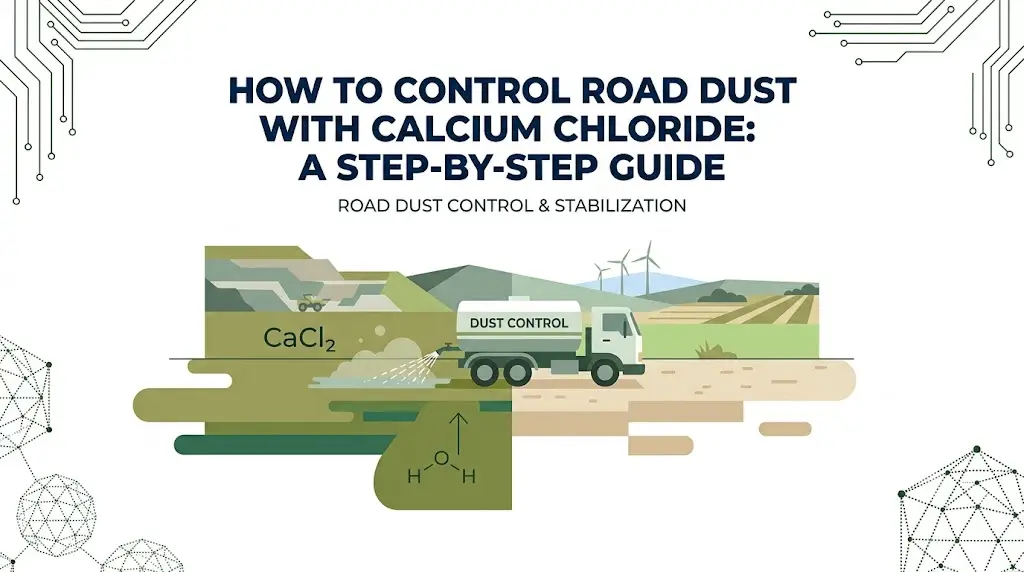
Compared with watering alone, calcium chloride can provide significantly longer-lasting dust suppression because moisture remains within the road surface instead of evaporating rapidly.
Its effectiveness is greatest when:
- Relative humidity is above approximately 30%
- The road has a well-graded aggregate structure
- Proper application rates are followed
- Traffic levels match the designed maintenance schedule
According to the U.S. Environmental Protection Agency (EPA), chemical dust suppressants can reduce particulate emissions from unpaved roads when properly selected and maintained.
Prerequisites Before Applying Calcium Chloride
Before beginning the application process, ensure the road is suitable for treatment.
Required Materials
- Calcium chloride flakes, pellets, or liquid brine
- Water truck or spray truck
- Motor grader
- Road roller or compactor
- Moisture meter (recommended)
- Personal protective equipment (gloves, goggles, boots)
Road Preparation Checklist
- Grade the road surface to remove potholes and washboarding.
- Repair drainage ditches and shoulders.
- Remove loose oversized rocks.
- Ensure the road crown allows proper drainage.
- Verify moisture conditions before application.
- Schedule treatment during suitable weather.
Applying calcium chloride to an uneven or poorly drained road usually reduces treatment effectiveness.
Step-by-Step Workflow for Calcium Chloride Dust Control
Step 1: Evaluate Existing Road Conditions
Purpose
Determine whether the road requires grading, moisture adjustment, or additional aggregate before treatment.
Expected Result
A stable road surface capable of retaining calcium chloride.
Inspect for:
- Loose fines
- Standing water
- Excessive potholes
- Poor drainage
- Deep corrugations
If severe defects exist, repair them before application.
Step 2: Grade the Road Surface
Purpose
Restore a smooth surface and redistribute aggregates evenly.
Expected Result
Uniform road geometry with consistent material depth.
A motor grader should:
- Remove washboarding
- Fill potholes
- Restore road crown
- Mix loose materials evenly
Grading immediately before application improves penetration of calcium chloride into the road structure.
Step 3: Adjust Moisture Content
Purpose
Prepare the road for maximum absorption.
Expected Result
Moist—but not saturated—road material.
If the road is extremely dry, lightly water the surface before applying calcium chloride.
Excess water should be avoided because it may dilute the solution and reduce penetration.
Step 4: Apply Calcium Chloride Evenly
Purpose
Distribute the material uniformly across the road.
Expected Result
Consistent dust suppression over the treated area.
Application methods include:
| Application Method | Typical Use | Advantages | Limitations |
|---|---|---|---|
| Liquid spray | Routine maintenance | Uniform coverage | Requires spray equipment |
| Flake application | New road treatment | High concentration | Requires watering afterward |
| Pellet application | Localized repair | Easy storage | Less uniform distribution |
Typical application rates vary depending on road material, climate, and traffic conditions.
| Road Condition | Typical Initial Application |
|---|---|
| Light traffic | 0.8–1.2 L/m² liquid solution |
| Medium traffic | 1.2–1.8 L/m² |
| Heavy haul roads | 1.8–2.5 L/m² |
Typical market practice may vary depending on local climate and engineering specifications.
Step 5: Compact the Road Surface
Purpose
Improve penetration and particle bonding.
Expected Result
A dense, stable road surface with improved durability.
Compaction should begin shortly after application while moisture remains within the surface layer.
Rollers typically perform several passes until the road reaches the desired density.
Step 6: Monitor Performance
Purpose
Evaluate treatment effectiveness.
Expected Result
Reduced airborne dust and improved road stability.
Observe:
- Dust generation behind vehicles
- Surface moisture retention
- Aggregate stability
- Wheel rut development
If dust begins increasing significantly, maintenance application may be required.
Calcium Chloride vs Water: Which Provides Better Dust Control?
Although water is the simplest dust suppression method, its effect is usually temporary because evaporation occurs rapidly during warm or windy conditions.
| Factor | Calcium Chloride | Water |
|---|---|---|
| Duration | Several weeks to months depending on conditions | Several hours to one day |
| Moisture retention | Excellent | Poor |
| Traffic resistance | High | Low |
| Application frequency | Low | High |
| Operating cost over time | Often lower due to fewer applications | Higher because of repeated watering |
For roads experiencing frequent traffic, calcium chloride generally reduces the number of watering cycles required throughout the operating season.
Troubleshooting Common Dust Control Problems
| Symptom | Possible Cause | Solution |
|---|---|---|
| Dust returns quickly | Application rate too low | Increase application rate during maintenance |
| Uneven dust suppression | Poor spray distribution | Calibrate spray equipment |
| Soft road surface | Excessive moisture | Improve drainage and reduce water addition |
| White residue appears | Excess material on surface | Reduce application rate and improve mixing |
| Potholes increase | Road not graded before treatment | Grade road before reapplication |
Routine inspections help identify these issues before they become significant maintenance problems.
Best Practices for Long-Term Calcium Chloride Dust Control
Following consistent maintenance practices often produces better results than relying on a single heavy application.
- Apply treatment before peak dry seasons whenever possible.
- Maintain proper drainage throughout the road network.
- Regrade roads before major reapplications.
- Monitor traffic growth and adjust maintenance schedules accordingly.
- Store calcium chloride in dry conditions before use.
- Record application rates and maintenance intervals for future planning.
The Federal Highway Administration (FHWA) recommends integrating dust suppression into an overall road maintenance program rather than treating it as a standalone activity.
Common Mistakes to Avoid
Applying Without Road Preparation
Skipping grading or drainage repairs limits penetration and reduces treatment life.
Using Excessive Application Rates
More material does not always produce better results. Overapplication may leave surface residues and increase costs.
Ignoring Drainage
Poor drainage allows standing water to weaken the road structure, reducing dust control performance.
Applying During Heavy Rain
Rain can dilute freshly applied calcium chloride before it penetrates the road surface.
Delaying Maintenance Too Long
Periodic maintenance applications are usually more economical than allowing the treatment to fail completely before retreatment.
Conclusion
Calcium chloride dust control remains one of the most effective methods for reducing dust on unpaved roads when combined with proper road preparation, correct application rates, and routine maintenance. Successful projects typically begin with grading, continue with even application and compaction, and achieve long-term performance through regular inspections and timely maintenance.
Road conditions, traffic intensity, aggregate quality, and local climate all influence treatment performance. Applying the steps outlined in this guide can help improve road safety, reduce maintenance frequency, and extend the service life of unpaved road surfaces. For the best results, evaluate local conditions carefully and prioritize proper preparation, accurate application, and ongoing maintenance over simply increasing material usage.
FAQs
What is calcium chloride dust control?
Calcium chloride dust control is a method of reducing dust on unpaved roads by applying calcium chloride, a hygroscopic material that attracts and retains moisture. This moisture keeps fine particles bound together, reducing airborne dust caused by vehicle traffic and wind.
How does calcium chloride reduce road dust?
Calcium chloride absorbs moisture from the surrounding air and helps retain water within the road surface. The retained moisture binds fine particles together, making them less likely to become airborne when vehicles travel across the road.
How long does calcium chloride dust control last?
Under normal traffic and weather conditions, a properly applied treatment can remain effective for several weeks or even several months. Performance depends on traffic volume, rainfall, road material, maintenance practices, and application rate.
Is calcium chloride better than watering roads?
For many unpaved roads, yes. Water provides immediate but short-term suppression because it evaporates quickly. Calcium chloride maintains moisture for longer periods, reducing the need for frequent watering and lowering long-term maintenance efforts.
How much calcium chloride should be applied to a gravel road?
Application rates vary depending on traffic, climate, and aggregate type. Typical liquid applications range from approximately 0.8 to 2.5 liters per square meter, although local engineering recommendations and manufacturer guidance should always be followed.
Can calcium chloride be applied during rainy weather?
Light moisture may assist penetration, but heavy rain is generally not recommended. Significant rainfall can dilute the material before it bonds with the road surface, reducing treatment effectiveness and increasing the likelihood of uneven application.
Is calcium chloride safe for road maintenance workers?
When handled according to safety guidelines, calcium chloride is commonly used in road maintenance. Workers should wear gloves, eye protection, and appropriate clothing to avoid skin or eye irritation during handling and application.
Does calcium chloride work in very dry climates?
Yes, although performance depends on relative humidity. Because calcium chloride attracts atmospheric moisture, it generally performs best where humidity periodically exceeds about 30%, allowing continued moisture absorption.
Can calcium chloride damage vehicles?
When applied correctly and allowed to penetrate the road surface, calcium chloride is not intended to damage vehicles. However, regular vehicle washing is recommended in areas where deicing salts or dust suppressants are frequently used to minimize corrosion risks over time.
When should a road receive maintenance applications?
Maintenance is usually scheduled when dust begins increasing, road surfaces become noticeably dry, or traffic patterns change. Regular inspections throughout the dry season help determine the most effective timing for reapplication instead of relying on fixed calendar intervals.