Calcium chloride is widely used across industries ranging from road maintenance and construction to food processing and chemical manufacturing. However, buyers often face a practical question when sourcing this material: calcium chloride flakes vs pellets—which form is better for a specific application?
While both forms contain the same chemical compound, their physical characteristics can influence handling, dissolution rates, storage performance, application efficiency, and overall operational costs. Choosing the wrong form may result in unnecessary material waste, inconsistent performance, or higher labor requirements.
For procurement teams, understanding the differences between calcium chloride flakes and pellets is essential for selecting the most suitable product for deicing, dust suppression, moisture control, brine preparation, or industrial processing. This guide compares both forms in detail and provides a framework for making informed purchasing decisions.
Key Takeaways
- Calcium chloride flakes typically dissolve faster than pellets due to their larger surface area.
- Calcium chloride pellets generally generate less dust during handling and storage.
- Both forms can achieve similar chemical performance when equal purity levels are used.
- Pellets are often preferred for automated dispensing systems because of their uniform shape.
- Flakes may offer operational advantages in applications requiring rapid solution preparation.
Quick Conclusion: Which Form Should You Choose?
For most applications, the answer depends on how the material will be stored, handled, and applied.
- Choose calcium chloride flakes when rapid dissolution and easy mixing are priorities.
- Choose calcium chloride pellets when consistent flowability, reduced dust, and controlled application are more important.
- If both products have similar purity levels, the performance difference often comes from physical form rather than chemical composition.
The remainder of this guide explains why these differences matter and how they affect specific applications.
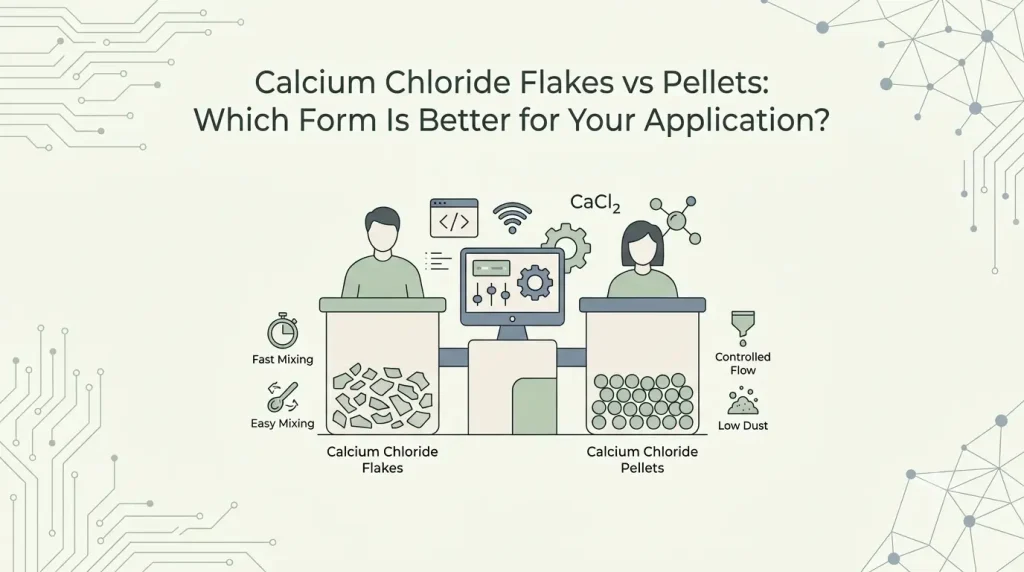
What Are Calcium Chloride Flakes and Pellets?
Calcium chloride (CaCl₂) is a highly hygroscopic salt capable of absorbing moisture from the surrounding environment. Commercial products are commonly available in several physical forms, including flakes, pellets, powders, and liquids.
Calcium Chloride Flakes: Thin and Fast-Dissolving
Flakes are produced by drying calcium chloride solutions into thin, irregular pieces.
Typical characteristics include:
- Irregular shape
- Large surface area
- Rapid dissolution
- Easy blending with water
- Common purity levels between 74% and 77%
Because flakes expose more surface area to water, they generally dissolve more quickly than larger solid forms.
Calcium Chloride Pellets: Dense and Uniform
Pellets are manufactured through granulation or compaction processes that create relatively uniform particles.
Typical characteristics include:
- Round or cylindrical shape
- Higher bulk density
- Reduced dust generation
- Better flow characteristics
- Common purity levels between 90% and 94%
The uniform structure makes pellets easier to store, transport, and dispense mechanically.
Calcium Chloride Flakes vs Pellets: Side-by-Side Comparison
| Factor | Calcium Chloride Flakes | Calcium Chloride Pellets |
|---|---|---|
| Physical Shape | Thin irregular pieces | Uniform granules or pellets |
| Typical Purity | 74–77% | 90–94% |
| Dissolution Speed | Faster | Moderate |
| Dust Generation | Moderate | Low |
| Flowability | Fair | Excellent |
| Storage Stability | Good | Excellent |
| Automated Feeding Systems | Less suitable | Highly suitable |
| Moisture Absorption | High | High |
| Handling Convenience | Moderate | High |
| Common Applications | Brine preparation, dust control | Deicing, moisture control, industrial dosing |
The most important distinction is not the chemical composition but how the product behaves during handling and application.
Dissolution Performance: Which Form Mixes Faster?
One of the most frequently discussed aspects of calcium chloride flakes vs pellets is dissolution speed.
Why Flakes Dissolve Faster
The dissolution process depends largely on exposed surface area.
Flakes have:
- Thin profiles
- Irregular edges
- Greater contact area with water
As a result, water can penetrate the material more quickly, accelerating dissolution.
Why Pellets Dissolve More Slowly
Pellets are denser and thicker than flakes.
Although they eventually achieve the same concentration in solution, they generally require:
- Longer mixing times
- Greater agitation
- Additional dissolution time in cold water
For applications where brine must be prepared quickly, flakes often provide operational advantages.
Typical Uses Requiring Fast Dissolution
Applications that frequently favor flakes include:
- Brine preparation
- Water treatment
- Industrial chemical mixing
- Food processing solutions
In these situations, reducing mixing time can improve operational efficiency.
Storage and Handling Characteristics
Storage conditions can significantly affect calcium chloride performance because the product readily absorbs moisture from the air.
Hygroscopic Behavior
According to the U.S. Food and Drug Administration (FDA), calcium chloride is recognized for its ability to absorb moisture and dissolve readily in water.
This hygroscopic nature creates both advantages and challenges.
Benefits include:
- Effective humidity control
- Moisture removal
- Dust suppression
Challenges include:
- Clumping during storage
- Packaging requirements
- Exposure sensitivity
Pellet Advantages in Storage
Pellets typically perform better during long-term storage because they:
- Generate less dust
- Resist caking more effectively
- Flow more consistently
- Pack efficiently
For warehouses managing large inventories, these characteristics can simplify handling procedures.
Flake Storage Considerations
Flakes remain stable when stored correctly but may:
- Compact more easily
- Generate additional fines
- Require greater attention to moisture protection
Proper packaging is important regardless of product form.
Calcium Chloride Flakes vs Pellets for Deicing
Deicing is among the largest commercial applications for calcium chloride.
Why Calcium Chloride Is Effective
Calcium chloride releases heat when dissolving.
This exothermic reaction helps:
- Accelerate ice melting
- Reduce bond formation between ice and pavement
- Maintain effectiveness at low temperatures
Many calcium chloride products remain effective at temperatures below -20°F (-29°C).
Flakes for Rapid Coverage
Flakes can provide:
- Quick dissolution
- Fast brine formation
- Broad surface coverage
These characteristics may improve initial melting performance.
Pellets for Controlled Application
Pellets often provide:
- More uniform spreading
- Reduced wind drift
- Longer surface persistence
Many road maintenance agencies prefer pelletized products for mechanical spreaders due to their consistent particle size.
Dust Control and Moisture Management Applications
Dust Suppression
Calcium chloride is commonly applied to:
- Gravel roads
- Construction sites
- Mining operations
- Agricultural roads
Its moisture-attracting properties help maintain surface moisture and reduce airborne particles.
Flakes for Dust Control
Flakes are often selected because they:
- Dissolve quickly
- Create brine rapidly
- Penetrate road surfaces efficiently
Pellets for Long-Term Moisture Control
Pellets may be advantageous when:
- Controlled release is desired
- Material handling efficiency is important
- Automated application systems are used
Both forms can achieve effective dust suppression when applied at appropriate concentrations.
Is Calcium Chloride Flakes Better Than Pellets for Industrial Processing?
The answer depends on the process requirements.
Choose Flakes When:
- Fast dissolution is critical
- Batch mixing is common
- Operators manually prepare solutions
- Short preparation times are required
Choose Pellets When:
- Precise dosing is necessary
- Automated systems are used
- Long-term storage is expected
- Material flow consistency is important
Many industrial facilities evaluate not only chemical performance but also labor efficiency, storage costs, and process reliability.
Decision Matrix: Choosing the Right Form
Choose Calcium Chloride Flakes When:
- Rapid dissolution is the highest priority
- Brine preparation occurs frequently
- Mixing equipment has limited agitation capability
- Application requires fast chemical activation
- Storage periods are relatively short
Choose Calcium Chloride Pellets When:
- Automated feeding systems are used
- Low dust generation is preferred
- Long-term storage is expected
- Consistent particle size is required
- Transportation efficiency is important
Consider Either Form When:
- Purity specifications are equivalent
- Moisture absorption is the primary objective
- Application performance has been validated through testing
- Existing equipment can handle both products effectively
Common Procurement Factors to Evaluate
Purchasing decisions should extend beyond product form alone.
Product Purity
Higher purity products generally contain more active calcium chloride per unit weight.
Common commercial grades include:
| Grade | Typical Calcium Chloride Content |
|---|---|
| Flakes | 74–77% |
| Pellets | 90–94% |
| Industrial Solutions | 30–38% |
Packaging Options
Buyers should evaluate:
- Bag sizes
- Bulk shipment availability
- Pallet configuration
- Moisture-resistant packaging
Supply Chain Stability
Important considerations include:
- Manufacturing consistency
- Lead times
- Seasonal availability
- Inventory management requirements
Regulatory Compliance
For food, pharmaceutical, or specialty industrial applications, ensure compliance with relevant specifications and documentation requirements.
Conclusion
The choice between calcium chloride flakes vs pellets ultimately depends on application requirements, handling preferences, and operational priorities. Flakes generally provide faster dissolution and efficient solution preparation, while pellets offer superior flowability, lower dust generation, and improved performance in automated systems.
Procurement teams should evaluate purity levels, storage conditions, application methods, and equipment compatibility before making a selection. In many cases, the most cost-effective option is not simply the lowest-priced product, but the form that best supports operational efficiency and consistent performance.
The right choice depends on your specific use case. Start by assessing how the material will be stored, mixed, transported, and applied before comparing available options.
FAQs
What is the difference between calcium chloride flakes and pellets?
The primary difference is physical form. Flakes are thin and irregular, while pellets are dense and uniform. This affects dissolution speed, handling characteristics, storage behavior, and application methods. Chemically, both products contain calcium chloride and can provide similar performance when purity levels are comparable.
Which dissolves faster, calcium chloride flakes or pellets?
Calcium chloride flakes generally dissolve faster because they have a larger exposed surface area. Water can penetrate thin flakes more quickly than dense pellets, reducing mixing time during solution preparation and brine production.
Are calcium chloride pellets stronger than flakes?
Not necessarily. Performance depends on purity and application requirements. Many pellets contain 90–94% calcium chloride, while flakes often contain 74–77%. Higher purity means more active ingredient per pound, but it does not automatically make pellets better for every application.
Which form is better for deicing roads?
Both forms are effective for deicing. Flakes often provide faster initial melting, while pellets offer more controlled spreading and reduced material loss during application. The best choice depends on equipment and environmental conditions.
Can calcium chloride flakes and pellets be used interchangeably?
In many applications they can be used interchangeably, but adjustments may be required for dosing rates, mixing times, and handling procedures. Equipment designed for uniform particle sizes may perform better with pellets.
Is calcium chloride safe to store long term?
Yes, when stored in sealed, moisture-resistant containers. Because calcium chloride is hygroscopic, exposure to humidity can lead to clumping or partial dissolution. Proper storage conditions are important regardless of product form.
Which form creates less dust during handling?
Calcium chloride pellets typically generate less dust than flakes. Their uniform structure reduces particle breakage and minimizes airborne fines during transportation, storage, and application.
When should buyers choose calcium chloride flakes?
Flakes are often preferred when rapid dissolution is required, such as in brine preparation, water treatment operations, and industrial mixing processes where minimizing preparation time is important.
Are calcium chloride pellets more expensive than flakes?
Pricing varies by purity, packaging, transportation costs, and market conditions. Pellets may have higher production costs, but improved handling efficiency can offset price differences in some operations.
What industries use calcium chloride pellets most frequently?
Pellets are widely used in road maintenance, industrial processing, humidity control, oil and gas operations, chemical manufacturing, and facilities that rely on automated material handling systems.