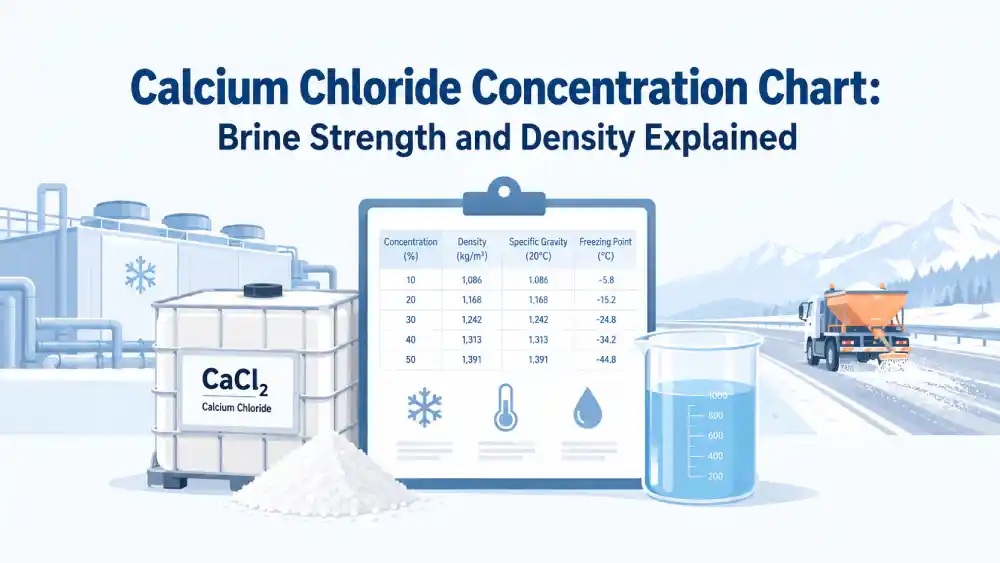
Calcium chloride brine dilution is a critical operation for engineers across dust control, concrete acceleration, tire weighting, and refrigeration applications. Calcium chloride is safe when handled properly. The key risks are thermal burns from the exothermic dissolution reaction and improper concentration leading to suboptimal performance or equipment damage. This guide provides step-by-step dilution procedures for achieving target concentrations from 5% to 38% by weight.
What This Article Covers
- Dilution mathematics: The formula for calculating water requirements from a stock brine concentration
- Application-specific targets: Required concentrations for dust control, concrete acceleration, tire ballast, and refrigeration
- Step-by-step workflow: Proper mixing sequence to avoid caking and thermal hazards
- Troubleshooting: Solutions for incomplete dissolution, crystallization, and concentration verification
- Bottom line: Accurate dilution requires accounting for the specific gravity of your stock solution—volume-based approximations introduce errors up to 15%.

What Is Calcium Chloride Brine and Why Does Concentration Matter?
Calcium chloride brine is an aqueous solution of Calcium Chloride (CaCl₂) used across industrial applications for its hygroscopic, exothermic, and freeze-point-depressing properties. The concentration of the brine—expressed as percent CaCl₂ by weight—determines nearly every performance characteristic: freezing point, density, viscosity, and effectiveness as a dust palliative or concrete accelerator.
A 30% calcium chloride brine freezes at approximately 3°F (-16°C), while a 32% solution reaches its eutectic minimum near -60°F (-51°C). For dust control, the most common liquid concentration in the United States is 38% by weight, though Canadian practice favors 35% due to different climatic conditions. Concrete acceleration requires much lower concentrations—typically not exceeding 2% calcium chloride by mass of cementitious material.
Engineers must understand that brine concentration cannot be inferred from appearance alone. A clear, colorless solution may range from 5% to 40% CaCl₂. Hydrometer measurement or refractometry is required for accurate verification.
How Do You Calculate Calcium Chloride Brine Dilution Ratios?
The dilution formula accounts for the specific gravity difference between your stock solution and the target concentration. A volume-based dilution (simply adding water without specific gravity correction) introduces significant error because calcium chloride brine is substantially denser than water.
The industry-standard formula for dilution is:
Volume of water to add = [ (C₁ - C₂) / C₂ ] × SG₁ × V₁
Where:
- C₁ = stock concentration (% CaCl₂ by weight)
- C₂ = target concentration (% CaCl₂ by weight)
- SG₁ = specific gravity of stock solution
- V₁ = volume of stock solution
Worked example: To dilute 50 mL of 30% brine (specific gravity 1.283) to 10%:
- Dilution factor = (30 - 10) / 10 = 2.0
- Specific gravity correction = 2.0 × 1.283 = 2.566
- Water volume = 2.566 × 50 mL = 128 mL
The resulting volume will be approximately 178 mL of 10% brine.
Dilution Reference Table
| Target Concentration | Dilution Factor from 30% | mL Water per 50 mL Stock |
|---|---|---|
| 20% | 0.642 | 32 mL |
| 15% | 1.283 | 64 mL |
| 10% | 2.566 | 128 mL |
| 5% | 6.415 | 321 mL |
| 2% | 17.96 | 898 mL |
Calculated using specific gravity 1.283 for 30% stock solution.
How to Dilute Calcium Chloride Brine: Step-by-Step Workflow
Prerequisites and Safety Preparation
- Stock solution: 30% or 38% calcium chloride brine (confirm concentration by hydrometer)
- Dilution water: Potable water or deionized water at 60-70°F (15-21°C)
- Mixing vessel: Plastic or stainless steel tank with volume capacity 25% above final target volume
- Mixing equipment: Mechanical agitator or recirculation pump rated for brine service
- PPE: Chemical splash goggles, nitrile gloves, rubber apron, face shield
- Measurement tools: Hydrometer (specific gravity range 1.000-1.400), graduated cylinder, thermometer
Step 1: Verify Stock Concentration and Specific Gravity
Measure the specific gravity of your stock brine using a hydrometer at 60°F. Cross-reference against standard tables to confirm concentration. A 30% CaCl₂ solution at 60°F exhibits a specific gravity of approximately 1.283. If the measured value deviates by more than 0.005, adjust your calculations accordingly.
Expected result: Confirmed concentration value and specific gravity reading for use in the dilution formula.
Step 2: Calculate Required Water Volume
Apply the dilution formula using your verified stock concentration. For large-scale operations, the weight-based approach may be preferred: a 3,400-gallon tank requires 16,864 pounds of 78% flake calcium chloride and 2,620 gallons of water to produce a 34% solution.
Expected result: Precise water volume in gallons or milliliters, and if using dry product, precise calcium chloride mass.
Step 3: Fill Mixing Vessel with Water First
Always add calcium chloride to water—never water to calcium chloride. This sequence provides thermal mass to absorb the heat of solution and prevents localized boiling or splattering. Fill your vessel with 80-90% of the calculated water volume.
Expected result: Water ready to receive calcium chloride addition.
Step 4: Add Calcium Chloride Gradually with Continuous Agitation
Add calcium chloride brine or dry product slowly to the water while maintaining vigorous agitation. The dissolution of solid calcium chloride is highly exothermic: making a 30% solution from 83-87% flake material raises the temperature by approximately 84°F (29°C). If dry solids are allowed to sit motionless in contact with water, a hard cake forms that resists dissolution.
For liquid-to-liquid dilution, add stock brine to the water stream under recirculation.
Expected result: Complete dissolution with a temperature rise of 20-85°F depending on starting materials.
Step 5: Verify Final Concentration and Specific Gravity
Allow the solution to cool to 60°F if elevated temperature is observed. Measure specific gravity and convert to concentration using standard tables. Make minor adjustments with water or stock brine as needed.
Expected result: Confirmed concentration within ±0.5% of target.
Step 6: Transfer to Storage or Application Equipment
Transfer diluted brine to application tanks, spreader trucks, or storage containers. For dust control applications, typical application rates range from 0.20 to 0.50 gallons per square yard depending on surface material and climate conditions.
Expected result: Ready-to-use brine at target concentration.
What Are the Required Concentrations for Specific Applications?
Different applications demand distinct calcium chloride brine dilution targets. Using an incorrect concentration reduces effectiveness or creates operational problems.
| Application | Target Concentration | Key Function | Notes |
|---|---|---|---|
| Dust control (US standard) | 38% by weight | Hygroscopic dust suppression | Higher concentrations crystallize when cooled |
| Dust control (Canada standard) | 35% by weight | Dust suppression in cooler climates | Better low-temperature stability |
| Concrete acceleration | ≤2% by mass of cement | Accelerate set time | Exceeding 2% risks corrosion and strength loss |
| Tire ballast | 25-30% by weight | Weight addition and freeze protection | Adds ~30% to weight of water |
| Refrigeration brine | 25-29% by weight | Secondary coolant | Eutectic concentration provides lowest freeze point |
| Drilling fluid | 8.4-11.6 lb/gal density range | Density control | Density determined by application requirements |
Choose the Right Dilution Approach
Choose high-concentration dilution (30-38%) when:
- Ambient relative humidity consistently exceeds 30%
- Application is for unpaved road dust control
- Storage temperatures remain above 20°F (-7°C)
Choose moderate-concentration dilution (20-25%) when:
- Winter temperatures drop below 0°F (-18°C)
- Brine will be stored in unheated tanks
- Tire weighting or refrigeration applications require moderate freeze protection
Choose low-concentration dilution (2-10%) when:
- Concrete acceleration is the objective
- Soil stabilization requires controlled application
- Laboratory or analytical procedures specify dilute concentrations
Concrete Acceleration: A Special Case for Calcium Chloride Brine
Concrete acceleration requires dramatically lower calcium chloride concentrations than other applications. The American Concrete Institute specifies that calcium chloride “should not be used in amounts in excess of 2%, preferably 1%, of the mass of cementitious material”. This limitation exists because chloride ions promote corrosion of reinforcing steel and prestressing strands.
For concrete applications, prepare a dilute brine by adding calcium chloride to the mixing water. A 30% brine can be diluted to 10-15% for metering convenience, then further adjusted based on cement content. Research demonstrates that concrete with 2% calcium chloride achieves equivalent cure strength at 50°F as plain concrete at 70°F.
Troubleshooting Calcium Chloride Brine Dilution
Symptom: Hard cake forms at vessel bottom
Solution: Calcium chloride solids were added too quickly or without sufficient agitation. Pre-dissolve all solids in a small volume of water before adding to the main batch.
Symptom: Crystals appear upon cooling
Solution: The solution is supersaturated at the storage temperature. Review the freeze point data for your concentration and dilute to a lower concentration that remains stable at expected low temperatures.
Symptom: Temperature spike exceeds 100°F
Solution: Addition rate was too fast. Add calcium chloride in smaller increments with agitation pauses between additions to allow heat dissipation.
Symptom: Concentration verification yields inconsistent readings
Solution: Calcium chloride brine is alkaline (pH ~9 for 35% solution) and may affect some hydrometers. Clean hydrometer with dilute acid solution and calibrate against known standards.
Symptom: Diluted brine freezes in storage tank
Solution: The target concentration is below the freeze point for your climate. Reference the freeze point table and select a higher concentration for winter storage.
FAQs
What is the correct sequence for mixing calcium chloride brine?
Always add calcium chloride to water, never water to calcium chloride. This sequence provides water thermal mass to absorb the heat of solution. The dissolution of 83-87% flake calcium chloride raises solution temperature by up to 84°F when making 30% brine.
How do I dilute 38% calcium chloride brine to 10%?
Apply the dilution formula: (38 - 10) / 10 × 1.357 (specific gravity of 38% brine) = 3.80 dilution factor. For 100 mL of 38% stock, add 380 mL of water to achieve approximately 10% concentration.
Is calcium chloride brine dilution different from sodium chloride brine dilution?
Yes, significantly. Calcium chloride has a much higher specific gravity per unit concentration and releases substantially more heat during dissolution. Sodium chloride dilution calculations typically use simpler volumetric ratios because density differences are smaller.
How long does diluted calcium chloride brine remain stable in storage?
Properly stored calcium chloride brine remains stable indefinitely if protected from evaporation and contamination. The solution is hygroscopic and will absorb atmospheric moisture, gradually diluting itself. For critical applications, verify concentration before use if storage exceeds 30 days.
Can I use tap water for calcium chloride brine dilution?
Potable water is acceptable for most industrial applications. Deionized or distilled water is preferred for laboratory work, refrigeration brines, and applications where mineral scaling could impair heat transfer.
What concentration of calcium chloride brine is needed for dust control?
The standard concentration for dust control in the United States is 38% by weight. Canadian practice typically uses 35% due to cooler average temperatures. Concentrations above 38% may crystallize as the solution cools.
How does temperature affect calcium chloride brine dilution calculations?
Specific gravity changes with temperature: brine is denser when cool. Dilution calculations should reference 60°F (15.5°C) standard. If stock brine is at a different temperature, adjust specific gravity reading using temperature correction tables.
What is the freezing point of 30% calcium chloride brine?
A 30% calcium chloride solution freezes at approximately 3°F (-16°C). Lower concentrations have higher freezing points; higher concentrations reach the eutectic minimum near 29.6% where freezing point drops to -60°F (-51°C).
Can diluted calcium chloride brine be used for concrete acceleration?
Yes, but with strict concentration limits. The American Concrete Institute recommends not exceeding 2% calcium chloride by mass of cementitious material. Dilute brine is added to mixing water, not directly to dry cement.
How do I verify calcium chloride brine concentration without a hydrometer?
Refractometry provides rapid concentration measurement for field verification. Alternatively, titrate a sample with silver nitrate solution to determine chloride concentration. For engineering accuracy, hydrometer measurement remains the preferred method.
Conclusion
Calcium chloride brine dilution is a precise operation that requires understanding the relationship between concentration, specific gravity, and application requirements. The key is to always verify your stock concentration, calculate dilution volumes using the specific gravity formula, and add calcium chloride to water with continuous agitation. When evaluating dilution procedures, prioritize specific gravity correction over simple volumetric ratios—the density difference between calcium chloride brine and water introduces errors of 15-35% in uncorrected calculations. Apply these steps to your next calcium chloride brine preparation and measure the results against your target concentration specifications.