Technical procurement teams working with calcium chloride face a persistent problem: concentration values arrive in inconsistent formats. One supplier reports specific gravity, another cites Baumé degrees, and a third lists percentage by weight. Converting between these systems introduces errors that compromise brine performance in refrigeration loops, dust suppression, or deicing applications. A reliable calcium chloride concentration chart eliminates guesswork, but only when the underlying relationships between strength, density, and freezing point are clearly understood.
This article explains how calcium chloride brine concentration is measured, interpreted, and selected for industrial applications. It covers the major concentration scales, the density-strength relationship, freezing point behavior across concentrations, and the practical criteria for specifying brine strength in procurement documents.
Calcium chloride is safe when handled properly. The key risks are thermal burns from its exothermic dissolution, eye irritation from dust or concentrated solutions, and corrosion of unprotected metals. The main causes are inadequate personal protective equipment, improper dilution procedures, and insufficient corrosion inhibition in closed-loop systems.
What Is Calcium Chloride Concentration and Why Does Measurement Matter?
Calcium chloride concentration expresses how much CaCl₂ is dissolved in a brine solution. The three primary measurement methods are percentage by weight, specific gravity, and Baumé degrees. Each scale serves different operational needs.
Percentage by weight is the most direct expression: a 30% calcium chloride brine contains 30 grams of anhydrous CaCl₂ per 100 grams of solution. This is the preferred scale for procurement specifications because it ties directly to chemical delivery and cost calculations.
Specific gravity measures solution density relative to water at a defined reference temperature, typically 60°F or 68°F. For calcium chloride brines, specific gravity ranges from 1.000 (pure water) to approximately 1.416 at saturation . This scale is critical for applications where brine density affects system hydraulics or formation pressure control.
Baumé degrees provide a legacy scale still encountered in refrigeration and older plant documentation. The relationship between Baumé and specific gravity depends on whether the solution is heavier or lighter than water. For calcium chloride brines, the conversion is approximated by the formula: Specific Gravity = 145 / (145 - °Bé) at 60°F.
Consistency in concentration measurement is essential for procurement because brine performance specifications depend on the scale used. A purchase order citing “30% calcium chloride” references weight percent, while a plant operating manual citing “30° Baumé” describes a different concentration entirely.
How Does Calcium Chloride Concentration Chart Relate Strength to Density?
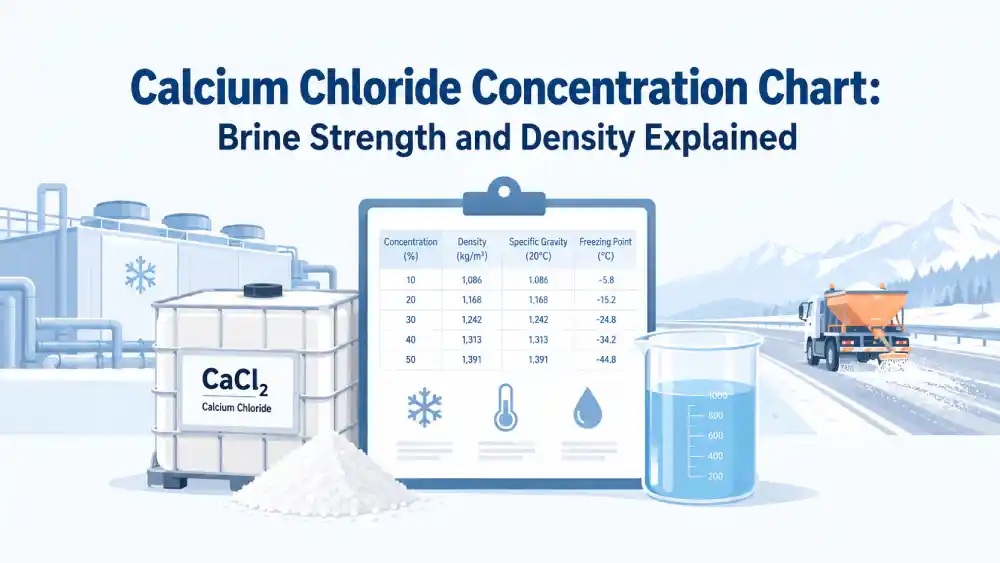
The calcium chloride concentration chart establishes the direct relationship between CaCl₂ weight percentage and solution density across the practical range. This relationship is nonlinear: density increases more rapidly at higher concentrations.
At 10% CaCl₂ by weight, specific gravity is approximately 1.087 and density is about 9.06 lb/gal. At 20%, specific gravity rises to 1.182 and density reaches approximately 9.80 lb/gal. At 30%, specific gravity is approximately 1.283. At 40%, the solution approaches saturation with specific gravity near 1.416 .
| CaCl₂ Concentration (% by weight) | Specific Gravity (60°F) | Density (lb/gal) | Freezing Point (°F) | Freezing Point (°C) |
|---|---|---|---|---|
| 5% | 1.043 | ~8.68 | 27.5°F | -2.5°C |
| 10% | 1.087 | ~9.06 | 22°F | -5.6°C |
| 15% | 1.134 | ~9.45 | 15°F | -9.6°C |
| 20% | 1.182 | ~9.85 | 5°F | -14.8°C |
| 25% | 1.234 | ~10.28 | -8°F | -22.1°C |
| 30% | 1.283 | ~10.69 | -50°F | -46°C |
| 35% | 1.338 | ~11.15 | -60°F | -51°C |
| 40% | 1.416 | ~11.80 | ~-70°F | ~-57°C |
Typical market reference values for calcium chloride brine properties. Actual values may vary with temperature and specific gravity measurement conditions.
The density range has practical implications for storage and handling. A 30% brine weighs approximately 10.7 lb/gal, meaning a 5,000-gallon storage tank holds roughly 53,500 pounds of solution. Procurement teams must verify that tank foundations, pumps, and piping are rated for the higher density compared to water.
The density-concentration relationship also determines dilution calculations. To reduce a concentrated brine to a target strength, the volume of water required follows the formula: (Strong Concentration - Weak Concentration) / Weak Concentration × Specific Gravity of Strong Solution × Volume of Strong Solution .
For example, diluting 50 mL of 30% calcium chloride brine (specific gravity 1.283) to 10% requires adding 128 mL of water. This calculation is embedded in most brine management software, but procurement specifications should reference the underlying concentration chart to avoid errors during site-level dilution.
What Is the Freezing Point Curve for Calcium Chloride Brine?
The freezing point curve is the most operationally significant feature of the calcium chloride concentration chart. Unlike sodium chloride, which exhibits a single eutectic point at -6°F, calcium chloride brine achieves progressively lower freezing points as concentration increases, reaching a eutectic minimum near -60°F at approximately 30-32% concentration .
At concentrations below 15%, freezing point depression follows a predictable linear relationship. Each additional 1% CaCl₂ by weight lowers the freezing point by approximately 0.5°F to 1.5°F. At 10% concentration, brine freezes at 22°F. At 15%, freezing occurs at 15°F. These concentrations suit moderate climate applications and dust suppression during shoulder seasons.
The curve steepens significantly above 20% concentration. At 25% CaCl₂, freezing point drops to -8°F. At 30%, the brine remains liquid to approximately -50°F, making it suitable for the most demanding refrigeration and deicing applications .
Concentrations above 32% offer diminishing returns. The freezing point plateau approaches the eutectic limit, and further additions of CaCl₂ do not meaningfully depress the freezing point. At 40%, the solution is at or near saturation, and any temperature reduction risks precipitation of calcium chloride hexahydrate crystals.
The eutectic point for calcium chloride brine is approximately -60°F at 30-32% concentration. Brines specified for low-temperature refrigeration should be formulated within this concentration window. Higher concentrations waste material without improving freeze protection, and lower concentrations fail to deliver the required low-temperature performance.
How Should Procurement Teams Select Calcium Chloride Brine Concentration?
Concentration selection follows directly from the application requirements. The decision framework prioritizes freezing point first, then considers density requirements, material compatibility, and delivery logistics.
For deicing and anti-icing applications, concentrations between 25% and 32% provide effective performance across most winter conditions. Pre-wetted salt and direct liquid application programs typically use 30% brine because it remains liquid during storage and application in temperatures down to -50°F .
For dust suppression on unpaved roads, lower concentrations between 15% and 25% are sufficient. The hygroscopic mechanism draws moisture from ambient air, and higher concentrations do not accelerate this process meaningfully. The 20-25% range balances performance with material cost.
For closed-loop refrigeration systems, the concentration must be matched to the evaporator temperature with an appropriate safety margin. A system operating at -20°F requires brine concentration of at least 28% to prevent freezing at the heat exchange surface. A safety margin of 10-15°F between operating temperature and brine freezing point is standard practice.
For oilfield completion fluids and packer fluids, density requirements drive concentration selection. A 11.6 lb/gal calcium chloride brine corresponds to approximately 40% concentration by weight . These high-density brines require specialized handling due to their weight and crystallization temperature sensitivity.
Why Does Temperature Affect Calcium Chloride Concentration Measurements?
Solution temperature affects both density and concentration readings. As brine temperature increases, thermal expansion reduces density. A brine measured at 100°F will report a lower specific gravity than the same brine at 60°F.
For a 30% calcium chloride brine, density decreases by approximately 0.4 lb/gal as temperature rises from 60°F to 100°F . This thermal expansion means that volume-based concentration measurements are temperature-dependent. Procurement specifications should reference a standard measurement temperature, typically 60°F or 68°F.
The concentration chart values cited in this article assume measurement at 60°F unless otherwise noted. Field measurements using hydrometers must apply temperature correction factors. Most calcium chloride suppliers provide temperature correction tables or digital meters with automatic temperature compensation.
Temperature also affects crystallization behavior. As brine cools, the least soluble component may begin to precipitate before the bulk solution freezes. The First Crystal to Appear (FCTA) temperature is typically several degrees above the True Crystallization Temperature (TCT) due to supercooling effects . Storage tanks and delivery lines should be maintained above the FCTA to prevent crystal accumulation.
Is Calcium Chloride Brine Corrosive to Common Materials?
Calcium chloride brine is corrosive to many metals, particularly when diluted or when in contact with dissimilar metals. The corrosion mechanism involves chloride attack on passive oxide layers, leading to pitting and galvanic corrosion.
Uninhibited calcium chloride brine can corrode mild steel at rates exceeding 50 mils per year (MPY) under aerated conditions. The addition of corrosion inhibitors—typically phosphate-based compounds, silicates, or zinc salts—can reduce corrosion rates by more than 70% compared to untreated brine .
| Material | Corrosion Risk with Uninhibited CaCl₂ Brine | Mitigation Approach |
|---|---|---|
| Mild Steel | High — pitting and uniform attack | Phosphate inhibitor package |
| Galvanized Steel | Moderate — zinc coating consumed | Avoid if possible; use inhibitor |
| Copper/Brass | Moderate — dezincification risk | Silicate-zinc inhibitors |
| Stainless Steel 304 | Low — generally acceptable | Verify chloride stress corrosion risk |
| Concrete | Low to Moderate — scaling possible | Surface sealers, limited exposure |
| Polyethylene/PVC | Low — compatible for piping | Standard materials acceptable |
Typical market reference values. Corrosion rates depend on temperature, aeration, and inhibitor concentration.
Procurement specifications for calcium chloride brine used in metal-contact applications should require corrosion inhibitor addition at the supplier level or specify an on-site inhibitor dosing program. The inhibitor package must be compatible with the brine concentration and operating temperature range.
Concrete exposure presents a separate concern. While calcium chloride does not attack concrete chemically in the way that sulfate salts do, repeated freeze-thaw cycles with brine can cause surface scaling. Air-entrained concrete provides better resistance, and surface sealers reduce brine penetration.
What Are the Common Concentration Units and How Do They Convert?
Technical buyers frequently encounter four concentration expressions: weight percent, specific gravity, Baumé degrees, and salometer degrees. Conversion between these scales is necessary when comparing supplier documentation or translating legacy plant specifications.
Weight percent to specific gravity follows the concentration chart relationship described earlier. No simple linear formula captures the full range because the density-concentration curve is nonlinear. The chart or a lookup table is required for accurate conversion.
Specific gravity to Baumé uses the formula: °Bé = 145 - (145 / Specific Gravity) at 60°F. A brine with specific gravity 1.283 corresponds to approximately 32.0° Baumé.
Salometer degrees are sometimes referenced in older refrigeration literature but are less common for calcium chloride than for sodium chloride. The salometer scale is calibrated for sodium chloride saturation and requires correction for calcium chloride.
| Concentration Scale | 10% CaCl₂ | 20% CaCl₂ | 30% CaCl₂ | 40% CaCl₂ |
|---|---|---|---|---|
| Weight Percent | 10.0% | 20.0% | 30.0% | 40.0% |
| Specific Gravity (60°F) | 1.087 | 1.182 | 1.283 | 1.416 |
| Baumé (60°F) | 13.4° | 22.3° | 32.0° | 42.6° |
| Density (lb/gal) | 9.06 | 9.85 | 10.69 | 11.80 |
Typical market reference values. Baumé conversion assumes the heavier-than-water formula.
Procurement documents should specify calcium chloride concentration in weight percent and include the measurement temperature for specific gravity verification. This eliminates ambiguity when brine is received at the plant gate.
What to Look for in Calcium Chloride Concentration Data from Suppliers?
Supplier-provided concentration data must be verifiable, traceable, and tied to a recognized measurement standard. The following criteria distinguish reliable calcium chloride concentration documentation from inadequate records.
Certificate of Analysis (CoA) requirements. Every brine delivery should include a CoA stating calcium chloride concentration in weight percent, specific gravity at a defined temperature, and the test method used (e.g., ASTM D1293 or equivalent). The CoA should reference the production lot and date of manufacture.
Measurement temperature documentation. Concentration and specific gravity values without a stated reference temperature are incomplete. A specific gravity of 1.28 at 40°F represents a different concentration than 1.28 at 80°F. Require suppliers to document measurement temperature on all certificates.
Inhibitor concentration reporting. If corrosion inhibitors are added, the CoA should state the inhibitor chemistry and dosage rate. Phosphate-based inhibitors are typically reported as parts per million of PO₄. This information is essential for maintaining inhibitor levels through dilution and system top-up.
Freezing point verification. For low-temperature applications, request a freezing point confirmation on the CoA. This can be calculated from concentration using the standard curve or measured directly by differential scanning calorimetry. The reported value should align with the concentration chart within the expected tolerance.
Consistency across deliveries. Procurement teams should track concentration and specific gravity values across successive deliveries from the same supplier. Systematic drift indicates either process variability at the production facility or measurement inconsistency. Both warrant corrective action.
Common Mistakes to Avoid in Calcium Chloride Concentration Specification
Several recurring errors compromise brine performance and increase operational costs. Recognizing these pitfalls improves procurement outcomes.
Confusing weight percent with volume percent. Calcium chloride solutions are almost universally specified by weight percent, but some legacy documentation uses weight/volume (w/v) expressions. A 30% w/v solution is approximately 25% w/w due to the density of the solution. This discrepancy can cause freezing point failures in refrigeration systems.
Neglecting temperature correction. Field measurements taken with hydrometers without temperature correction introduce errors of 1-3% concentration. In critical applications, this translates to 5-15°F of freezing point uncertainty.
Over-concentrating for dust suppression. Higher concentration does not always mean better performance. For dust suppression, 20-25% brine provides the same hygroscopic benefit as 30% brine at lower material cost. Over-concentration also increases corrosion risk and residue accumulation on road surfaces.
Ignoring crystallization in storage. High-concentration brines stored in unheated tanks during winter may crystallize. A 35% brine begins to precipitate calcium chloride hexahydrate at temperatures below approximately 50°F. Storage tank heating or concentration reduction to 30% or below prevents crystallization.
Using the wrong corrosion inhibitor for the metal system. Phosphate inhibitors protect steel but may not adequately protect galvanized surfaces. Silicate-zinc formulations provide broader protection but require pH control. Matching inhibitor chemistry to the system metallurgy is essential.
FAQs
What is a calcium chloride concentration chart?
A calcium chloride concentration chart is a reference table that correlates CaCl₂ weight percentage with specific gravity, density, and freezing point. It allows technical buyers and operators to convert between measurement scales and select the appropriate brine strength for a given application. Charts typically cover the range from 1% to 40% CaCl₂ by weight.
How does calcium chloride concentration affect freezing point?
Freezing point decreases as calcium chloride concentration increases up to the eutectic point at approximately 30-32% CaCl₂. At this concentration, brine remains liquid to about -60°F. Further concentration increases do not meaningfully depress the freezing point and risk crystallization. The relationship is nonlinear, with steeper freezing point depression occurring above 20% concentration .
Is calcium chloride brine denser than water?
Yes, calcium chloride brine is significantly denser than water. At 10% concentration, specific gravity is approximately 1.087. At 30%, specific gravity reaches 1.283, meaning the brine weighs 28.3% more than an equal volume of water. At saturation near 40%, specific gravity approaches 1.416 .
What concentration of calcium chloride is used for dust control?
Dust suppression applications typically use 20-25% calcium chloride brine. This concentration provides sufficient hygroscopicity to maintain surface moisture without excessive material cost or corrosion risk. Higher concentrations offer no performance advantage for dust control and increase residue accumulation.
How do you convert Baumé degrees to specific gravity for calcium chloride?
Use the formula: Specific Gravity = 145 / (145 - °Bé) for brines heavier than water, measured at 60°F. For example, 30° Baumé corresponds to specific gravity 1.271. This conversion is accurate for calcium chloride concentrations between 10% and 40%.
What is the eutectic point of calcium chloride brine?
The eutectic point of calcium chloride brine is approximately -60°F (-51°C) at a concentration of 30-32% CaCl₂ by weight. At this point, the brine freezes as a single composition without separation of components. Operating below the eutectic temperature causes complete solidification of the brine.
Is calcium chloride brine corrosive to stainless steel?
Calcium chloride brine presents low corrosion risk to 300-series stainless steels under most conditions, but chloride stress corrosion cracking can occur at elevated temperatures and concentrations. Type 316 stainless steel offers better resistance than Type 304. For critical applications, verify material compatibility with the brine supplier and consider corrosion inhibitor addition .
How should calcium chloride brine be stored to prevent concentration changes?
Store calcium chloride brine in sealed tanks to prevent moisture absorption from ambient air, which dilutes the concentration. For high-concentration brines above 30%, maintain tank temperature above 50°F to prevent crystallization. Above-ground tanks should be shaded or insulated to minimize temperature-driven density variation.
What is the difference between food grade and technical grade calcium chloride concentration?
Concentration specifications are similar between food grade and technical grade calcium chloride, typically ranging from 30% to 40% for liquid products. The difference lies in purity requirements: food grade must meet FCC or USP standards for heavy metals and other contaminants, while technical grade is governed by industrial specification requirements.
How do you calculate dilution for calcium chloride brine?
Use the formula: Water to Add = ((Strong Concentration - Weak Concentration) / Weak Concentration) × Specific Gravity of Strong Brine × Volume of Strong Brine. For example, diluting 100 gallons of 30% brine (specific gravity 1.283) to 15% requires adding approximately 128 gallons of water .
Conclusion
The calcium chloride concentration chart is more than a reference table—it is the foundation for accurate brine specification, safe handling, and reliable performance across deicing, dust suppression, refrigeration, and oilfield applications. Calcium chloride concentration drives every critical property: density for system hydraulics, freezing point for low-temperature operation, and dilution ratios for cost-effective material use.
Procurement decisions should prioritize weight percent as the primary concentration specification, supported by specific gravity verification at a documented temperature. The freezing point curve—culminating at the -60°F eutectic near 30-32% concentration—defines the practical operating envelope for low-temperature applications. Corrosion inhibitor requirements must be matched to system metallurgy, and storage conditions must prevent both dilution and crystallization.
For technical buyers evaluating calcium chloride suppliers, request Certificates of Analysis with concentration, specific gravity, measurement temperature, and inhibitor documentation for every delivery. Verify that concentration values align with the published chart for the stated measurement conditions. This practice ensures that the brine received performs as specified in the application.