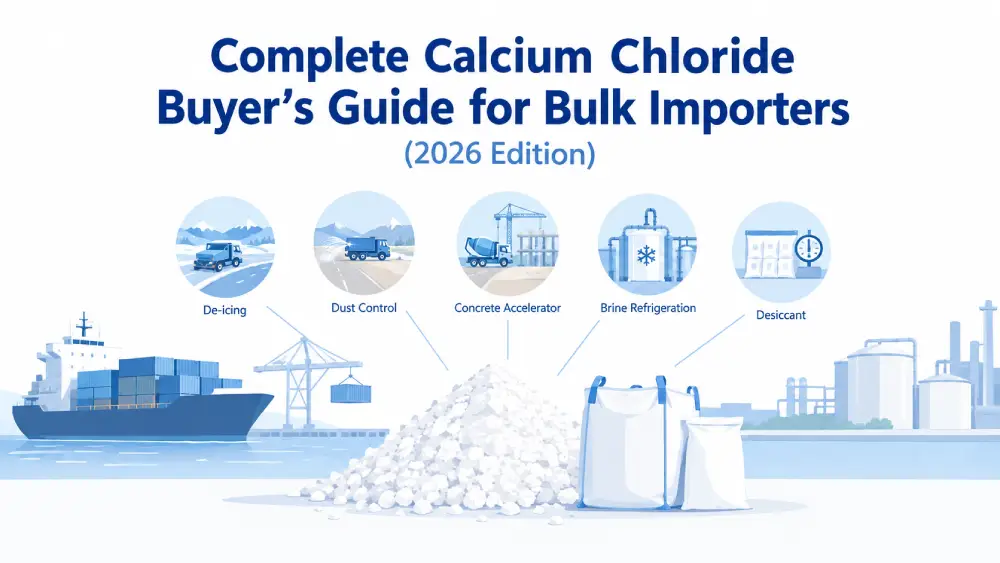
International procurement of industrial chemicals involves documentation requirements, compliance thresholds, and logistics considerations that vary by jurisdiction and product grade. For calcium chloride, a commodity with applications ranging from de-icing to oilfield drilling to food processing, the regulatory landscape differs significantly depending on end use and destination market. This guide addresses the most common questions from importers navigating bulk calcium chloride orders, covering classification, compliance, sourcing, storage, and logistics.
Calcium chloride is safe when handled properly. The key risks are moisture absorption leading to product caking, skin and eye irritation from direct contact, and regulatory non-compliance if documentation is incomplete. The following questions and answers address the practical concerns importers face when sourcing this material in bulk quantities.
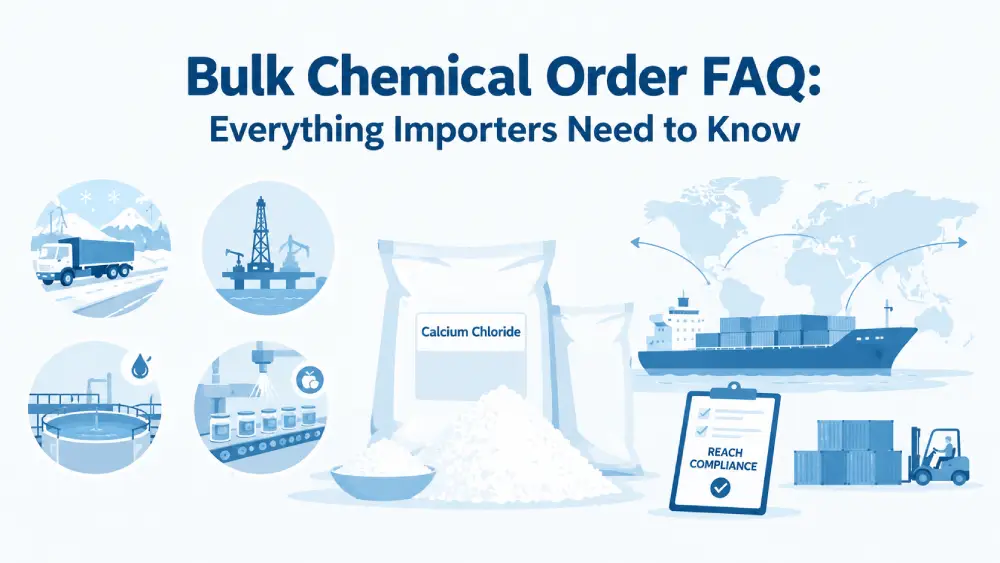
What Is Calcium Chloride and What Forms Are Available for Bulk Import?
Calcium chloride is an inorganic compound with the chemical formula CaCl₂. It exists in two primary forms relevant to bulk trade: dihydrate (CaCl₂·2H₂O, CAS 10035-04-8) and anhydrous (CaCl₂, CAS 10043-52-4). The dihydrate form typically contains 74–77% calcium chloride by weight, while anhydrous grades reach 94–97% purity.
Solid calcium chloride is supplied as white flakes, pellets, granules, or powder. The choice of form affects dissolution rate, storage behavior, and end-use suitability. Flake and pellet forms are common for de-icing and dust control, while powder forms are preferred for rapid dissolution in water treatment and laboratory applications.
For international bulk orders, standard packaging includes 25 kg woven bags with PE liners and 1,000 kg jumbo bags. Liquid calcium chloride is also available in IBC tanks or flexitanks for large-volume industrial users.
How Is Calcium Chloride Classified for Import Tariff Purposes?
Under the Harmonized Tariff Schedule of the United States (HTSUS), calcium chloride is classified under subheading 2827.20.0000. The general duty rate is free for this classification.
Importers should note that Section 301 tariffs may apply to Chinese-origin calcium chloride. List 2 of the Section 301 action covers certain chemical products, with additional duties ranging from 7.5% to 25% depending on the specific tranche and product scope. Verification of current tariff status is recommended before finalizing landed cost calculations.
For other markets, tariff treatment varies. The European Union applies its own tariff schedule, and importers should consult the TARIC database for the applicable rate. Calcium chloride imported into the EU is also subject to REACH regulation, discussed below.
What Documentation Is Required for Bulk Calcium Chloride Shipments?
A complete documentation package for international calcium chloride shipments typically includes the following:
- Bill of Lading (B/L) — Contract of carriage and title document
- Material Safety Data Sheet (MSDS/SDS) — Required in GHS Revision 8 format
- Certificate of Analysis (COA) — Batch-specific test results confirming specification compliance
- Packing List — Itemized contents of the shipment
- Certificate of Origin — Confirming manufacturing country for tariff purposes
- Commercial Invoice — Declared value and terms of sale
- Cargo Insurance Certificate — If shipped under CIF or CIP terms
For calcium chloride classified as non-dangerous goods (most solid forms), a Dangerous Goods Declaration is not required. However, some jurisdictions may require specific import licenses or registration numbers depending on end-use application.
What Are the REACH Requirements for Calcium Chloride Imported into the EU?
Calcium chloride is subject to REACH registration when imported into the European Union in quantities exceeding 1 tonne per year. The regulation, formally (EC) No 1907/2006, requires that substances manufactured or imported above this threshold be registered with the European Chemicals Agency (ECHA).
Key compliance obligations for importers include:
- Registration: Either the importer or an appointed Only Representative must complete registration
- Safety Data Sheet: Updated SDS must accompany shipments and be available throughout the supply chain
- Traceability: Documentation confirming origin and quantity must be maintained
Non-compliance risks include customs blocking, market withdrawal, financial penalties defined at the national level, and legal liability for the importer.
How Should Calcium Chloride Be Stored to Maintain Quality?
Solid calcium chloride is hygroscopic — it absorbs moisture from the air, and in sufficient humidity, it can become deliquescent (dissolving in absorbed moisture). Proper storage is essential to maintain product assay and prevent caking.
Recommended storage conditions:
- Store in a cool, dry, well-ventilated area
- Keep containers tightly sealed when not in use
- Use palletized storage with intact plastic shrouds if outdoor storage is necessary
- Store on well-drained surfaces to prevent moisture wicking
When properly protected from moisture contact, the expected shelf life is 36 months from date of manufacture. Calcium chloride does not degrade chemically; shelf life is limited by moisture intrusion. Lightly caked product may be broken up by knocking the closed package against a hard surface. Do not attempt forceful hammering to break apart severely caked product — flying pieces present an eye hazard, and heavily caked material may be unusable.
What Are Typical Calcium Chloride Prices for Bulk Orders?
Calcium chloride pricing varies by form (dihydrate vs. anhydrous), purity grade, packaging, and delivery terms. As of September 2026, the business agency benchmark price for dihydrate calcium chloride was 1,036.67 RMB per tonne, stable from the beginning of the month.
International FOB pricing indicators from recent market data suggest:
| Form | Origin | Typical FOB Range (USD/tonne) |
|---|---|---|
| Dihydrate (74%) | China | $180–$220 |
| Anhydrous (94%) | China | $250–$300 |
Typical market reference values; actual pricing depends on order volume, Incoterms, and contract terms
Importers should factor in freight costs, insurance, customs duties, and inland transportation when calculating total landed cost. For large-volume contracts, FOB pricing allows independent freight negotiation, while CIF terms provide price certainty at potentially higher all-in cost.
Does Calcium Chloride Require Special Handling During Ocean Freight?
Calcium chloride in solid form is generally not classified as dangerous goods under IMDG Code for most grades. However, the following precautions are recommended for bulk ocean shipments:
- Moisture barrier protection: Use PE-lined bags or container desiccants to prevent moisture ingress during transit
- Pallet integrity: Ensure plastic shrouds remain intact; torn packaging allows moisture penetration
- Ventilation: Avoid container condensation by managing temperature differentials between load and discharge ports
- Stowage: Keep away from direct contact with container walls where condensation may form
For liquid calcium chloride shipments, flexitank or IBC tank arrangements require specific stowage plans and may be subject to additional carrier requirements.
FAQs
What is the difference between calcium chloride dihydrate and anhydrous?
Calcium chloride dihydrate (CaCl₂·2H₂O) contains two water molecules per calcium chloride unit, yielding 74–77% CaCl₂ content by weight. Anhydrous calcium chloride (CaCl₂) contains 94–97% CaCl₂ and is produced through drying processes that remove the water of crystallization. Anhydrous grades command higher prices due to additional processing and are preferred where maximum calcium chloride concentration per unit weight is critical.
How long does it take to receive a bulk calcium chloride order from China?
Lead times vary by supplier and order specifications. For stock products, shipment can occur within 7–10 working days after order confirmation. For custom specifications or large-volume orders, lead times may extend to 4–6 weeks depending on production scheduling and vessel availability. Importers should confirm production timelines before placing time-sensitive orders.
Is calcium chloride considered a dangerous good for shipping?
Calcium chloride in solid form (dihydrate and anhydrous) is generally not classified as dangerous goods under IMDG Code. It is not subject to dangerous goods declarations for most ocean freight shipments. However, the SDS must accompany all shipments, and importers should verify classification with the carrier, as some jurisdictions or specific grades may have different requirements.
What purity grades are available for calcium chloride?
Calcium chloride is supplied in multiple grades:
- Industrial grade: 74–77% (dihydrate), 90–97% (anhydrous)
- Food grade: 99% minimum, meeting Food Chemical Codex (FCC) or equivalent standards
- Feed grade: 94–96%, meeting animal feed additive specifications
Grade selection depends on end use. Industrial applications such as de-icing, dust control, and oilfield use typically employ technical grades, while food processing (tofu coagulation, beverage fortification) requires food-grade material with appropriate certifications.
How does calcium chloride work as a de-icing agent?
Calcium chloride lowers the freezing point of water through colligative properties, and its exothermic dissolution releases heat that accelerates ice melting. A 30% calcium chloride solution freezes at approximately -55°C, making it effective at temperatures where sodium chloride becomes ineffective. The rapid dissolution rate of flake and pellet forms allows quick penetration through snow and ice layers.
Can calcium chloride be stored outdoors?
Yes, with conditions. Calcium chloride on pallets covered by an intact plastic shroud can be stored outdoors on a well-drained surface. If the shroud is torn, pierced, or removed, the product should be moved indoors or under a waterproof covering. Unprotected outdoor storage in humid conditions will lead to moisture absorption, assay reduction, and caking.
What is the REACH registration threshold for calcium chloride?
The REACH registration threshold for calcium chloride is 1 tonne per year for imports into the European Union. Below this threshold, registration is not required. Above it, importers must either register directly with ECHA or appoint an Only Representative to handle registration obligations.
How do I verify the quality of a calcium chloride shipment?
Request a Certificate of Analysis (COA) for each batch before shipment. The COA should include:
- Assay (CaCl₂ content)
- pH (5% aqueous solution)
- Water insoluble matter
- Magnesium and alkali metal chlorides
- Appearance
- Heavy metals (if food or feed grade)
For food-grade material, confirm compliance with FCC or applicable national standards. A pre-shipment sample can be requested for independent verification before full order release.
What are the main applications for bulk calcium chloride imports?
Major end-use applications include:
- De-icing and snow removal — Roads, highways, parking lots, airports
- Dust control — Unpaved roads, construction sites, mining haul roads
- Oil and gas — Drilling mud additive, completion fluids, well workover
- Water treatment — Coagulant, pH adjustment, heavy metal precipitation
- Food processing — Tofu coagulant, beverage calcium fortification, cheese making
- Desiccant — Container moisture control, packaging dehumidification
- Concrete acceleration — Cold-weather construction additive
Importers should specify the intended end use when ordering to ensure the correct grade and documentation.
What are common quality issues with calcium chloride shipments?
The most common quality concerns include:
- Caking/clumping from moisture ingress during transit or storage
- Assay below specification due to moisture absorption
- Packaging damage leading to product loss and contamination
- Documentation discrepancies (COA results not matching shipment)
- Heavy metal or microbial contamination in food-grade material
Mitigation strategies include moisture barrier packaging, container desiccants, pre-shipment sampling, and supplier qualification through audit or verified transaction history.
Conclusion
Navigating bulk calcium chloride orders requires attention to tariff classification, compliance documentation, storage logistics, and quality verification. The core considerations are straightforward: confirm the applicable HTS code and duty treatment for your destination market, ensure REACH or equivalent compliance if importing into regulated jurisdictions, specify the correct grade and form for your application, and verify COA and SDS documentation before shipment release.
For importers evaluating suppliers, prioritize those who can provide batch-specific COAs, current SDS documentation, and verified packaging specifications. When sourcing from Chinese manufacturers, confirm whether Section 301 tariffs apply to your specific product classification and origin. The most reliable bulk chemical sourcing relationships are built on documentation transparency and specification consistency rather than price alone.