The global chemical supply chain is experiencing its most significant restructuring in decades. From geopolitical disruptions in the Middle East to tightening environmental regulations across Europe and Asia, international procurement teams face a landscape where traditional sourcing assumptions no longer hold. The ongoing tensions in the Persian Gulf have created what industry analysts describe as a "supply shock" that differs fundamentally from demand-driven disruptions, with pricing pressure across commodities likely to persist long after immediate conflicts resolve .
For global buyers of calcium chloride and other industrial chemicals, 2026 presents a convergence of challenges: supply route uncertainty, regulatory compliance deadlines, and the rapid adoption of artificial intelligence in supply chain management. Calcium chloride is safe when handled properly. The key risks are primarily related to improper storage, inadequate worker protection, and environmental loading in sensitive water systems. Understanding how these trends intersect will determine whether procurement strategies succeed or fail in the coming years.
Key Takeaways
- The Middle East supply shock has redirected chemical trade flows, with buyers increasingly dependent on U.S. Gulf Coast ports that face capacity constraints
- Asia Pacific dominates calcium chloride production with 38% of global capacity, while China alone accounts for approximately 35.9% of global revenue
- AI adoption in chemical logistics is delivering 1-2% efficiency improvements that materially affect profitability
- Regulatory deadlines in the EU, UK, and Turkey require immediate compliance planning for 2026-2028
- Supply chain resilience has shifted from competitive advantage to baseline operational requirement
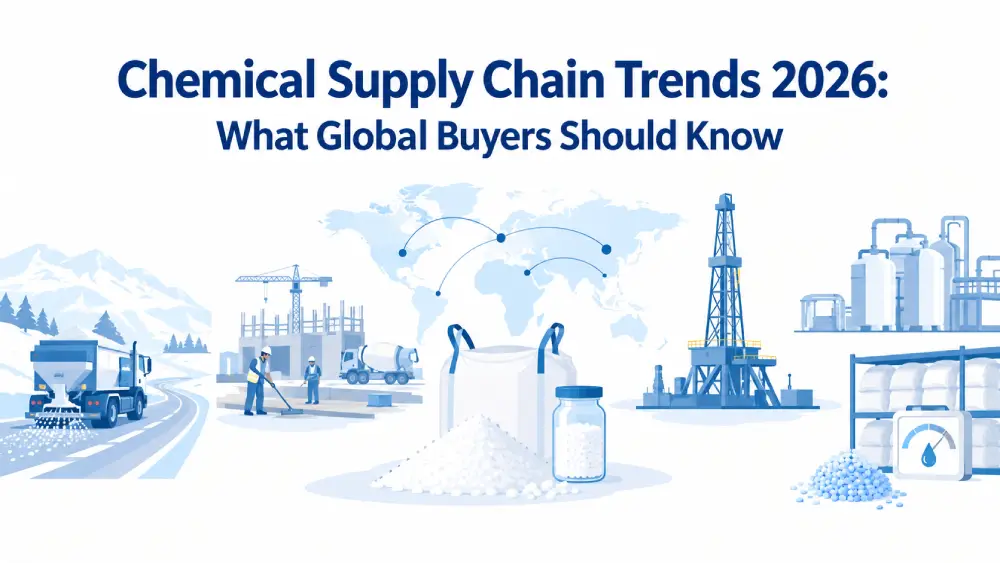
- Calcium chloride demand continues growing at 2.6% CAGR through 2034, driven by de-icing, construction, and oilfield applications
What Is Reshaping Global Chemical Supply Chains in 2026?
The chemical industry entered 2026 with what S&P Global's Global Chief Economist described as "desynchronized economic narratives" across major markets—China, the United States, and the Eurozone each exhibiting distinct growth patterns and market conditions . This fragmentation has complicated procurement planning for international buyers who previously relied on relatively synchronized global demand cycles.
The most disruptive factor has been the Middle East conflict, which fundamentally altered supply availability. Unlike demand shocks that resolve when consumption patterns normalize, supply shocks create lasting infrastructure damage. Industry executives at the World Petrochemical Conference noted that many oil production facilities and supply infrastructure in the Persian Gulf region will be difficult to restart, with some problems potentially taking years to resolve .
For chemical buyers, this translates to several immediate consequences:
- Route diversification pressure: With Middle East exports nearly halted, buyers are scrambling for alternative cargoes from North America, Asia, and Europe
- Port congestion: U.S. Gulf Coast ports, particularly the three major terminals, face capacity constraints as everyone seeks American supply
- Price volatility: Commodity pricing pressure is expected to persist long-term, requiring procurement teams to build volatility buffers into contracts
The situation has accelerated a trend that was already emerging: regionalization of chemical supply chains. Companies increasingly prioritize regional suppliers who can deliver within predictable timeframes, even at higher unit costs, rather than optimizing purely for lowest price.
How Does Geopolitical Uncertainty Affect Calcium Chloride Sourcing?
Calcium chloride procurement illustrates how geopolitical trends translate into practical sourcing challenges. The global market for this versatile chemical stood at approximately 5,500 kilotons in 2025, with demand projected to grow at 2.6% CAGR through 2034 . However, the geographic distribution of supply and demand creates specific vulnerabilities.
North America held 36.22% of the calcium chloride market share in 2025, supported by substantial municipal de-icing demand and active oilfield operations . The region benefits from natural brine resources in Michigan and California that provide cost advantages for producers with access to these deposits. However, the same supply shock affecting broader chemical markets has created export pressure that may constrain domestic availability during peak seasons.
Asia Pacific presents a different picture, with the region projected to grow at 6.11% CAGR through 2031 . China's dominance in calcium chloride production—contributing nearly 84% of Asia Pacific's 3,000 kilotons of capacity—creates both opportunity and risk for international buyers . Chinese producers leverage soda-ash co-production to supply cost-competitive industrial material, but regulatory changes and export policies can quickly alter availability.
European buyers face unique pressures. The region's demand is led by Germany, the United Kingdom, and Nordic countries, serving as key centers for de-icing and high-purity applications . European production capacity, while substantial at over 300 kilotons from major producers, cannot fully meet regional demand for all grades, creating import dependencies that geopolitical disruptions can stress.
Why Do Regulatory Deadlines Matter for 2026 Procurement?
Regulatory compliance has emerged as a critical procurement variable rather than a back-office concern. The European Union's CLP regulation update introduced new hazard categories for endocrine disruptors and persistent, bioaccumulative, and mobile substances, with compliance deadlines spanning 2025-2028 . Buyers must verify that suppliers can provide properly classified and labeled products.
Several regulatory milestones demand attention from international chemical buyers in 2026:
- EU Microplastics Reporting: Companies benefiting from exemption to microplastics restrictions must submit annual environmental release reports by May 31, 2026
- UK REACH Extension: The UK government has extended registration deadlines to 2029, 2030, and 2031, providing welcome breathing room but not eliminating compliance requirements
- Turkey KKDIK Registration: The first formal registration deadline of December 31, 2026, applies to substances with volumes exceeding 1,000 tons annually
For calcium chloride specifically, ASTM D98-15(2021) provides the standard specification covering both solid and liquid forms used for dust control, ice removal, concrete acceleration, and desiccant applications . International buyers should verify supplier compliance with this standard and confirm that impurity levels—particularly alkali chlorides, magnesium, and calcium hydroxide—fall within specified limits.
ASTM International requires that "concentrations shall be expressed as a percentage of the total" and that impurity levels remain within specified composition limits . Procurement contracts should reference this standard explicitly to ensure quality consistency across shipments.
What Does Supply Chain Resilience Look Like in Practice?
The chemical industry has moved beyond discussing resilience as a theoretical concept. Following discussions at LogiChem 2026, logistics providers report strong demand from chemical manufacturers for greater transparency and integrated logistics solutions, with end-to-end visibility now a top operational priority .
Resilience in calcium chloride procurement involves several practical elements:
Supplier diversification means identifying qualified producers across multiple regions. While China dominates production, North American and European suppliers offer shorter lead times and reduced geopolitical exposure for buyers in those regions. New capacity additions totaling over 400 kilotons are planned in Kazakhstan and Russia by 2028, potentially creating new sourcing options .
Inventory strategy requires balancing carrying costs against supply interruption risks. For seasonal products like de-icing calcium chloride, pre-season stockpiling can protect against winter supply crunches, but storage requirements for different product forms—flakes, pellets, liquid—must be considered.
Logistics partnerships have become more strategic. The shift toward 4PL models offering integrated, end-to-end supply chain management reflects recognition that chemical logistics complexity exceeds internal capabilities for many buyers .
Where Does Artificial Intelligence Deliver Value?
AI adoption in chemical supply chains has moved from experimental pilots to production deployments. At the World Petrochemical Conference, business leaders emphasized that implementation does not require cutting-edge innovation to deliver value. As Evonik's Chief Operating Officer noted, "Small improvements, even 1-2% efficiency, can materially improve profitability" .
For calcium chloride procurement specifically, AI applications include:
- Demand forecasting: Machine learning models incorporate weather data, construction schedules, and oilfield activity to predict regional demand spikes with greater accuracy
- Route optimization: Real-time traffic, weather, and port congestion data enable dynamic logistics planning
- Supplier risk monitoring: AI systems track geopolitical events, regulatory changes, and financial health indicators across supplier networks
The competitive advantage from AI implementation stems from workforce capabilities and cultural shifts, not tools alone . Buyers should evaluate whether their logistics partners have successfully integrated AI into operational workflows rather than simply possessing the technology.
How Do Product Forms Affect Procurement Decisions?
Calcium chloride is available in multiple forms, each with distinct procurement implications. Understanding these differences helps buyers specify the right product for their applications.
The shift toward pellets and prills reflects evolving end-user requirements for precision and safety. Oilfield operators need consistent dissolution rates for drilling fluids, while food processors require low-dust forms that minimize contamination risks .
For de-icing applications, liquid calcium chloride offers operational advantages including pre-storm application capability and reduced dry residue on road surfaces . However, liquid forms present higher transportation costs per unit of active ingredient, making them less economical for long-distance shipping.
What Should Buyers Prioritize When Evaluating Suppliers?
International procurement teams should apply a structured evaluation framework that addresses quality, compliance, reliability, and total cost.
Choose suppliers with verified certifications when:
- Your applications require food-grade or pharmaceutical-grade material
- Regulatory compliance documentation is essential for your market
- Traceability from production to delivery is mandated
Choose regional suppliers when:
- Lead time reliability outweighs unit cost savings
- Geopolitical risk in distant supply sources is elevated
- Just-in-time inventory models are operationally required
Choose diversified multi-source strategies when:
- Volume requirements exceed single-supplier capacity
- Seasonal demand peaks create supply tightness
- Contract terms require supply security guarantees
When evaluating potential suppliers, prioritize those who provide ASTM D98-15(2021) compliance documentation and can demonstrate consistent quality management practices .
FAQs
What is calcium chloride and how is it used in industrial applications?
Calcium chloride is an inorganic compound with the chemical formula CaCl₂ that exists in solid and liquid forms. It is widely used for de-icing roads, controlling dust on construction sites, accelerating concrete setting, and as a desiccant in industrial processes. The compound is valued for its ability to lower the freezing point of water and absorb moisture from the air.
Is calcium chloride safe to handle and transport?
Calcium chloride is safe when handled properly. The key risks are primarily related to improper storage, inadequate worker protection, and environmental loading in sensitive water systems. According to safety guidelines, the compound is irritating to eyes and should be handled with personal protective equipment in adequately ventilated areas . The ASTM D98-15(2021) standard specifies composition limits for impurities to ensure product quality and safety .
How does calcium chloride differ from rock salt for de-icing?
Calcium chloride is effective at lower temperatures than rock salt, working in conditions down to -25°F compared to rock salt's practical limit of about 15°F. Calcium chloride also releases heat when it dissolves, accelerating ice melting, while rock salt requires heat from the environment to begin working.
When should buyers consider liquid versus solid calcium chloride?
Liquid calcium chloride is preferable for pre-storm anti-icing applications and when rapid coverage of large areas is needed. Solid forms—flakes, pellets, or prills—are more economical for storage and long-distance transport. The choice depends on application timing, available equipment, storage infrastructure, and total cost per unit of active ingredient.
What are the main supply regions for calcium chloride globally?
Asia Pacific dominates global calcium chloride production with 38% of installed capacity, with China contributing approximately 84% of regional capacity . North America holds 37% of global capacity, supported by natural brine resources. Europe maintains significant production, with major producers operating plants across the Netherlands, Sweden, Finland, and Germany .
How is the calcium chloride market expected to grow?
The global calcium chloride market is projected to grow at 2.6% CAGR from 2026 to 2034, reaching approximately 5,500 kilotons in 2025 . Asia Pacific is expected to grow faster at 6.11% CAGR through 2031, driven by construction activity in China and India, food-grade demand in Japan and South Korea, and pharmaceutical applications in Southeast Asia .
What certifications should buyers verify for food-grade calcium chloride?
Food-grade calcium chloride should meet EN 233 (European standard for food additives) or equivalent FDA requirements for direct food contact. For pharmaceutical applications, British Pharmacopoeia (BP) or United States Pharmacopeia (USP) certification ensures appropriate purity levels. Major producers have expanded certified food-grade and pharmaceutical-grade capacity to meet growing demand .
How do regulatory changes affect calcium chloride procurement?
Recent regulatory developments include the EU's CLP update introducing new hazard categories, with compliance deadlines through 2028 for existing products . UK REACH has extended registration deadlines to 2029-2031, while Turkey's KKDIK requires formal registration by December 2026 for high-volume substances . Buyers should verify supplier compliance with applicable regulations in their destination markets.
What role does artificial intelligence play in chemical supply chains?
AI applications in chemical supply chains include demand forecasting, route optimization, inventory management, and supplier risk monitoring. Industry leaders report that even 1-2% efficiency improvements from AI implementation can materially affect profitability . The technology enables more accurate prediction of regional demand patterns and dynamic logistics planning.
What are the key risks in calcium chloride supply chains for 2026?
Key risks include geopolitical disruptions affecting Middle East supply routes, port capacity constraints at U.S. Gulf Coast terminals, regulatory compliance deadlines requiring supplier verification, and seasonal demand peaks creating temporary supply tightness . Buyers should diversify supplier relationships and build appropriate inventory buffers for critical applications.
Conclusion
Chemical supply chain trends in 2026 reflect a fundamental shift from efficiency-optimized global networks toward resilience-focused regional strategies. For international buyers of calcium chloride, this means navigating supply shocks from Middle East disruptions, complying with evolving regulations across multiple jurisdictions, and leveraging AI-enabled visibility to maintain operational continuity.
The key is to prioritize supply chain resilience over lowest-cost sourcing. When evaluating calcium chloride suppliers, prioritize verified quality certifications and demonstrated reliability over marginal price differences. The geopolitical and regulatory landscape will continue evolving through 2026 and beyond, making flexibility and supplier diversification essential components of procurement strategy.