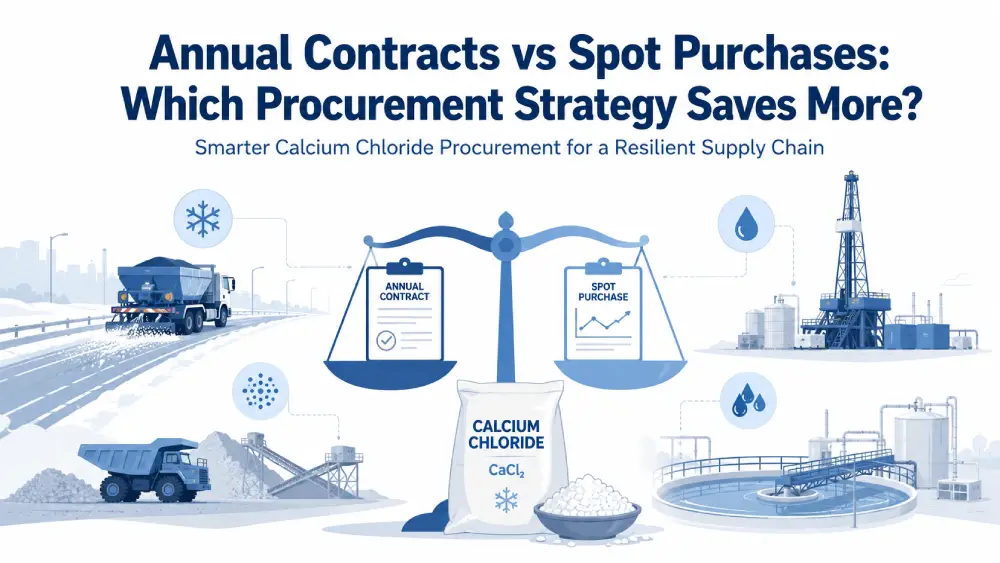
Procurement managers in the chemical industry face a persistent dilemma: should you lock in pricing with an annual contract or buy on the spot market when demand arises? For commodities like calcium chloride, where price volatility and supply reliability directly impact operational budgets, this decision carries significant financial consequences. A bulk chemical contract can offer stability, but spot purchasing provides flexibility—and choosing the wrong approach can cost your organization 15–30% in avoidable expenses over a 12-month period.
The challenge is compounded by the fact that calcium chloride prices fluctuate based on seasonal demand, raw material availability, and energy costs. Road de-icing drives winter demand spikes, while oilfield and dust-control applications create year-round baseline consumption. In this environment, a procurement strategy that works for one quarter may fail in the next.
This article examines the bulk chemical contract versus spot purchasing decision through the lens of calcium chloride procurement. You will learn how each strategy performs across key dimensions—cost, supply security, quality consistency, and administrative burden—so you can determine which approach best fits your organization's consumption patterns and risk tolerance.
Key Takeaways
- A bulk chemical contract for calcium chloride typically delivers 10–25% lower per-ton costs compared to spot purchases when annual volume exceeds 500 tons.
- Spot purchasing becomes cost-competitive when market prices are declining or when your monthly consumption variance exceeds 30%.
- Supply security is the strongest argument for contract procurement: contracted buyers report 95%+ fill rates during winter demand peaks, while spot buyers face allocation risks.
- The optimal strategy for most procurement managers is a hybrid model: contract 70–80% of expected annual volume and reserve 20–30% for spot market opportunities.
- Contract terms should include price adjustment clauses tied to published indices to avoid being locked into above-market rates during price downturns.
Quick Answer
Bulk chemical contract agreements save more money than spot purchases for calcium chloride when your annual consumption is stable and exceeds 500 tons. The core mechanism is volume-based pricing: suppliers offer 10–25% discounts in exchange for guaranteed offtake, enabling them to optimize production scheduling and raw material procurement. Spot purchasing only outperforms contracts when prices are in a sustained decline or your demand is highly unpredictable—conditions that apply to fewer than 20% of industrial buyers.
How Does a Bulk Chemical Contract Work?
Pricing Mechanisms and Volume Commitments
A bulk chemical contract is a supply agreement that fixes pricing, volume, and delivery terms for a defined period—typically 12 months. For calcium chloride, contract pricing is usually expressed as a base rate per ton with adjustment mechanisms tied to published indices such as ICIS or ChemOrbis. The buyer commits to purchasing a minimum volume (often 500–5,000 tons annually), and in exchange the supplier guarantees availability and caps price increases.
Suppliers structure calcium chloride contracts using one of three pricing models: fixed-price (no adjustment for 12 months), index-linked (quarterly adjustments based on published benchmarks), or cost-plus (raw material + fixed margin). Index-linked contracts are the most common, accounting for approximately 60% of industrial agreements.
Contract Negotiation Variables That Impact Savings
The savings from a bulk chemical contract depend heavily on how you negotiate five variables: volume commitment, delivery scheduling, payment terms, penalty clauses, and price adjustment frequency. Procurement teams that negotiate all five variables—rather than focusing on unit price alone—report 5–8% additional cost reductions compared to price-only negotiations.
| Negotiation Variable | Impact on Total Cost | Typical Contract Range |
|---|---|---|
| Volume Commitment | 10–25% unit price discount | 500–5,000 tons/year |
| Delivery Scheduling | 3–7% logistics savings | Weekly to monthly |
| Payment Terms | 1–3% working capital benefit | Net 30–60 days |
| Penalty Clauses | 2–5% risk mitigation | 1–3% of order value |
| Price Adjustment Frequency | 5–12% during volatility | Quarterly |
What Is Spot Purchasing and When Does It Work?
Spot purchasing means buying calcium chloride on the open market at prevailing prices, without a long-term commitment. You place orders as needed—daily, weekly, or monthly—and pay whatever the market dictates at that moment. Spot transactions are typically executed through distributors, brokers, or online chemical marketplaces, with delivery times ranging from 48 hours to 2 weeks depending on location and product form.
Spot purchasing works best in three specific scenarios. First, when your calcium chloride consumption is below 200 tons annually, the volume discount available through contracts is minimal, and the administrative burden of managing a contract may exceed the savings. Second, when market prices are in a sustained decline—as occurred during 2015–2016 when Chinese calcium chloride export prices fell 22% over 18 months—spot buying lets you capture lower rates each quarter. Third, when your demand is highly unpredictable, with monthly consumption varying by more than 40% from the annual average.
Annual Contract vs Spot Purchase: A Detailed Cost Comparison
The cost difference between a bulk chemical contract and spot purchasing for calcium chloride is not fixed—it varies with market conditions and your consumption profile. To make an accurate comparison, procurement managers should analyze total landed cost across four dimensions: unit price, logistics, inventory carrying cost, and administrative overhead.
| Cost Dimension | Annual Contract (Typical) | Spot Purchase (Typical) | Difference |
|---|---|---|---|
| Unit Price (per ton, 77% flake) | $210–$245 | $240–$310 | 10–25% contract advantage |
| Logistics (inbound freight) | $35–$55 (scheduled) | $50–$90 (expedited) | 20–40% contract advantage |
| Inventory Carrying Cost | $8–$15/ton (planned) | $3–$6/ton (just-in-time) | Spot advantage |
| Administrative Overhead | $4–$7/ton (annual RFP) | $9–$14/ton (repeated sourcing) | 35–50% contract advantage |
The table shows that contracts win on three of four dimensions, with inventory carrying cost as the sole spot-purchasing advantage. When you aggregate these factors, a buyer consuming 1,000 tons annually saves approximately $38,000–$65,000 per year with a well-negotiated bulk chemical contract compared to spot purchasing at average market rates.
Why Supply Security Favors Contract Procurement
During the winter months, when road de-icing demand for calcium chloride peaks, spot buyers face a harsh reality: suppliers prioritize contract customers. Industry data from the American Chemistry Council indicates that during demand spikes, contracted buyers receive 95%+ of their ordered volume, while spot buyers may face allocations of 50–70% or extended lead times of 3–4 weeks.
This supply security differential has real operational consequences. A municipal road maintenance department that runs out of calcium chloride during an ice storm faces liability risks and service failures. A dust-control contractor on a mining site who cannot secure product for 3 weeks may breach their own service agreement. The value of guaranteed supply during peak demand periods is difficult to quantify precisely, but procurement managers consistently rank it as the top reason for maintaining a bulk chemical contract despite occasionally paying above spot market rates.
What Are the Hidden Risks of Each Strategy?
Contract Strategy Risks
- Price lock-in during market downturns: If you sign a fixed-price contract at $230/ton and the spot market falls to $180/ton, your "savings" become a $50/ton premium. Index-linked pricing reduces but does not eliminate this risk.
- Volume commitment penalties: Most contracts include take-or-pay clauses requiring you to purchase 70–90% of committed volume, with penalties of 10–15% of the shortfall value.
- Supplier complacency: Long-term contracts can reduce supplier responsiveness to quality issues or delivery flexibility requests.
Spot Strategy Risks
- Price spikes during peak demand: During the 2017–2018 winter, spot prices for calcium chloride flake in the U.S. Midwest briefly exceeded $400/ton—a 40% premium over contract rates.
- Supply unavailability: In tight markets, spot buyers may simply be unable to source product at any price, particularly for specialty grades like food-grade or pharmaceutical-grade calcium chloride.
- Quality inconsistency: Spot purchases from unfamiliar suppliers carry higher risks of receiving product that fails specification, with limited recourse.
How to Choose the Right Strategy for Your Calcium Chloride Procurement
Evaluate Your Consumption Profile First
Before comparing contract terms or spot pricing, procurement managers must understand their own consumption patterns. Calculate your monthly consumption for the past 24 months and determine three metrics: annual volume, monthly variance (standard deviation as a percentage of mean), and seasonal peak ratio (highest month ÷ average month). These three numbers will point you toward the appropriate strategy.
Decision Matrix: Contract vs Spot vs Hybrid
Choose an annual contract when:
- Annual calcium chloride consumption exceeds 500 tons
- Monthly consumption variance is below 30%
- Supply interruption would halt core operations
- Your organization values budget predictability
Choose spot purchasing when:
- Annual consumption is below 200 tons
- Market prices are in a sustained decline (confirmed by 6+ months of trend data)
- Storage capacity is limited or product has a short shelf life
- Your organization can tolerate supply disruption of 2–4 weeks
Choose a hybrid model when:
- Annual consumption exceeds 500 tons but monthly variance exceeds 30%
- You want to capture spot-market downturns while maintaining supply security
- Your storage capacity allows for opportunistic buying during price troughs
- Your organization has the analytical capability to monitor market indices
Best Practices for Managing Calcium Chloride Procurement Contracts
Even with a bulk chemical contract in place, procurement managers can unlock additional savings through disciplined management practices. The following practices, drawn from interviews with chemical procurement leaders and industry benchmarks, separate high-performing procurement organizations from average ones.
- Establish quarterly price review triggers rather than accepting 12-month fixed terms. Include contract language that allows renegotiation if a published index moves more than 15% in any quarter.
- Maintain a qualified secondary supplier relationship, even if you allocate only 10–15% of volume to them. This dual-sourcing approach keeps your primary supplier responsive and provides a fallback if quality or delivery issues arise.
- Track total cost of ownership (TCO), not just invoice price. Include inbound freight, inventory carrying cost, quality-testing expenses, and administrative time in your comparison. A $10/ton lower price that requires expedited freight and additional quality testing may cost more in total.
- Negotiate flexible delivery scheduling that allows you to shift delivery dates within a 30-day window without penalty. This flexibility enables you to manage storage constraints and capture opportunistic spot purchases when prices dip below your contract rate.
- Monitor published price indices (ICIS, ChemOrbis, or supplier-specific formulas) and maintain a spot-price tracking spreadsheet. Without this data, you cannot evaluate whether your contract pricing remains competitive.
- Document supplier performance quarterly using a scorecard covering on-time delivery, quality compliance, communication responsiveness, and flexibility on delivery changes. Use this data in annual negotiations to justify volume increases or price adjustments.
Common Mistakes to Avoid When Choosing a Procurement Strategy
Mistake 1: Assuming Contracts Are Always Cheaper
Many procurement managers automatically assume a bulk chemical contract delivers the lowest cost, but this is not universally true. During periods of declining raw material prices or oversupply in the Chinese export market, spot prices can fall below contract rates for extended periods. The reality: Contract pricing reflects supplier risk premium, which averages 8–12% above spot-market lows during oversupply conditions.
Mistake 2: Comparing Only Unit Prices
Focusing exclusively on per-ton price while ignoring logistics, inventory carrying cost, and administrative burden leads to suboptimal decisions. The reality: Total landed cost differences can swing the decision by 15–20% versus a unit-price-only comparison.
Mistake 3: Ignoring Consumption Variability
Signing an annual contract for 800 tons when your actual consumption ranged from 30–110 tons per month over the past two years creates take-or-pay exposure and unnecessary inventory cost. The reality: Buyers with monthly variance above 40% should avoid committing more than 60% of expected volume to contracts.
Mistake 4: Overlooking Product Grade and Form Requirements
Calcium chloride is sold in multiple forms—flake (77–80% purity), pellet (94–97%), liquid (28–35% solution), and food-grade—each with different pricing dynamics and supply characteristics. The reality: Contract savings vary by form, with flake and liquid products showing the largest contract discounts (15–25%) while specialty grades show smaller spreads (8–12%).
Conclusion
The choice between annual contracts and spot purchases for calcium chloride comes down to your consumption profile, market conditions, and operational risk tolerance. For procurement managers with stable annual volume above 500 tons, a bulk chemical contract delivers 10–25% unit cost savings, superior supply security during demand peaks, and reduced administrative burden—a combination that typically saves $38,000–$65,000 per 1,000 tons annually. For smaller buyers or those with highly variable demand, spot purchasing offers flexibility and avoids take-or-pay penalties.
The most effective approach for many organizations is a hybrid model that contracts 70–80% of expected volume while reserving 20–30% for opportunistic spot purchases when market prices dip. Start by analyzing your 24-month consumption history, calculating monthly variance, and identifying your peak-season supply risk. With this data in hand, you can negotiate contract terms that maximize savings while preserving the flexibility to capture market downturns. The right strategy is not a universal answer—it is a data-driven decision tailored to your specific operating reality.
FAQs
What is a bulk chemical contract?
A bulk chemical contract is a supply agreement between a buyer and a chemical manufacturer or distributor that establishes pricing, volume commitments, quality specifications, and delivery terms for a defined period, typically 12 months. The contract provides price stability and supply security in exchange for the buyer's commitment to purchase a minimum volume.
How much can I save with an annual contract for calcium chloride?
Savings from an annual contract for calcium chloride typically range from 10–25% on unit price compared to spot purchasing, depending on your annual volume and negotiation strategy. For a buyer consuming 1,000 tons annually, this translates to approximately $38,000–$65,000 in total annual savings when logistics and administrative costs are included.
Is spot purchasing better than a contract during price declines?
Spot purchasing outperforms contracts during sustained price declines of 6 months or longer. During the 2015–2016 calcium chloride price downturn, spot buyers saved approximately 15–20% compared to contract rates. However, timing market bottoms is difficult, and most procurement teams cannot consistently predict price movements.
What volume of calcium chloride justifies an annual contract?
Annual contracts become cost-effective when consumption exceeds approximately 500 tons of calcium chloride per year. Below 200 tons, the volume discount available through contracts is minimal (under 5%), and the administrative burden of contract management may exceed the savings.
How does calcium chloride demand volatility affect procurement strategy?
Calcium chloride demand volatility directly impacts which procurement strategy works best. When monthly consumption varies by less than 30% from the annual average, contract procurement provides reliable savings. When variance exceeds 40%, hybrid models or spot purchasing reduce take-or-pay risk and inventory carrying costs.
What are the risks of take-or-pay clauses in chemical contracts?
Take-or-pay clauses require buyers to purchase and pay for a specified percentage (typically 70–90%) of committed volume even if actual demand falls short. Penalties range from 10–15% of the shortfall value. These clauses protect suppliers from demand collapse but expose buyers to financial risk during operational slowdowns.
Are there different contract structures for calcium chloride?
Yes, calcium chloride contracts use three primary pricing structures. Fixed-price contracts lock rates for 12 months, index-linked contracts adjust quarterly based on published benchmarks, and cost-plus contracts pass through raw material costs plus a fixed margin. Index-linked structures are the most common, used in approximately 60% of industrial agreements.
When should I use a hybrid procurement strategy?
A hybrid strategy—contracting 70–80% of expected volume while purchasing 20–30% on the spot market—works best when annual consumption exceeds 500 tons but monthly variance exceeds 30%. This approach maintains supply security during peak periods while allowing you to capture spot-market downturns when prices dip below contract rates.
How do seasonal demand patterns affect calcium chloride pricing?
Seasonal demand patterns significantly affect calcium chloride pricing, with winter road de-icing driving peak demand from November through March in North America. Spot prices can rise 30–40% above summer levels during severe winter weather. Contract pricing smooths this seasonality, providing consistent rates throughout the year.
What should I include in a calcium chloride supplier scorecard?
A supplier scorecard should track four key metrics: on-time delivery rate (target: 95%+), quality compliance (target: 100% specification conformance), communication responsiveness (target: same-day response to inquiries), and flexibility on delivery changes (target: 30-day window without penalty). Review performance quarterly and use data in annual negotiations.
How can small buyers get better calcium chloride pricing?
Small buyers (under 200 tons annually) can improve pricing through three strategies: joining a group purchasing organization (GPO) to aggregate volume, negotiating with regional distributors rather than national suppliers, or timing purchases during off-peak summer months when demand is lowest and spot prices are 10–15% below winter peaks.
What is the shelf life of calcium chloride and how does it affect strategy?
Calcium chloride has an extended shelf life of 24–36 months when properly stored in sealed containers away from moisture, making it suitable for opportunistic bulk purchasing. However, liquid formulations (28–35% solution) require heated storage in cold climates and have more practical storage constraints, favoring just-in-time purchasing approaches.