The global chemical trade is built on trust, but for importers, that trust must be verified. Every year, thousands of chemical shipments are rejected at international borders due to non-compliance, leading to demurrage fees that can exceed $500 per day per container and contractual penalties. For an importer sourcing Calcium Chloride for de-icing, dust control, or food processing, the challenge is not finding a supplier—it’s confirming the quality and regulatory standing of the product before it leaves the port. A failure to do so can turn a profitable shipment into a logistical and financial disaster.
The primary tools for this verification are chemical certifications. Yet the landscape of documentation is confusing. An importer might receive a certificate from the International Organization for Standardization (ISO), a Registration, Evaluation, Authorisation and Restriction of Chemicals (REACH) compliance statement, and a test report from SGS. What do these documents prove? Are they interchangeable, or does each serve a distinct function in the supply chain? Misunderstanding their purpose is a common mistake that leads to sourcing the wrong grade of material or assuming a level of legal clearance that doesn’t exist.
This article decodes the three most commonly encountered certifications in the chemical import industry. It will clarify which entity sets the rules, which entity verifies the product, and which certification proves what. For importers of chemicals like Calcium Chloride, this decision guide provides a clear framework for using these certifications to de-risk procurement and ensure a smooth customs clearance process.
Key Takeaways
- ISO certifies that a factory operates a standardized quality management system; it does not certify the chemical product itself.
- REACH is a mandatory EU regulation. A REACH compliance statement proves a substance is legally registered for the EU market, not necessarily that it's safe for all uses.
- SGS is an independent testing company. An SGS report provides a snapshot of product quality against a specific standard, such as purity or heavy metal content.
- For EU importers, REACH is a non-negotiable legal requirement, while ISO and SGS are powerful tools for quality assurance and risk management.
- When importing Calcium Chloride, a REACH certificate alone won’t tell you the product’s purity (e.g., 74% vs. 94% pellets). You need an SGS test report or equivalent for that.
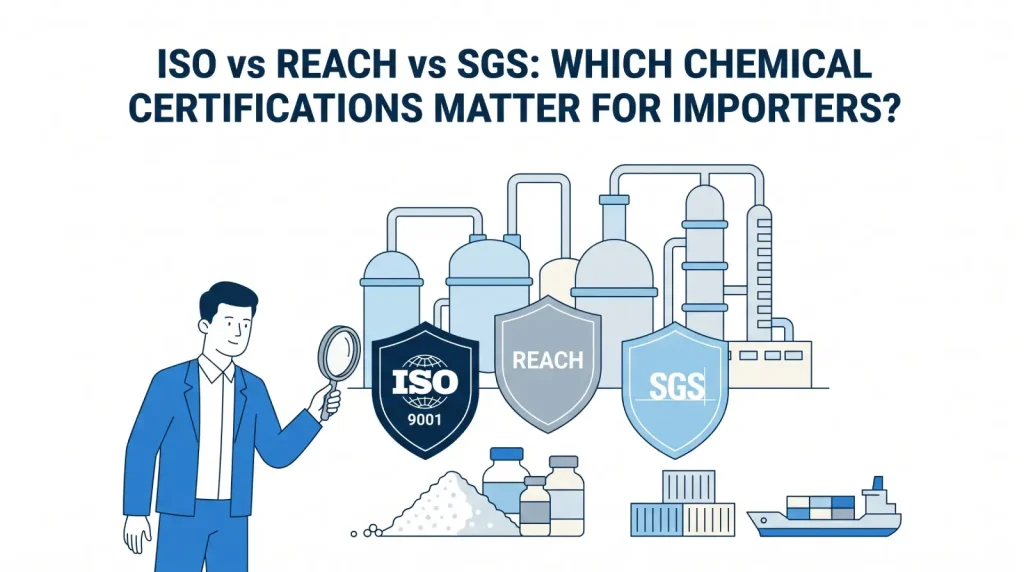
Calcium Chloride is safe to import and handle when proper compliance steps are followed. The key risk is not the chemical's inherent hazard, but liability from undocumented shipments. The differences between these certifications determine whether your documentation demonstrates systematic quality control, regulatory market access, or verifiable product integrity.
What Is ISO Certification and Why Does It Matter for Chemical Importers?
ISO certification is often the first document an importer encounters when vetting a new supplier. A factory’s website may prominently display an “ISO 9001 Certified” badge, but its meaning is frequently misunderstood in procurement conversations. It is a certification of a management system, not a product seal of approval.
What Is ISO 9001 and How Does It Apply to Chemical Manufacturing?
ISO 9001:2015 is the most common standard in this family. It specifies requirements for a quality management system (QMS) where an organization needs to demonstrate its ability to consistently provide products that meet customer and applicable statutory and regulatory requirements. For a Calcium Chloride manufacturer, this means they have documented procedures for everything from raw material sourcing and production processes to customer complaint handling and corrective actions.
The certification is granted by an accredited third-party body after a rigorous audit of the factory’s systems. The core principle is process standardization. An ISO-certified plant should produce Calcium Chloride with a consistent purity and granulation profile, batch after batch, because the process is controlled. For an importer, this reduces the variability of receiving an off-spec shipment that could damage their reputation with downstream industrial or food-processing clients.
What ISO Does Not Cover: Common Misconceptions in Procurement
The critical limitation is that ISO does not test the chemical itself. An ISO 9001 certificate for a factory in Qingdao making Calcium Chloride makes no claim that the product is 94% pure, food-grade, or compliant with EU impurity limits. It simply confirms that the factory has a system for quality control. A factory could, in theory, have a perfectly documented system for producing a low-purity, industrial-grade product and still be ISO 9001 certified. Importers who equate ISO certification with product quality risk sourcing an unsuitable grade of Calcium Chloride for their application.
What Is REACH and How Does It Function as a Market Passport?
Unlike ISO, which is voluntary, REACH is a hard legal requirement for chemicals sold within the European Union. For an importer, understanding REACH is the difference between having a legal product and a product that can be seized and destroyed at customs, resulting in total cargo loss.
The Core of the Regulation: Registration, Evaluation, and Authorization
The REACH regulation (EC 1907/2006) places the burden of proof on companies. Under its "no data, no market" principle, any substance manufactured in or imported into the EU at 1 ton or more per year must be registered with the European Chemicals Agency (ECHA). Registration involves submitting a detailed dossier that includes the substance's physicochemical, toxicological, and ecotoxicological properties and a chemical safety report for quantities above 10 tons per year.
For an importer of Calcium Chloride, this means the non-EU manufacturer must have an Only Representative (OR) in the EU who has successfully registered the substance. A valid REACH registration number on a Safety Data Sheet (SDS) is the proof. It declares that the substance, in this case CaCl₂, is legally allowed on the EU market for its specified uses. Without this, the shipment is illegal, regardless of its quality.
REACH vs. Product Quality: Why Compliance Isn’t a Purity Guarantee
A compliance statement confirms legal market access, not product integrity. A REACH dossier for Calcium Chloride could cover a technical-grade flake with significant levels of alkali metal chlorides as impurities, just as it could cover a high-purity FCC-grade pellet for cheesemaking. The regulation’s focus is the safe use of the substance across its lifecycle, from manufacturing to disposal, focusing on human health and environmental endpoints. It does not specify a minimum purity percentage for industrial applications, a fact that surprises many new importers who believe REACH compliance doubles as a quality certificate.
SGS vs. ISO vs. REACH: A Direct Comparison for Risk Management
This confusion is the source of most procurement errors. A factory manager claiming, “Our product is REACH registered, so the quality is high,” is conflating two separate domains. To make informed decisions, importers must separate legal compliance from quality verification and factory management, as shown in the following table.
Comparison Table: Certification Purpose and Scope
| Certification/Body | What It Is | Primary Purpose | Does It Test the Product? |
|---|---|---|---|
| ISO 9001 | A voluntary standard for quality management systems. | Certifies the factory’s processes are consistent and documented. | No. It audits the system, not the output. |
| REACH | A mandatory EU regulation (EC 1907/2006). | Provides a legal market passport for a substance in the EU. | Partly. It requires safety data, but not purity for commercial specs. |
| SGS Report | A commercial, third-party inspection and testing service. | Provides a product snapshot against a defined standard (e.g., GB, ASTM, FCC). | Yes. It analyzes a specific sample for contractual specifications. |
SGS as an Independent Verifier: What an SGS Report Proves
SGS, along with other testing, inspection, and certification (TIC) companies like Bureau Veritas and Intertek, provides a distinct service. An importer can contract SGS to perform a pre-shipment inspection (PSI) at the manufacturer’s facility. For a Calcium Chloride order, the importer’s SGS contract would stipulate the testing parameters, such as CaCl₂ content (e.g., ≥94%), sodium chloride (NaCl) content, magnesium and alkalinity levels, and heavy metal limits.
The resulting SGS report provides a certified analysis of the batch being shipped. This is a powerful tool to verify that the product in the container matches the proforma invoice’s specifications before payment is released. The American Society for Testing and Materials (ASTM) publishes standard specifications, like ASTM D98 for calcium chloride, that can be directly referenced in an SGS inspection scope, creating a clear, legally defensible quality benchmark.
How to Build a Chemical Certification Strategy for Your Imports
A mature procurement strategy does not ask for "all certificates," which can increase costs without adding corresponding value. Instead, it layers these tools according to the risk profile of the market and the end-application of the chemical.
When to Prioritize REACH Over an ISO Certificate
For any importer placing Calcium Chloride on the EU market, the hierarchy is non-negotiable. The first gate is always legal access. If the substance and its tonnage band require registration and the supplier cannot provide a valid REACH registration number linked to an EU-based OR, the negotiation should stop immediately. An ISO 9001 certificate from a non-REACH-compliant factory is irrelevant in this context because the product cannot legally clear EU customs. Prioritizing ISO over REACH here is a fundamental error that guarantees a compliance failure.
When to Use an SGS Inspection to Supplement REACH
Conversely, if a supplier for a food-grade application provides a REACH registration but cannot offer a recent, independent batch analysis for heavy metals (such as lead at ≤2 mg/kg for FCC-grade Calcium Chloride), the importer is taking a significant quality risk. In this scenario, the REACH certificate proves legality, but an SGS inspection is what proves the product’s suitability for its intended use in food processing. The inspection scope must be precisely defined, referencing a specific standard like the Food Chemicals Codex (FCC) monograph for calcium chloride. A generic "quality test" request is insufficient and will not yield a defensible result.
How to Choose a Certified Supplier for Calcium Chloride
When evaluating potential partners, the conversation moves beyond a simple checklist of documents. The goal is to find a supplier whose certifications form a coherent system of quality assurance. An ISO-certified factory producing REACH-registered Calcium Chloride and facilitating transparent third-party testing presents the lowest procurement risk.
The first step is to verify the authenticity of the documents. An ISO certificate can be validated through the issuing body’s accreditation database. A REACH registration number must be checked against the public data on the European Chemicals Agency (ECHA) website, confirming the registrant is the supplier’s designated Only Representative. An SGS report should be verified for authenticity using its unique report number on the SGS online verification platform. A certificate is only as valuable as its verifiability.
Secondly, audit the specifications against your specific use-case. Importing Calcium Chloride for oil drilling fluids has completely different purity requirements than importing it for dust control. The supplier’s documentation—whether it’s the REACH dossier’s identified uses or the data on the Safety Data Sheet (SDS)—must align with your downstream application. A failure to match this can render even a perfectly certified product technically non-compliant for your clients, leading to breach of contract.
A final consideration is the non-EU regulatory landscape. While REACH governs the EU, importers must also be aware of the Toxic Substances Control Act (TSCA) in the United States. A REACH registration has no standing in the U.S., where a substance like Calcium Chloride must be on the TSCA Inventory. A sophisticated supplier will understand these jurisdictional differences and have the appropriate documentation for each market, demonstrating a high level of professional maturity.
Conclusion
Navigating chemical certifications for importing a substance like Calcium Chloride requires a clear separation of legal, quality, and systemic proof. REACH is the non-negotiable legal passport that grants a substance access to the European Union, yet it does not guarantee a specific purity grade. ISO 9001 indicates a factory is a managed and consistent operation, which is a strong foundation for quality but is not a product test itself. SGS bridges this gap by providing an independent, verifiable product snapshot against precise specifications like those from ASTM or the FCC.
The most effective risk mitigation for an importer is to layer these certifications strategically. Start with the legal requirement (REACH for the EU), ensure the factory’s ability to produce consistently (ISO), and verify the product before shipment against a mutually agreed, standardized specification (SGS). For importers seeking to build a resilient supply chain for chemicals, a partner who seamlessly integrates these three components—regulatory compliance, systematic quality management, and radical transparency in product testing—offers the most secure path to market.
FAQs
What is a chemical certification?
A chemical certification is a documented confirmation that a substance, or the process used to create it, meets a defined standard. This can be a regulatory requirement, like a REACH registration, or a voluntary standard, like an ISO management system certificate.
How does REACH certification differ from an ISO standard?
REACH is a mandatory EU regulation granting market access for a specific chemical substance. An ISO standard, like ISO 9001, is a voluntary certification that a factory's quality management system follows a documented, audited process. REACH is about the substance’s legal standing; ISO is about the factory’s operational consistency.
What does an SGS report show that a REACH certificate doesn’t?
An SGS report provides a quantitative analysis of a specific batch against a chosen standard, showing data points like purity percentage or heavy metal levels. A REACH certificate proves the substance is legally registered for the EU market and its safe use is documented, but it doesn't specify a commercial purity grade.
Is SGS a certification for calcium chloride?
No, SGS is not a certification body for products. It is an independent testing, inspection, and verification company. It provides a report with test results on a sample of Calcium Chloride. The report may state "conforms to ASTM D98," but SGS does not issue a general, ongoing "SGS Certified" seal for the product.
When is REACH compliance mandatory for chemical imports?
REACH compliance is mandatory for any chemical substance, including Calcium Chloride, imported into the European Union in quantities of 1 ton or more per year. Without a valid REACH registration by an Only Representative, the substance cannot be legally placed on the EU market.
How can I verify a supplier’s SGS test report?
To verify a supplier’s SGS test report, you should:
- Obtain the unique report number from the document.
- Contact your local SGS office directly through the official website.
- Provide the report number and request a verification of its authenticity and content.
- Ensure the sample details on the report match your specific order and lot number.
Can a factory be ISO certified but produce non-REACH compliant chemicals?
Yes, absolutely. A factory outside the EU can be ISO 9001 certified for its production process but not have a REACH registration for its products. ISO focuses on internal process management, while REACH is a market-specific legal requirement for the product’s entry into the EU.
What is the difference between an SDS and a REACH certificate?
A Safety Data Sheet (SDS) is a hazard communication document. A REACH certificate, often a statement confirming a successful registration, is proof of legal compliance. The SDS must be consistent with the REACH registration dossier, but the registration number itself is the legal proof of market access.
Why is a COA not enough for international chemical sourcing?
A Certificate of Analysis (COA) is issued by the manufacturer and reports its own internal test results. For international sourcing, a COA has these limitations:
- It is a self-declaration and is not independently verified, creating a conflict of interest.
- Methods may differ from international standards like ASTM, making results non-comparable.
- It only covers the batch and doesn't verify factory systems (ISO) or legal market status (REACH).
Does the United States accept REACH certification for chemicals?
No, the United States does not recognize REACH. The U.S. operates under the Toxic Substances Control Act (TSCA), administered by the EPA. A chemical like Calcium Chloride must be listed on the TSCA Inventory to be legally manufactured or imported into the U.S., completely independent of any REACH registration.