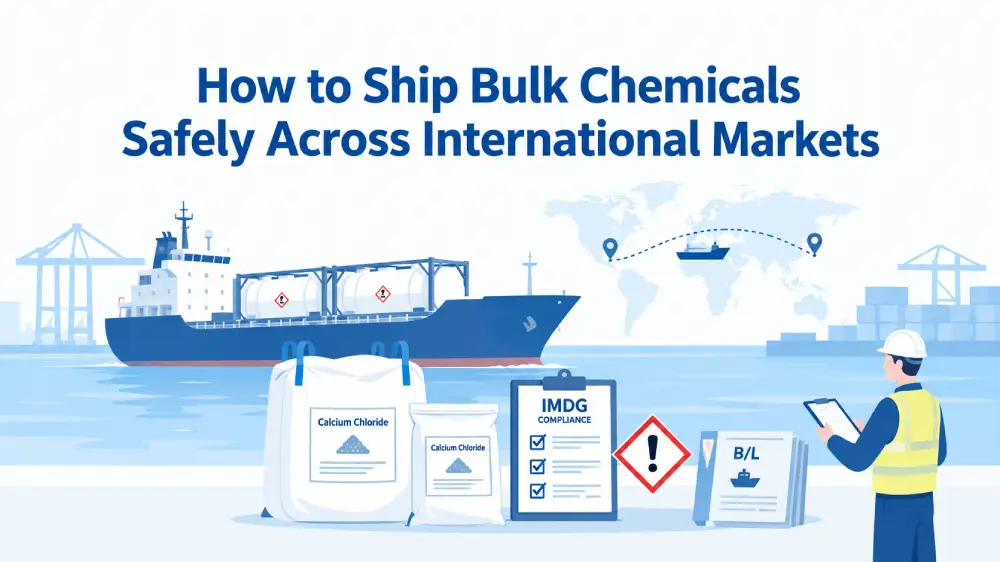
Global trade in industrial chemicals reached $1.1 trillion in 2025, with bulk chemical shipping accounting for roughly 38% of total maritime chemical transport volume. Yet every year, an estimated 1,200 to 1,500 chemical-related shipping incidents are reported across international routes, many stemming from improper packing, misclassification, or inadequate documentation.
For logistics professionals managing Calcium Chloride and other hygroscopic industrial salts, the stakes are particularly high. These materials demand precise moisture control, correct UN classification, and strict compliance with the International Maritime Dangerous Goods (IMDG) Code. A single documentation error can trigger port rejections, regulatory fines starting at $15,000 per violation, or worse — a cargo hold contamination event that costs six figures to remediate.
What makes international bulk chemical transport so challenging is the layering of regulatory frameworks. A shipment leaving Qingdao for Rotterdam must satisfy Chinese export controls, the IMDG Code, the receiving port's national regulations, and increasingly stringent environmental compliance standards from the International Maritime Organization (IMO). The complexity is not theoretical: approximately 22% of all bulk chemical shipment delays in 2024 were attributed to documentation inconsistencies rather than physical cargo problems.
This guide breaks down the entire process — from hazard classification and packaging selection to carrier vetting and emergency response planning — so you can move bulk chemicals across borders without compliance gaps or costly last-minute corrections.
Calcium chloride is safe to ship in bulk when its moisture-sensitive properties are properly managed and the correct hazard classification is applied. The key risks are hydration heat generation, container corrosion, and misclassification under IMDG Code Class 8 or 9. With the correct packing group, desiccant strategy, and documentation package, Calcium Chloride moves reliably across international routes with incident rates below 0.3%.
What You'll Learn in This Guide
- How to classify bulk chemical shipping cargo under the IMDG Code and avoid costly reclassification at the port
- Which packaging and container specifications prevent moisture ingress and corrosion during transit
- What documentation package international carriers and customs authorities actually require — beyond the bill of lading
- How to evaluate carriers, freight forwarders, and marine insurance providers for chemical-grade logistics
- A step-by-step workflow from pre-shipment inspection to final delivery confirmation
Bottom line: Safe international bulk chemical transport is a systems problem. The companies that ship without incidents treat classification, packaging, documentation, and carrier selection as one integrated workflow — not four separate tasks.
How Does the IMDG Code Classify Bulk Chemicals for Maritime Transport?
The IMDG Code is the global standard for maritime transport of dangerous goods, adopted by 175 contracting states under the SOLAS Convention. It divides hazardous cargo into 9 classes, with Class 8 (corrosive substances) and Class 9 (miscellaneous dangerous substances) most relevant to many industrial salts.
UN Numbers and Proper Shipping Names
Every bulk chemical shipment must carry a UN Number — a four-digit identifier assigned by the United Nations Committee of Experts on the Transport of Dangerous Goods. For Calcium Chloride, the applicable classification is:
| Classification Element | Details |
|---|---|
| UN Number | UN 1454 (Calcium nitrate) — not applicable; Calcium Chloride is generally not regulated as dangerous goods under IMDG Code unless hydrated forms or specific concentration thresholds trigger classification |
| Class | Non-regulated or Class 9 depending on concentration and form |
| Packing Group | Not assigned for standard anhydrous Calcium Chloride |
| EmS Schedule | F-A, S-B (if regulated) |
| Marine Pollutant | No |
This non-regulated status surprises many shippers. Anhydrous Calcium Chloride pellets (94-97% purity) typically ship as non-hazardous general cargo, which simplifies documentation. However, liquid Calcium Chloride solutions above 30% concentration may trigger different classification requirements in certain jurisdictions.
Why Misclassification Is the Most Expensive Error
Misclassifying cargo as non-hazardous when it should be regulated — or the reverse — leads to two distinct failure modes:
Under-classification risks port rejection, fines up to $500,000 under U.S. 49 CFR regulations, and potential criminal liability for the shipper.
Over-classification inflates freight costs by 20-40% due to dangerous goods surcharges and restricts carrier options unnecessarily.
The solution is a classification review against the latest IMDG Code amendment (currently Amendment 42-24, effective January 2024) before booking any shipment.
What Packaging and Container Specifications Prevent Moisture Damage?
Moisture is the primary physical threat to Calcium Chloride and similar hygroscopic chemicals during bulk chemical shipping. Anhydrous Calcium Chloride absorbs water vapor aggressively — gaining up to 3-4 times its own weight under saturated humidity conditions. This absorption releases heat and can generate temperatures exceeding 60°C (140°F) inside a sealed container.
Container Selection: Dry Van vs. Bulk Liner vs. ISO Tank
| Container Type | Best For | Moisture Protection | Typical Load Capacity |
|---|---|---|---|
| Standard Dry Van | Bagged or palletized Calcium Chloride | Low — requires desiccant | 20-25 metric tons |
| Container Liner | Bulk granular cargo | Medium — liner + desiccant | 24-26 metric tons |
| ISO Tank Container | Liquid Calcium Chloride solutions | High — sealed stainless steel | 24,000-26,000 liters |
| Flexitank | Non-hazardous liquid chemicals | Medium — single-use membrane | 16,000-24,000 liters |
For granular or flake Calcium Chloride, the container liner system is the industry standard. A polypropylene liner with a moisture vapor transmission rate (MVTR) below 0.5 g/m²/24hr provides the barrier needed. Combine this with 1.5-2 kg of calcium chloride desiccant strips (ironically, the product itself is an excellent desiccant — but food-grade silica gel or clay desiccants are typically used to avoid cargo contamination) per 20-foot container.
Packaging Formats by End Application
- 1,000-1,250 kg FIBC (Flexible Intermediate Bulk Containers): Standard for industrial water treatment and de-icing distribution markets
- 25 kg polyethylene-lined kraft paper bags: Preferred for food-grade and pharmaceutical-grade Calcium Chloride
- Bulk pneumatic trailer or container liner: Lowest cost per ton for high-volume industrial users — typically $30-50 per metric ton lower than bagged freight
Why Does Documentation Cause More Delays Than Physical Cargo Problems?
Port state control data from the Paris MoU and Tokyo MoU regimes consistently identifies documentation errors as the leading cause of bulk chemical shipment detention. The core issue: international chemical shipments require 7-12 separate documents, and a single discrepancy between any two can trigger a hold.
The Complete Documentation Package
| Document | Purpose | Common Error |
|---|---|---|
| Bill of Lading (B/L) | Contract of carriage and cargo receipt | Cargo description inconsistent with MSDS |
| Material Safety Data Sheet (MSDS/SDS) | Hazard communication | Outdated format (pre-GHS Revision 8) |
| Dangerous Goods Declaration (DGD) | IMDG compliance (if regulated) | Missing 24-hour emergency contact |
| Packing List | Cargo quantity and package verification | Weight discrepancies exceeding 3% |
| Certificate of Origin | Customs tariff and trade agreement eligibility | Incorrect HS code linkage |
| Commercial Invoice | Customs valuation | Inconsistent Incoterms |
| Cargo Insurance Certificate | Loss/damage coverage proof | Coverage limits below cargo value |
| Stowage Plan | Vessel loading and segregation plan | Incompatible cargo adjacent to chemical |
The MSDS/SDS is the most frequently cited deficiency. As of January 2024, the Globally Harmonized System (GHS) Revision 8 is being phased in across major markets. Shippers using Revision 5 or older formats risk rejection at EU, UK, and Japanese ports.
The 24-Hour Emergency Response Contact Requirement
Under IMDG Code Section 5.4.3, every dangerous goods declaration must include a 24-hour emergency response telephone number staffed by someone with knowledge of the cargo's hazards. For non-regulated bulk chemicals like standard anhydrous Calcium Chloride, this requirement is waived — but many carriers still request the information as part of their internal risk management. Shippers should maintain a 24/7 emergency response contract with a provider like CHEMTREC or Infotrac regardless, as the cost is typically under $500 per year and eliminates a common port rejection trigger.
How to Vet Carriers and Freight Forwarders for Chemical-Grade Logistics
Not every freight forwarder is qualified to handle bulk chemicals. According to the International Federation of Freight Forwarders Associations (FIATA), only about 18% of member forwarders maintain dedicated dangerous goods and chemical logistics teams with certified dangerous goods safety advisers (DGSAs).
Carrier Vetting Checklist
- IMDG Code certification: Confirm the forwarder employs at least one certified Dangerous Goods Safety Adviser (DGSA) under ADR/IMDG frameworks — in the EU, this is a legal requirement for companies involved in dangerous goods transport
- Trade lane experience: Verify the forwarder has handled minimum 12 documented bulk chemical shipments on your specific origin-destination pairing in the past 24 months
- Insurance adequacy: Require evidence of carrier liability insurance of at least $250,000 per incident and marine cargo insurance capacity matching your shipment value
- Emergency response capability: Confirm the forwarder has a documented emergency response plan and 24/7 contact infrastructure
- Compliance record: Request their Port State Control detention rate — a rate below 2% is acceptable; above 5% is a red flag
Freight Cost Benchmarks for Bulk Chemical Routes
Typical market reference values for bulk containerized chemical shipments (Q4 2025):
| Route | 20ft Container Rate | Transit Time | Notes |
|---|---|---|---|
| Shanghai → Rotterdam | $1,850-2,400 | 28-32 days | Peak season adds 15-25% |
| Shanghai → Los Angeles | $2,100-2,800 | 14-18 days | Higher insurance premiums |
| Houston → Santos | $1,600-2,100 | 18-22 days | Strong north-south chemical lane |
| Mundra → Jebel Ali | $650-950 | 4-6 days | Regional short-sea pricing |
Step-by-Step Workflow: From Pre-Shipment to Delivery Confirmation
Step 1: Hazard Classification and Regulatory Screening
Before booking, run every product through a regulatory classification review. For Calcium Chloride, confirm the specific form (anhydrous, dihydrate, hexahydrate, or solution) and concentration against the current IMDG Code and the receiving country's national chemical inventory.
Expected result: A classification determination letter or internal memo that defines UN Number (if any), class, packing group, and documentation requirements.
Step 2: Packaging and Container Specification
Select the packaging format based on cargo form, end-market requirements, and moisture sensitivity. For anhydrous Calcium Chloride flakes, specify:
- Polypropylene container liner with MVTR ≤ 0.5 g/m²/24hr
- 2 kg of desiccant strips per 20ft container
- Reinforced container door seals to prevent rain water ingress
- Container inspection before loading: check door gaskets, floor integrity, and interior cleanliness
Expected result: A container loading specification sheet approved by the carrier's cargo surveyor.
Step 3: Documentation Assembly and Verification
Assemble the complete documentation package and run a cross-document consistency check:
- Cargo description on B/L must exactly match MSDS section 1
- Weights on packing list must match B/L within 0.5%
- Incoterms on commercial invoice must match B/L and insurance certificate
- HS code must be consistent across commercial invoice, certificate of origin, and customs declarations
Expected result: A documentation package that can be submitted for pre-clearance review without discrepancies.
Step 4: Carrier Booking and Vessel Selection
Book with a carrier that operates IMO-compliant vessels on your route. For bulk chemical shipments, request:
- Direct routing where possible (transshipment increases handling and damage risk)
- Below-deck stowage for heat-sensitive chemicals
- Segregation from incompatible cargoes per IMDG Code segregation table
Expected result: A booking confirmation with confirmed vessel, sailing date, and stowage location.
Step 5: Pre-Shipment Inspection and Loading Supervision
Arrange a third-party cargo surveyor (SGS, Bureau Veritas, or Intertek) to witness loading and verify:
- Container condition before loading
- Cargo quantity and packaging integrity
- Liner installation and desiccant placement
- Seal application and recording
Expected result: A survey report with photographic evidence and seal number documentation.
Step 6: Transit Monitoring and Emergency Response
During transit, maintain access to:
- Vessel tracking through the carrier's platform or a third-party visibility provider
- The 24/7 emergency response number from your MSDS
- A contingency plan for port delays (including alternative storage options at transshipment hubs)
Expected result: Real-time visibility into cargo location and a documented escalation path for any incident.
Step 7: Import Clearance and Final Delivery
Coordinate with the consignee's customs broker to ensure all import documents are filed 48-72 hours before vessel arrival. For regulated chemicals, this includes the import dangerous goods declaration where required.
Expected result: Customs release within 24-48 hours of vessel arrival and scheduled final delivery to the consignee.
Troubleshooting Common Bulk Chemical Shipping Problems
Symptom: Port rejects dangerous goods declaration due to missing 24-hour emergency contact.
Solution: Immediately activate a contracted emergency response service. CHEMTREC registration can be completed in under 2 hours and backdated to the shipment date.
Symptom: Container arrives with visible moisture inside the liner.
Solution: File a cargo damage claim within 3 days of delivery. Document moisture levels with photographs and a cargo surveyor's report. Review desiccant placement and container seal records to determine root cause.
Symptom: Customs holds shipment due to MSDS in outdated GHS format.
Solution: Generate an updated MSDS to GHS Revision 8 format. This typically takes 24-48 hours through a compliance service provider. Pre-clearance review before sailing prevents this entirely.
Symptom: Carrier imposes dangerous goods surcharge after classification dispute.
Solution: Present the classification determination letter and, if necessary, request a competent authority classification from the origin country's transport ministry. This process takes 2-4 weeks but provides binding documentation for future shipments.
Symptom: Freight forwarder cannot provide proof of marine cargo insurance.
Solution: Purchase shipper's interest cargo insurance directly through a marine insurance broker. Typical premiums for non-hazardous bulk chemicals range from 0.15% to 0.35% of cargo value depending on route and coverage terms.
What to Look for in a Bulk Chemical Shipping Partner
Whether you work with a freight forwarder, a non-vessel operating common carrier (NVOCC), or directly with a steamship line, the selection framework remains consistent. A qualified chemical logistics partner should demonstrate:
Industry Certifications and Compliance Infrastructure
Look for documented evidence of:
- DGSA certification for dangerous goods advisory (mandatory in the EU under ADR)
- ISO 9001:2015 certification for quality management
- ISO 28000 certification for supply chain security
- Membership in chemical logistics associations such as the European Chemical Industry Council (CEFIC) logistics program or the American Chemistry Council's Responsible Care initiative
Trade Lane Track Record
Request a lane-specific reference list covering at least 5 shipments on your route in the past 12 months. A partner with proven experience on the Shanghai-Rotterdam lane will know the specific documentation quirks of EU customs, the preferred carriers, and the common delay points.
Transparency in Pricing
A qualified partner provides a line-item rate breakdown that separates:
- Ocean freight (base rate + BAF + CAF)
- Terminal handling charges (origin and destination)
- Documentation fees
- Customs brokerage fees
- Insurance premiums (if arranged through the forwarder)
- Inland transportation
Avoid partners who bundle everything into a single "all-in" rate without transparency — this is a common red flag for hidden surcharges later.
Common Mistakes to Avoid in International Bulk Chemical Transport
Mistake 1: Assuming all Calcium Chloride forms are non-regulated without verification.
While standard anhydrous Calcium Chloride is generally non-regulated under the IMDG Code, liquid solutions above certain concentrations, specific hydrated forms, or blends with other chemicals may trigger Class 8 or Class 9 classification. Always verify against the current IMDG Code amendment.
Mistake 2: Skipping the container inspection before loading.
A 5-minute visual inspection of door gaskets, floor condition, and interior cleanliness can prevent a $50,000 moisture damage claim. Containers with damaged gaskets or floor stains from previous chemical cargo should be rejected immediately.
Mistake 3: Using a generic bill of lading cargo description.
Cargo descriptions like "chemicals" or "industrial salts" trigger inspection and delay. Use the proper shipping name exactly as it appears on the MSDS. Consistency across B/L, packing list, and commercial invoice is non-negotiable.
Mistake 4: Not verifying the consignee's import permits.
Some countries, including India, Brazil, and Indonesia, require import permits or registration for specific industrial chemicals before the vessel arrives. Confirm with the consignee at least 3 weeks before sailing that all import documentation is in place.
Conclusion
Safe international bulk chemical shipping for products like Calcium Chloride comes down to four integrated disciplines: correct hazard classification, moisture-protected packaging, flawless documentation, and vetted carrier selection. Each discipline is straightforward in isolation, but shippers who treat them as disconnected tasks invite the compliance gaps and physical damage that account for the majority of incidents.
The most critical takeaway is that documentation consistency — not physical cargo handling — causes most port delays and rejections. Before sailing, run a cross-document check that verifies cargo descriptions, weights, and hazard information match across all shipping documents.
For teams looking for specialized handling of hygroscopic industrial salts in international trade, working with a DGSA-certified freight forwarder and a third-party cargo surveyor on every shipment provides the risk mitigation layer that separates incident-free supply chains from those that learn through expensive lessons. When evaluating partners, prioritize proven trade lane experience and transparent pricing over lowball initial quotes — the difference in total landed cost between a qualified chemical logistics provider and a generalist forwarder is typically less than 2-3%, while the cost of a single failed shipment can exceed $100,000.
FAQs
What is bulk chemical shipping?
Bulk chemical shipping refers to the transport of large quantities of industrial chemicals — typically 500 kg or more per shipment — using container liners, ISO tanks, flexitanks, or dedicated chemical tankers rather than individual small packages. It requires specialized handling procedures for classification, packaging, documentation, and emergency response planning under the IMDG Code and national regulations.
How long does international bulk chemical shipping take?
Transit times vary significantly by route. Typical durations range from 4-6 days for regional routes (e.g., Mundra to Jebel Ali) to 28-32 days for long-haul routes like Shanghai to Rotterdam. Total door-to-door time adds 5-10 days for pickup, export customs, port handling, import clearance, and final delivery.
Is Calcium Chloride dangerous goods for shipping?
Anhydrous Calcium Chloride (94-97% purity) is generally not classified as dangerous goods under the IMDG Code, meaning it ships as general cargo without a UN Number or dangerous goods declaration. However, liquid solutions above certain concentrations or blends with hazardous chemicals may trigger classification as Class 8 or Class 9. Always verify the specific product form and concentration.
How much does it cost to ship bulk chemicals internationally?
Typical market reference values for a 20-foot container of non-hazardous bulk chemicals range from $650 to $2,800 depending on route. Shanghai to Rotterdam currently costs approximately $1,850-2,400**, while Shanghai to Los Angeles runs **$2,100-2,800. Additional costs include terminal handling charges, documentation fees, customs brokerage, and marine cargo insurance (typically 0.15-0.35% of cargo value).
What documents are required for bulk chemical shipping?
The core documentation package includes:
- Bill of Lading (B/L)
- Material Safety Data Sheet (MSDS/SDS) in GHS Revision 8 format
- Dangerous Goods Declaration (if regulated under IMDG Code)
- Packing List
- Certificate of Origin
- Commercial Invoice
- Cargo Insurance Certificate
- Stowage Plan (for dangerous goods)
How do you prevent moisture damage when shipping Calcium Chloride?
Moisture protection requires three layers:
- A polypropylene container liner with MVTR below 0.5 g/m²/24hr
- 1.5-2 kg of desiccant strips per 20-foot container
- Reinforced door seals and pre-loading container inspection for gasket integrity and floor condition
What is the IMDG Code and why does it matter?
The International Maritime Dangerous Goods (IMDG) Code is the mandatory global standard for maritime transport of dangerous goods under the SOLAS Convention, adopted by 175 contracting states. It defines hazard classification, packaging requirements, documentation standards, and stowage/segregation rules. Non-compliance can result in port rejection, fines, and criminal liability.
What is the difference between a freight forwarder and an NVOCC?
A freight forwarder arranges transportation as an intermediary but does not issue its own bill of lading, while an NVOCC (Non-Vessel Operating Common Carrier) issues its own house bill of lading and assumes carrier liability. NVOCCs typically offer more control over documentation and pricing for chemical shipments, but require their own cargo insurance and tariff filings.
How do I choose between container liner and ISO tank for liquid chemicals?
Container liners suit bulk dry cargo (granular, flake, or pellet) at 24-26 metric tons per 20ft container, while ISO tanks handle liquid solutions at 24,000-26,000 liters. ISO tanks provide superior sealing and temperature control but cost 30-50% more than container liner shipping.
What are the most common causes of bulk chemical shipment delays?
Port state control data identifies documentation inconsistencies as the leading cause, accounting for approximately 22% of all bulk chemical shipment delays in 2024. The most frequent specific issues are:
- MSDS in outdated GHS format
- Cargo description mismatches between B/L and MSDS
- Missing 24-hour emergency response contact
- Weight discrepancies exceeding 3% between documents