Industrial processes depend on predictable chemical reactions. Whether treating municipal drinking water or controlling dust on unpaved roads, operators rely on chemicals performing exactly as specified. When chemical performance drifts, the consequences cascade: regulatory violations, corroded equipment, failed specifications, and expensive rework. The root cause is almost always the same—variation in the input material that no one detected until it was too late.
Engineers responsible for specifying and procuring bulk chemicals face a fundamental tension. Suppliers promise purity and performance, but real-world shipments can vary based on raw material sources, manufacturing processes, storage conditions, and transport handling. A chemical quality control program bridges this gap between supplier claims and on-the-ground reality. It provides the verification framework that catches deviations before they reach the process stream.
Chemical consistency is achievable if three core conditions are met: incoming material is tested against clear, measurable specifications; supplier processes are periodically audited against recognized standards; and a feedback loop exists to catch and correct drift before it becomes failure. When these three conditions are satisfied, performance variation drops to manageable levels.
What This Article Covers
- What chemical quality control means in an industrial context and which specifications matter
- How testing protocols detect variation in critical parameters before they impact production
- Why Calcium Chloride serves as a representative case study for understanding chemical performance consistency
- How supplier qualification and auditing complements laboratory testing
- What common failures a robust QC program prevents and how to build a defendable verification framework
- Bottom line: Consistent chemical performance is the product of a deliberate quality control system, not a supplier promise.
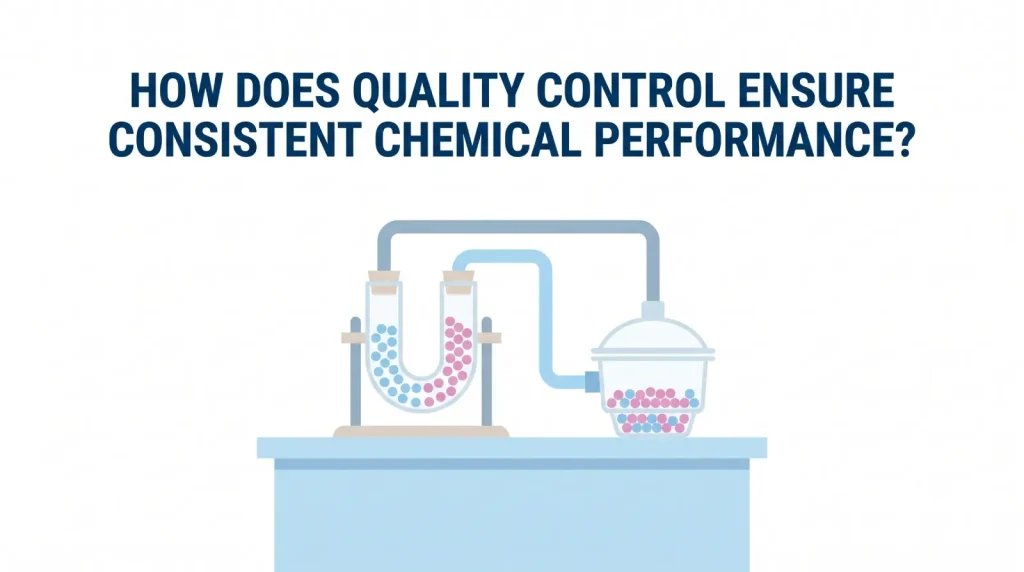
How Does Chemical Quality Control Detect Performance Drift?
Quality control is not a single test. It is a system of interconnected verifications designed to answer one question: does this material match the specification on which the process was designed?
In chemical quality control, the specification defines the acceptable range for each parameter that influences performance. For industrial chemicals, these parameters typically include assay or purity, moisture content, impurity profiles, physical form, and solubility. When any parameter drifts outside its acceptable range, process behavior changes.
The detection mechanism relies on statistical sampling. Every shipment, every production lot, or every tanker truck represents a population. Testing a representative sample from that population provides an estimate of the whole. The ASTM International standards body publishes sampling protocols for hundreds of industrial chemicals, each designed to ensure the sample tested actually represents the material it purports to represent. Poor sampling technique invalidates even the most precise laboratory analysis.
Once sampled, the material moves through a defined testing sequence. Critical performance parameters are measured first—those parameters most likely to affect downstream process outcomes. Less critical parameters follow. The results are compared to the purchase specification. Shipments that fall within the specified range are accepted. Shipments that fall outside trigger a non-conformance process: rejection, return, or negotiated acceptance with adjusted usage protocols.
What Are the Critical Performance Parameters for Industrial Chemicals?
Industrial chemicals are not defined by a single number. A certificate of analysis may report a dozen parameters, but not all carry equal weight. The parameters that matter most are those with a direct causal link to the process outcome the chemical is meant to achieve.
| Parameter | What It Measures | Why It Matters |
|---|---|---|
| Assay (Purity) | Percentage of the target compound in the material | Underdosing or overdosing when using the standard recipe |
| Moisture Content | Water present in the solid or liquid product | Dilutes active ingredient; alters handling and mixing behavior |
| Impurity Profile | Types and concentrations of non-target substances | Some impurities accelerate corrosion; others interfere with target reactions |
| Particle Size Distribution | Range of particle diameters in granular or powdered products | Dissolution rate, dust generation, and handling characteristics |
| Solution Clarity / Insolubles | Non-dissolving residue when the chemical is put into solution | Clogs spray nozzles, dosing pumps, and injection equipment |
A chemical may meet its assay specification and still fail in service if an uncontrolled impurity catalyzes an unwanted side reaction. This is why the impurity profile matters as much as the headline purity number.
How Do Testing Methods Influence QC Reliability?
The choice of analytical method determines the precision, accuracy, and repeatability of QC data. Methods fall into categories based on what they measure and how they measure it.
Titrimetric methods remain common for assay determination. They measure the amount of a known reagent required to react completely with the target analyte. These methods are well-established, relatively low-cost, and reproducible across laboratories when following a standardized procedure.
Gravimetric methods measure mass change—precipitation, drying, or ignition. Moisture content by loss on drying is the classic example. The method is simple but requires careful technique to avoid errors from incomplete drying or re-absorption of atmospheric moisture.
Instrumental methods—inductively coupled plasma spectroscopy, ion chromatography, X-ray fluorescence—provide detailed impurity profiles at trace concentrations. These methods detect elements or ions present at parts-per-million levels that older methods would miss.
The ISO/IEC 17025 standard specifies general requirements for the competence of testing and calibration laboratories. Laboratories accredited to this standard have demonstrated that their methods, equipment, and personnel produce valid results. Requiring ISO/IEC 17025 accreditation from contract testing labs adds a layer of confidence to QC data.
Calcium Chloride: A Case Study in Performance Consistency
Calcium Chloride (CaCl₂) illustrates why quality control matters for chemical performance. This salt serves multiple industrial roles: dust suppressant on unpaved roads, accelerator in concrete, brine for refrigeration systems, and hardness adjuster in water treatment. In each application, the chemical's performance depends on specific physical and chemical properties—and those properties vary significantly between suppliers and production methods.
Why Does Calcium Chloride Purity Vary Between Production Methods?
Calcium Chloride is manufactured through several distinct routes, and each produces a material with a characteristic impurity profile.
The Solvay process route produces calcium chloride as a byproduct of sodium carbonate manufacturing. This material typically contains residual sodium chloride and calcium carbonate. The impurity levels depend on how thoroughly the byproduct stream is purified before concentration and drying.
The direct reaction route—reacting hydrochloric acid with limestone—produces a material with a different impurity signature. Iron and magnesium from the limestone source rock carry through into the final product. The magnesium content is particularly significant because it affects the hygroscopic behavior of the material.
A third route recovers calcium chloride from naturally occurring brine deposits. This material can achieve high purity if the brine source is clean, but may contain other dissolved salts characteristic of the geological formation from which it was extracted.
A quality control program that only checks total assay may miss these differences. Two shipments of "94% calcium chloride" could perform very differently if one carries 3% magnesium chloride and the other carries 3% sodium chloride.
What Testing Protocols Verify Calcium Chloride Performance?
Standardized testing methods provide the data needed to predict field performance. The following table summarizes key test methods applicable to Calcium Chloride quality verification.
| Test Parameter | Common Method Basis | Performance Relevance |
|---|---|---|
| CaCl₂ Assay | Titration with EDTA (complexometric) | Determines active ingredient available for target reaction |
| Total Alkali Chloride (as NaCl) | Calculation or separate chloride determination | Indicates residual sodium chloride from Solvay process |
| Magnesium (as MgCl₂) | Atomic absorption or ICP spectroscopy | Affects hygroscopicity and de-icing performance |
| Sulfate (as CaSO₄) | Gravimetric precipitation as barium sulfate | High sulfate can cause scaling in heat exchange systems |
| Water Insolubles | Gravimetric after dissolution and filtration | Predicts nozzle clogging and pump wear in liquid application systems |
A defensible QC program tests not just the assay but the parameters that matter for the intended application. Calcium chloride intended for dust control needs different verification emphasis than material intended for concrete acceleration.
How Does Moisture Content Affect Calcium Chloride Handling and Performance?
Calcium chloride is highly hygroscopic—it absorbs moisture from the air. This property makes it effective as a dust suppressant (the absorbed moisture keeps road surfaces damp) but creates challenges in storage and handling.
As moisture content rises, several things happen simultaneously. The effective active ingredient concentration drops. A shipment sold as "94% CaCl₂" may test at 90% if it absorbed moisture during transport. The physical handling characteristics change—the material transitions from free-flowing prills to a sticky, caked mass that resists metering equipment. For solution preparation, operators must account for the actual concentration when calculating dosing rates, not the nominal specification.
A QC protocol must therefore measure moisture content on receipt and adjust acceptance criteria or usage calculations accordingly. This is a prime example of a parameter whose importance is not reflected in the headline assay number but directly determines field performance.
How Do Supplier Qualification and Auditing Reduce QC Burden?
Laboratory testing alone cannot guarantee consistent chemical performance. Testing catches problems after they occur—when a non-conforming shipment has already been manufactured, shipped, and delivered. A more efficient approach reduces the probability of non-conformance before material leaves the supplier's facility.
Supplier qualification is the proactive complement to incoming inspection. It involves evaluating the supplier's manufacturing process control, quality management system, and testing capabilities before approving them as a qualified source. A well-qualified supplier produces fewer non-conforming lots because their internal controls catch deviations before shipment.
What Should a Supplier Audit Evaluate?
A meaningful supplier audit goes beyond reviewing paperwork. It examines the physical reality of the manufacturing and quality control operation.
The audit should verify that the supplier's testing equipment is calibrated and traceable to national or international standards. It should confirm that sampling procedures follow a recognized protocol and that samples are handled to preserve their representativeness. The audit should review retained sample programs—does the supplier keep samples from past production lots for retrospective testing if a problem is discovered later?
The manufacturing process itself deserves attention. Are critical process parameters monitored and controlled? For calcium chloride production, this might include evaporator temperatures, drying temperatures, and screening operations that control particle size. A supplier that cannot demonstrate process control cannot guarantee product consistency.
Audit frequency scales with risk. A single-source supplier of a critical chemical warrants annual audits. A supplier providing a commodity chemical available from multiple sources might be audited every two to three years. Changes in supplier ownership, raw material sources, or manufacturing location should trigger a re-audit regardless of schedule.
How Does Quality Control Prevent Common Chemical Failures?
Chemical failures in industrial settings rarely announce themselves in advance. They manifest as process upsets, product quality deviations, or equipment damage. Tracing the root cause back to chemical quality requires the kind of documentation that a formal QC program generates.
Corrosion in storage and handling systems often traces to impurities that were not specified or tested. Chloride salts other than the target compound can accelerate pitting corrosion in stainless steel. A specification that limits total chloride is not sufficient if the form of that chloride affects corrosion differently.
Process efficiency drops when chemical concentration in the feed stream is lower than assumed. Operators following a standard recipe add a fixed volume or mass of chemical, expecting a certain active ingredient delivery. If the actual assay is low, the process runs underdosed. The effect may not be dramatic enough to trigger an alarm, but accumulates over time as reduced throughput or increased rework.
Equipment fouling and clogging stems from insolubles, oversized particles, or unexpected precipitates. A calcium chloride solution that carries fine calcium sulfate particles will eventually foul heat exchanger surfaces or clog spray nozzles. The QC parameter that predicts this—water insolubles or particle size distribution—must be part of the specification and verified on receipt.
The common thread is that each failure mode is predictable if the right parameters are tested. A QC program that only verifies assay will miss the majority of failure causes that originate in other parameters.
How to Build a Defensible Chemical Quality Control Program
Building or upgrading a chemical QC program follows a logical sequence. The objective is not maximum testing but appropriate testing—verifying the parameters that matter for the application with sufficient frequency to catch problems before they cause damage.
Step 1: Define the Performance Specification
Start with the process, not the chemical. What does this material need to do, and what chemical or physical properties determine whether it does that successfully? Consult process engineers, equipment suppliers, and chemical reference literature. Translate performance requirements into measurable parameters with acceptable ranges.
Step 2: Select Test Methods
Match test methods to the parameters identified in Step 1. Prefer standardized methods published by ASTM, ISO, or EPA over proprietary or in-house methods. Standardized methods are defensible in disputes and reproducible across laboratories. Document the chosen methods and their acceptance criteria.
Step 3: Establish Sampling Protocols
Define how samples will be taken, from what locations, using what equipment, and in what quantity. For bulk deliveries, specify whether samples are taken from the top, middle, and bottom of the tanker. For packaged goods, specify the number of randomly selected containers to sample. The goal is a sample that represents the entire lot.
Step 4: Set Testing Frequency
Not every shipment requires full-spectrum testing. Initial qualification of a new supplier or new product grade warrants comprehensive testing. Once a supplier demonstrates consistent performance over multiple shipments, testing frequency can shift to periodic verification—testing every third or fifth shipment for the full suite while continuing to check critical parameters on every receipt.
Step 5: Create a Non-Conformance Response
What happens when a shipment fails to meet specification? The response procedure should be documented before it is needed. Options include outright rejection, acceptance with a price adjustment, or acceptance with adjusted usage instructions. The decision criteria should consider the nature and magnitude of the deviation and the criticality of the process the chemical serves.
Step 6: Maintain Records and Review Trends
QC data accumulates value over time. A single test result tells you about one shipment. Twelve months of test results reveal supplier trends, seasonal variation patterns, and gradual drifts that individual tests miss. Review QC data periodically and adjust specifications, testing frequency, or supplier status based on the trends observed.
Best Practices for Chemical Quality Control
The following practices elevate a basic QC program to a robust, defensible system.
- Specify the application, not just the chemical name. "Calcium chloride for concrete acceleration" imposes different requirements than "calcium chloride for refrigeration brine." The application context determines which parameters matter.
- Audit the supplier's own QC program. A supplier certificate of analysis is only as reliable as the laboratory that produced it. Verify that the supplier's testing practices meet your standards.
- Retain samples from every lot received. Retained samples enable retrospective investigation if a process problem emerges weeks or months after the material was consumed. Store retained samples in sealed, labeled containers under conditions that preserve their original characteristics.
- Train receiving personnel to recognize obvious non-conformances. A truck driver presenting paperwork for the wrong chemical grade, visible contamination, or damaged packaging should trigger a hold before laboratory testing even begins.
- Correlate QC data with process performance data. The ultimate measure of chemical quality is how the process behaves. If process indicators shift when a particular supplier's material enters the system, investigate even if all QC tests passed.
- Require certificates of analysis before unloading, not after. Review COA data against your specification before the truck or railcar is emptied into your storage. Once material is commingled in a bulk tank, the option to reject is lost.
Conclusion
Consistent chemical performance does not happen by accident. It is the product of a deliberate chemical quality control system that defines what "good" looks like, verifies that incoming material meets that definition, and creates a feedback loop that catches drift before it becomes failure. The system rests on three foundations: clear, application-relevant specifications; testing protocols that measure the parameters that actually predict performance; and supplier qualification that reduces the probability of non-conformance at the source.
The Calcium Chloride example demonstrates that parameters beyond headline purity—moisture content, impurity profile, particle size distribution—frequently determine whether a chemical succeeds or fails in service. A QC program that tests only assay tests only part of the story. When evaluating chemical quality control practices, verify that your program addresses the full set of performance-defining parameters for your specific application.
FAQs
What is chemical quality control in manufacturing?
Chemical quality control in manufacturing is the systematic process of verifying that incoming chemical raw materials conform to predetermined specifications before they enter the production process. It combines sampling, laboratory testing, supplier qualification, and documentation to ensure that chemical inputs consistently meet the purity, composition, and physical property requirements that the manufacturing process was designed around.
- Testing verifies that each parameter falls within its specified acceptable range
- Results are compared to purchase specifications to determine acceptance or rejection
- Non-conformance triggers documented response procedures specific to each chemical
How is calcium chloride quality tested in industrial settings?
Industrial calcium chloride quality is tested using a combination of titrimetric, gravimetric, and instrumental methods that measure assay, impurity profile, moisture content, and physical properties. The specific test suite depends on the intended application—dust control, concrete acceleration, refrigeration, or water treatment—because different applications are sensitive to different parameters.
- EDTA complexometric titration determines total calcium chloride content
- Loss-on-drying gravimetric analysis measures moisture content
- Atomic absorption or ICP spectroscopy quantifies magnesium, iron, and other metal impurities
What parameters affect calcium chloride performance?
The parameters that most significantly affect calcium chloride performance include assay or purity level, moisture content, magnesium chloride concentration, sulfate content, and water-insoluble residue. Each parameter influences a different aspect of field performance. High magnesium content increases hygroscopicity and improves dust control effectiveness but may reduce concrete setting acceleration rates.
- Assay determines the active ingredient available for the target chemical reaction
- Moisture content affects handling characteristics and actual delivered concentration
- Insolubles predict the likelihood of nozzle clogging and pump wear in liquid application systems
How does moisture content affect chemical quality?
Moisture content affects chemical quality by diluting the active ingredient concentration, altering physical handling characteristics, and potentially introducing variability into dosing calculations. For hygroscopic chemicals like calcium chloride, moisture content can increase during storage and transport if packaging is compromised, making receipt testing essential.
- A shipment sold at 94% assay may test lower if moisture was absorbed during transit
- Caking and clumping from excessive moisture interferes with metering and conveying equipment
- Solution preparation calculations require actual concentration data, not nominal specification values
Why is impurity profiling important in chemical quality control?
Impurity profiling is important because impurities that are present at even low concentrations can catalyze unwanted side reactions, accelerate corrosion, or interfere with the intended chemical reaction. Two shipments with identical assay values can behave very differently in service if their impurity profiles differ. A specification limited to total purity provides incomplete protection against performance problems.
- Chloride salt impurities beyond the target compound can increase pitting corrosion risk in stainless steel
- Magnesium and sulfate impurities alter the physical and chemical behavior of calcium chloride products
- Impurity data enables root cause investigation when process upsets coincide with supplier or lot changes
What is the difference between assay and purity in chemical specifications?
Assay refers to the measured quantity of the target compound as determined by a specific analytical method, while purity is a broader concept encompassing freedom from all unwanted substances. A chemical may have high assay but low practical purity if it contains interfering impurities that the assay method does not distinguish from the target compound. The two terms are related but not interchangeable.
- Assay is method-dependent and reflects what a particular test measures
- Purity considers all substances present, including those individual assay methods may miss
- Specification language must clearly define which term is being used and what it includes
How often should chemical shipments be tested for quality?
Chemical shipment testing frequency follows a risk-based approach. New suppliers and new product grades warrant comprehensive testing of every shipment. Established suppliers with a documented history of conformance can transition to reduced-frequency testing—full-suite testing on every third or fifth shipment with critical parameters still checked on every receipt. Changes in supplier raw material sources, manufacturing location, or ownership should trigger a return to full-frequency testing.
- Initial qualification period requires testing every shipment for all specified parameters
- Statistical process control data guides decisions about reducing testing frequency
- Any non-conformance event resets the clock and warrants increased testing until confidence is restored
What standards apply to chemical quality control laboratories?
Chemical quality control laboratories operate under several recognized standards, the most prominent being ISO/IEC 17025, which specifies general requirements for testing and calibration laboratory competence. Laboratories accredited to this standard have demonstrated proficiency in their test methods, equipment calibration and maintenance, personnel training, and quality assurance procedures. Industry-specific standards and pharmacopoeias may impose additional requirements.
- ISO/IEC 17025 accreditation provides independent verification of laboratory competence
- ASTM International publishes standardized test methods referenced in chemical specifications
- Good Laboratory Practice regulations apply to certain testing contexts and jurisdictions
How does supplier auditing improve chemical quality?
Supplier auditing improves chemical quality by verifying that the manufacturer's process controls, quality management systems, and testing capabilities are capable of consistently producing conforming material. Audits identify potential failure points before they affect shipped product and create accountability for the supplier's internal quality practices. A supplier that knows its processes will be audited invests more in maintaining control.
- On-site audits examine equipment calibration records, retained sample programs, and sampling procedures
- Process control verification confirms that critical manufacturing parameters are monitored and documented
- Audit frequency scales with the criticality of the chemical and the availability of alternative sources
What causes chemical quality failures in industrial processes?
Chemical quality failures in industrial processes typically trace to one of several root causes: incoming material that does not meet specification, undetected changes in supplier raw material sources or manufacturing processes, parameter drift that accumulated gradually across multiple shipments without detection, or specifications that omitted parameters critical to the specific application. Robust QC programs address all four pathways.
- Supplier process changes without notification can alter impurity profiles even when assay remains consistent
- Inadequate sampling technique produces non-representative test results that miss real quality problems
- Specification gaps leave important performance parameters untested and uncontrolled