Chemical exporter services exist because moving calcium chloride across borders involves far more than booking freight. Calcium chloride is safe when handled properly. The key risks are moisture contamination, regulatory non-compliance, and documentation errors that can delay shipments by weeks or render cargo unsellable upon arrival. The difference between a smooth export operation and a costly failure often comes down to whether the exporter understands these risks before the container leaves the loading dock.
Calcium chloride (CaCl₂) ranks among the most widely traded industrial chemicals globally. China exported approximately 1.4 million metric tons of calcium chloride in 2024, with a total value exceeding $237 million. Major destinations include Saudi Arabia, South Korea, Russia, Chile, and Japan. For new buyers entering this market, the question is not whether calcium chloride is available—it is how to source it reliably without absorbing unnecessary risk.
This article explains what professional chemical exporters actually do, why their role matters beyond logistics, and what buyers should evaluate when selecting an export partner.
What This Article Covers
- The specific risks that professional exporters mitigate
- How export documentation and compliance work in practice
- What separates qualified exporters from intermediaries
- Bottom line: Professional exporters reduce transaction risk by managing compliance, quality verification, and logistics coordination that individual buyers cannot efficiently replicate.
What Makes Calcium Chloride Export Different from Domestic Sales?
Exporting calcium chloride introduces variables that do not exist in domestic transactions. The product itself is stable under normal conditions—calcium chloride is chemically stable at room temperature and does not decompose under standard ambient conditions. But stability does not equal simplicity in international trade.
The first variable is moisture. Calcium chloride is highly hygroscopic. Anhydrous calcium chloride reacts exothermically with water, and even hydrated forms will absorb atmospheric moisture if packaging fails. A container that travels through tropical waters without proper liner protection can arrive with caked or liquefied product.
The second variable is regulatory classification. Calcium chloride sits in an unusual position: it is not listed in China‘s Catalogue of Hazardous Chemicals (2015 Edition), yet it still requires export inspection and a valid MSDS. Different destination countries apply different rules. The EU, for example, does not classify anhydrous calcium chloride as dangerous goods under IMDG Code, but certain liquid solutions or blends may trigger Class 8 or Class 9 classification.
The third variable is documentation consistency. Customs authorities compare the bill of lading, packing list, commercial invoice, and MSDS. Any discrepancy—even a minor one—triggers inspection. Generic cargo descriptions like “chemicals” or “industrial salts” are frequent causes of delay.
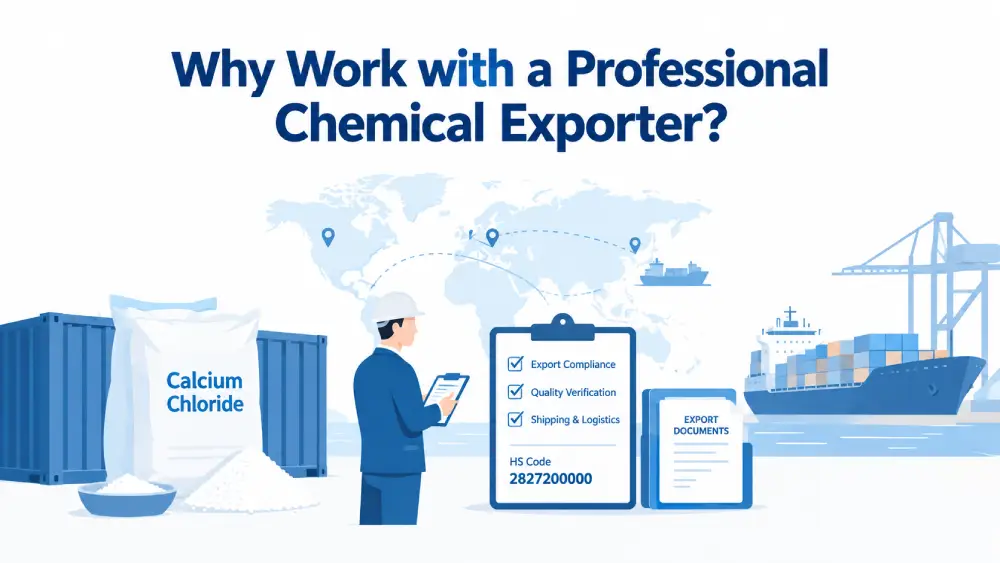
Professional chemical exporters exist to absorb these variables. They maintain compliance infrastructure, quality verification processes, and carrier relationships that individual buyers cannot replicate cost-effectively.
How Does Calcium Chloride Export Compliance Work in Practice?
Export compliance for calcium chloride operates on two levels: Chinese export requirements and destination-country import requirements.
On the Chinese side, calcium chloride under HS Code 2827200000 carries regulatory condition “B,” which means export legal inspection is mandatory. The exporter must obtain an Outbound Goods Customs Clearance Form from customs before shipment can proceed. This is not optional, regardless of whether the product is classified as dangerous goods.
A qualified MSDS is the central document for this process. Chinese customs authorities use the MSDS to confirm that calcium chloride is not a regulated dangerous chemical. An inaccurate or outdated MSDS—particularly one not aligned with current GHS format—can cause the shipment to be held or rejected.
On the destination side, requirements vary significantly. The U.S. Food and Drug Administration maintains calcium chloride on its GRAS (Generally Recognized as Safe) list when used as a direct human food ingredient. The U.S. Department of Agriculture and Environmental Protection Agency have evaluated calcium chloride for dust suppression and de-icing applications. But food-grade calcium chloride entering certain markets requires additional health certificates. Egypt, for example, mandates a food health certificate issued by the exporting country’s customs authority—a document that must be prepared before shipment, not after.
ASTM D98 provides the standard specification for technical-grade calcium chloride, covering Type S (solid: flake, pellet, or granular) and Type L (liquid) forms, with defined limits on alkali chlorides, magnesium, and calcium hydroxide impurities. Buyers who specify compliance with ASTM D98 give themselves a reference point for quality verification.
FDA genotoxicity studies concluded that calcium chloride is not genotoxic. This matters for buyers in food-adjacent applications who need assurance that the product carries no mutagenic risk. The CDC’s National Institute for Occupational Safety and Health evaluated calcium chloride as a dust suppressant and found it poses little internal hazard to humans and animals, though vegetation toxicity near application sites should be expected.
What Does a Professional Chemical Exporter Actually Do?
The functional difference between a chemical exporter and a trading company lies in what they control versus what they coordinate.
A professional exporter typically manages these functions directly:
- Quality verification at origin. This includes batch testing against specifications, certificate of analysis generation, and pre-shipment sampling. The exporter should be able to produce test results before the cargo reaches the port.
- Regulatory documentation. MSDS preparation to current GHS standards, export inspection coordination, and destination-specific certificate procurement.
- Packaging specification. Calcium chloride packaging must prevent moisture ingress during ocean transit. Standard configurations include 25kg plastic woven bags with inner plastic liners and 1,000kg jumbo bags. The liner specification matters more than the outer bag.
- Carrier and freight management. Booking with carriers experienced in chemical cargo, providing accurate MSDS to the shipping line, and managing container inspection before loading.
- Contingency planning. What happens if the vessel is delayed at a transshipment port? What if the consignee’s customs broker requests additional documentation? Professional exporters maintain escalation paths and emergency contacts.
A trading intermediary may coordinate some of these tasks but typically does not control quality at origin or maintain direct carrier relationships. For buyers, the distinction is risk allocation: the more functions the exporter controls, the fewer handoffs where problems can occur.
Is It Better to Source Directly from a Manufacturer or Through an Exporter?
This is a legitimate question, and the answer depends on order scale, destination complexity, and buyer resources.
| Factor | Direct Manufacturer | Professional Exporter |
|---|---|---|
| Minimum order quantity | Often 20MT+ per grade | Can consolidate smaller volumes |
| Quality documentation | Produces COA for own output | May verify across multiple producers |
| Regulatory support | Limited to own product registrations | Can navigate destination-specific rules |
| Logistics flexibility | Tied to own port and carrier agreements | Can select routing based on buyer needs |
| Risk absorption | Manufacturer bears production risk only | Exporter absorbs coordination and compliance risk |
| Price transparency | Generally lower per-unit cost | Includes service component |
Choose a direct manufacturer when:
- You purchase in full container or vessel quantities
- Your destination market has simple, well-understood import requirements
- You maintain your own customs brokerage and compliance staff
- You have verified the manufacturer‘s quality systems through audit
Choose a professional exporter when:
- You need consolidated volumes or mixed specifications
- Your destination requires specialized documentation
- You lack in-house trade compliance expertise
- You want a single point of accountability across multiple risk areas
The calculus shifts further when regulatory changes occur. The U.S. Department of Commerce reviews antidumping and countervailing duty orders on certain calcium-based chemicals periodically. Exporters who track these developments can adjust routing or documentation before a shipment is affected. Individual buyers may discover the issue only when the container is already on the water.
Where Does Calcium Chloride Export Risk Concentrate?
Risk in calcium chloride export concentrates in three areas: moisture damage, documentation failure, and quality disputes. Each has a different mitigation path.
Moisture damage is the most visible failure mode. A container that arrives with water inside the liner produces caked, unusable product. Mitigation begins with container inspection before loading—rejecting containers with damaged door gaskets or floor contamination. Desiccant placement and liner integrity matter as much as the packaging itself.
Documentation failure is the most common delay cause. An MSDS in outdated format, a missing export inspection certificate, or an inconsistent cargo description across documents all trigger holds. The fix is pre-clearance review: submitting documentation to a customs broker or compliance reviewer 48-72 hours before vessel arrival at destination.
Quality disputes arise when the delivered product does not match the agreed specification. This is where the exporter’s quality verification process matters. A certificate of analysis generated at the production facility, with batch traceability, provides the buyer a reference point. Without it, disputes become unresolvable.
The pattern across all three risk areas is the same: problems are cheaper to prevent than to resolve. Professional exporters build prevention into their process rather than relying on remediation after cargo has moved.
What Regulatory Trends Affect Calcium Chloride Export?
Two regulatory trends are reshaping the calcium chloride export landscape.
First, antidumping and countervailing duty actions targeting Chinese chemical exports have expanded. While calcium chloride itself is not currently subject to blanket AD/CVD orders in the U.S., related products like calcium hypochlorite have faced continued duty enforcement. The mechanism exists, and the precedent matters for buyers who assume chemical imports face no trade policy risk.
Second, destination-country import requirements are tightening, particularly for food-grade and pharmaceutical-adjacent applications. The Egyptian food health certificate requirement is one example. As more countries demand origin-issued health documentation, exporters must build certificate procurement into their standard workflow rather than treating it as an exception.
For buyers, the implication is that exporter capability now includes regulatory intelligence—the ability to know what a given destination will require before the order is placed, not after the container arrives.
FAQs
What is a chemical exporter?
A chemical exporter is a business that manages the sale and shipment of chemical products across international borders. This includes quality verification at origin, regulatory documentation, customs clearance coordination, and logistics management. Professional chemical exporters typically maintain relationships with multiple manufacturers, carriers, and customs brokers to serve buyers in different markets.
How does calcium chloride export inspection work in China?
Calcium chloride under HS Code 2827200000 carries mandatory export inspection. The exporter must file an inspection application with Chinese customs, provide a valid MSDS, and obtain an Outbound Goods Customs Clearance Form before the shipment can be cleared for export. The inspection may involve document review or physical sampling.
Is calcium chloride considered dangerous goods for shipping?
Anhydrous and standard hydrated calcium chloride are generally not classified as dangerous goods under international maritime rules. However, certain liquid solutions or chemical blends may trigger classification. Always verify against the current IMDG Code amendment for your specific product form and concentration.
What documents does a calcium chloride exporter need to provide?
Required documents typically include:
- Commercial invoice and packing list
- Bill of lading
- Certificate of analysis
- MSDS in current GHS format
- Export inspection certificate (China origin)
- Destination-specific certificates as required
How long does calcium chloride export shipping take?
Ocean transit time depends on route and carrier. China to U.S. West Coast typically runs 14-21 days. China to Europe runs 28-35 days via Suez or 45-50 days via Cape of Good Hope. China to Southeast Asia runs 5-10 days. Customs clearance adds 24-72 hours at destination.
What are the risks of buying calcium chloride without a professional exporter?
The primary risks are:
- Moisture damage from improper packaging or container selection
- Customs delays from documentation errors
- Quality disputes without verified certificates of analysis
- Regulatory non-compliance at destination
- No clear accountability when problems occur
Can calcium chloride be shipped in bulk or must it be bagged?
Calcium chloride ships in both bagged and bulk configurations. Standard bagged options include 25kg woven bags and 1,000kg jumbo bags. Bulk shipments use lined containers or specialized bulk vessels. The choice depends on destination handling capacity and buyer requirements.
How is calcium chloride quality verified before shipment?
Quality verification involves:
- Batch sampling at the production facility
- Testing against agreed specifications (purity, insolubles, pH)
- Certificate of analysis generation
- Pre-shipment sample retention for dispute resolution
What certifications should a calcium chloride exporter have?
Key certifications include:
- ISO 9001:2015 for quality management
- ISO 28000 for supply chain security
- Membership in chemical industry associations such as CEFIC or ACC Responsible Care
- DGSA certification if handling dangerous goods advisory
Why do calcium chloride export prices vary between suppliers?
Price variation reflects differences in:
- Purity grade (74% flake vs. 94% anhydrous)
- Packaging configuration
- Incoterms (FOB vs. CIF)
- Order volume
- Exporter service scope
A lower quoted price often excludes compliance or quality verification services that the buyer will need to source separately.
Conclusion
Working with a professional chemical exporter for calcium chloride purchases means transferring risk rather than simply paying a markup. Calcium chloride is safe when handled properly, but the export process introduces risks—moisture, regulation, documentation—that require systematic management. Exporters who control quality verification, maintain current regulatory knowledge, and build prevention into their logistics process reduce the probability of costly failures.
When evaluating export partners, prioritize those who can demonstrate documented quality systems, current MSDS compliance, and destination-specific regulatory experience. The lowest price matters less than the total cost of a delayed or rejected shipment. For buyers new to calcium chloride sourcing, starting with an exporter who provides clear documentation and responsive communication establishes a baseline for future transactions.