
Calcium chloride is safe when handled properly. The key risks are moisture absorption during transit, improper storage leading to product clumping, and inadequate supplier verification. For bulk importers, the primary concerns are not product hazards but rather supply chain reliability, specification accuracy, and total landed cost optimization. This guide provides a structured framework for evaluating calcium chloride suppliers, verifying product specifications, and managing the logistics of bulk calcium chloride procurement in 2026.
Key Takeaways
- Calcium chloride purity ranges from 74% (dihydrate) to 94-99% (anhydrous), with specification mismatches being the leading cause of import disputes .
- Calcium chloride is hygroscopic and deliquescent, meaning it absorbs moisture from air and can convert to liquid brine if packaging integrity fails during ocean transit .
- A 20-foot container typically holds 25 metric tons of bagged calcium chloride without pallets, or 20 tons when palletized .
- U.S. Customs classifies calcium chloride under HTS 2827.20.0000 with a general duty rate of Free, while Japan imposes 3.9% general tariff or 1.5% under RCEP for Chinese-origin material .
- Properly stored calcium chloride maintains a 36-month shelf life when protected from moisture intrusion .
What Is Calcium Chloride and Why Does Purity Grade Matter?
Calcium chloride (CaCl₂) is an inorganic compound composed of calcium and chlorine. It is highly soluble in water and exists in three primary commercial forms: anhydrous (94-99% CaCl₂), dihydrate (74-77% CaCl₂), and liquid solutions (typically 28-42% concentration) . The choice of form determines not only application suitability but also freight economics, storage requirements, and handling procedures.
For bulk importers, purity grade directly affects cost per unit of active ingredient. A metric ton of 94% anhydrous calcium chloride delivers approximately 27% more CaCl₂ content than the same weight of 74% dihydrate material. However, anhydrous product commands a higher unit price and requires more stringent moisture protection during shipping. The specification sheet should always be verified against independent laboratory analysis before contract finalization.
Industrial Grade vs Food Grade Specifications
Industrial grade calcium chloride typically specifies minimum 74% CaCl₂ for flakes and pellets, or 94% for powder and granular forms. Key impurities are controlled: free alkali as Ca(OH)₂ ≤ 0.25%, total alkali chlorides as NaCl ≤ 5.0%, magnesium and alkali salts ≤ 5.0%, sulfate ≤ 0.05%, and iron ≤ 0.01% .
Food grade calcium chloride must meet additional requirements for heavy metals, arsenic, and lead content, and is typically certified under FCC (Food Chemicals Codex) standards. Importers sourcing for food processing applications must explicitly confirm food-grade certification rather than assuming industrial-grade material meets food safety requirements .
How Does Moisture Absorption Affect Bulk Shipment Economics?
Calcium chloride’s hygroscopic nature creates a direct financial risk for bulk importers: product that absorbs moisture during transit gains weight without adding value, and may convert to unusable brine before reaching the destination warehouse . This phenomenon, called deliquescence, occurs when relative humidity exceeds approximately 35% at standard temperature.
The practical implications are significant:
- Weight disputes: If packaging fails and product absorbs moisture, the bill of lading weight may not match the received weight, complicating customs clearance and duty calculations.
- Quality rejection: Caked or liquefied product may be rejected at the port, leaving the importer responsible for disposal or re-export costs.
- Storage constraints: Once received, calcium chloride must be stored in sealed containers in dry conditions; open or damaged bags will degrade within weeks in humid environments .
Packaging Integrity Verification Checklist
Bulk importers should verify the following before shipment authorizes:
- Confirm inner liner specification: Standard 25kg bags use PP (polypropylene) woven outer with PE (polyethylene) inner liner; double-bag construction provides superior moisture barrier .
- Request pre-shipment packaging photos: Visual confirmation of sealed bags, intact pallet shrouds, and container loading patterns reduces disputes.
- Verify desiccant inclusion: For anhydrous grades, silica gel desiccant packs in the container provide additional moisture protection during long ocean voyages.
- Inspect container condition: Reject containers with visible water damage, compromised door seals, or evidence of prior chemical cargo contamination.
Calcium Chloride Dihydrate vs Anhydrous: Which Form Suits Your Application?
The selection between dihydrate and anhydrous forms is application-driven, not merely a purity preference. The table below compares key decision factors.
| Factor | Calcium Chloride Dihydrate (74-77%) | Anhydrous Calcium Chloride (94-99%) |
|---|---|---|
| Typical appearance | White flakes | White granules, pellets, or powder |
| CaCl₂ content per ton | 740-770 kg | 940-990 kg |
| De-icing performance | Effective above -25°C (-13°F) | Effective down to -51°C (-60°F) |
| Dust control application | Standard choice for road stabilization | Higher concentration, lower application rate |
| Desiccant suitability | Limited due to lower absorption capacity | Preferred for gas and solvent drying |
| Construction use | Concrete acceleration | Concrete acceleration, higher dosage efficiency |
| Relative unit price | Lower per metric ton | Higher per metric ton |
| Ocean freight consideration | Lower value density; more weight per CaCl₂ unit | Higher value density; better freight economics |
Choose dihydrate when: your application prioritizes cost per delivered metric ton over concentration, you require flake form for dissolution equipment compatibility, or you are supplying de-icing markets where 74% material meets performance specifications .
Choose anhydrous when: your application demands maximum CaCl₂ concentration per unit weight, you serve desiccant or food processing markets requiring high-purity material, or your logistics network penalizes higher freight weight .
How to Verify Calcium Chloride Suppliers Beyond Platform Badges
Supplier verification platforms display “Verified,” “Gold,” or “Audited” badges, but these indicators provide variable assurance levels. Bulk importers should conduct independent verification that goes beyond platform reputation systems.
The most reliable verification involves requesting the supplier’s production license, ISO certification scope, and recent third-party inspection reports. For Chinese suppliers, the National Chemical Industry Production License and ISO 9001:2015 certification are baseline requirements. REACH registration is mandatory for EU imports, and food-grade material requires FCC or equivalent certification .
Supplier Due Diligence Framework
- Verify business license registration matches the production facility location, not merely a trading company address.
- Request Certificate of Analysis (COA) from the actual production batch, not a generic specification sheet.
- Conduct video audit of production and packaging lines for initial orders exceeding 100 metric tons.
- Confirm transaction history via platform data; suppliers with established transaction records and repeat buyer percentages above 50% present lower counterparty risk .
- Test sample through independent laboratory before committing to full container volume.
What Are the Key Incoterms and Logistics Considerations for Calcium Chloride?
For bulk calcium chloride imports, the Incoterm selection affects both cost structure and risk allocation. CIF (Cost, Insurance, Freight) provides price certainty but may embed inflated logistics costs; FOB (Free On Board) offers cost transparency but requires the importer to manage freight procurement .
For first-time importers from a new supplier, FOB terms with an independent freight forwarder provide better cost visibility and allow the importer to verify actual shipping costs. For established supply relationships with high-volume annual contracts, CIF can simplify administration if the supplier’s freight rates are competitive.
Container Loading Optimization
A standard 20-foot container loading pattern for bagged calcium chloride:
Palletized loading reduces net product weight by approximately 20% but simplifies discharge operations and reduces bag damage during unloading. Importers with limited warehouse labor should factor this trade-off into total cost calculations.
FAQs
What is calcium chloride used for in industrial applications?
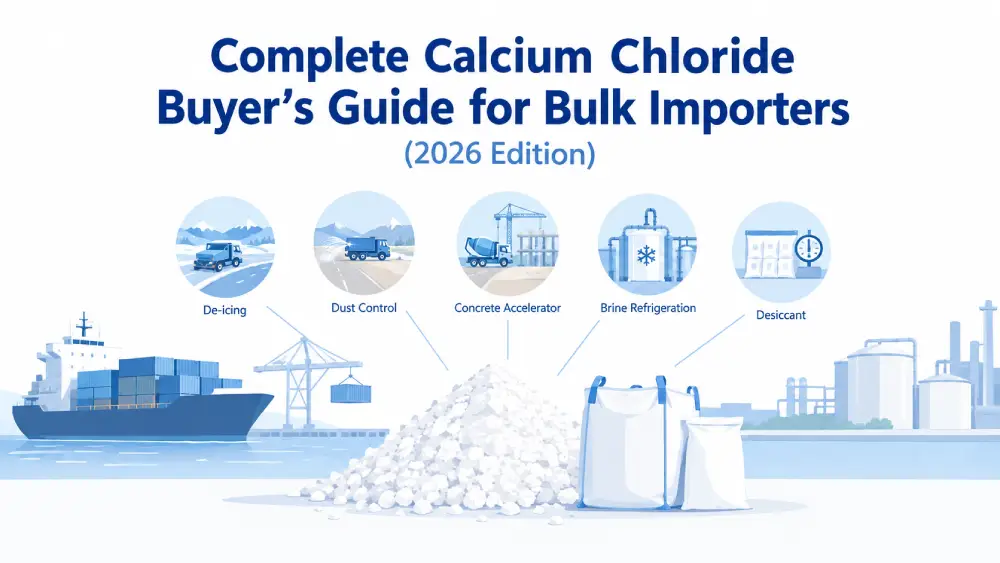
Calcium chloride serves multiple industrial functions including de-icing and anti-icing of roads and airport runways, dust suppression on unpaved roads and mining sites, concrete acceleration in cold-weather construction, brine solution for refrigeration plants, and desiccant applications for moisture control . The specific grade and form selection depends on the target application and required performance characteristics.
Is calcium chloride safe to handle and store?
Calcium chloride is safe when handled with standard chemical safety precautions. The material is not classified as hazardous for transportation, but direct eye contact causes irritation requiring immediate flushing with water for at least 15 minutes . Prolonged skin contact may cause dryness due to the material’s desiccant properties. Proper PPE including gloves and safety goggles is recommended during handling.
How long can calcium chloride be stored without quality degradation?
Properly stored calcium chloride maintains quality for 36 months. The product does not chemically degrade, but moisture absorption causes clumping and eventual conversion to liquid brine if packaging integrity is compromised . Storage in sealed containers in cool, dry conditions preserves product quality throughout the rated shelf life.
What is the difference between calcium chloride dihydrate and anhydrous?
Calcium chloride dihydrate contains two water molecules per CaCl₂ unit, yielding 74-77% CaCl₂ content by weight. Anhydrous calcium chloride contains no water of crystallization and delivers 94-99% CaCl₂ content . Anhydrous material provides higher concentration per unit weight but costs more per metric ton. Dihydrate is commonly supplied as flakes; anhydrous is available as granules, pellets, or powder.
What certifications should bulk importers require from calcium chloride suppliers?
Importers should require ISO 9001:2015 quality management certification, Certificate of Analysis for the specific production batch, Safety Data Sheet (SDS) compliant with destination country regulations, and for EU imports, REACH registration confirmation . Food-grade material requires additional FCC certification or equivalent food safety documentation. Suppliers claiming certification without providing documentation should be considered high-risk.
How is calcium chloride classified for customs and tariff purposes?
Calcium chloride is classified under HS Code 2827.20 in the Harmonized System. The U.S. HTS classification 2827.20.0000 carries a general duty rate of Free . Japan applies 3.9% general tariff, 3.3% under WTO terms, or 1.5% under RCEP for Chinese-origin material . Importers should verify current duty rates and applicable trade agreement preferences before finalizing landed cost calculations.
What are the common quality issues in calcium chloride imports?
The most frequent quality issues include CaCl₂ content below specification (typically 2-5% lower than quoted), excessive moisture absorption causing caking, inconsistent particle size distribution affecting application performance, and packaging failures during ocean transit leading to partial product loss. Independent pre-shipment inspection for orders exceeding 50 metric tons is strongly recommended.
Can calcium chloride be shipped in the same container as other chemicals?
Calcium chloride should not be co-loaded with materials that are moisture-sensitive, reactive with chlorides, or prone to cross-contamination. Oxidizing agents, strong acids, and materials requiring absolute dryness should ship separately. If co-loading is unavoidable, calcium chloride must be positioned to prevent leakage contact with other cargo, and the container should be lined with moisture barrier material.
What is the typical minimum order quantity for bulk calcium chloride?
Standard minimum order quantities range from 15 to 25 metric tons, corresponding to one 20-foot container load . Some suppliers accept lower volumes for trial orders but may apply price premiums or LCL consolidation fees. For annual contract pricing, importers should negotiate based on quarterly or annual volume commitments rather than single container quantities.
How should receiving inspections be conducted for calcium chloride shipments?
Receiving inspections should verify bag count against shipping documents, inspect packaging for moisture damage or seal failures, collect composite samples for independent laboratory analysis, and weigh a representative sample of bags to confirm net weight compliance. Any deviation exceeding 1% from specified CaCl₂ content should trigger formal supplier notification and potential claim procedures.
Conclusion
Effective calcium chloride procurement in 2026 requires importers to prioritize specification verification over price alone, establish moisture-protection protocols throughout the supply chain, and conduct supplier due diligence that goes beyond platform badges. The difference between a successful import program and a problematic one often lies in pre-shipment verification rather than post-arrival remediation. When evaluating potential calcium chloride suppliers, prioritize those who provide batch-specific Certificates of Analysis, demonstrate packaging integrity through documented inspection, and can support independent verification of production capabilities.