A calcium chloride technical data sheet is one of the most consequential documents a quality control or procurement professional will handle. It determines whether a delivered lot meets specification, whether a supplier stays qualified, and whether a production batch performs as expected. Yet in practice, these documents are frequently skimmed rather than read.
Many QA and purchasing teams assume that a data sheet is a formality — a PDF filed alongside the certificate of analysis and reviewed only when something goes wrong. In reality, the TDS is the primary contractual and technical reference for the material, and the gaps between what it states, what the COA reports, and what actually arrives in the tank car are where most compliance problems originate.
This guide explains, section by section, what a calcium chloride technical data sheet contains, how to interpret each parameter, where suppliers commonly present information ambiguously, and how to build a verification routine that protects both product quality and audit standing. The focus is on reading the document critically rather than accepting it at face value.
Calcium chloride is safe when handled properly. The key risks are thermal burns from the exothermic dissolution reaction, skin and eye irritation from concentrated brines, and dust inhalation during handling of the anhydrous form. These risks are managed through documented personal protective equipment requirements, ventilation controls, and correct storage — all of which should be traceable to specific statements in the technical data sheet. If a TDS does not address them, that omission is itself a finding.
What Is a Calcium Chloride Technical Data Sheet?
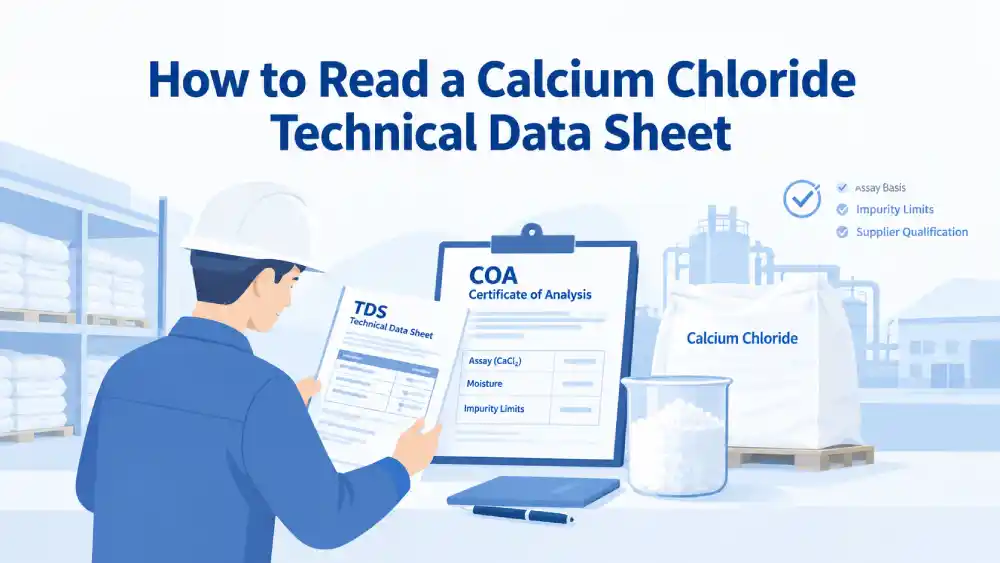
A calcium chloride technical data sheet is a supplier-issued document that defines the physical, chemical, and handling characteristics of a specific grade of calcium chloride. It is not the same as a Safety Data Sheet, although the two are often stored together and sometimes confused.
The distinction matters for procurement and QA workflows:
- The TDS describes what the material is — assay, purity, form, particle size, bulk density, and typical applications.
- The SDS describes what the material does to people and the environment — hazard classification, first aid, firefighting, and disposal.
The TDS is the document you use to confirm that a delivered grade matches the specification you ordered. The SDS is the document you use to train handlers and satisfy regulatory requirements. A complete supplier file contains both, and a calcium chloride technical data sheet should cross-reference the SDS revision number so that the two documents remain synchronized when either is updated.
Calcium chloride is available in three principal forms — anhydrous, dihydrate, and liquid — and the TDS must state which one applies. The form determines the assay range, the heat released on dissolution, and the storage requirements, so a data sheet that omits the form is incomplete regardless of how detailed the remaining parameters appear.
How Does the Assay Section Define Material Quality?
The assay, usually expressed as a percentage of CaCl₂, is the single most important number on the document. It establishes the concentration basis for every downstream calculation, including dosage rates, brine preparation, and cost-per-unit comparisons.
Assay is reported in one of two conventions, and confusing them is a common source of error:
- As-is basis — the percentage of CaCl₂ in the material as delivered, including moisture and impurities.
- Dry basis — the percentage of CaCl₂ in the material after accounting for water content.
A calcium chloride technical data sheet that reports "assay: 94%" without stating the basis is ambiguous. The same material might be 94% on a dry basis and 77% as-is if it contains significant residual moisture. For procurement teams comparing quotations, this ambiguity can translate into a meaningful cost difference per ton of active material.
Typical assay ranges by form, as reported in supplier documentation, are:
| Form | Typical CaCl₂ Content (as-is) | Notes |
|---|---|---|
| Anhydrous | 93–97% | Highest concentration, highest exotherm |
| Dihydrate | 74–77% | Most common industrial grade |
| Liquid | 28–42% | Concentration stated at 20 °C reference |
ASTM E449 provides standard test methods for calcium chloride analysis, and a well-prepared TDS will cite the method used for each reported value. Where the method is not cited, ask the supplier to confirm it in writing before approving the material for a regulated application.
What Do Physical Property Tables Actually Tell You?
Physical property tables translate the chemical assay into the practical behavior a plant will experience. For QA and procurement readers, four parameters carry the most operational weight.
Bulk density determines how much material fits in a silo, hopper, or supersack, and therefore affects freight economics and dosing calibration. Anhydrous calcium chloride typically runs 0.9–1.1 g/cm³, while the dihydrate runs 0.8–0.9 g/cm³. A TDS that lists a single figure without a range is usually reporting a typical value rather than a specification limit.
Particle size distribution governs dissolution rate, dust generation, and flowability in feeders. It is normally presented as a mesh range or a percentage passing a stated sieve. For prill and granular forms, a distribution curve is more informative than a single number, because a material can meet a nominal size while containing excessive fines that cause caking.
pH of a 1% or 5% solution is reported because calcium chloride brines are mildly acidic to near-neutral depending on grade and impurities. Values outside the expected range can indicate contamination or incomplete reaction during manufacture.
Melting point and solubility matter for applications involving freeze-point depression, such as road deicing or refrigeration brines. These values are temperature-dependent, and the TDS should state the reference temperature alongside the figure.
ASTM E449 specifies that calcium chloride test methods must report the sample preparation procedure alongside the analytical result, because as-received moisture content materially changes the measured values.
Why Does the Impurity Profile Matter for Regulated Applications?
Impurity limits determine whether a given lot of calcium chloride is acceptable for food, pharmaceutical, or drinking-water contact applications. They are the parameters most likely to be omitted from a general-purpose TDS and most likely to be required during an audit.
A calcium chloride technical data sheet intended for regulated use will typically list:
- Heavy metals (as Pb), usually ≤ 5 ppm for food-grade material
- Arsenic, typically ≤ 3 ppm
- Fluoride, typically ≤ 40 ppm
- Sulfate, typically ≤ 0.5%
- Magnesium and alkali salts, typically ≤ 2–3% combined
- Water-insoluble matter, typically ≤ 0.1–0.3%
These limits are not interchangeable between jurisdictions. The Food Chemicals Codex (FCC) and the European Pharmacopoeia (Ph. Eur.) set different thresholds for several of these parameters, and a TDS prepared for one market may not satisfy the other. Procurement teams sourcing across regions should confirm which compendial standard the supplier is declaring against, and QA teams should verify that the COA for each lot reports against the same standard.
Where a supplier cannot provide impurity data for a regulated application, the correct response is to request a lot-specific certificate of analysis rather than to accept the general TDS figure. The TDS describes capability; the COA documents actual results.
Is the Certificate of Analysis the Same as the TDS?
No, and treating them as interchangeable is one of the more consequential errors in incoming material inspection.
The calcium chloride technical data sheet is a standing document that describes the grade a supplier is capable of producing. The certificate of analysis is a lot-specific record of what was actually produced and tested. A supplier may hold a TDS showing an assay range of 74–77% while shipping a lot that tested at 73.6%, which is out of specification against the TDS but still reported on a COA as a passing result against a wider internal limit.
For QA teams, the verification routine should confirm:
- The COA lot number matches the delivery documentation and the container labels.
- The COA test methods match those cited in the TDS.
- The reported values fall within the TDS specification range, not merely within the supplier's internal acceptance criteria.
- The COA is signed or authenticated by an authorized signatory.
Where any of these checks fail, the lot should be quarantined pending supplier clarification. This is a documentation control decision as much as a technical one, and it should be recorded in the supplier quality file.
How to Choose a Calcium Chloride Grade for Your Application
Selecting the correct grade follows from the application requirements rather than from the supplier's catalog. The following decision matrix reflects the criteria most commonly applied across water treatment, deicing, food processing, and industrial manufacturing.
Choose anhydrous calcium chloride when:
- Maximum concentration per unit weight is required and freight cost dominates
- The application tolerates or requires a high exotherm on dissolution
- Moisture introduction must be minimized in the process stream
Choose dihydrate calcium chloride when:
- General industrial use is intended and cost per ton is the primary driver
- Dust generation during handling must be controlled
- The application does not require the highest achievable assay
Choose liquid calcium chloride when:
- The process uses brine directly and dissolving dry material is impractical
- Dust elimination is a hard requirement for the site
- Storage and dosing infrastructure already supports liquid handling
Choose food-grade calcium chloride when:
- The material contacts food, beverages, or potable water
- FCC, Ph. Eur., or equivalent compendial compliance must be documented
- Traceability from lot to certificate is required for audit purposes
Each selection should be supported by a written specification that references the applicable compendial standard, the required assay basis, and the impurity limits. A calcium chloride technical data sheet that does not align with that specification is grounds for supplier qualification review.
What Are the Common Mistakes in Reading a Calcium Chloride Technical Data Sheet?
Three errors appear repeatedly in supplier qualification reviews.
Reading the TDS as a specification. The TDS describes typical properties and capability. It becomes a specification only when both parties agree to it contractually. Without that step, a supplier can legitimately deliver material that falls outside the published values while remaining within their own internal limits.
Ignoring the assay basis. As noted earlier, dry-basis and as-is figures are not comparable. Comparing quotations on mismatched bases systematically favors the supplier reporting the higher, dry-basis number.
Overlooking revision control. A calcium chloride technical data sheet carries a revision number and date. When a supplier updates a TDS — often to reflect a changed raw material source or process adjustment — the change may not be communicated proactively. QA teams should record the revision number in the supplier file and verify it at each periodic review.
A fourth, less obvious error is failing to reconcile the TDS with the SDS. Where the two documents disagree on hazard classification, the discrepancy should be resolved before the material is approved for use.
FAQs
What is a calcium chloride technical data sheet?
A calcium chloride technical data sheet is a supplier document that specifies the physical and chemical properties of a particular grade of calcium chloride, including assay, form, bulk density, particle size, pH, and impurity limits. It describes the material's composition and typical performance, and it is used by procurement and quality teams to confirm that a purchased grade matches the required specification.
How does a TDS differ from a certificate of analysis?
The TDS describes what a supplier is capable of producing for a given grade. The certificate of analysis reports the actual test results for a specific lot. A COA should always be evaluated against the specification range published in the TDS, and any result falling outside that range should trigger a documented review before the lot is accepted.
Is calcium chloride safe to handle in industrial settings?
Calcium chloride is safe when handled properly. The key risks are thermal burns from the exothermic heat released when the anhydrous form dissolves, skin and eye irritation from concentrated brines, and respiratory irritation from dust. These risks are controlled through the personal protective equipment, ventilation, and storage requirements stated in the safety data sheet.
What assay basis should I specify when ordering?
Specify the basis explicitly in the purchase order. As-is basis reflects the material as delivered, including moisture, while dry basis excludes water content. For most procurement comparisons, as-is basis is the appropriate figure because it reflects what is actually received and paid for per ton.
Which impurities matter most for food-grade calcium chloride?
The critical impurity parameters for food-grade material are heavy metals, arsenic, fluoride, sulfate, and water-insoluble matter. Acceptable limits are set by the applicable compendial standard, such as the Food Chemicals Codex or the European Pharmacopoeia, and the COA should report against the specific standard named in the specification.
How often should a calcium chloride TDS be reviewed?
Review the TDS at least annually and whenever a supplier notifies of a process or sourcing change. Record the revision number and date in the supplier quality file. An unreviewed TDS that has been superseded can lead to acceptance of material that no longer meets the agreed specification.
What should I do if the COA values fall outside the TDS range?
Quarantine the lot and request written clarification from the supplier before releasing it to production. The supplier should confirm whether the TDS has been revised, whether the COA reflects a legitimate specification change, or whether the lot is genuinely out of specification. Document the resolution in the supplier file.
Is liquid calcium chloride covered by the same TDS parameters?
Liquid grades share the same fundamental parameters but express them differently. Assay is reported as a concentration at a stated reference temperature, typically 20 °C, and bulk density is replaced by specific gravity. Impurity limits remain comparable, though they are usually expressed on a dry-solids basis.
When should a buyer request a lot-specific COA instead of relying on the TDS?
Request a lot-specific COA whenever the material is destined for a regulated application, whenever the purchase specification includes impurity limits, and whenever the receiving inspection procedure requires lot traceability. The TDS establishes capability; the COA establishes conformity for the specific delivery.
What are the risks of accepting a TDS without a revision number?
A TDS without a revision number cannot be reliably controlled in a document management system. If the supplier later changes the specification, there is no version identifier to distinguish the superseded document from the current one, which undermines both audit traceability and the ability to demonstrate that the correct specification was applied at the time of purchase.
Conclusion
Reading a calcium chloride technical data sheet is a control activity, not a formality. The document defines the assay basis, physical properties, impurity limits, and handling characteristics that determine whether a delivered grade is fit for its intended use — and whether the supplier file will withstand audit scrutiny.
Three points carry the most weight. First, confirm the assay basis before comparing any two quotations, because dry-basis and as-is figures are not equivalent. Second, treat the TDS as a capability statement and the COA as the lot-specific proof of conformity, verifying each against the other at every receipt. Third, maintain revision control on the TDS itself, recording the revision number and date so that superseded documents cannot be mistaken for current ones.
When evaluating potential suppliers, prioritize those who cite recognized test methods such as ASTM E449, declare compliance against a named compendial standard, and provide lot-specific certificates of analysis on request. These are the indicators that the documentation reflects a controlled process rather than a marketing description.