Choosing between industrial grade calcium chloride and food grade calcium chloride is not simply a matter of price. The two materials share the same chemical formula—CaCl₂—but they are manufactured, tested, and certified for very different purposes. Selecting the wrong grade can lead to regulatory violations, product contamination, unnecessary costs, or performance issues.
Many buyers assume that a higher purity percentage automatically means a better product. In practice, purity is only one part of the decision. Manufacturing controls, impurity limits, certification requirements, and intended applications are equally important. Understanding these differences helps procurement teams purchase materials that meet both technical and regulatory requirements while avoiding unnecessary expense.
Industrial grade calcium chloride or food grade calcium chloride? The answer depends entirely on the intended application. Industrial grade calcium chloride is appropriate for applications such as road maintenance, dust suppression, oil and gas operations, refrigeration, concrete acceleration, and industrial drying when regulatory food-contact requirements do not apply. Food grade calcium chloride should only be selected for food processing, beverage production, and other applications requiring compliance with food safety regulations. The key purchasing factors are intended use, applicable standards, impurity limits, and supplier documentation.
Key Takeaways
- Industrial grade calcium chloride is designed for industrial processes where food-contact regulations are not required.
- Food grade calcium chloride follows stricter impurity limits and manufacturing controls to meet food safety standards.
- Higher purity does not always mean better performance; the correct grade depends on the application.
- Purchasing food grade material for industrial applications often increases costs without providing operational benefits.
- Procurement decisions should consider certifications, traceability, regulatory compliance, and total lifecycle cost—not only product price.
What Is Industrial Grade Calcium Chloride?
Industrial grade calcium chloride is a calcium salt produced for technical and industrial applications. Although the primary component remains CaCl₂, manufacturing specifications prioritize industrial performance instead of direct human consumption.
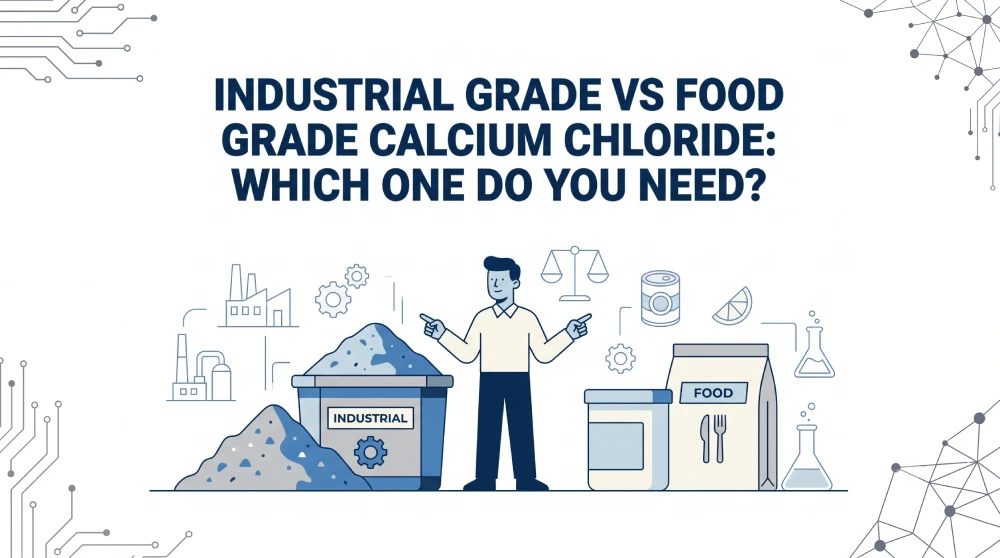
Typical industrial products are supplied as:
- Pellets
- Flakes
- Powder
- Granules
- Solution (20–42%)
Common concentration ranges include:
| Product Form | Typical CaCl₂ Content | Common Applications |
|---|---|---|
| Dihydrate flakes | 74–77% | Dust control, deicing |
| Dihydrate pellets | 77–80% | Industrial processing |
| Anhydrous powder | 90–94% | Chemical manufacturing |
| Anhydrous pellets | 94–97% | Drying and desiccants |
| Calcium chloride solution | 20–42% | Refrigeration, drilling fluids |
Industrial products generally focus on:
- Moisture absorption
- Freezing point depression
- Dust suppression
- Heat generation during dissolution
- Chemical processing
Unlike food grade products, industrial grades allow higher limits for certain trace impurities as long as they remain within industrial specifications.
What Makes Food Grade Calcium Chloride Different?
Food grade calcium chloride uses the same fundamental chemical compound but is manufactured under significantly stricter quality controls.
Typical applications include:
- Cheese manufacturing
- Canned vegetables
- Beverage mineral adjustment
- Brewing
- Tofu production
- Fruit firmness enhancement
- Food preservation
Instead of focusing only on calcium chloride concentration, food grade production also emphasizes:
- Heavy metal limitations
- Food-contact safety
- Microbiological control
- Manufacturing hygiene
- Batch traceability
- Regulatory compliance
The U.S. Food and Drug Administration (FDA) permits calcium chloride for specified food uses under applicable food additive regulations, while food manufacturers must comply with relevant purity requirements.
Similarly, international standards such as the Food Chemicals Codex (FCC) establish specifications covering identity, purity, and allowable impurity levels for food ingredients.
For buyers, these certifications often matter more than achieving the highest possible purity percentage.
Industrial Grade vs Food Grade Calcium Chloride: What Are the Main Differences?
Although both products contain calcium chloride, several purchasing factors distinguish them.
| Comparison Factor | Industrial Grade Calcium Chloride | Food Grade Calcium Chloride |
|---|---|---|
| Primary use | Industrial operations | Food processing |
| Regulatory requirements | Industrial specifications | Food safety regulations |
| Manufacturing controls | Industrial quality systems | Food-grade manufacturing practices |
| Heavy metal limits | Industrial limits | Much stricter limits |
| Batch traceability | Usually available | Typically required |
| Food contact | Not intended | Permitted where regulations allow |
| Typical cost | Lower | Higher |
| Purchasing priority | Performance | Safety and compliance |
One common misconception is that food grade products always outperform industrial grades.
In reality, performance differences are often minimal in industrial applications, while purchasing costs can increase because of additional testing, documentation, and manufacturing controls.
Why Does Application Matter More Than Purity?
Many procurement professionals compare products primarily by purity.
However, industrial purchasing decisions usually involve multiple technical considerations.
Industrial Drying
Moisture adsorption capacity depends primarily on calcium chloride concentration and environmental conditions rather than food certification.
Dust Control
Road stabilization performance depends on:
- Application rate
- Surface condition
- Relative humidity
- Traffic volume
Food certification provides no measurable improvement for dust suppression.
Concrete Acceleration
Performance depends on:
- Cement chemistry
- Dosage
- Ambient temperature
- Reinforcement requirements
Again, food certification offers no technical advantage.
Refrigeration Systems
Brine performance depends on:
- Concentration
- Freezing point
- Corrosion management
- System maintenance
Industrial grade products are widely used because food-grade compliance is generally unnecessary.
Selecting material according to operational requirements instead of purity alone often results in lower procurement costs while maintaining equivalent technical performance.
Where Is Industrial Grade Calcium Chloride Commonly Used?
Industrial grade calcium chloride supports numerous industries because of its hygroscopic properties and high solubility.
Road Maintenance
Applications include:
- Ice melting
- Anti-icing
- Gravel road stabilization
- Dust suppression
Because calcium chloride attracts atmospheric moisture, treated surfaces remain damp longer than surfaces treated only with water.
Oil and Gas
Calcium chloride serves as:
- Completion fluid component
- Drilling fluid additive
- Density adjustment chemical
- Formation stabilization agent
Chemical Manufacturing
Industrial processes use calcium chloride for:
- Intermediate production
- Catalyst support
- Process control
- Reaction adjustment
Construction
Common uses include:
- Concrete acceleration
- Cold-weather placement
- Moisture control
- Cement processing
Industrial Drying
High-concentration calcium chloride functions as:
- Desiccants
- Gas drying agents
- Air drying systems
- Packaging moisture absorbers
According to OSHA, employers are responsible for ensuring chemicals are used according to appropriate safety information and workplace hazard communication requirements. Selecting the correct grade is therefore both a procurement and compliance decision.
Industrial Grade vs Food Grade: Which Industries Require Food Grade?
Only certain industries truly require food grade calcium chloride.
Food grade is generally appropriate for:
- Food manufacturing
- Beverage processing
- Brewing
- Dairy production
- Pharmaceutical applications where required
- Certain laboratory procedures
Industrial grade is generally appropriate for:
- Mining
- Construction
- Road maintenance
- Oilfield operations
- Wastewater treatment
- Refrigeration systems
- Chemical manufacturing
- Industrial drying
- Dust suppression
Purchasing food grade material for these industrial sectors typically increases procurement costs without improving operational results.
Is Industrial Grade Calcium Chloride Better Than Food Grade for Industrial Applications?
The answer is usually yes—provided the application has no food-contact or regulatory requirement.
Industrial buyers should evaluate products based on operational performance rather than assuming that food grade automatically represents a superior material.
Factors worth comparing include:
- Calcium chloride concentration
- Particle size consistency
- Dissolution characteristics
- Moisture absorption performance
- Packaging integrity
- Storage stability
- Documentation quality
- Supply reliability
In many industrial environments, these practical factors have a greater influence on long-term operating efficiency than food-grade certification alone.
Industrial Grade vs Food Grade: Cost Comparison
Price is often the first factor procurement teams evaluate, but it should rarely be the only one. The total cost of ownership includes product price, regulatory compliance, documentation requirements, inventory management, and operational performance.
Food grade calcium chloride generally costs more because manufacturers must maintain stricter production controls, perform additional laboratory testing, and provide documentation demonstrating compliance with applicable food standards.
Typical cost drivers include:
| Cost Factor | Industrial Grade | Food Grade |
|---|---|---|
| Raw material | Standard industrial specification | Higher purity specification |
| Manufacturing controls | Industrial quality management | Food-grade quality management |
| Laboratory testing | Industrial testing | Additional food safety testing |
| Regulatory documentation | Standard COA | COA plus food compliance documentation |
| Traceability | Often available | Typically required |
| Typical purchase cost | Lower | Higher |
For applications such as dust suppression, drilling fluids, concrete acceleration, or industrial drying, the additional cost of food grade material rarely translates into better operational performance.
Instead of asking, "Which grade is better?", procurement teams should ask:
- Does the application involve direct food contact?
- Are food safety regulations applicable?
- Do customers require food-grade certification?
- Will auditors review material compliance?
- Does purchasing food grade reduce operational risk?
If every answer is No, industrial grade calcium chloride is usually the more economical choice.
Industrial Grade vs Food Grade: Which One Should You Choose?
There is no universal "best" grade. The correct choice depends entirely on the intended application, regulatory environment, and procurement objectives.
Choose Industrial Grade Calcium Chloride When:
- The application is industrial rather than food-related.
- No food-contact regulations apply.
- Performance is the primary purchasing objective.
- Cost optimization is important.
- Standard industrial quality documentation satisfies customer requirements.
Typical industries include:
- Mining
- Construction
- Oil and gas
- Municipal road maintenance
- Wastewater treatment
- Chemical manufacturing
- HVAC and refrigeration
- Industrial desiccant production
Choose Food Grade Calcium Chloride When:
- The product contacts food or beverages.
- Food additive regulations apply.
- Customers require food-grade documentation.
- Manufacturing follows HACCP or similar food safety systems.
- Regulatory inspections require food-grade traceability.
Examples include:
- Cheese production
- Beverage processing
- Brewing
- Vegetable canning
- Tofu manufacturing
- Food ingredient blending
The purchasing decision should always begin with regulatory requirements. Performance, purity, and price should be evaluated only after confirming which grade is legally and operationally appropriate.
Industrial Grade vs Food Grade: A Procurement Decision Matrix
The following matrix can help buyers quickly determine the appropriate grade for common scenarios.
Choose Industrial Grade Calcium Chloride when:
- The application involves industrial processing only.
- The product will never contact food or beverages.
- Industrial specifications satisfy customer contracts.
- Cost efficiency is a purchasing priority.
- Moisture absorption, freezing point depression, or dust control are the primary performance requirements.
Choose Food Grade Calcium Chloride when:
- The product becomes a food ingredient.
- Food-contact regulations apply.
- Customer specifications explicitly require FCC or equivalent compliance.
- Product traceability is mandatory.
- Food safety audits are part of normal operations.
When uncertainty exists, procurement teams should review applicable regulations before issuing purchase orders rather than relying solely on product names or purity percentages.
Common Purchasing Mistakes to Avoid
Selecting the wrong calcium chloride grade often results from misconceptions rather than technical limitations.
Assuming Higher Purity Means Better Performance
Higher purity does not automatically improve dust control, deicing, or drying efficiency. The appropriate grade depends on the application.
Ignoring Regulatory Requirements
Industrial materials should not be substituted where food-grade compliance is legally required.
Buying Food Grade "Just to Be Safe"
While this approach may appear conservative, it often increases procurement costs without reducing operational risk.
Comparing Price Without Documentation
A lower price may not include essential documents such as Certificates of Analysis (COAs), batch traceability, or compliance records.
Overlooking Storage Conditions
Calcium chloride is highly hygroscopic. Improper storage can reduce product quality regardless of grade.
Proper storage includes:
- Keeping containers tightly sealed.
- Protecting products from humidity.
- Avoiding prolonged exposure to air.
- Rotating inventory using first-in, first-out (FIFO) practices.
Conclusion
Industrial grade calcium chloride and food grade calcium chloride share the same chemical composition, but they are designed for different regulatory and operational purposes. The most important purchasing considerations are application, compliance requirements, documentation, and total cost, rather than purity alone.
For industrial operations such as road maintenance, construction, chemical manufacturing, refrigeration, oil and gas, and moisture control, industrial grade calcium chloride typically provides the required performance at a lower overall procurement cost. Food grade calcium chloride should be reserved for applications involving food contact or where food safety regulations specifically apply.
Before making a purchasing decision, verify the intended application, review applicable regulations, compare supplier documentation, and evaluate lifecycle costs rather than unit price alone. A structured procurement process helps ensure compliance while avoiding unnecessary expenses.
Next: Continue with supplier qualification by reviewing product specifications, Certificates of Analysis (COAs), regulatory documentation, and quality management records before comparing commercial offers.
FAQs
What is industrial grade calcium chloride?
Industrial grade calcium chloride is a technical chemical manufactured for non-food applications such as dust control, deicing, oil and gas operations, refrigeration, concrete acceleration, and industrial drying. It meets industrial quality specifications but is not intended for food processing or other applications requiring food-grade regulatory compliance.
Is industrial grade calcium chloride safe to use?
Yes. Industrial grade calcium chloride is safe when handled according to the product's Safety Data Sheet (SDS) and workplace safety procedures. Appropriate personal protective equipment, proper storage, and correct handling practices help minimize risks such as skin or eye irritation caused by concentrated solutions or dust.
Can industrial grade calcium chloride be used in food processing?
No. Industrial grade calcium chloride should not be used where food-grade regulations apply. Food processing typically requires food grade calcium chloride that complies with applicable food safety standards and impurity limits established by regulatory authorities or recognized industry specifications.
What is the difference between industrial grade and food grade calcium chloride?
The primary differences involve manufacturing controls, impurity limits, regulatory compliance, testing, and intended use. Both products contain calcium chloride (CaCl₂), but food grade material is produced under stricter quality systems for food-contact applications, while industrial grade is intended for technical and industrial processes.
Is food grade calcium chloride more pure than industrial grade?
In many cases, yes, but purity alone does not determine suitability. Food grade calcium chloride generally follows tighter impurity specifications and additional testing requirements. For most industrial applications, however, these extra controls provide little or no operational advantage over an appropriate industrial grade product.
Which industries typically use industrial grade calcium chloride?
Industrial grade calcium chloride is widely used in road maintenance, mining, oil and gas, wastewater treatment, refrigeration systems, construction, chemical manufacturing, moisture control, and industrial drying. These applications prioritize technical performance and regulatory compliance with industrial standards rather than food safety requirements.
Does industrial grade calcium chloride perform differently from food grade?
For most industrial applications, performance differences are minimal because both grades rely on the same chemical properties, including hygroscopicity and freezing point depression. The main distinctions relate to certification, allowable impurities, documentation, and intended use rather than fundamental chemical performance.
How should industrial grade calcium chloride be stored?
Store industrial grade calcium chloride in tightly sealed, moisture-resistant containers in a cool, dry, and well-ventilated area. Because calcium chloride readily absorbs moisture from the air, limiting exposure to humidity helps preserve product quality, prevents caking, and extends storage life.
Is industrial grade calcium chloride less expensive than food grade?
Generally, yes. Industrial grade calcium chloride usually has a lower purchase cost because it does not require the same level of food safety certification, testing, manufacturing controls, or documentation. Actual pricing depends on purity, product form, packaging, purchase volume, and regional supply conditions.
How do buyers choose the correct calcium chloride grade?
Procurement teams should first determine whether food-contact regulations apply. They should then compare product specifications, required certifications, impurity limits, Certificates of Analysis (COAs), supply reliability, and total lifecycle cost. Selecting the appropriate grade based on application requirements helps balance compliance, performance, and purchasing efficiency.