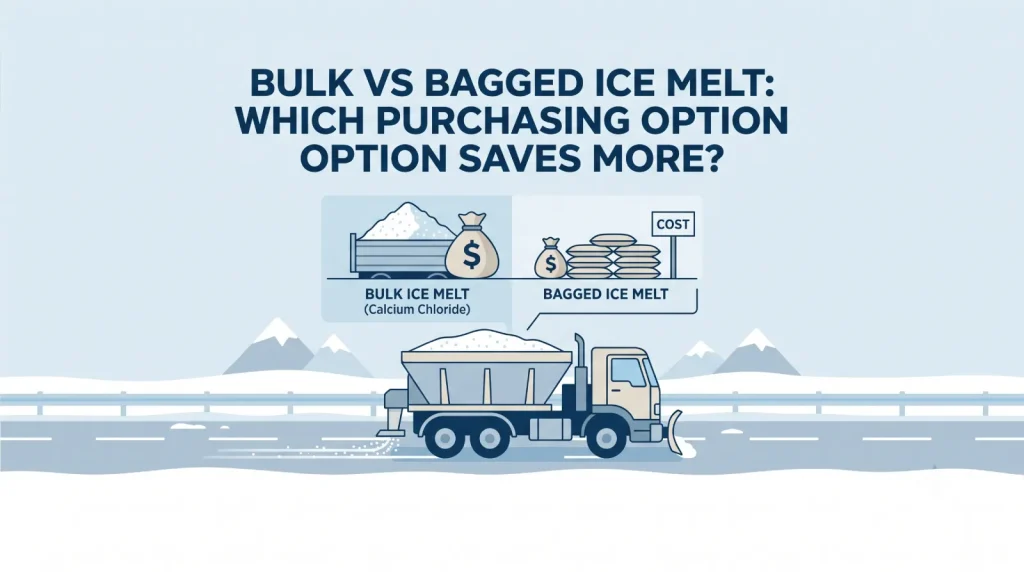
For de-icing distributors and professional snow management companies, procurement isn’t just about getting product on pallets. It’s a strategic calculation that directly impacts margins, logistics, and winter readiness. Sourcing decisions ripple through warehouse operations, fleet utilization, and customer satisfaction metrics. Yet many dealers default to familiar purchasing patterns without a rigorous, data-driven comparison of the two primary formats: bulk and bagged.
The storage footprint, handling equipment, and labor model required for each format differ significantly. A miscalculation can lead to product loss from environmental exposure, inefficient truck loading, or stranded inventory that ties up working capital through the off-season. What appears cheaper per ton on a purchase order can become far more expensive when total landed cost and operational overhead are factored in.
The right choice depends on a dealer’s customer mix, storage infrastructure, and throughput volume. This analysis breaks down the true cost comparison between bulk and bagged ice melt, with a specific focus on calcium chloride formulations, to provide a clear framework for maximizing profitability. It examines not just the price per pound, but the operational realities that determine which format delivers the better bottom line for your specific business model.
Is bulk ice melt cheaper than bagged? Yes, the per-ton cost of bulk ice melt is typically lower. However, it only saves money if your operation has the infrastructure to handle, store, and repackage bulk material without excessive labor cost or product loss. If those conditions aren’t met, the hidden costs of bulk can exceed the premium paid for pre-packaged bags.
Key Takeaways
- Bulk calcium chloride ice melt can reduce product cost by 15-25% per ton compared to bagged equivalents, but requires significant infrastructure investment.
- Total cost of ownership must include storage, labor for repackaging, equipment maintenance, and an estimated 3-8% product loss from spillage and environmental exposure.
- Bagged ice melt simplifies logistics and inventory management, making it the preferred format for dealers serving a high volume of small to mid-sized accounts.
- Calcium chloride is hygroscopic, meaning bulk storage demands strict moisture control to prevent product degradation and hazardous liquid runoff.
- A hybrid procurement strategy often delivers the best balance of margin and operational flexibility for mid-market distributors.
What Is the True Cost of Bulk vs Bagged Ice Melt?
A simple price-per-ton comparison is misleading. Decision-makers must calculate total landed cost, which folds in transport, handling, storage overhead, and loss factors specific to the chemical properties of the product being stored.
Bulk Ice Melt: Cost Breakdown and Hidden Expenses
Purchasing bulk ice melt means receiving loose product, typically in pneumatic tanker trucks or open-top walking floor trailers. For calcium chloride specifically, bulk delivery often comes in the form of pellets or flake that must be kept absolutely dry from the moment of delivery. The initial purchase price for bulk calcium chloride typically ranges from $150 to $280 per ton, depending on regional proximity to production and seasonal contract timing.
However, the per-ton price is only the beginning. The facility must be equipped with a containment bay or silo system. A basic fabric structure with a concrete floor and drainage control might cost $15,000 to $40,000. A vertical silo system with automated loading conveyors represents a capital investment of $80,000 to $250,000 or more. On top of this, labor for manual repackaging into smaller bags for resale adds $15 to $25 per ton. An estimated 3-8% of product is lost to clumping, floor sweep that can’t be sold, or moisture exposure that triggers brine runoff. That loss must be factored into the true cost per usable ton.
Bagged Ice Melt: Premium Pricing, Predictable Costs
Bagged ice melt arrives palletized, wrapped, and ready for storage or direct resale. The unit cost is higher—typically $250 to $400 per ton for calcium chloride formulations, with pricing influenced by bag weight, branding, and private labeling arrangements. The premium buys operational simplicity. A forklift and standard racked warehouse space suffice. There’s no repackaging labor, no specialized containment for loose material, and near-zero product loss if pallets remain intact and dry. For a dealer moving fewer than 500 tons per season, the bagged premium may be less than the per-ton overhead of managing bulk.
| Cost Factor | Bulk Ice Melt | Bagged Ice Melt |
|---|---|---|
| Product Price per Ton | $150 – $280 | $250 – $400 |
| Infrastructure | $15k – $250k+ (capital) | Standard warehouse racking |
| Labor (Handling/Repackaging) | $15 – $25 per ton | Minimal |
| Estimated Product Loss | 3% – 8% | Less than 1% |
| Inventory Management | Complex (FIFO critical) | Simple (pallet-level tracking) |
| Customer Readiness | Requires repackaging | Ready for immediate resale |
How Does Storage Infrastructure Affect Profitability?
The hygroscopic nature of calcium chloride makes storage a critical profitability lever. This chemical draws moisture from the air aggressively. In an unsealed bulk pile, calcium chloride pellets will begin to absorb humidity, fuse together into a hard mass, and eventually generate a brine solution that can corrode concrete floors, steel equipment, and create an environmental discharge concern.
Bulk Storage Requirements for Calcium Chloride
A proper bulk storage setup for this material requires a vapor-tight environment. At minimum, a concrete containment bay with an under-roof cover and curtain sides is needed. For high-volume dealers, a welded steel or bolted silo with a desiccant breather vent and a sealed loading chute is the standard. The floor must be sloped toward a contained sump to manage any condensation or brine runoff, and that captured liquid cannot be discharged to storm drains without treatment.
Bagged Storage: Lower Risk, Lower Cost
Bagged calcium chloride is unitized in moisture-resistant packaging, typically a woven polypropylene outer with a polyethylene liner. Pallets stored in a dry, covered warehouse with intact wrapping can maintain product integrity for an entire off-season. The only monitoring required is visual inspection for pallet wrap tears. For dealers without dedicated, sealed bulk containment, this format eliminates a major source of seasonal product write-off.
Bagged vs Bulk: Operational Workflow Comparison
The daily workflow of fulfilling customer orders looks very different under each procurement model, and that difference has a direct impact on labor cost and delivery speed.
Bulk Workflow: The Repackaging Bottleneck
When a truck returns to the yard needing a load of 50-pound bags for the next morning’s route, a bulk dealer must allocate labor and equipment time to fill bags from the bulk pile or silo. An automated bagging line can output 15 to 20 bags per minute, but it requires a dedicated operator, regular scale calibration, and maintenance. Semi-manual systems—a hopper, a weigh station, and a heat sealer—might produce 2 to 4 bags per minute and tie up an employee for hours. This repackaging step introduces a bottleneck that can limit a dealer’s ability to respond to demand spikes during a storm cycle.
Bagged Workflow: Load and Go
With bagged inventory, the order fulfillment sequence is to pull pallets from racking, stage them at the dock, and load trucks. A single forklift operator can prepare a 20-ton order in under an hour. There’s no intermediate processing step, no quality-control check on bag weights, and no equipment cleanup. For operations that prioritize rapid turnaround and high delivery frequency, this streamlined workflow reduces labor hours per ton shipped and cuts overtime costs during peak events.
How Does Product Quality and Consistency Compare?
Quality control responsibility shifts depending on the purchasing format, and this is particularly relevant for calcium chloride products where pellet size and purity affect spreading performance.
In bagged procurement, the manufacturer assumes full quality assurance. Bagged product is packaged in a controlled environment with standardized fill weights and sealed against contamination. Any performance issue is traceable to a specific lot number printed on the bag, and liability is clearly defined. For bulk ice melt, the dealer effectively becomes the final step in the quality chain. Contamination can occur during transport, storage, or repackaging. Foreign material, particle size segregation, or moisture exposure can degrade product performance. The dealer carries the risk of customer complaints related to these factors, which may offset the initial purchasing savings.
Calcium Chloride vs Other De-Icers: Why the Chemistry Matters in Format Decisions
The specific chemical chosen for a winter program influences which format makes more financial sense. Calcium chloride is an exothermic ice melter that works at temperatures as low as -25°F (-32°C). It is also one of the most hygroscopic ice melt chemistries available. This dual characteristic—exceptional low-temperature performance combined with aggressive moisture attraction—makes it both a high-value product for customers and a higher-risk product for bulk storage.
By contrast, sodium chloride (rock salt) is less hygroscopic and more forgiving in bulk storage, but its effective temperature bottoms out around 15°F (-9°C). Magnesium chloride also attracts moisture but is typically sold in liquid or flake form with its own handling complexity. For a dealer building a premium brand around low-temperature performance, the storage investment for bulk calcium chloride may be justified. For those serving a broad customer base in moderate climates, bagged calcium chloride and bulk rock salt could form a more capital-efficient mix.
Choosing the Right Procurement Model for Your Dealer Business
The decision between bulk and bagged ice melt is not a one-size-fits-all calculation. Use the following decision matrix to evaluate which format aligns with your current business profile and where a hybrid strategy might optimize both margin and operational flexibility.
Choose bulk ice melt when:
- Your annual volume exceeds 1,000 tons of de-icing product.
- You have or can finance the sealed, moisture-controlled storage infrastructure required for hygroscopic materials.
- Your customer base includes large commercial accounts willing to accept bulk delivery or repackaged product in unbranded bags.
- You have available labor capacity during the off-season and pre-season to handle repackaging efficiently.
Choose bagged ice melt when:
- Your annual volume is under 500 tons per season.
- Warehouse space is your only available storage resource, without sealed bulk containment.
- Your customer base is composed primarily of small to mid-sized accounts that expect branded, ready-to-sell packaging.
- You prioritize rapid fulfillment speed and minimal labor processing during storm events.
Consider a hybrid model when:
- Your volume falls between 500 and 1,000 tons annually.
- You can segment your customer base: bulk-delivered product for large municipal or commercial contracts, and bagged product for retail and small-commercial accounts.
- You want to test the bulk model with a single, dedicated customer contract before committing to full infrastructure investment.
How to Mitigate Risk in Bulk Ice Melt Procurement
Dealers transitioning to or scaling a bulk program should implement specific operational controls to prevent the margin erosion that can come from product loss and quality claims.
- Schedule bulk deliveries just-in-time for the season. Storing bulk calcium chloride for 6-8 months of warm, humid weather significantly increases the risk of caking and brine formation. Target delivery windows no more than 60 days before the expected first application.
- Invest in moisture-monitoring protocols. Place relative humidity sensors inside the storage structure and establish a threshold (typically above 40% RH) that triggers inspection of the pile surface.
- Calibrate repackaging scales weekly during active filling periods. Overfilling bags erodes margin; underfilling creates regulatory compliance risk under weights-and-measures laws. A 1-pound average overfill on a 50-pound bag across 500 tons represents a loss of 10 tons of product.
- Segregate inventory lots. Assign a batch number to each bulk delivery and track which customers receive product from that lot. This enables targeted recall or quality investigation if issues arise, mirroring the traceability inherent in bagged product.
- Audit end-of-season product reconciliation. Calculate total tons purchased minus tons sold, and reconcile the difference against the assumed 3-8% loss factor. Use this data to refine next year’s procurement volume and loss assumptions.
FAQs
What is bulk ice melt and how is it delivered?
Bulk ice melt is loose, unpackaged de-icing product transported in large quantities, typically by pneumatic tanker or walking floor trailer. Unlike palletized bags, it is dumped directly into a storage structure at the dealer’s facility. This format eliminates packaging costs but shifts the responsibility for storage containment, moisture control, and repackaging onto the purchaser.
How much cheaper is bulk calcium chloride per ton compared to bagged?
Bulk calcium chloride is typically $70 to $120 less per ton than the equivalent bagged product, translating to a 15-25% reduction in unit cost. However, this gap narrows after accounting for infrastructure depreciation, labor, and product loss. A full landed-cost analysis is required to determine if the per-ton savings flow through to the bottom line.
What is the minimum volume needed to justify buying bulk ice melt?
Most dealers find that a consistent annual volume of 500 to 1,000 tons is the threshold where bulk purchasing begins to make financial sense.
- Below 500 tons, the infrastructure investment is difficult to amortize.
- Between 500 and 1,000 tons, a hybrid model or a single large-contract customer may justify the move.
- Above 1,000 tons, the scale typically supports the capital expenditure for a proper storage and handling system.
Is calcium chloride safe to store in bulk?
Calcium chloride is safe to store in bulk if proper moisture control and containment measures are in place. The critical hazard is its hygroscopic reaction: contact with moisture generates heat and forms a corrosive brine. Storage must be in a sealed, covered structure with a sealed floor and sump to capture any liquid runoff. Without these controls, bulk storage poses a risk of product solidification, equipment corrosion, and environmental discharge.
How long can you store bulk calcium chloride without it going bad?
In a properly sealed, vapor-tight silo or containment bay kept below 40% relative humidity, bulk calcium chloride pellets can be stored for 12 months or more with minimal degradation. In a less controlled environment, significant caking can begin within 60-90 days during humid summer months. The product does not lose its chemical de-icing ability, but solidified mass requires mechanical breaking and grinding before it can be used, which adds labor and equipment cost.
Which is better for small snow removal contractors: bulk or bagged?
Bagged ice melt is almost always better for small contractors and the dealers who serve them. Small contractors rarely have the equipment to handle bulk material, need the convenience of manageable bag weights, and often prefer branded product for end-user confidence.
- They typically purchase by the pallet, not the truckload.
- They lack mechanical loading systems for bulk.
- They have limited dry storage space that bags utilize efficiently.
Can I switch between bulk and bagged based on seasonal demand?
Yes, many dealers operate a flexible procurement strategy where they maintain a baseline inventory of bagged product and supplement with bulk purchases during peak demand periods when supply chains tighten.
- This provides a margin uplift during high-volume, high-urgency periods.
- It reduces off-season bulk storage liability.
- It requires strong, pre-season relationships with multiple suppliers to secure spot-market bulk availability.
What are the hidden costs of buying bagged ice melt that dealers overlook?
The hidden costs of bagged ice melt include pallet disposal fees, the warehouse square footage dedicated to pallet racking, and the labor for inventory rotation to prevent bag degradation from prolonged stacking. Additionally, the unit price premium for bags reduces margin flexibility during competitive bidding for large contracts. These overhead items should be allocated as a per-ton cost to make an accurate comparison with bulk.
What type of liability comes with repackaging bulk ice melt?
Repackaging creates product liability that the original manufacturer otherwise carries for bagged goods.
- The dealer assumes responsibility for accurate fill weights under weights-and-measures regulations.
- If an injury or property damage claim arises, the dealer may need to demonstrate that repackaging did not introduce contamination or alter the product’s performance.
- Product labeling for repackaged material must meet all applicable consumer safety and hazardous materials communication standards.
Is bulk calcium chloride more effective than bagged calcium chloride for de-icing?
There is no chemical performance difference between bulk calcium chloride and bagged calcium chloride if the bulk material has been properly stored and protected from moisture. The active ingredient is identical. Performance differences arise only when bulk product has absorbed humidity and begun to form clumps, which can affect spreading uniformity and dissolution rate on pavement.
Conclusion
The bulk ice melt versus bagged decision ultimately hinges on whether the per-ton savings of bulk purchasing survive the gauntlet of operational overhead, infrastructure cost, and product loss specific to calcium chloride chemistry. For high-volume dealers with sealed storage and repackaging capacity, bulk offers a genuine cost advantage that can fund further business investment. For growing distributors and those with diverse, small-footprint customers, the logistical efficiency and risk transfer of bagged product present a compelling value proposition that initial unit-price comparisons miss.
The key is to model your own numbers. Calculate total landed cost per usable ton using your actual labor rates, storage costs, and season-end reconciliation data. Account for the value of speed and flexibility during a storm cycle, not just the price on the purchase order. Use this analysis annually, as your customer mix, throughput volume, and available capital shift over time. The optimal answer is not static—it evolves with your business, and revisiting this comparison each spring positions you to make the most profitable decision for the season ahead.