The way mining and construction companies manage airborne particulates has undergone a fundamental shift. Where once the primary concern was simply keeping dust down to avoid neighbor complaints, today’s site managers face a convergence of tightening regulatory pressure, advanced environmental monitoring, and a direct link between dust management and operational profitability. The traditional approach of periodically spraying water is rapidly giving way to data-driven, chemically optimized programs designed to solve multiple problems simultaneously.
Mining and construction operations lose an estimated 1-3% of total material volume annually due to wind erosion and particulate loss, a figure that translates directly to eroded profit margins before the costs of regulatory non-compliance are even calculated. Simultaneously, the U.S. Environmental Protection Agency’s updated National Ambient Air Quality Standards (NAAQS) for particulate matter have reduced the annual PM2.5 standard, placing more facilities into non-attainment zones and requiring more sophisticated control measures. These dust control trends are not about marginal improvement; they are about operational survival.
However, a significant misconception persists in the industry that effective dust suppression requires a trade-off between performance and environmental or worker safety, particularly when chemical additives are involved. This creates unnecessary resistance to adopting solutions that could dramatically improve compliance and reduce water consumption. A more nuanced understanding is essential for strategic decision-making.
Calcium chloride is safe when handled according to standard industrial hygiene practices. The key risks are limited to mild skin and eye irritation upon direct contact with the concentrated product, and these are fully mitigated through the use of basic personal protective equipment (PPE) like gloves and safety glasses, as recommended in any Safety Data Sheet.
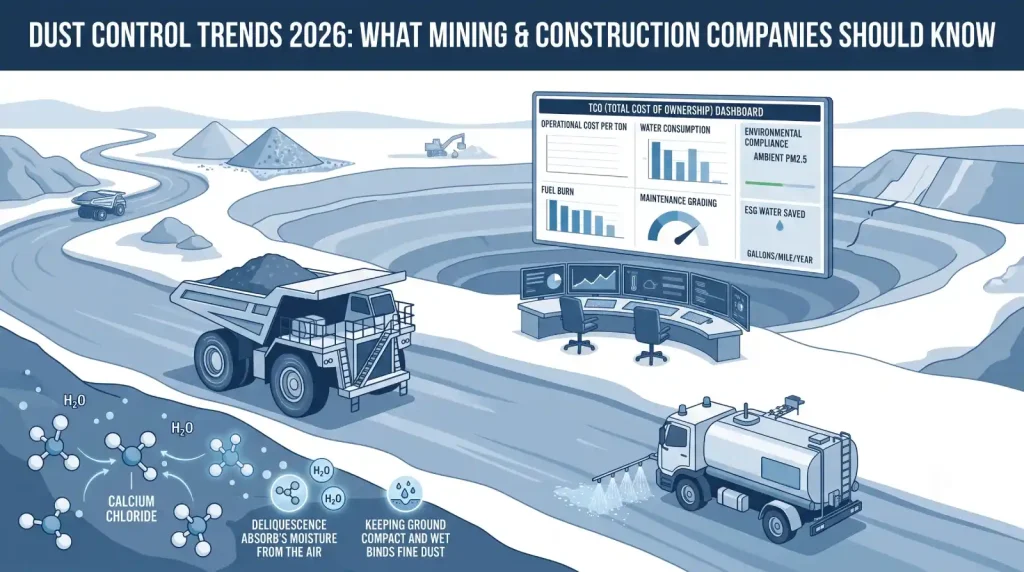
It is critical to distinguish between the concentrated chemical in a storage tank and the diluted solution applied to a roadway. Once applied, calcium chloride binds with fine dust particles by absorbing atmospheric moisture, creating a hygroscopic effect that maintains surface dampness long after water alone would have evaporated. This mechanism drastically reduces the frequency of re-application, limiting worker exposure potential. The decision to not use a proven suppressant often carries its own safety risks, including reduced visibility on haul roads, which is a leading cause of workplace accidents. With a clear understanding of its safety profile established, this article explores the four pivotal trends redefining dust control in 2026.
What This Article Covers
- How evolving federal and local regulations are compelling a shift toward higher-performance chemical suppressants.
- The technology stack that is turning dust control from a manual task into a data-verified function.
- Why the total cost of ownership model is replacing the simple purchase price in chemical procurement.
- How sustainability metrics are being redefined to include water conservation and road maintenance savings.
- Bottom line: The future of dust control is an integrated system of chemistry, data, and automation, where the most successful operators will be those who leverage all three to lower their total operational cost per ton.
How Is the Regulatory Landscape Shaping Modern Dust Control?
The regulatory environment in 2026 is the single most powerful driver of change in dust management practices. The EPA’s decision to lower the primary annual PM2.5 standard from 12.0 µg/m³ to 9.0 µg/m³ has had cascading effects. This change, finalized in 2024 with state implementation plans due in 2025-2026, directly impacts the permitting and daily operations of mines and large construction earthwork projects. It is no longer sufficient to visually assess dust; facilities must now demonstrate compliance through continuous ambient air monitoring or robust operational records.
This regulatory pressure is accelerated by the rise of community-based, low-cost air quality sensors. Hyper-local monitoring networks, operated by citizen groups and environmental justice organizations, provide data that can trigger third-party audits and enforcement actions. A single week of PM10 exceedances recorded on a publicly accessible PurpleAir sensor near a site perimeter can result in a Notice of Violation. Consequently, the industry is moving away from reactive, water-only control—which often fails during hot, windy afternoons—toward proactive, preventive strategies. This includes the shift from purely mechanical controls to advanced chemical additives that maintain surface stability for extended periods, even under adverse conditions.
How Do Hygroscopic Salts and Advanced Polymers Compare as Suppressants?
The core chemistry of modern dust control rests on two primary categories: hygroscopic salts and synthetic polymers. Understanding their distinct mechanisms is crucial for matching a product to a specific application.
Hygroscopic Salts (e.g., Calcium Chloride, Magnesium Chloride)
These products work by absorbing water vapor from the air. Calcium chloride, for instance, is a deliquescent compound, meaning it will continue to attract moisture and form a brine solution that binds fine particles together, as long as the relative humidity is above approximately 29%. This process creates a compacted, high-density road surface that resists the shearing forces of vehicle tires. It is exceptionally effective as a base stabilizer for unpaved haul roads, where its ability to penetrate and bind the aggregate results in a 50-80% reduction in the frequency of maintenance grading. The performance is directly correlated to climatic conditions; it is ideal for arid and semi-arid regions where periodic low humidity is countered by higher nighttime moisture.
Synthetic Polymers and Bitumen Emulsions
These products create a physical, film-forming crust on the surface of a material. Once sprayed onto a stockpile or a tailings beach, the liquid emulsion cures to form a flexible, water-insoluble membrane. This is the superior technology for long-term, static applications—such as capping a coal pile for months or stabilizing a sloped tailings dam face against wind shear. The crust is highly effective, but once broken, it offers no residual control and does not self-heal. It also typically requires a higher upfront material cost and specialized application equipment to ensure uniform coverage without clogging nozzles.
What Role Does Data and Automation Play in Application Efficiency?
The most significant operational trend is the integration of telematics and real-time data into the application process itself. Water trucks and spray units without performance feedback are becoming a liability. In 2026, a best-practice fleet management system integrates three layers of data: onboard moisture sensors on the water truck that measure surface conditions pre- and post-application; a local weather station that feeds live data on wind speed, temperature, and relative humidity; and a centralized fleet management dashboard that logs every application cycle.
This integration enables dynamic chemical dosing. Instead of a fixed, pre-set dilution ratio, the system automatically adjusts the concentration of a calcium chloride brine being applied to a road segment. On a hot, dry, windy day, the system might increase the application volume per square yard while holding the chemical concentration constant to achieve a longer-lasting effect without over-salting. This automation directly addresses the primary failure mode of dust control: inconsistent application by human operators. Autonomous compaction and spray systems, guided by GPS and following digital pre-set routes, can reduce spray overlap and missed areas by over 30%, ensuring every dollar of suppressant is placed precisely where the fugitive dust originates.
Why Is Total Cost of Ownership Replacing Upfront Price in Procurement?
A silent revolution is occurring in mine and construction procurement offices, where the financial analysis of a dust control program is shifting from an operational expenditure (OpEx) line item to a broader total cost of ownership (TCO) model. The unit price per gallon of a chemical suppressant is a misleading metric when evaluated in isolation.
A TCO analysis for a 5-mile unpaved mine haul road reveals a different cost hierarchy. The analysis must capture not only the delivered chemical cost but also the water procurement and hauling cost, the diesel and maintenance cost for water trucks, and the critical lost productivity cost from blading and road repairs. When comparing a water-only program to a managed calcium chloride program over a 12-month period, the water-only approach can require 8-12 applications per day in peak summer, versus 1-2 for a chemically stabilized road. The diesel fuel, truck maintenance, and operator labor hours saved by the hygroscopic program often outweigh the cost of the chemical by a factor of two. This TCO framework elevates product quality and long-term performance over lowest-bidder purchasing, which is a core characteristic of the 2026 dust control market.
What Are the New Sustainability and ESG Metrics Beyond Just Compliance?
Environmental, Social, and Governance (ESG) reporting is redefining what constitutes a "green" dust control solution. The narrow definition of environmental friendliness—often limited to a product’s aquatic toxicity profile—is expanding to encompass a full lifecycle assessment. The most critical new metric is water conservation. In regions like the U.S. Southwest, the Colorado River Basin, and parts of Australia, mining operations are losing their social license to operate based on their water consumption. A dust control plan that achieves its targets while consuming millions of gallons of fresh water from a stressed aquifer is no longer considered sustainable.
This is a key dust control trend that strongly favors hygroscopic salts. A single application of calcium chloride on a 30-foot-wide haul road can provide effective dust suppression for 4-8 weeks, saving an estimated 300,000-500,000 gallons of water per mile of road annually compared to a water-only program with a 4-hour respray cycle. This translates directly into a measurable ESG data point: "gallons of water saved." A second pillar of this trend is the reduction of fugitive road dust (PM10), which is now documented in sustainability reports as a community health improvement metric.
Where Is Calcium Chloride Used in Modern Dust Control Applications?
The versatility of calcium chloride in dust control stems from its dual action as a hygroscopic agent and a base stabilizer. Its application profiles have become more specialized as the industry moves toward performance-based specifications.
Unpaved Haul Road Stabilization
This is the predominant industrial application. A liquid calcium chloride brine, typically at a 30-38% concentration, is applied to the road surface and allowed to penetrate up to 3 inches deep. The chloride ions interact with the fine clay and silt particles, permanently altering their electrochemical charge and compacting them into a dense, hard surface. This surface resists the formation of washboards and potholes, which are primary sources of dust. The reduction in road grading alone cuts maintenance costs by 30-50%.
Sub-surface Base Injection
A growing technique involves injecting the brine into the road base rather than just spraying it on top. This treats the road from the bottom up, creating a chemically stabilized structural layer that remains effective even after surface erosion from heavy rain. For roads with high truck traffic volumes, this method provides more consistent performance over a 6-12 month period.
Coal and Mineral Stockpile Crusting
While polymers form a physical crust, calcium chloride’s hygroscopic action maintains equilibrium moisture deep within a stockpile. For materials like sub-bituminous coal, which is prone to spontaneous combustion when it dries and oxidizes, this internal moisture retention adds a critical safety function. Spraying the pile’s perimeter keeps the surface material dense and wind-resistant without altering the combustion properties of the fuel.
How to Choose the Right Dust Control Program for Your Site
Selecting a dust control program in 2026 is an engineering decision, not merely a purchasing transaction. The framework must begin with a site-specific diagnostic that categorizes each dust source by its mechanism: traffic-generated, wind-generated, or process-generated (e.g., crushing, conveying). Each mechanism points to a different chemical and mechanical solution.
An effective selection framework evaluates four criteria: the required performance period (hours vs. weeks), the mechanical stress the treated surface will endure (static stockpile vs. 100-ton trucks), the local climate’s humidity and rainfall profile, and the site’s water availability and cost. A site that is water-rich but has steep tailings slopes will have a fundamentally different optimal solution than a site that is water-scarce with long, flat haul roads.
A diagnostic process will often show that a hybrid program is the most cost-effective. This might involve using a polymer emulsion for a remote tailings dam that needs quarterly inspections, while concurrently running a managed calcium chloride program on the primary ore and waste haulage roads, where the combination of dust suppression and road stabilization delivers a measurable reduction in rolling resistance and fuel burn.
Conclusion
The dominant dust control trends in 2026 point toward a fully integrated operational discipline, where chemistry, data, and automation converge to deliver verifiable financial and environmental returns. The era of generic water spraying is ending, replaced by a strategic approach that treats each dust source with a tailored, performance-verified solution. The key drivers are a stricter EPA regulatory ceiling for PM2.5, the financial logic of a total cost of ownership model that prioritizes water and fuel savings over chemical price alone, and an ESG framework that credits verifiable resource conservation. The most valuable next step for any operation is to commission a site-specific dust source audit, categorizing each emission point and matching it with the appropriate chemistry and application technology to build a defensible, data-backed compliance and efficiency plan.
FAQs
What is the most cost-effective long-term method for dust control on unpaved roads?
The most cost-effective long-term method is the application of a hygroscopic salt like calcium chloride at the start of the dry season. The key to cost efficiency is not just the initial spray but the subsequent compaction and maintenance schedule.
- Conduct a deep-penetration application to treat the road base.
- Perform light surface applications only when signs of raveling appear.
- Track the reduction in grading frequency to quantify the true savings.
How does calcium chloride compare to magnesium chloride for road dust suppression?
Both are effective hygroscopic salts, but their performance is dictated by relative humidity and temperature. Calcium chloride is generally preferred in very dry, hot conditions because it remains active at a lower relative humidity (around 29%) than magnesium chloride.
- Calcium chloride is more effective in arid climates due to its lower equilibrium relative humidity.
- It is more aggressive as a base stabilizer, bonding tightly with fine clay particles.
- Magnesium chloride can be a good choice in regions with higher ambient humidity.
How long does a single calcium chloride application last?
The effective lifespan of a single application on a busy haul road varies from 4 to 8 weeks, depending on aggregate type, traffic volume, and weather. The degradation mechanism is primarily dilution from heavy rainfall.
- A well-compacted road with fine aggregate will hold the treatment longer.
- High-traffic roads with stop-start zones may require a mid-cycle top-up.
- The treatment is not "consumed"; it is gradually diluted by water and must be replenished.
What are the primary environmental effects of using calcium chloride for dust control?
The primary environmental effect is a localized increase in soil salinity on the treated roadbed, which is a manageable, non-bioaccumulative concern. The more significant positive environmental metric is the massive reduction in water consumption and the elimination of airborne PM10 that would otherwise travel off-site.
- It saves hundreds of thousands of gallons of water per mile of road annually.
- It prevents fine particulate matter from becoming an airborne health hazard.
- It does not bioaccumulate in the food chain and is a naturally occurring mineral.
Is it safe to use calcium chloride for dust control near waterways?
Direct application into or immediately adjacent to a waterway is prohibited without a rigorous containment plan. Standard best practice requires a vegetated buffer strip or berm between a treated road and any natural drainage.
- Vegetative buffers effectively filter and manage stormwater runoff from a treated road surface.
- The compacted road surface itself reduces erosion that would otherwise carry sediment into water.
- Spill prevention plans during refilling operations are a standard requirement.
How does traffic intensity affect the performance of a chemical dust suppressant?
Traffic intensity is one of the two most critical performance variables, alongside rainfall. The mechanical grinding action of heavy truck tires physically destroys the treated road surface, breaking the chemical bond and generating new loose particles.
- Stop-and-go zones at intersections degrade up to 3 times faster than straight haul segments.
- The surface in wheel tracks can be damaged, requiring targeted re-application rather than a full road respray.
- Higher traffic volumes necessitate a treatment program with a more frequent re-application schedule.
What is deliquescence and why is it important for dust control?
Deliquescence is the process by which a substance absorbs moisture from the air until it dissolves into a liquid solution. This is the fundamental mechanism that makes calcium chloride such a powerful dust suppressant.
- The substance absorbs water vapor, forming a brine that wets each dust particle.
- This continuous dampness is maintained even on hot days when sprayed water would evaporate in hours.
- The brine’s surface tension helps bind particles together more strongly than plain water.
Can you combine calcium chloride with other organic binders like lignin sulfonate?
Yes, and hybrid programs are becoming a technical best practice. Combining calcium chloride with a lignin sulfonate can leverage the hygroscopic properties of the salt and the longer-term crusting strength of the organic binder.
- The calcium chloride helps the road retain initial moisture for deeper binder penetration.
- The lignin component adds organic polymers that create a more rigid, cement-like surface crust.
- This combination can be particularly effective on roads with a poor gradation of aggregate.
When should you not use calcium chloride for dust suppression?
You should not use calcium chloride on roads that are already sealed with a bituminous surface, as the brine can cause surface stripping. It is also not the ideal choice for roads built on extremely sensitive, high-water-table ecosystems where any increase in soil conductivity is a primary permit violation.
- The chemistry of the brine can emulsify certain thin asphalt surface treatments.
- In environments regulated for soil electrical conductivity, a synthetic polymer may be a safer regulatory choice.
- It is less effective in regions with sustained, multi-day rain events that continuously flush the road.
What is the connection between dust control and rolling resistance on haul roads?
A well-compacted road treated with a hygroscopic suppressant has a smooth, hard surface that significantly reduces rolling resistance compared to a loose, corrugated gravel road. This directly lowers the cycle time and fuel consumption per ton-mile hauled.
- The reduction in road surface deformation means tires roll over the surface rather than constantly pushing through loose material.
- Smoother roads allow for higher safe travel speeds, improving fleet productivity.
- A 2-3% reduction in rolling resistance can translate into a measurable drop in diesel consumption across a large haul truck fleet.