The global chemical trade operates on thin margins and strict timelines. For procurement managers and supply chain directors, a single miscalculated logistics decision can erase profitability on an entire container load. When importing bulk industrial chemicals like calcium chloride, the choice of shipping terms directly impacts your total landed cost, risk exposure, and operational control from the factory floor to your warehouse.
Traditional wisdom often defaults to one incoterm out of habit. However, the reality is that neither FOB (Free on Board) nor CIF (Cost, Insurance, and Freight) is universally superior. The right choice depends entirely on your organization’s cash flow position, in-house logistics expertise, cargo insurance requirements, and tolerance for supply chain disruptions.
This article dissects the FOB vs CIF decision specifically through the lens of chemical imports. We analyze cost structures, risk transfer points, insurance implications for hazardous and hygroscopic materials, and the hidden expenses that often catch first-time importers off guard. By the end, you’ll have a clear decision-making framework tailored to your specific operational profile.
Key Takeaways
- Calcium chloride, a hygroscopic salt, requires meticulous moisture control during transit, making the choice between FOB and CIF a critical quality assurance decision, not just a cost one.
- FOB gives the buyer control over freight, insurance, and routing from the port of origin, which typically reduces total logistics costs by 15-22% for companies with established freight networks.
- CIF shifts the administrative burden to the seller, but the buyer assumes all risk of loss or damage once the goods are loaded onto the vessel, often with minimal, seller-procured insurance coverage.
- For high-volume chemical imports, FOB paired with a specialized chemical freight forwarder and all-risk cargo insurance consistently outperforms standard CIF arrangements in both cost and risk management.
- The “best” incoterm is not static; it should be re-evaluated annually based on your shipping volume, spot vs. contract freight rates, and your team’s capacity to manage international logistics.
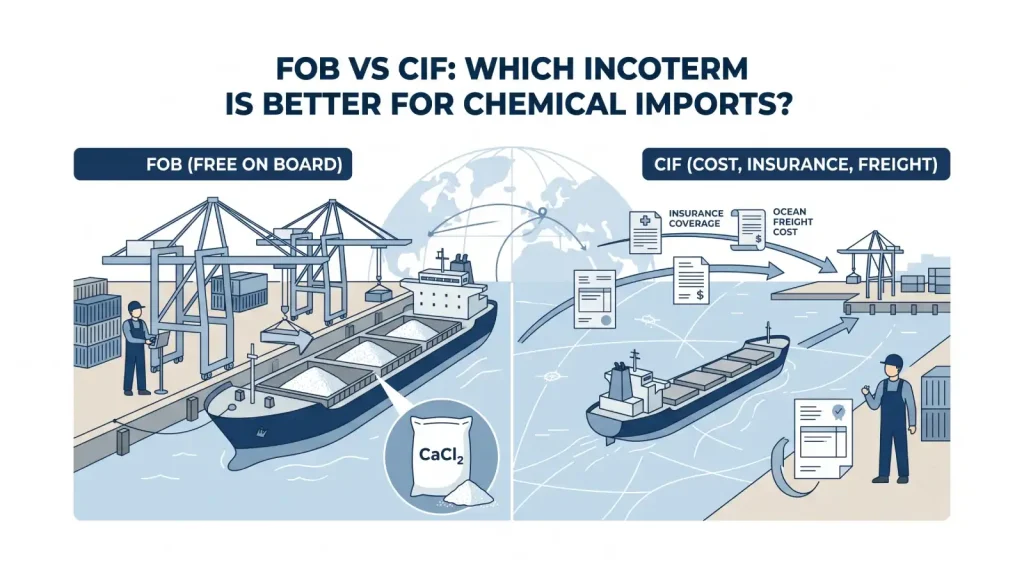
FOB vs CIF for Calcium Chloride: A Conditional Conclusion
For most established chemical importers with quarterly volumes exceeding 500 metric tons, FOB is the financially and operationally superior choice for importing calcium chloride—but only if your organization possesses the internal logistics expertise to manage international freight procurement and cargo insurance directly. The primary reason is control: FOB allows you to select a carrier experienced in handling hygroscopic chemicals, ensure proper container sealing and desiccant placement, and secure comprehensive insurance that covers moisture damage, contamination, and general average events.
If your company is new to importing, lacks a dedicated logistics team, or prioritizes a single, predictable invoice over long-term cost optimization, CIF offers a simpler, though more expensive and risk-obscured, entry point.
The main risks driving this conclusion are cargo insurance gaps, hidden destination port charges, and loss of supply chain visibility.
What Are FOB and CIF? A Chemical Importer’s Definition
FOB (Free on Board)
Under FOB terms, the seller is responsible for all costs and risks until the goods are loaded onto the vessel nominated by the buyer at the named port of shipment. From that point forward, the buyer assumes all risk of loss or damage and bears all costs, including ocean freight, insurance, unloading, customs clearance, and inland transportation to the final warehouse.
For a chemical importer, this means you contract directly with a freight forwarder and an insurance provider, allowing you to specify cargo handling protocols for sensitive materials.
CIF (Cost, Insurance, and Freight)
Under CIF terms, the seller pays for the cost of the goods, ocean freight to the named destination port, and a minimum level of insurance coverage. Critically, the risk transfers to the buyer at the same point as FOB: when the goods are loaded on board the vessel at the port of origin. The seller is merely responsible for procurement, not risk.
This distinction is the source of most disputes in chemical shipments. The seller buys insurance per the contract, typically the minimum Institute Cargo Clauses (C) coverage, which excludes many common perils for chemical cargo, such as water damage from condensation, insufficient packing, or inherent vice.
Why Does the FOB vs CIF Decision Matter for Chemical Importers?
Maritime transport of industrial chemicals presents unique challenges that make the incoterm decision more consequential than in general cargo trading.
How Does Moisture Risk Affect Calcium Chloride Shipments?
Calcium chloride is aggressively hygroscopic, meaning it readily absorbs moisture from the air. A standard 20-foot container of calcium chloride pellets can be ruined by caking, liquefaction, or chemical degradation if exposed to humidity fluctuations over a 30-day ocean voyage. The quality specification, typically 94-97% purity for industrial-grade flakes, can drop below marketable thresholds if packaging is compromised.
Under CIF, the seller selects the carrier and the packaging. A seller optimizing for cost might book a lower-rated container line with older equipment, or use basic polypropylene bags instead of laminated, moisture-barrier sacks. Under FOB, the buyer’s logistics team can mandate specific container types, inspect them for watertight integrity before loading, and require desiccant blankets and vapor barrier liners. This control directly translates to a lower rate of cargo claims.
What Are the Insurance Gaps in CIF for Bulk Chemicals?
Institute Cargo Clauses (C) , the default insurance coverage under most CIF contracts, is a named-perils policy. It covers fire, explosion, vessel stranding, sinking, collision, and loss overboard during loading and unloading. It explicitly does not cover:
- Damage from condensation, humidity, or temperature changes (common for hygroscopic salts)
- Inadequate or unsuitable packing
- Rust, oxidation, or discoloration not caused by a listed peril
- Contamination from residues of prior shipments in the container
For a full-risk shipment of calcium chloride, the buyer needs Institute Cargo Clauses (A) all-risk coverage, which is typically 0.3-0.6% of the cargo’s CIF value. Under FOB, the buyer procures this directly and is certain of the coverage terms. Under CIF, the buyer pays for the insurance within the seller’s invoice but rarely has the option to upgrade it.
Cost Breakdown: FOB vs CIF for a Standard Calcium Chloride Shipment
Consider a representative shipment: 10 x 20-foot containers of 94% purity calcium chloride flakes from Qingdao, China, to Houston, Texas, USA. The FOB unit price is $180 per metric ton, with 200 MT total volume.
| Cost Component | FOB (Buyer’s Procurement) | CIF (Seller’s Invoice) |
|---|---|---|
| FOB Cost (200 MT) | $36,000 | $36,000 |
| Ocean Freight (Spot Rate) | $17,500 (negotiated directly) | $23,000 (seller’s markup) |
| Insurance (All-Risk) | $320 (0.48% of CIP value) | $500 (estimated, min. cover) |
| Origin Port Charges (THC, docs) | $0 (seller pays to ship’s rail) | $0 |
| Destination THC & Terminal Fees | $8,200 (direct invoice) | $9,840 (often marked up) |
| Customs Brokerage & Clearance | $2,500 (your broker) | $2,500 (your broker) |
| Inland Haulage (Port to Houston WH) | $4,800 (contracted rate) | $4,800 (your contract) |
| Total Landed Cost | $69,320 | $76,640 |
In this typical scenario, the FOB shipment results in a $7,320 total cost saving (9.5%) compared to the CIF shipment. The primary sources of savings are the avoidance of ocean freight markup and reduced port-to-port charge padding, which can range from 20% to 35% of the actual terminal cost when passed through a seller’s line item.
Decision Matrix: When Should a Chemical Importer Choose FOB?
Choose FOB when:
- Your annual import volume for a single chemical exceeds 1,000 metric tons, giving you leverage to secure competitive ocean freight contracts.
- Your organization employs a dedicated logistics specialist or retains a freight forwarder with proven expertise in hazardous and hygroscopic chemical shipping.
- Your product quality is highly sensitive to transit conditions, requiring you to control container selection, loading supervision, and packaging specifications.
- Your corporate insurance strategy favors a master cargo policy, which can reduce all-risk per-shipment premiums to 0.2-0.3% of the insured value.
- You have the working capital to manage separated cost centers, understanding that the visible FOB price will be augmented by multiple freight, insurance, and handling invoices.
Choose CIF when:
- You are a new importer running a trial shipment of 1-3 containers to test a new chemical supplier or a new market application.
- Your logistics team has no bandwidth to manage the complexities of international freight procurement and prefers a single, all-in payment per container.
- The seller is located in a country with heavily restricted freight markets, making it difficult for foreign buyers to obtain competitive rate quotes.
- The shipment is small enough (e.g., less than 50 MT) that the administrative cost of managing FOB logistics exceeds the potential savings.
How to Transition from CIF to FOB for Chemical Imports: A Step-by-Step Framework
Migrating from seller-controlled shipping to buyer-controlled logistics is a structured process. A premature switch can cause supply chain disruptions, demurrage charges, and strained supplier relationships.
Step 1: Conduct a Total Landed Cost Audit
Collect 12 months of CIF invoices for a specific chemical and a single supplier. Decompose each invoice, requesting the supplier to break out the ocean freight and insurance components. Compare these line items against spot market rates available from two independent freight forwarders for the same lane, container type, and volume. The difference is the benchmark savings potential.
Step 2: Engage a Chemical-Competent Freight Forwarder
Interview forwarders specifically about their experience with your chemical class. Ask: “Have you shipped hygroscopic salts in containers with desiccant blankets before? What is your standard operating procedure for a container that presents moisture at a transshipment port?” Select a forwarder who can describe specific protocols, not just general freight handling.
Step 3: Secure a Master Cargo Policy with All-Risk Terms
Work with a marine cargo insurance broker. Specify that you need Institute Cargo Clauses (A) coverage, extended to cover container sweat condensation, packing failure, and contamination. Request a policy that covers warehouse-to-warehouse, not just port-to-port. Confirm the per-shipment reporting procedure and premium calculation method.
Step 4: Renegotiate the Supplier Contract as FOB
Present the supplier with a clear, phased timeline. For example: “For all POs issued after Q3, we will place orders on an FOB Qingdao basis. Our nominated forwarder will contact your shipping department 14 days prior to the vessel cut-off.” Provide the supplier with your forwarder’s contact details and standard operating procedures (SOPs) for container booking and documentation. Expect initial resistance, as suppliers profit from freight markup, and be prepared to leverage your order volume.
Common Mistakes to Avoid When Choosing an Incoterm for Chemicals
Mistake 1: Assuming CIF Insurance Is Sufficient
Why it’s a mistake: Many importers discover only during a claim that CIF minimum cover excludes condensation damage, the most common cause of loss for sea-shipped calcium chloride. The correction: Always read the insurance clause in the sales contract. If it specifies Institute Cargo Clauses (C), assume you are self-insured for moisture, packing failure, and contamination, and procure separate gap coverage.
Mistake 2: Overlooking Destination Port Charges
Why it’s a mistake: CIF does not mean “free to your door.” The seller’s responsibility ends at the destination port’s quay. Terminal handling, container cleaning, exam fees, and demurrage are exclusively the buyer’s costs. Sellers can inflate the freight line item, then use a congested port’s slow operations to generate detention fees, which the buyer pays. The correction: When comparing CIF offers, always get a binding quotation from a local customs broker for the destination THC, exam, and trucking for the same port, and add it to the CIF price for an honest comparison.
Mistake 3: Choosing an Incoterm Based Solely on Unit Price
Why it’s a mistake: A CIF supplier might offer a lower unit price but embed a 30% freight margin that erases the benefit. Conversely, an FOB supplier might have a slightly higher unit price, but the total landed cost is lower due to your ability to consolidate containers and negotiate lower ocean freight. The correction: Never evaluate a chemical supplier on unit price. Always convert every quote to a total landed cost to your warehouse using real freight, insurance, and handling numbers.
What to Look for in a Chemical Freight Forwarder
The right logistics partner transforms FOB from an administrative burden into a strategic advantage. When evaluating forwarders for chemical imports, prioritize demonstrated chemical handling competence over general freight brokerage scale.
A qualified forwarder should provide a documented Chemical Cargo Handling SOP that addresses your specific product. For example, a forwarder experienced with calcium chloride will specify that containers must be inspected for a maximum of six interior surface patches, as more indicates prior damage that could allow moisture ingress. They should also specify that containers older than five years or with non-operational refrigeration units (for nominally “dry” ventilated boxes) should be rejected at the depot.
The forwarder’s insurance relationship is equally critical. They should be able to facilitate a seamless, low-cost master cargo policy with an A-rated marine insurer, with a documented claims-to-resolution ratio below 21 days. Ask for a reference from another chemical importer who ships a hygroscopic material on the same trade lane.
Transparency in cost structure is non-negotiable. The forwarder’s quotation should cleanly break out the ocean freight, bunker adjustment factor, terminal handling at origin, documentation fee, and any surcharges. A lump-sum “all-in” quote from a potential FOB partner is a red flag, as it obscures margins and makes contract-year rate renegotiation impossible.
Conclusion
The FOB vs CIF decision for importing chemicals like calcium chloride is fundamentally a choice between control and convenience, with measurable cost and risk implications. For companies with the scale and expertise to manage international logistics, FOB consistently unlocks lower total landed costs, superior cargo insurance protection, and tighter quality control over transit conditions critical for hygroscopic cargo.
The most informed importers avoid a one-size-fits-all approach. They use CIF for small trial shipments and new supplier onboarding, then systematically transition to FOB as volumes cross a defined threshold, typically between 300 and 500 metric tons per year on a single trade lane. This hybrid strategy maximizes initial simplicity while capturing long-term financial and operational benefits. When evaluating your next contract, consult a marine cargo insurance specialist to review the coverage terms line by line, as this single clause often determines who bears the financial brunt of a damaged shipment.
FAQs
What is the main difference between FOB and CIF for chemical buyers?
The main difference lies in who contracts and pays for the main carriage and insurance, but risk transfers at the same point: when goods are loaded on the vessel. Under FOB, the buyer controls and pays for ocean freight and insurance. Under CIF, the seller procures these, but the buyer bears all risk of loss once the cargo is on board. For chemical buyers, this means CIF often obscures the true quality and scope of insurance coverage.
How does calcium chloride sensitivity affect the FOB vs CIF decision?
Calcium chloride's aggressive hygroscopic nature makes moisture control during ocean transit paramount. Under FOB, the importer can:
- Specify laminated, moisture-barrier packaging
- Require container inspection and desiccant placement protocols
- Procure all-risk cargo insurance covering condensation damage
Under CIF, the seller’s cost-minimizing incentive may lead to standard packaging and minimal insurance, increasing the risk of caking, liquefaction, and cargo rejection at destination.
Is CIF insurance enough for a full container of hygroscopic chemicals?
In almost all cases, no. CIF only requires the seller to procure minimum insurance cover, typically Institute Cargo Clauses (C) , which is a named-perils policy. This excludes damage from condensation, sweat, temperature changes, and inadequate packing—the most common loss causes for hygroscopic salts. Chemical importers need Institute Cargo Clauses (A) all-risk coverage, which is better procured directly under FOB.
When should I switch from CIF to FOB for chemical imports?
The optimal switch point is when the cost of managing logistics internally is exceeded by the savings from eliminating seller freight markups and gaining control over insurance. This typically occurs at an annual volume of 300-500 metric tons on a single trade lane. At this scale, the spread between CIF-invoiced freight and direct FOB rates widens sufficiently to fund a dedicated logistics role or a specialized freight forwarder.
What are the hidden costs in a CIF chemical shipment?
The most significant hidden costs under CIF for chemical shipments include:
- Inadequate insurance coverage, requiring the buyer to self-insure or purchase gap coverage
- Inflated ocean freight and destination terminal handling charges passed through by the seller at a 20-35% margin
- Container demurrage and detention at congested ports, which remain the buyer’s responsibility even under CIF
- Quality-related losses from moisture damage or contamination that fall outside the scope of the seller’s minimal insurance policy
How does Incoterms 2020 define risk transfer in FOB and CIF?
Under Incoterms 2020, both FOB and CIF transfer risk from seller to buyer when the goods are placed on board the vessel at the port of shipment. The critical distinction is not risk transfer, but cost and procurement responsibility. The seller, under CIF, pays for freight and insurance to the destination port but does so on the buyer’s risk after loading. This creates a scenario where the party procuring cargo protection has no financial interest in the quality of that protection after the cargo is loaded.
Can I negotiate an all-risk insurance clause within a CIF contract?
Yes, a knowledgeable buyer can and should negotiate the insurance clause within a CIF contract. The standard minimum is Institute Cargo Clauses (C). You can contractually require the seller to provide Institute Cargo Clauses (A) or similar all-risk cover. However, the seller will pass this additional cost to you, often with a markup. Structurally, if you are sophisticated enough to negotiate specific insurance clauses, you are likely better off switching the entire contract to FOB and procuring the insurance yourself.
What is the safest incoterm for first-time chemical importers?
For a first-time chemical importer running a small trial shipment, CIF provides a simpler entry point with a single, consolidated invoice. The safest approach under CIF is to explicitly request the seller’s insurance certificate before shipment, review the scope of cover, and purchase separate gap coverage from your own marine insurance broker for perils like condensation and contamination that are excluded from standard CIF cover.
How does an FOB shipment reduce demurrage risk?
FOB reduces demurrage risk by giving the buyer control over destination port logistics. The buyer’s contracted customs broker and inland carrier are aligned under a single, pre-planned workflow. Under CIF, the seller’s chosen ocean carrier arrives at the destination terminal, where the buyer’s separate logistics chain begins, creating a coordination gap that can cause delays. Faster, coordinated clearance, inspection, and container pickup directly reduce the clock time that generates demurrage charges.
Does FOB or CIF give the buyer more control over container selection?
FOB gives the buyer significantly more control. Under FOB, the buyer’s nominated forwarder can:
- Specify a container not older than five years
- Reject a container with more than six internal patches or any sign of prior moisture damage
- Ensure the container is a food-grade or clean chemical-grade unit if required
Under CIF, the seller selects the container based on availability and cost, which may not meet the strict quality standards required for hygroscopic chemical cargo.