
Dust control is a priority for HSE teams responsible for protecting workers, maintaining regulatory compliance, and reducing operational risks. However, implementing a dust suppression program is only the first step. Without effective dust monitoring, it is impossible to determine whether a control strategy is delivering measurable improvements or simply increasing operating costs.
Many organizations assume that visual observations alone are enough to evaluate dust conditions. In practice, airborne particulate concentrations can fluctuate significantly throughout the day due to weather, traffic volume, equipment operation, and material handling activities. As a result, objective measurement methods provide a far more reliable basis for decision-making.
Whether the goal is improving workplace safety, meeting environmental regulations, or optimizing maintenance schedules, understanding how to measure dust control performance allows HSE professionals to make evidence-based improvements rather than relying on assumptions.
What This Article Covers
- The key indicators used to evaluate dust control performance.
- Common dust monitoring technologies and how they differ.
- Practical methods for collecting reliable monitoring data.
- How to compare dust control results over time.
- Best practices for interpreting monitoring data.
- Bottom line: Effective dust control should be evaluated using measurable exposure data rather than visual appearance alone.
Dust control performance can be measured accurately if monitoring objectives, sampling methods, and evaluation criteria are clearly defined before data collection begins. The most meaningful assessments combine airborne particulate measurements, operational observations, and trend analysis instead of relying on a single indicator.
What Is Dust Monitoring?
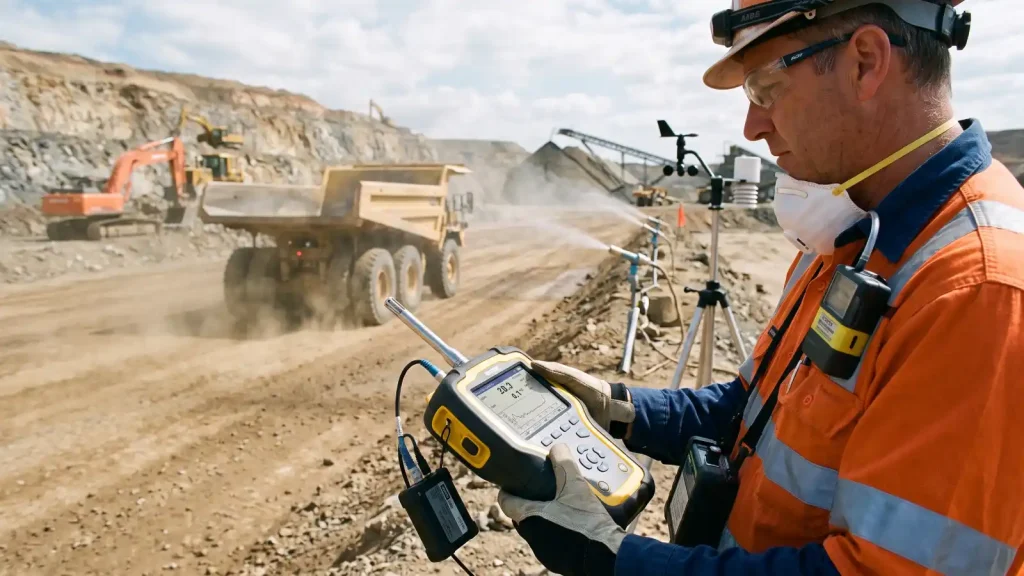
Dust monitoring is the systematic measurement of airborne particulate matter to evaluate worker exposure, environmental impact, and the effectiveness of dust suppression measures.
Unlike simple visual inspections, dust monitoring provides quantitative data that can be compared over time. Modern monitoring programs typically measure particulate concentrations such as PM₁₀, PM₂.₅, total suspended particles (TSP), or respirable dust depending on the workplace and applicable regulations.
For HSE professionals, dust monitoring supports several important objectives:
- Measuring employee exposure to airborne particles
- Evaluating the effectiveness of engineering controls
- Identifying high-risk operating periods
- Supporting environmental compliance reporting
- Improving long-term dust management strategies
Because dust generation varies continuously, monitoring should be performed under representative operating conditions rather than during isolated events.
How Does Dust Control Performance Get Measured?
No single measurement can fully describe dust control effectiveness. Instead, HSE teams typically evaluate multiple indicators that together provide a comprehensive picture of system performance.
Airborne Particulate Concentration
The most direct indicator is the concentration of airborne particles measured before and after dust control measures are implemented.
Common measurements include:
| Measurement | Typical Particle Size | Common Application |
|---|---|---|
| Total Suspended Particles (TSP) | <100 μm | General environmental monitoring |
| PM₁₀ | ≤10 μm | Construction, mining, roads |
| PM₂.₅ | ≤2.5 μm | Occupational exposure and air quality |
| Respirable Dust | Typically <4 μm | Worker health assessments |
| Inhalable Dust | Up to 100 μm | Industrial hygiene evaluations |
Selecting the appropriate metric depends on regulatory requirements, workplace hazards, and monitoring objectives.
Dust Reduction Percentage
Organizations frequently compare dust concentrations before and after implementing control measures.
The basic calculation is:
Dust Reduction (%) = (Baseline Concentration − Controlled Concentration) ÷ Baseline Concentration × 100
For example:
| Monitoring Stage | PM₁₀ Concentration |
|---|---|
| Before treatment | 320 μg/m³ |
| After treatment | 140 μg/m³ |
| Reduction | 56% |
The percentage alone should not be considered the only performance indicator because environmental conditions may differ between sampling periods.
Worker Exposure Levels
For occupational health programs, exposure measurements often provide more meaningful information than environmental monitoring alone.
Personal sampling devices worn by workers measure the concentration of airborne dust within the breathing zone throughout a work shift. These measurements help determine whether engineering controls adequately reduce employee exposure under actual operating conditions.
Occupational exposure assessments are particularly important in industries such as:
- Mining
- Cement manufacturing
- Aggregate processing
- Bulk material handling
- Construction
- Quarry operations
Why Is Baseline Data Essential Before Evaluating Dust Control?
One of the most common mistakes in dust monitoring programs is implementing suppression methods without first establishing baseline conditions.
Baseline monitoring creates a reference point against which future measurements can be compared. Without this reference, improvements cannot be quantified objectively.
A useful baseline should include:
- Monitoring during normal production conditions
- Multiple sampling locations
- Different weather conditions
- Several operating shifts
- Consistent sampling equipment
- Repeat measurements over multiple days
Collecting baseline data over at least several representative operating cycles generally produces more reliable comparisons than measurements taken during a single day.
Checklist: Preparing an Effective Dust Monitoring Program
Before beginning performance measurements, HSE teams should complete the following preparation checklist:
- ✔ Define the monitoring objective before selecting equipment.
- ✔ Identify the particle size fraction that needs evaluation.
- ✔ Select representative monitoring locations.
- ✔ Record weather conditions during every sampling event.
- ✔ Use the same monitoring methodology for comparison studies.
- ✔ Calibrate monitoring instruments according to manufacturer recommendations.
- ✔ Document production rates during monitoring.
- ✔ Maintain consistent sampling durations across measurement periods.
How to Collect Reliable Dust Monitoring Data
Accurate measurements depend as much on the sampling process as on the monitoring equipment itself. Even highly precise instruments can produce misleading results if sampling locations, durations, or operating conditions vary significantly between measurements.
A structured monitoring program improves data consistency and makes long-term trend analysis more meaningful.
Step 1: Define the Monitoring Objective
Begin by identifying exactly what the monitoring program should evaluate.
Common objectives include:
- Measuring worker exposure
- Evaluating a new dust suppression system
- Demonstrating regulatory compliance
- Comparing different control methods
- Identifying major dust generation sources
Each objective may require different sampling methods and monitoring frequencies.
Step 2: Select Representative Sampling Locations
Sampling locations should reflect where dust is actually generated or where employees are most likely to be exposed.
Typical monitoring locations include:
- Haul roads
- Loading and unloading points
- Crushers and screening equipment
- Conveyor transfer stations
- Material stockpiles
- Plant boundaries
- Worker breathing zones
Avoid selecting locations solely because they are easy to access. Monitoring points should represent real operating conditions rather than convenient measurement sites.
Step 3: Choose Appropriate Monitoring Equipment
Different monitoring technologies serve different purposes. Selecting the correct instrument is essential for obtaining meaningful results.
| Monitoring Method | Typical Use | Advantages | Limitations |
|---|---|---|---|
| Gravimetric samplers | Compliance monitoring | High accuracy | Results available after laboratory analysis |
| Real-time aerosol monitors | Continuous workplace monitoring | Immediate data and trend visualization | Require regular calibration |
| Optical particle counters | Particle size distribution | Fast measurements | Sensitive to humidity and particle characteristics |
| Personal dust samplers | Worker exposure assessment | Measures breathing-zone exposure | Limited to individual workers |
| Fixed ambient monitoring stations | Environmental monitoring | Long-term trend analysis | Higher installation and maintenance costs |
No single monitoring method is suitable for every application. Many HSE programs combine several techniques to obtain a more complete understanding of dust conditions.
Step 4: Record Environmental Conditions
Environmental variables often influence airborne dust concentrations as much as the control measures themselves.
Important variables include:
- Wind speed
- Wind direction
- Relative humidity
- Temperature
- Recent rainfall
- Vehicle traffic volume
- Production rate
Recording these variables alongside monitoring results helps distinguish operational changes from environmental effects.
Step 5: Repeat Measurements Consistently
One measurement rarely represents overall dust performance.
Instead, establish a consistent monitoring schedule, such as:
- Every operating shift
- Daily during major projects
- Weekly for routine operations
- Monthly for long-term trend evaluation
Consistent sampling intervals improve statistical confidence and reduce the influence of short-term fluctuations.
How to Compare Dust Monitoring Results Over Time
Dust levels naturally change throughout the day and across seasons. Comparing two isolated measurements often leads to incorrect conclusions.
Instead, HSE professionals should evaluate trends using standardized performance indicators.
Useful comparison metrics include:
| Performance Indicator | Why It Matters |
|---|---|
| Average PM₁₀ concentration | Indicates overall airborne dust conditions |
| Peak dust events | Identifies short-term exposure risks |
| Worker exposure averages | Supports occupational health evaluations |
| Number of exceedances | Measures compliance performance |
| Seasonal averages | Removes weather-related variability |
| Monthly trend lines | Shows long-term effectiveness |
Trend analysis is generally more valuable than isolated measurements because it reflects sustained operational performance rather than temporary conditions.
Watering vs Dust Monitoring: Why Visual Inspection Is Not Enough
Many facilities continue to evaluate dust control by observing visible dust clouds. While visual inspections remain useful for identifying obvious problems, they cannot accurately quantify airborne particulate concentrations.
| Evaluation Method | Visual Inspection | Instrument-Based Dust Monitoring |
|---|---|---|
| Quantitative measurements | No | Yes |
| Regulatory documentation | Limited | Yes |
| Long-term trend analysis | Difficult | Excellent |
| Worker exposure assessment | No | Yes |
| Repeatability | Low | High |
Visual observations can complement monitoring programs, but they should not replace objective measurements when evaluating control performance.
Step-by-Step Workflow for Evaluating Dust Control Performance
An effective evaluation process follows a logical sequence.
Step 1 — Establish Baseline Conditions
Purpose: Measure existing dust levels before implementing any control measures.
Expected result: Reliable reference data.
Step 2 — Apply the Dust Control Strategy
Purpose: Introduce engineering controls, operational changes, or dust suppressants.
Expected result: Reduced airborne dust generation.
Step 3 — Perform Follow-Up Monitoring
Purpose: Measure airborne particulate concentrations using the same equipment and methodology.
Expected result: Comparable post-treatment data.
Step 4 — Analyze Performance Trends
Purpose: Compare baseline and follow-up measurements while accounting for weather and production variables.
Expected result: Objective assessment of dust reduction.
Step 5 — Adjust the Dust Management Plan
Purpose: Improve operational practices based on monitoring results.
Expected result: Continuous improvement rather than one-time optimization.
Common Mistakes to Avoid
Even well-designed monitoring programs can produce misleading results if common errors are overlooked.
Measuring Only During Ideal Weather
Monitoring exclusively on calm or humid days may underestimate actual dust exposure. Sampling should represent the full range of operating conditions.
Changing Equipment Between Monitoring Events
Different instruments may use different measurement principles, making direct comparisons unreliable unless proper correlation studies are performed.
Ignoring Production Rates
Higher production volumes often generate more dust. Monitoring data should always be interpreted alongside operational activity levels.
Using Too Few Sampling Locations
Monitoring a single location rarely reflects conditions across an entire facility. Multiple representative sampling points provide a more complete picture.
Relying Only on Visible Dust
Some of the smallest respirable particles remain airborne even when no visible dust cloud is present. Instrument-based measurements are therefore essential for evaluating health-related exposure.
Best Practices for Long-Term Dust Monitoring
Organizations with successful dust management programs typically follow several consistent practices:
- Develop written monitoring procedures to ensure every survey follows the same methodology.
- Review monitoring data together with operational and maintenance records.
- Maintain calibration records for all monitoring instruments.
- Analyze seasonal trends instead of relying on isolated measurements.
- Periodically review sampling locations as production processes change.
- Integrate monitoring results into continuous HSE improvement programs.
Consistent monitoring methods, standardized data collection, and regular trend analysis provide a far more accurate picture of dust control performance than occasional inspections alone.
Conclusion
Dust monitoring is the foundation of evaluating dust control performance because it replaces subjective observations with measurable data. By establishing baseline conditions, selecting appropriate monitoring methods, collecting data consistently, and analyzing long-term trends, HSE professionals can determine whether dust suppression measures are achieving their intended objectives.
No single indicator provides a complete picture. The most effective evaluation programs combine airborne particulate measurements, worker exposure assessments, environmental observations, and operational records. This integrated approach supports regulatory compliance, improves workplace safety, and helps organizations continuously refine their dust management strategies. The key is to apply standardized monitoring procedures, compare results under similar operating conditions, and focus on long-term performance rather than isolated measurements.
FAQs
What is dust monitoring?
Dust monitoring is the process of measuring airborne particulate matter to evaluate air quality, worker exposure, and the effectiveness of dust control measures. Depending on the application, monitoring may focus on PM₂.₅, PM₁₀, respirable dust, or total suspended particles.
- Identify the particle size relevant to the workplace.
- Use calibrated monitoring equipment.
- Record environmental conditions with every measurement.
How often should dust monitoring be performed?
Monitoring frequency depends on operational risk, regulatory requirements, and production schedules. High-risk operations often require continuous or daily monitoring, while lower-risk facilities may conduct weekly or monthly assessments.
- Perform baseline monitoring before operational changes.
- Increase monitoring during high-production periods.
- Review monitoring schedules annually.
What equipment is used for dust monitoring?
Several types of instruments are available, each designed for different monitoring objectives. Selecting the appropriate equipment depends on whether the goal is compliance, exposure assessment, or operational improvement.
- Gravimetric samplers for regulatory measurements.
- Real-time aerosol monitors for continuous observation.
- Personal samplers for worker exposure assessment.
What is the difference between PM₂.₅ and PM₁₀ monitoring?
PM₂.₅ measures particles with aerodynamic diameters of 2.5 micrometers or smaller, while PM₁₀ includes particles up to 10 micrometers. PM₂.₅ generally penetrates deeper into the respiratory system and is often used in health-related assessments.
- PM₂.₅ focuses on fine particles.
- PM₁₀ includes larger inhalable particles.
- Both metrics may be monitored simultaneously.
Can visual inspections replace dust monitoring?
No. Visible dust provides only a qualitative indication of airborne particles and cannot accurately measure concentrations or worker exposure. Instrument-based monitoring is necessary for objective performance evaluation and regulatory documentation.
- Visibility varies with lighting conditions.
- Fine particles may be invisible.
- Quantitative data supports trend analysis.
How can weather affect dust monitoring results?
Weather conditions significantly influence airborne dust concentrations, making it essential to document environmental variables during each monitoring event.
- Wind speed can increase dust dispersion.
- Relative humidity may suppress airborne particles.
- Rainfall often reduces short-term dust emissions.
- Temperature can influence surface drying.
Which industries benefit most from dust monitoring?
Dust monitoring is widely used wherever airborne particulate matter presents operational, environmental, or health risks.
- Mining and quarrying.
- Construction projects.
- Cement and aggregate production.
- Bulk material handling facilities.
What should be included in a dust monitoring program?
A comprehensive monitoring program combines technical measurements with operational documentation to improve long-term performance evaluation.
- Clearly defined monitoring objectives.
- Standardized sampling procedures.
- Equipment calibration records.
- Regular trend analysis.
- Corrective action documentation.
Is continuous dust monitoring always necessary?
Not always. Continuous monitoring is valuable for high-risk operations or facilities with rapidly changing conditions, but many organizations achieve effective performance evaluation through scheduled monitoring supported by periodic exposure assessments. The appropriate frequency should be based on operational hazards, regulatory expectations, and historical monitoring data.
How can HSE teams improve dust control performance over time?
Continuous improvement depends on collecting reliable data, reviewing trends, and adjusting dust control strategies as operating conditions change. Organizations should treat monitoring as an ongoing management process rather than a one-time compliance activity. Regular data review, equipment maintenance, employee training, and periodic reassessment of monitoring locations all contribute to more effective long-term dust management.