The first time a procurement team places an order for industrial chemicals like calcium chloride, the focus often narrows to a single variable: price per ton. A requisition lands on the desk, a quick internet search returns a dozen quotes, and the lowest bidder seems like the obvious choice. This approach works for office supplies, but it fails catastrophically when applied to bulk chemical sourcing. The fallout from a mismanaged purchase isn’t a late report; it’s production downtime, corroded equipment, or a rejected shipment at the receiving dock due to non-compliant paperwork.
What makes buying industrial chemicals uniquely challenging is the gap between the theoretical purity of a data sheet and the reality of how a chemical performs under specific operating conditions. Two suppliers might both offer 94% purity calcium chloride pellets, but differences in trace heavy metal content, particle size distribution, or packaging integrity can mean the difference between a smooth winter's de-icing operation and a clogged spray system that halts work for days. The risk is compounded by logistics, storage requirements, and safety data sheets that vary from manufacturer to manufacturer.
Calcium chloride is safe when handled properly. The key risks are exothermic heat generation upon dissolution, severe skin and eye irritation upon direct contact, and potential incompatibility with certain metals or storage materials. When these parameters are understood and specified in a purchase agreement, the chemical becomes a predictable, manageable tool. This article breaks down the procurement process into a series of verifiable steps, offering a framework for new buyers to move from price-centric quoting to total value assessment.
What This Article Covers
- How to identify and avoid the most frequent sourcing errors in chemical procurement.
- The critical difference between a generic product specification and a fit-for-use specification.
- A practical step-by-step workflow for vetting industrial chemical suppliers.
- Troubleshooting common post-purchase problems like caking, off-spec deliveries, and safety compliance gaps.
- A detailed checklist to use before issuing a purchase order.
How Does Mismatched Specification Lead to Procurement Failure?
The single most expensive error in chemical procurement is treating all grades of a chemical as interchangeable. A buyer sourcing calcium chloride for food-grade brine production who accepts a quote for industrial-grade material has created a compliance violation that cannot be fixed downstream. The product has already been manufactured, packaged, and delivered, but it is legally unusable for the intended application.
An "industrial grade" specification is an umbrella term. It indicates a chemical is not meant for pharmaceutical or food use, but it does not define which performance parameters matter. For example, technical grade calcium chloride might contain trace levels of alkali metal chlorides that have no impact on road dust control but can accelerate corrosion in a closed-loop heat transfer system. The mistake is not buying a bad product; it is buying a product where the manufacturer’s definition of acceptable impurities differs from the user’s operational tolerance. The solution is to define a fit-for-use specification before soliciting quotes, which explicitly names the acceptable ranges for the parameters that matter to your operation—such as maximum insoluble matter, target pH in solution, or concentration of specific trace elements.
Why Does Exclusively Focusing on Price Per Ton Lead to Higher Total Costs?
Procurement teams measured solely on cost savings often optimize the wrong metric. A low price per ton that secures a bulk shipment of flaked calcium chloride becomes a false economy when the material arrives severely compacted, requiring hours of manual labor to break apart before it can be loaded into a hopper. The hidden costs of off-spec material are never itemized on the initial invoice. They surface later as overtime pay for operators, excess waste disposal fees, or expedited freight charges for a replacement order.
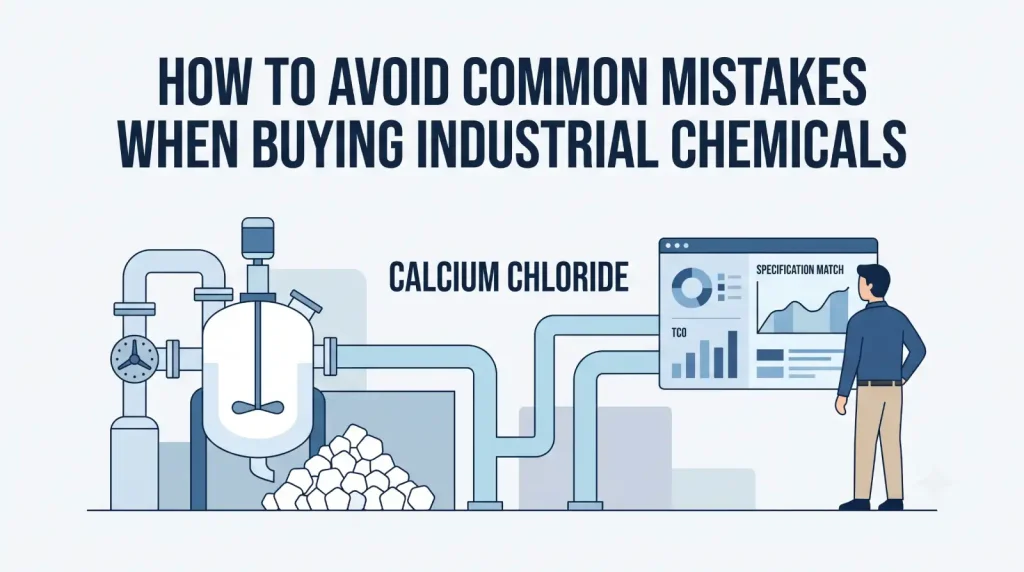
The error stems from a transactional rather than a relational view of the chemical supply chain. A more robust approach is to build a simple total cost of ownership model that includes three categories: material cost, logistics and handling cost, and cost of quality risk. Logistics costs include factors like minimum order quantity and demurrage charges if a truck is held up during offloading. Quality risk cost is calculated by estimating the probability and financial impact of a batch failure. Assigning even a rough monetary value to these variables, such as a 5% probability of a $2,000 disposal fee, adds $100 to the true cost equation. This calculation almost always demonstrates that a supplier offering a slightly higher unit price but with a verifiable track record of on-spec deliveries and responsive technical support is the less expensive option over a fiscal year.
Supplier Qualification vs. Supplier Screening: What’s the Right Depth for Chemical Sourcing?
A common pitfall for new buyers is confusing a basic supplier screening with a full qualification process. Screening answers the question, "Can this company supply this chemical?" Qualification answers a deeper question: "Can this company reliably supply this chemical to our facility, under our conditions, with the documentation we require?" The former requires a business license and a specification sheet; the latter requires a structured audit.
An effective qualification process for a material like calcium chloride includes verifying the source of raw materials. Is the supplier a manufacturer that produces the chemical through a primary process, or is it a redistributor that blends or repackages material from multiple sources? This matters because a redistributor’s supply chain may introduce variability that its own quality control doesn’t detect if it only performs basic appearance checks. The qualification step should also confirm the specific analytical test method the supplier uses to generate its Certificate of Analysis. A purity percentage is meaningless without naming the test method; the percentage of calcium chloride determined by a simple chloride titration will differ from one determined by a more specific inductively coupled plasma method. Without this clarity, two suppliers offering “94% calcium chloride” might be shipping chemically different products.
How to Develop a Fit-for-Use Specification for Calcium Chloride
This step transforms a generic purchase order into a legally defensible technical document. The specification must capture all the attributes that influence whether the chemical will work in the buyer’s specific application. For calcium chloride, this starts with physical form but extends into chemical properties that are invisible to the naked eye.
Why Physical Form Is a Critical Parameter
Calcium chloride is supplied as powder, flake, pellet, or liquid solution, and each form introduces distinct handling challenges. A dry powder is highly reactive and generates significant heat when mixed with water, which is desirable for activating a cold-weather concrete cure but potentially dangerous if added too quickly to a large volume of liquid. Pellets typically offer reduced dusting and a slower dissolution rate, making them preferable for de-icing roadways where a controlled release is needed. The specification must include not only the form but also the acceptable particle size range, as this directly affects the material’s flowability and bridging behavior in storage silos. A specification for flake product intended for dust control should include a maximum allowable percentage of fines—particles that pass through a specific mesh screen—to prevent the material from turning into airborne dust before it even reaches the road surface.
Which Chemical Purity Parameters Actually Affect Your Process?
The headline "94% purity" figure on a technical data sheet is an aggregate that may obscure critically important trace components. For a closed-loop geothermal heat transfer fluid, the presence of sulfate ions in the calcium chloride can promote scaling on heat exchanger surfaces, reducing thermal efficiency over time. In this case, the specification must add a maximum allowable sulfate content, even though this detail is absent from a standard industrial grade description.
| Parameter | Standard Industrial Grade | Fit-for-Use Spec (Dust Control) | Fit-for-Use Spec (De-Icing) |
|---|---|---|---|
| CaCl₂ Content (%) | 94% min | 90-94% (acceptable for soil stabilization) | 94% min (for maximum ice melting) |
| Insoluble Matter (%) | Not specified | 0.5% max (to prevent nozzle clogging) | 1.0% max (acceptable for spreader use) |
| Alkalinity (as Ca(OH)₂) | Not specified | 0.2% max (to minimize corrosion in holding tanks) | Not specified |
| Particle Size | Not specified | 0-5mm flake, <2% fines | 3-8mm pellet, <1% fines |
| Sulfate (as CaSO₄) | Not specified | Not specified | 0.1% max (for corrosion-sensitive infrastructure) |
This table illustrates how a generic specification provides a starting point, but only a fit-for-use specification provides true control over the chemical’s performance and handling characteristics. The act of filling out this table for each major chemical purchased is the single most effective way to prevent specification mismatch errors.
Step-by-Step Workflow for a First-Time Chemical Purchase
Step 1: Define the Operational Need, Not the Chemical Name
The initial request from an internal department will often state, "We need five tons of calcium chloride." The buyer’s first task is to reverse-engineer this request to its operational origin. The questions to ask are: What specific problem is this material solving? Where and under what environmental conditions will it be used? What are the consequences if it underperforms? A request for dust control on a limestone haul road requires a different calcium chloride grade than a request for brine to fill tractor tires for ballast. By starting with the functional requirement, the buyer reduces the risk of ordering the correct chemical in the wrong form or grade.
Step 2: Draft the Fit-for-Use Specification
Using the operational needs as a guide, draft a preliminary specification document. This should include physical form, target chemical purity, critical limits on known problematic impurities, packaging type, and required documentation package. This draft becomes the request for quotation’s technical appendix, ensuring that all potential suppliers are bidding on the exact same deliverable.
Step 3: Issue a Request for Information Before a Request for Quotation
Before asking for a price, send the fit-for-use specification to a shortlist of potential suppliers and ask four questions: Can you supply to this specification? Provide a sample Certificate of Analysis for a recent batch. What is your standard packaging for this material? And what is your typical lead time? This RFI stage filters out suppliers who cannot technically meet the requirements, preventing a situation where a buyer is tempted by an unrealistically low quote from a supplier that will later deliver non-conforming goods.
Step 4: Evaluate Quotes with a Total Cost of Ownership Model
For the suppliers who pass the RFI stage, request formal quotations. Enter the quoted price per ton, freight cost, estimated demurrage or waiting time charges, and the calculated cost of quality risk into a simple spreadsheet. The supplier with the lowest evaluated total cost, not the lowest invoice price, represents the best value.
Step 5: Conduct a Pre-Shipment Sample or First-Article Inspection
For a new supplier relationship, especially on a high-value or operationally critical order, negotiate for a pre-shipment sample. A 1 kg sample sent to your facility for a simple performance test—such as a dissolution rate check or a material compatibility test with your existing equipment—can catch a catastrophic mismatch before a full truckload is in transit. This step costs a few dollars in freight and can prevent thousands of dollars in rejected inventory.
How to Interpret a Certificate of Analysis
A Certificate of Analysis is the supplier’s certified statement that the shipped batch meets agreed-upon specifications. The mistake buyers make is simply filing this document without reviewing it against the purchase order. Every parameter on the CoA should be traceable back to the fit-for-use specification. If a buyer specified a maximum insoluble matter content of 0.5% and the CoA reports a value of 0.8%, the material is technically out of specification, regardless of whether it appears visually acceptable. ASTM E29, which outlines standard practices for using significant digits in test data, provides a framework for determining conformance when a reported value is close to a specification limit, but the primary rule is that the purchase agreement’s specified limit is the authoritative threshold. A systematic review of each CoA upon receipt, with an explicit pass/fail decision recorded, creates an auditable trail and provides objective data for future supplier performance reviews.
Troubleshooting Common Post-Purchase Problems
Symptom: Solid Chemical Has Arrived as a Hard, Compacted Mass
Solution: This is typical for hygroscopic materials like calcium chloride that have been exposed to moisture through torn bag liners or improper warehouse storage. Immediately document the condition with photographs and sample the material for moisture content analysis. If the moisture content exceeds the specification limit, file a discrepancy report with the supplier, referencing the CoA’s specification. For future orders, specify a multi-layer, sealed polyethylene liner bag with a minimum thickness and include a clause in the purchase order requiring the supplier to certify that the product was loaded in dry conditions.
Symptom: Supplier Claims "Equivalent" Product When Ordered Grade Is Out of Stock
Solution: Never accept an unverified equivalence claim. An “equivalent” calcium chloride might meet the same ASTM specification number but have a different manufacturing process, such as a Solvay process product versus a natural brine-derived product, which can affect trace element profiles. Request a full CoA and specification sheet for the alternate product and compare it point-by-point with the originally approved specification before accepting any substitution.
Symptom: Safety Data Sheet Lists Different Hazard Codes Than Expected
Solution: A Safety Data Sheet is not a static document; its classification can change if the supplier modifies its raw material source or manufacturing process. A calcium chloride product that was previously non-hazardous might gain a specific target organ toxicity classification if a new impurity profile meets regulatory thresholds. The receiving team should compare the new shipment’s SDS with the SDS on file from the qualification stage. Any changes must be assessed for impact on workplace labeling, storage, and personal protective equipment requirements before the material is released from quarantine.
How to Build a Supplier Monitoring and Requalification Schedule
A single successful delivery does not qualify a supplier for life. Chemical supply chains are dynamic, and a manufacturer’s raw material sources or production methods can shift without notice. A monitoring schedule should include an annual review of the supplier’s quality certifications, a rolling comparison of CoAs against specification limits to detect any gradual drift in key parameters, and a bi-annual check of the supplier’s business continuity and logistics capabilities. For materials with a direct impact on product quality or regulatory compliance, such as calcium chloride used in a FDA-regulated food processing aid, a formal questionnaire should be sent every 12 months to confirm that the manufacturing facility and its raw material sources have not changed. This proactive monitoring catches potential supply chain failures before they manifest as a production line stoppage.
Pre-Order Checklist for Buying Industrial Chemicals
- Verify the internal requisition specifies the intended use, not just the chemical name.
- Draft a fit-for-use specification document covering physical form, purity, critical impurities, and packaging.
- Obtain and review a Safety Data Sheet from the supplier before committing to an order.
- Send a Request for Information to verify a supplier’s ability to meet the specification before requesting a price.
- Analyze quotes using a total cost of ownership model that includes freight, risk of quality failure, and handling costs.
- Negotiate for a pre-shipment sample for all first-time purchases of operationally critical materials.
- Confirm the analytical test method the supplier will use to produce the Certificate of Analysis.
- Document the agreed-upon process for handling out-of-specification material in the purchase contract.
- Set an internal trigger for annual supplier requalification reviews.
- File the original, approved specification and qualified supplier SDS for side-by-side comparison with each new shipment’s CoA and SDS.
Conclusion
Effective buying industrial chemicals like Calcium Chloride begins not with a purchase order, but with a rigorously developed fit-for-use specification. The most damaging mistakes—selecting the wrong grade, ignoring physical form requirements, neglecting to define acceptable impurity limits—are all made before a single quote is received. The remedy is a procurement process built on three pillars: a technical specification drafted in collaboration with internal end-users, a supplier qualification workflow that distinguishes between a manufacturer and a redistributor, and a total cost of ownership model that prices out the risks of quality failure and logistics delays.
Implementing this framework transforms the buyer’s role from a transactional processor to a strategic value protector. The key is to document every assumption. A specification that exists only in a verbal conversation evaporates the moment a dispute arises, but a specification that is attached to a purchase order becomes a binding standard. For teams looking to establish a disciplined, repeatable process for sourcing their operation-critical chemical inputs, start by applying the fit-for-use table in this guide to the one chemical that currently causes the most operational variability.
FAQs
What is the single biggest mistake when buying industrial chemicals?
The biggest mistake is procuring based solely on the product's name and a generic grade descriptor, without a written specification that defines fit-for-use parameters. This leads to materials that meet the minimum legal definition of the chemical but fail in the specific operational context. A fit-for-use spec connects the chemical’s properties directly to the process, preventing this fundamental error and ensuring performance.
How does calcium chloride purity impact performance in different applications?
Purity directly dictates whether the chemical helps or harms a process. In food-grade applications, insufficient purity is a regulatory violation. For dust control, slightly lower purity might be acceptable if insoluble matter remains low enough not to clog spray nozzles.
- 94% food-grade purity: Mandatory for brine used in food processing.
- 90-94% technical grade: Often acceptable for soil stabilization if key impurities are controlled.
- High sulfate content: Can cause scaling in heat exchangers and accelerate corrosion in steel tanks.
- Low insoluble matter: Critical for any application involving spray systems to prevent nozzle blockages.
Where is calcium chloride used in industrial applications?
Calcium chloride is a versatile workhorse used across many industrial sectors where its hygroscopic and freezing-point depression properties are valuable. Its ability to attract moisture and generate heat upon dissolving makes it uniquely suited for specific operational challenges.
- Road dust control and stabilization on unpaved surfaces.
- De-icing and anti-icing of roads, parking lots, and airport runways.
- Accelerating concrete setting time in cold-weather construction.
- As a brine for refrigeration, ballast, and heat transfer fluid systems.
When should a buyer reject a shipment of industrial chemicals?
A shipment should be rejected upon arrival if a visual inspection or an immediate review of its accompanying Certificate of Analysis reveals a critical non-conformance that makes the material unsafe or unusable for its intended purpose.
- The CoA indicates a purity or impurity level outside the purchase order’s specification limits.
- Physical form is incorrect, such as receiving powder when pellets were ordered.
- The Safety Data Sheet lists new hazard classifications not communicated during the qualification process.
- Packaging is severely damaged, especially torn inner liners of hygroscopic materials, showing signs of moisture exposure.
- The lot number on the CoA does not match the lot number on the physical container.
Who should be involved in creating a chemical fit-for-use specification?
The creation of a specification must be a cross-functional effort between the procurement team and the internal technical experts who will use the chemical. Procurement contributes sourcing strategy and commercial terms, while process engineers, plant managers, or quality control staff define the technical boundaries of what will and will not work in their operations, ensuring the final document is both commercially viable and operationally meaningful.
What documentation is non-negotiable for a new chemical supplier?
A complete documentation package is the foundation of a verifiable supply chain and must be required before a new supplier is approved. This package provides the objective evidence needed to confirm the supplier’s technical and quality capabilities.
- A valid, product-specific Safety Data Sheet.
- A signed Certificate of Analysis for a recent batch of the exact grade being sourced.
- An ISO 9001 or similar quality management system certificate.
- A product specification sheet detailing standard purity, impurities, and physical properties.
Is buying industrial chemicals based on price alone a common error?
Yes, it is one of the most common and costly errors in industrial procurement, as it ignores the total cost of ownership. A low unit price can mask substandard packaging that leads to product degradation, inconsistent quality that causes production downtime, or poor technical support that delays issue resolution, all of which generate expenses that far outweigh the initial price difference. The American Chemistry Council notes that supply chain reliability and technical capability are key value drivers in chemical sourcing.
What causes calcium chloride to harden in storage?
Calcium chloride hardens due to its strong hygroscopic nature, meaning it vigorously absorbs moisture from the surrounding air. When a bag's inner liner is compromised by a tear or an inadequate seal, the product absorbs atmospheric humidity, and the individual flakes or pellets partially dissolve and then re-crystallize, fusing together into a solid, intractable mass that is difficult to handle and use.
What is the difference between industrial grade and food grade calcium chloride?
The difference lies in the manufacturing process, quality control, and purity specifications, particularly concerning heavy metal content. Food-grade calcium chloride is manufactured to meet strict Food Chemicals Codex requirements, with tightly controlled limits on contaminants like lead and arsenic, making it safe for human consumption. Industrial grade is manufactured for performance, not ingestion, and its impurity profile may not meet food safety standards.
How should a new buyer compare quotes from different industrial chemical suppliers?
A buyer should not compare quotes by the sticker price per ton alone; a systematic comparison must normalize all bids to the same baseline of specification compliance and service. This requires a simple total cost of ownership model that includes the product price, freight, an estimate of quality risk cost, and documented confirmation that the supplier can genuinely meet the fit-for-use specification for every parameter.