
The construction industry faces few challenges as pervasive and persistent as dust. From initial earthworks to interior fit-outs, construction dust control impacts worker respiratory health, threatens surrounding communities, and directly determines a project's ability to pass increasingly stringent environmental regulations. While traditional methods like water spraying can offer temporary relief, they often treat symptoms rather than the root cause, failing to meet modern demands for efficiency, precision, and sustainability.
At the heart of the problem, many site managers lack a systematic planning framework. They know to apply water and use covers, but there’s no clear blueprint for when to deploy these measures, how to combine them, or how to evaluate their success. This leads to wasted costs, subpar results, and even fines or work stoppages due to non-compliance. An effective construction dust control plan isn't a random collection of isolated actions; it's a closed-loop management process that extends from front-end assessment to continuous optimization.
This article provides a clear, actionable framework, front-loading a conditional conclusion: you can create a highly effective dust control plan, provided you follow every structured step, from baseline assessment to performance review. The most critical success factor is treating your control measures as a precise formula to be mixed, not a shopping list to be bought. Follow this guide, and you will systematically manage construction dust, keeping your project on the path to compliance and safety.
What This Article Covers
- The four core assessments you must complete before writing the plan
- How to select dust control measures based on construction activity
- Key steps for creating a specific implementation plan
- Why monitoring and documentation make the plan work
- Bottom line: A successful plan rests on three pillars: accurate diagnosis, hierarchical control, and a dynamic feedback loop.
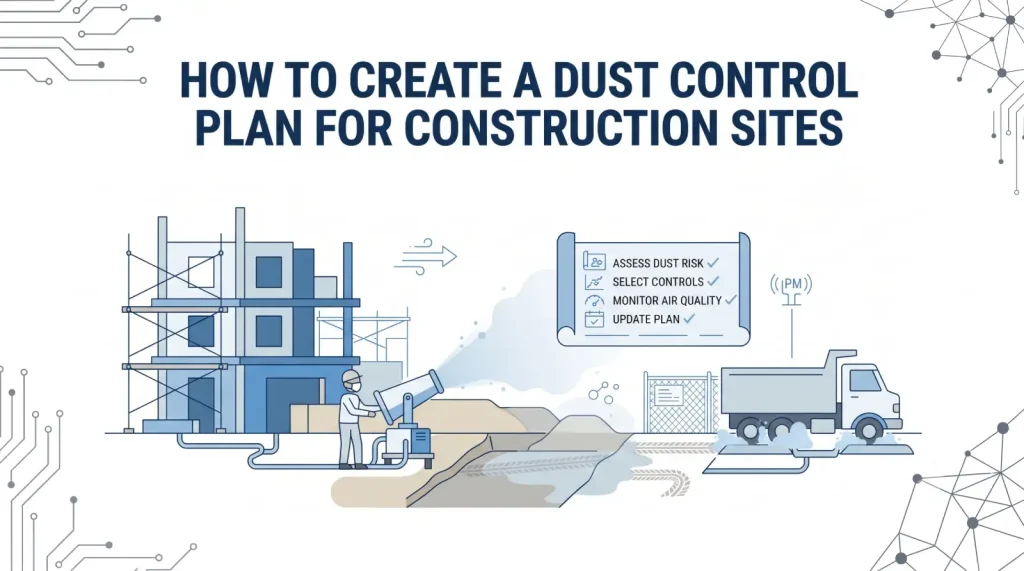
Why Your Construction Site Needs a Written Dust Control Plan
A written dust control plan’s value far exceeds a document for regulatory checks. It’s the translator that turns legal requirements and management intentions into specific on-site actions.
Moving from Reactive Response to Proactive Management
Without a plan, dust control is reactive: measures are taken only when dust becomes visible or a complaint is received. This lagging management style cannot meet the demands of modern construction. A written plan empowers you to predict high-dust activities based on the project schedule and deploy resources at the source beforehand. For example, initiating misting and containment measures before demolition begins, not after a dust cloud has formed. This foresight significantly reduces environmental risks and communication costs.
A Direct Tool for Regulatory Compliance and Risk Avoidance
The OSHA respiratory protection standard and EPA particulate matter regulations set clear requirements for construction dust. A detailed plan is the strongest evidence you can provide to regulators that you’ve met your "general duty clause." It clearly documents who you are, where, when, and what kind of dust will be generated, and the hierarchical control measures (source, pathway, receptor) you will deploy. When facing community complaints or regulatory inquiries, this dynamically updated document can minimize the risk of fines and work stoppages.
How Do You Assess the Site Before a Dust Control Plan?
Before writing down any control measures, you must first complete a "diagnosis" of your site. This foundational assessment determines the entire plan's direction.
Step 1: Classifying Dust Risk by Construction Activity
Not all activities generate equal hazards. List all tasks across the project lifecycle and assign each a high, medium, or low dust risk classification. This is the basis for resource allocation.
| Risk Level | Typical Construction Activities | Key Dust Characteristics |
|---|---|---|
| High Risk | Concrete cutting/breaking, dry masonry grinding, dry sweeping, spoil dumping | High volume, contains respirable particles (PM10/PM2.5), rapid dispersal |
| Medium Risk | Earthworks, vehicle movement, batching plant operations, wood cutting | Moderate volume, mainly larger particles, significant local impact |
| Low Risk | Wet drilling, manual plasterboard cutting, paint sanding (wet method) | Low volume, larger particles, highly controllable |
Step 2: Identifying Sensitive Receptors and Setting Buffer Distances
Dust impact extends beyond your site boundary. You must map all "sensitive receptors" within at least 500 meters of your site perimeter.
- Sensitive Locations: Schools, hospitals, nursing homes, parks, residential areas, major commercial zones.
-
Ecological Receptors: Water bodies, farmland, nature reserves.
Establish buffer distance requirements for each. For example, when a high-risk activity is within 100 meters of a residential area, the highest level of continuous misting and physical barriers must be activated.
Step 3: Sampling to Establish Baseline Dust Concentration
Before you break ground, the air quality at your site already has a background level. Deploy at least two continuous particulate matter (PM10 and PM2.5) monitors, positioned upwind and downwind of the prevailing wind, to record baseline data for a minimum of 7 days. This data is your only scientific basis for later determining whether "a dust exceedance was caused by us, or by background pollution." It’s also the starting point for setting specific control targets, such as "downwind PM10 concentration shall not exceed 150% of the baseline."
Step 4: Evaluating Water, Power, and Site Conditions
The best control plan is useless if it ignores actual site conditions. You must answer these questions: Can the sustainable water supply source and pressure support the planned number of misting devices? Can the power supply at key workfaces handle the load of fixed cannons or electrostatic precipitators? Is the site’s road paving and drainage setup sufficient to support a vehicle wheel-washing facility? These physical conditions are hard constraints on your choice of control measures.
What Is the Hierarchy of Controls for Construction Dust?
With the assessment complete, you enter the measure selection phase. The most effective strategy is a "Source-Pathway-Receptor" control hierarchy.
Source Control: Eliminating Dust Before It’s Generated
This is the most cost-effective and efficient method. The core idea is to change work methods so dust is never released.
- Wet Methods: Concrete saws, drills, and angle grinders must connect to a water supply with sufficient flow to form a continuous water curtain at the cutting point.
- Dust Suppressants Over Water: On earthwork faces, temporary roads, and material stockpiles, use liquid suppressants that meet local environmental standards, such as calcium chloride or magnesium chloride solutions, instead of water alone. These solutions keep the ground moist by absorbing atmospheric moisture, with an effective suppression time typically 8-12 times longer than water, significantly reducing fuel costs and safety risks from water trucks.
- Pre-mixed Materials and Vacuum Attachments: For dry mortar and other powders, prioritize factory-pre-wetted batches. All handheld power sanding tools must be equipped with an industrial HEPA vacuum cleaner for simultaneous dust collection.
Pathway Control: Cutting Off the Transmission Path
When source elimination is impossible, the goal is to stop generated dust from spreading.
- Physical Barriers: Around all dust-generating work areas, install continuous, dense dust screens or hoardings no less than 2 meters high. The aperture ratio should be selected based on control needs, with 30%-50% generally recommended.
- Spraying and Misting: Deploy fixed or mobile misting cannons at site gates, main internal roads, and upwind of earthwork areas to create a curtain of water mist. Droplet size should be controlled between 50-200 microns; too small and they evaporate, too large and they cannot capture suspended particles.
- Vehicle Controls: All vehicles leaving the site must have their tires and chassis washed for at least 30 seconds on a hardened wheel-wash pit or a washing platform equipped with a high-pressure washer. Loads of loose material must be fully covered with a tight, heavy-duty tarpaulin and securely tied down.
Receptor Protection: The Last Line of Defense
When residual risk remains after source and pathway controls, the final defense is protecting people.
- Personal Protective Equipment (PPE): In all high-risk dust areas, clearly post signs mandating respiratory protection. Based on exposure assessment results, provide workers with at least N95 filtering facepiece respirators, or higher-protection elastomeric respirators with exhalation valves.
- Behavioral Controls: Strictly demarcate contaminated and clean zones, forbidding workers from wearing dusty work clothes in canteens or offices. Set up an independent rest area with a high-efficiency filtered air supply to act as a refuge in emergencies.
How to Implement a Dust Control Plan Step by Step
A clear list of measures now needs to be turned into an executable action plan.
Step 1: Assign Responsibility and Resources to Specific Roles
The core of the plan is defining "who does what and when." Don't write "Zhang is responsible for watering" in your plan. Be specific: "Earthwork team member Zhang San will operate Water Truck No. 2 along route A-B-C at 9:00 AM, 11:00 AM, 2:00 PM, and 4:00 PM daily for 30 minutes, ensuring the road surface is free of dry dust, and will upload a time-stamped photo of the water refill log to the project management app." For key tasks like dust suppressant application and mist cannon maintenance, designate specific responsible persons and performance indicators.
Step 2: Establish a Dynamic Monitoring and Recording System
You can’t manage what you don’t measure. Your plan must include a "Dust Monitoring Location and Frequency Table."
| Monitoring Location | Parameters | Minimum Frequency | Recording Responsibility |
|---|---|---|---|
| Downwind Boundary (closest to sensitive receptor) | PM10, PM2.5, Wind Speed/Direction | Continuous, Real-Time | Environmental Officer A |
| High-Risk Activity Perimeter (e.g., cutting point) | Total Dust Concentration | Every 2 hours | Work Crew Leader |
| Vehicle Exit Wash Station | Visual Check | Every vehicle | Gatekeeper/Washer |
All data, including daily weather conditions, on-site water truck mileage, suppressant consumption, and complaint records, must be archived in a unified system. When real-time PM10 monitoring data continuously exceeds a trigger value (e.g., 190 µg/m³) for 30 minutes, the plan must include a pre-defined escalation response, such as increasing misting frequency or stopping specific high-risk work.
Step 3: Create a Contingency Plan for Extreme Weather and Surprises
A good plan anticipates failure. For example, during prolonged summer heat, applied water can evaporate in 10 minutes. A secondary plan for immediate dust suppressant application must be ready. In high winds (instantaneous wind speed exceeding 10m/s), all high-dust-concentration activities (like demolition or dry cutting) must stop unconditionally, and full-scale misting pressure must be immediately initiated. These emergency triggers and corresponding actions must be clearly listed in the plan.
What Are Common Mistakes That Derail a Dust Control Plan?
Many teams fall into the same cognitive traps when creating and executing a plan. Avoid these common missteps.
Mistake 1: Focusing Only on Visible Dust, Ignoring Respirable Dust
This is a critical error. Particles visible to the naked eye are typically larger than 10 microns, but the more hazardous PM2.5 is invisible. Your plan must explicitly designate PM2.5 as an independent key performance indicator to be monitored and controlled, not glossed over using total suspended particulates (TSP) or PM10.
Mistake 2: Thinking Water Spraying Is the Universal, Cheapest Solution
From a single-use cost perspective, water is indeed cheap. However, the whole-life cost of repeated watering—including water bills, labor, equipment fuel, and cleaning up muddy roads—often far exceeds the total cost of using a suppressant. More importantly, the slurry created by over-watering is a pollutant in itself and can lead to new environmental violation risks. Your plan should consider full life-cycle cost-effectiveness.
Mistake 3: Treating Monitoring Data as a Check-the-Box Exercise
If monitoring data is only recorded in a form and never used to guide operational decisions on-site (like whether to add an extra misting cycle this afternoon), the plan system is failing. The data stream's endpoint must be the decision-making level, forming a closed loop with the action plan.
Conclusion
A successful construction dust control plan is much more than a collection of techniques. Its core lies in a rigorous logic from assessment to execution: first, understand your battlefield through a baseline assessment; then, scientifically select measures following the "Source-Pathway-Receptor" hierarchy; next, execute with steps precisely assigned to individuals and times; and finally, use high-frequency monitoring and dynamic reviews to ensure your plan remains perpetually effective. These three pillars—precise diagnosis, hierarchical control, and dynamic closed-loop management—are the common DNA of every successful plan.
Your next step is to use this guide’s framework to re-examine the existing dust management approach on your current project. Start by completing the "four-step pre-assessment," and you will find that a clear, executable, implementable, and effective plan is the most powerful tool you have to manage regulatory risk and safeguard health.
FAQs
What is the typical timeframe for creating a full construction dust control plan?
For a medium-sized project, after completing the initial site walkthrough and data collection, it typically takes an environmental officer 5-7 working days to draft, review, and gain internal approval for the first version of a written plan.
How are the monitoring trigger values set in a dust control plan?
- Values should be based on WHO Air Quality Guidelines and local regulations. Typical suggestions are:
- Action Level: When the 24-hour average PM10 concentration reaches 50-75 µg/m³, daily control measures must be reinforced.
- Alert Level: When the 30-minute average PM10 concentration reaches 190 µg/m³ or PM2.5 reaches 90 µg/m³, emergency procedures, such as halting specific work, must be activated immediately.
- Set specific values stricter than your local environmental agency’s limits.
Which is a better choice for my project, water spraying or dust suppressants?
- Choose water spraying for short-term (1-2 days), small-area tasks with no water source limits, or in areas with strict bans on chemical substances.
- Choose calcium chloride-based suppressants for long-term exposed earth surfaces and unpaved roads with heavy vehicle traffic. Their suppression effect can last for weeks.
- The key deciding factor is comparing the total cost over at least a one-week cycle, including water, labor, equipment, and potential road mud cleanup costs.
What emergency scenarios must be included in a dust control plan?
- A step-by-step escalation process for exceeding monitoring trigger values (check → reinforce measures → stop work).
- Special measures and work restrictions for high wind (sustained > 10m/s) and extreme heat conditions.
- A backup water supply plan for when the main water system fails.
- A communication and response process for large-scale complaints from neighbors or local businesses.
How do I determine which construction activities are high-risk for dust?
Use a "risk matrix" scoring method for all construction activities, comprehensively evaluating their "dust generation intensity" and "dust generation duration." Activities with the highest scores, such as uncontrolled dry cutting, breaking, abrasive blasting, and large-scale soil dumping, are classified as high-risk. Refer to the table earlier in this guide for the specific classification standard.
Should a good dust control plan focus on PM10 or PM2.5?
Both are essential. PM10 represents the total mass of particles that can enter the respiratory system and is a common regulatory metric. PM2.5 poses a greater health hazard because it can penetrate deep into the alveoli and enter the bloodstream. A good plan monitors both concurrently and sets stricter control objectives for PM2.5.
How can I implement wet methods if my site has no stable water main?
- Equip the site with a mobile water storage tank of sufficient volume (e.g., 10-20 tons) and use a booster pump to supply water to the work points.
- For tools like saws and grinders, use backpack-style pressure sprayers for precise, point-specific water delivery.
- For road and stockpile control, shift to using long-lasting dust suppressants to drastically reduce both water dependency and transport frequency.
How do I get subcontractors and workers to truly comply with the dust control plan?
- Include specific dust control requirements as a mandatory appendix to their contracts, linked to payment milestones.
- Implement a graduated penalty system: "verbal warning for the first offense, fine for the second, removal from the site for the third."
- Establish a monthly "Best Dust Control Crew" award to create positive reinforcement.
How often should my dust control plan be updated?
- Routine Update: At least once per quarter, based on monitoring data trends and changes in the construction phase.
- Triggered Update: Must be completed within 48 hours of any of the following events—receiving a regulatory fine, a dust-related safety incident, a surge in community complaints, or the project entering a major new dust-generating construction phase.
How do you correctly evaluate the real-world effectiveness of a dust control plan?
- Process Indicators: On-time execution rate of control measures, equipment uptime, and consistency of consumable usage with the plan.
- Outcome Indicators: Comparison of daily average and peak PM10/PM2.5 concentrations at boundary monitoring points against baseline and trigger values.
- Compliance Indicators: Number of regulatory fines, number of validated community complaints, and the rate of respiratory illness-related clinic visits among workers.