The way organizations approach dust control budgeting has fundamentally shifted. For years, the conversation revolved around the simple purchase price per ton of a suppressant. Today, that narrow view has proven inadequate, often leading to budget overruns and performance gaps. Procurement teams and site managers now face a more complex challenge: untangling the web of application costs, longevity, and hidden operational expenses that constitute the true cost of effective dust management.
This shift is driven by a deeper understanding of total cost of ownership. A low upfront price can mask frequent reapplication needs, higher labor costs, and increased wear and tear on application equipment. Conversely, a product with a higher initial cost may deliver superior longevity, slashing the operational demands and ultimately lowering the annual expenditure. Navigating this landscape requires a framework that moves beyond a simple price-per-ton comparison.
This article provides a data-driven method for building a realistic dust control budget. We will break down the direct and indirect costs, analyze the key variables that cause pricing to fluctuate, and compare the financial implications of common suppressant strategies over a full season.
Key Takeaways
- The purchase price of a dust control agent represents only 40-60% of the total annual program cost; application, labor, and road preparation are significant hidden expenses.
- Calcium chloride programs, while varying in upfront cost, often reduce total annual spending by 30-50% compared to water-only or short-lived organic suppressants due to lower application frequency.
- Proper road base preparation is the single most impactful cost-saving measure, potentially extending suppressant life by 25-40%.
- A realistic budget should be calculated as an annual, per-mile cost that includes material, freight, application, and maintenance, not as a simple per-ton price.
- Climate and traffic volume can independently swing your total annual dust control pricing by up to 35%, making a site-specific evaluation essential.
Does a Higher Upfront Cost Mean a Bigger Budget?
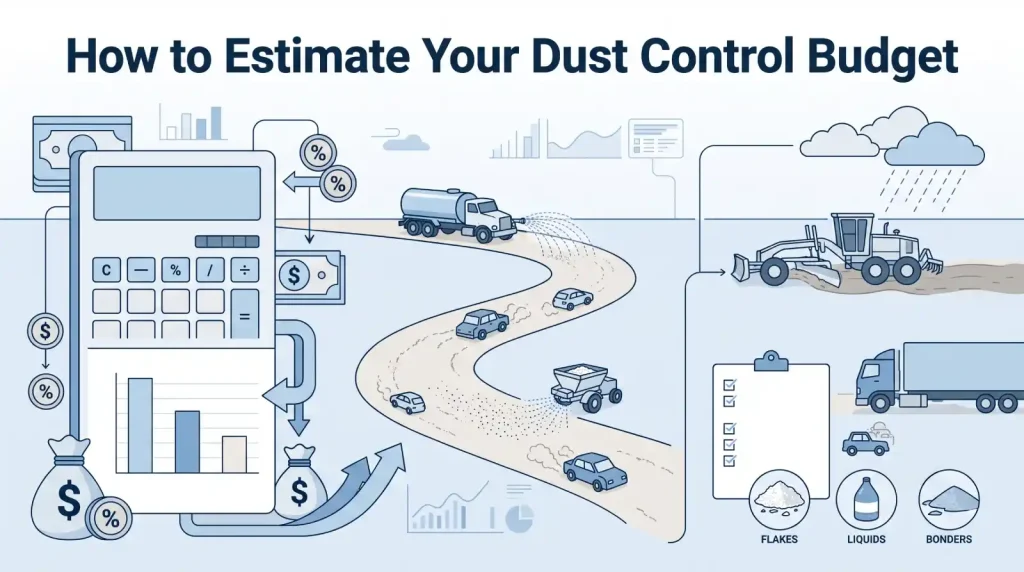
Not necessarily. A higher material cost can significantly reduce your overall annual dust control budget if it increases the duration of effectiveness. The core economic trade-off is not about the price per ton; it's about the cost per day of effective dust suppression. Programs that rely on frequent, low-cost applications often have hidden costs in labor, equipment usage, water, and road grading that eclipse the material savings. The main drivers of a program's total cost are application frequency and road preparation standards, not just the suppressant's purchase price.
What Are the Core Components of Dust Control Pricing?
Building a comprehensive budget requires moving beyond the unit cost of a suppressant. A full financial model must account for every step from product manufacture to end-of-season grading. Failing to itemize these components is the primary reason budgets are exceeded.
Direct Material and Freight Costs
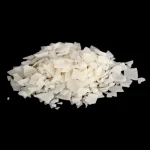
This is the most visible cost, typically quoted per ton. However, the delivered cost is what matters. For projects in remote locations, freight can equal or exceed the material cost. Calcium chloride pricing, for instance, is heavily influenced by its form. Liquid solutions (30-38% concentration) are cost-effective for large-scale programs with on-site storage, but have high water-weight freight costs. Flake products (77-80% purity) are more economical to ship, especially for smaller projects or those without bulk storage. Request quotes as "delivered price per ton" to ensure comparability.
The Application Cost Equation
Application is a multi-variable cost center. It breaks down into labor, equipment, and water. In-house application requires amortizing the cost of a water truck, spray system, and operator labor. A typical water truck with operator costs between $75 and $150 per hour. Application rate (gallons per square yard) dictates coverage speed. A higher application rate means fewer tons of product needed but more hours of equipment and labor time per mile. Contracted application services typically charge on a per-square-yard or per-linear-foot basis, bundling labor, equipment, and insurance, allowing for more predictable budgeting.
Road Preparation and Maintenance
This is the most frequently omitted budget line. A suppressant applied to a degraded, potholed road will fail prematurely. Mechanical grading and shaping must be budgeted before the first application to create a proper crown for drainage. This typically costs $100-$250 per mile per grading event. Mid-season light grading may also be required, particularly on high-traffic roads, to re-establish the surface profile before a maintenance application. Ignoring this cost is a leading cause of dust control program failure and budget overruns.
How Do Different Dust Control Methods Impact Your Annual Budget?
A direct financial comparison over a 6-month season reveals the stark difference in budget structures between approaches. The following cost table models a typical one-mile, 24-foot wide unpaved road with moderate traffic (100-200 vehicles per day). All figures are typical market reference values.
Total Annual Cost Comparison by Methodology
| Cost Category | Water-Only (Baseline) | Magnesium Chloride (Liquid) | Calcium Chloride (Flake) | Lignin Sulfonate |
|---|---|---|---|---|
| Primary Application Frequency | Daily/As Needed | 1 initial, 1-2 mid-season | 1 initial, 0-1 mid-season | 1 initial |
| Annual Material Cost (per mile) | $0 | $2,800 – $4,500 | $2,200 – $3,800 | $3,100 – $5,200 |
| Estimated Water & Freight (per mile) | Included in equipment | Integrated into material | $500 – $900 | Integrated into material |
| Total Application Events (Labor/Equip.) | 60-100+ | 2-3 | 1-2 | 1-2 |
| Annual Application & Labor Cost (per mile) | $12,000 – $20,000 | $1,800 – $2,700 | $900 – $1,800 | $1,400 – $2,400 |
| Road Grading Maintenance (per mile) | $600 – $1,500 | $200 – $400 | $100 – $300 | $200 – $500 |
| Total Estimated Annual Budget Range (per mile) | $12,600 – $21,500 | $4,800 – $7,600 | $3,200 – $5,900 | $4,700 – $8,100 |
This table illustrates that while material is a new line item for a chemical suppressant budget, it significantly offsets the dominant equipment and labor costs of a water-only program. Calcium chloride flake programs often represent the lowest total annual cost model due to reduced application frequency.
How Much Does Application Method and Rate Influence Costs?
Your choice of application method directly dictates both the material's performance and your budget's accuracy. The two primary methods—spray-on for liquids and placement for flakes—carry distinct cost profiles.
Liquid Application: Coverage and Dilution Economics
Liquid suppressants, including calcium chloride brine, are priced on concentration. A 35% solution might cost less per ton delivered but requires more gallons to achieve the same active ingredient coverage as a 38% solution. The key budget metric is the cost per square yard at a given active application rate. Applying 0.25 gallons per square yard of a 38% solution costs more in material than 0.35 gallons of a 30% solution but may deliver longer control, reducing the number of maintenance applications. Over-diluting concentrate on-site is a common way to inadvertently inflate the total budget by reducing lifespan and necessitating earlier re-treatment.
Flake/Pellet Application: Precision and Placement
Flake products are applied using a spreader, placing solid material directly on the road surface. The water truck then follows to dissolve it. This method eliminates freight costs associated with shipping water and allows for precise control over application width. The primary cost risk is poor calibration of the spreader, leading to over-application and wasted material, or under-application and premature failure. Post-application watering must be thorough enough to fully dissolve the flakes without creating runoff, which is a direct waste of budgeted material. A well-executed flake application of high-purity calcium chloride consistently delivers the lowest material-to-effectiveness ratio.
Where Do Hidden Costs Wipe Out Your Dust Control Budget?
Beyond the visible line items, a set of frequently overlooked factors can erode a well-planned budget. These hidden costs are predictable and can be neutralized with proactive planning.
The most costly oversight is inadequate water management. It has a dual impact. First, poorly graded roads trap water, leading to potholes that physically break up the treated surface, requiring costly repair and re-application. Second, insufficient water volume during flake application leaves undissolved product that blows or washes away, representing a direct 10-20% material loss.
The second hidden cost is traffic-induced degradation. For public roads or high-traffic mine haul routes, the rate of surface wear is exponential, not linear. A road with 500 vehicles per day may require 3x the maintenance applications of a road with 100 vehicles per day, not 5x. Budgets that do not factor in vehicle count and, critically, average vehicle weight, systematically underestimate re-application needs. Light vehicles cause dust; heavy trucks destroy the road structure and treated layer.
The third is the cost of a premature washout. A budget based on ideal conditions will fail after a single intense rain event. A sustainable budget must include a contingency line for one unscheduled maintenance application for every 3-4 miles of road, based on historical local weather patterns. Without this, a single storm can force a difficult choice between a safety hazard and an unbudgeted expense.
What Is a Practical Framework for Estimating Your Total Budget?
Moving from theory to a specific number for your site requires a structured, step-by-step estimation process. This framework converts site-specific variables into a defensible budget figure.
Step 1: Calculate Total Treated Area
Measure the exact length and average width of each road segment to be treated. The budget unit is square yards. For a 24-foot wide road, one mile equals 14,080 square yards. Accurate area measurement is the foundation; a 10% overestimation here cascades into significant material waste.
Step 2: Define a Performance-Based Specification
Do not budget based solely on a product type. Budget based on a performance requirement, such as "minimum 90% dust control efficacy for 3 months under [X] traffic count per day." This allows suppliers to propose optimized solutions. Share your traffic data and road condition assessment and request a proposal that guarantees a minimum active life for the treatment, shifting some performance risk and cost certainty to the application.
Step 3: Model a Three-Scenario Budget
Create a single spreadsheet with three columns: Best Case (ideal weather, low traffic), Expected Case (typical weather, predicted traffic), and Contingency Case (one major rain event, a surge in traffic). For each scenario, itemize the costs from the "Total Annual Cost Comparison" table. This gives you a realistic budget range, not a single brittle number. The Contingency Case should be the basis for your financial planning to avoid mid-season funding gaps.
Step 4: Factor in the End-of-Season Liability
All chloride-based suppressants, including calcium chloride, are hygroscopic and will eventually leach from the road. Some organizations budget for a yearly end-of-season deep grading to remove any accumulated surface fines and any residual salts. Failing to plan for this $150-$300 per mile expense is a year-over-year budget trap that degrades future road performance.
Conclusion
Estimating a dust control budget is fundamentally an exercise in calculating total cost of ownership, not tallying a single line-item price. The analysis demonstrates that dust control pricing is driven by the interplay of material longevity, application frequency, and rigorous site preparation. For many applications, a program centered on a high-performance, hygroscopic suppressant like calcium chloride yields the lowest total annual cost by slashing the labor, water, and equipment expenses that dominate a water-only program.
The most critical budget levers you control are a properly engineered road base and a clear, performance-based specification. Prioritizing these elements de-risks your investment and ensures that funds allocated for dust control deliver measurable, season-long results. The key is to audit your site's specific variables—traffic, climate, and road condition—and build a detailed, scenario-based budget.
For a precise budget tailored to your specific road network and operational requirements, consult with a dust control application specialist who can conduct a thorough site assessment and provide a performance-guaranteed, fixed-cost proposal for the season.
FAQs
What is a realistic per-mile cost for dust control?
A typical annual budget for a one-mile unpaved road treated with a hygroscopic salt like calcium chloride ranges from $3,200 to $7,600. This total includes material, application, water, and necessary road grading. A water-only program, while having no material cost, often totals $12,600 to $21,500 per mile per year due to extreme labor and equipment demands.
- Material costs alone are a poor estimator, making up only 40-60% of the total.
- Remote locations can see freight costs add 20-30% to the material budget.
- Contractor-applied programs often have a 10-15% premium over in-house programs but provide fixed, predictable pricing.
How does calcium chloride pricing compare to other dust suppressants?
Calcium chloride typically has a lower delivered cost per active ingredient than magnesium chloride and is significantly cheaper than synthetic polymers. While liquid lignin sulfonate can be price-competitive per ton, it often requires more frequent application and rigid curing conditions.
- Calcium chloride flake (77-80% purity) often costs $300-$450 per ton delivered.
- Liquid magnesium chloride (30% solution) often costs $0.60-$1.00 per gallon delivered.
- The key comparison is not cost per ton, but the cost per day of effective dust suppression for your specific road.
Is calcium chloride safe for gravel roads?
Yes, calcium chloride is safe for typical unpaved road applications when handled according to standard safety procedures. It is a hygroscopic salt that attracts moisture to bind road fines together, and it is not classified as a hazardous substance for this use case.
- Standard personal protective equipment (gloves and eye protection) is recommended during handling.
- It is water-soluble and will eventually leach from the road over time, with no persistent toxic residues.
- Proper road design with a crown prevents ponding and minimizes any potential environmental impact to roadside vegetation.
What are the hidden costs in a dust control budget?
The most damaging hidden costs are the ones that are entirely predictable but often omitted from initial estimates. These are not true surprises but failures in budget modeling.
- Inadequate road preparation: Applying suppressant to a degraded road can shorten product life by 25-40%, forcing early re-application and doubling material costs for the season.
- Unbudgeted mid-season maintenance: Failing to reserve funds for one light re-grading and re-application event after a heavy summer rain is the single most common budget overrun cause.
- Poor application calibration: A miscalibrated spreader can over-apply by 15%, wasting material, or under-apply, leading to performance failure and costly call-backs.
When should I apply for the best product longevity and budget efficiency?
The optimal application window provides the best product performance and cost efficiency. Timing the application incorrectly can reduce a product's effective life by weeks.
- Early Summer Application: Apply after the last spring freeze and after the road base has fully dried and been mechanically graded to a proper crown. This allows the suppressant to penetrate and bond with the fines.
- Avoid Late-Fall Application: Applying suppressants late in the season provides minimal benefit as the road is often wet, and the product can be leached away over winter.
- Mid-Season Refresh: Budget for a light re-application after peak traffic periods or significant rain events to maintain a continuous treated surface.
Who should I hire for dust control application?
The choice between hiring a professional contractor and using in-house crews is a decision between cost control and budget certainty. The best choice depends on your organization's core competencies.
- In-house crews are best for organizations with multiple pieces of road maintenance equipment and trained operators who can dedicate focused time to precise application.
- Professional contractors provide a turnkey solution that bundles insurance, calibrated equipment, and performance risk, converting a variable cost into a fixed, predictable line item.
- Fleet rental is a cost-effective hybrid model for organizations with skilled labor but aging equipment, providing access to modern, well-calibrated water trucks and spreaders.
Why does calcium chloride work for dust control?
Its effectiveness is based on a continuous cycle of moisture absorption, rather than simply coating particles. This mechanism explains its long-lasting, recrusive action compared to water or organic binders.
- Hygroscopy: It draws moisture from the air down into the road base, maintaining an optimal compaction moisture content that resists the formation of airborne dust.
- Surface Tension Modification: The dissolved salt increases the surface tension of the moisture film between aggregate particles, acting as a powerful binding agent.
- Freeze-Point Depression: In the late fall, its presence can provide a secondary benefit by lowering the freezing point of pore water, offering some protection against light frost heave.
How does freight impact dust control pricing?
Freight is not a fixed percentage; it is a geometric cost driven by distance, product form, and order volume. For remote operations like mining, it can be the dominant budget line item.
- Liquid vs. Solid: Shipping liquid solutions means paying to transport 62-70% water. Switching to a flake product like calcium chloride eliminates this cost, often reducing delivered cost by 25-30%.
- Full Truckload (FTL) vs. LTL: Ordering a full truckload (22-25 tons) can reduce per-ton freight costs by up to 50% compared to less-than-truckload shipments.
- Jobsite Offloading: Always confirm if a delivered price includes offloading capability, or if you must budget for a telehandler or skid steer with a hopper at your site.
What is the difference between calcium chloride flake and liquid for my budget?
The optimal form is a trade-off between logistical efficiency and the need for on-site infrastructure. This single decision can shift your cost profile from material-heavy to equipment-heavy.
- Calcium chloride flake (77-80%) is cheaper to ship per active unit, ideal for smaller programs or those without storage tanks. It requires a spreader and precise post-application watering, adding steps and potential labor cost.
- Liquid calcium chloride (30-38%) is ideal for high-volume programs with on-site bulk storage. It simplifies the application to a single spray step, reducing labor, but has a much higher freight burden.
- On-Site Dissolving: Some operators buy flake to save on freight and then invest in mixing tanks to create a custom liquid solution, a capital-intensive move that pays off for very large, multi-year programs.
Where can I find reliable dust control cost data?
Cost data is not secret, but it is scattered and requires specific requests to be comparable. The most reliable information comes from grounding public data with project-specific quotes.
- State DOTs: Many state Departments of Transportation publish annual average unit price databases for road maintenance items, including dust palliatives. These are an excellent public source for benchmarking.
- Industry Associations: Organizations like the National Stone, Sand & Gravel Association (NSSGA) sometimes provide industry-wide cost studies for their members.
- Direct Quotations: The only truly reliable method is to secure three detailed quotations for your specific site, requiring suppliers to bid on a clear performance specification rather than a generic product.