Wastewater treatment facilities constantly juggle tightening discharge permits, rising operational costs, and the physical limits of existing infrastructure. Removing emulsified oils, heavy metals, phosphates, and fluoride to meet legally mandated parts-per-billion thresholds requires chemical precision that traditional coagulants like lime or alum sometimes fail to deliver reliably.
Operators frequently encounter "pin floc" that refuses to settle, sludge that remains soupy despite extended pressing, and pH swings that destabilize the entire treatment train. These mechanical failures usually trace back to poor ionic balance in the water chemistry—specifically, a lack of available calcium ions to bridge negatively charged particles. This is exactly where calcium chloride wastewater treatment chemistry provides a direct, low-footprint intervention that restores separation efficiency without requiring capital-intensive plant upgrades.
Calcium chloride is safe and effective for wastewater treatment when handled with proper PPE and dosing protocols. The key risks involve exothermic heat release during dissolution and corrosion of carbon steel, both of which are fully manageable with chemical-resistant materials and controlled mixing procedures. The main mechanisms by which calcium chloride improves treatment are free calcium ion donation for fluoride and phosphate precipitation, ionic strength adjustment for emulsion breaking, and sludge structure improvement for mechanical dewatering.
What This Article Covers
- The electrochemical mechanisms behind calcium chloride's coagulation and precipitation effects
- Step-by-step implementation from jar testing through full-scale dosing
- Troubleshooting common problems like pH swings and excessive sludge volume
- Safety and material compatibility protocols
- Bottom line: Calcium chloride functions primarily as a calcium ion donor—its treatment value comes from what the calcium does, not the chloride.
How Does Calcium Chloride Work in Wastewater Treatment?
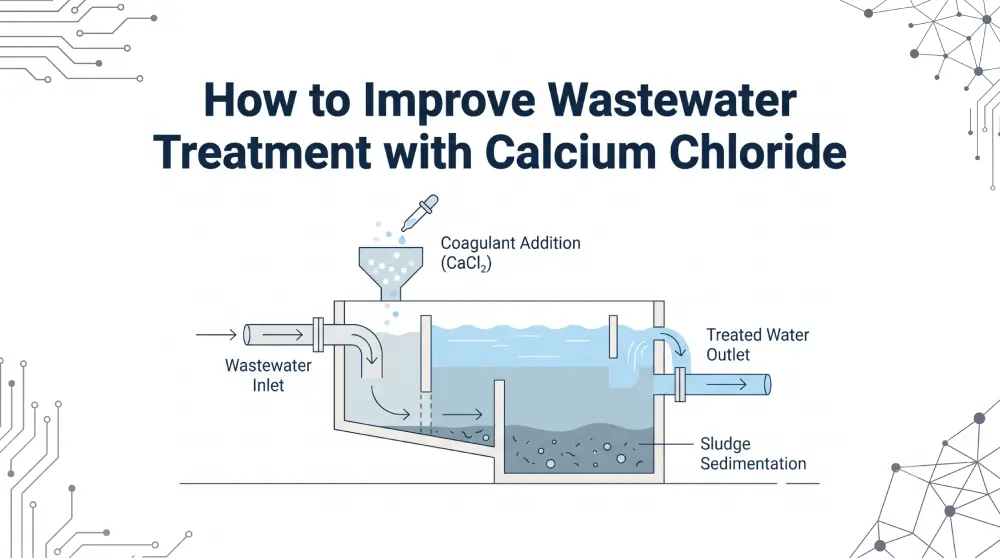
Calcium chloride (CaCl₂) dissociates completely in water into one Ca²⁺ ion and two Cl⁻ ions. While the chloride ions remain largely spectators, it is the free calcium ions that perform all the treatment functions. Understanding this distinction prevents the common mistake of treating CaCl₂ as a simple coagulant—it is more accurately a coagulant aid and precipitation agent.
The Electrochemical Mechanism: Charge Neutralization Explained
Most suspended solids, emulsified oils, and dissolved contaminants in wastewater carry a net negative surface charge. These like charges repel each other, keeping particles in stable suspension and preventing them from aggregating into settleable masses. Calcium ions, being divalent cations (Ca²⁺), compress the electrical double layer around each particle more efficiently than monovalent ions like sodium (Na⁺).
The Schulze-Hardy rule quantifies this: the coagulation power of an ion is proportional to the sixth power of its valence. A calcium ion (valence = 2) is roughly 64 times more effective at destabilizing colloids than a sodium ion (valence = 1). This means small doses of calcium chloride can achieve what would require massive salt loads otherwise.
Why Calcium Ions Matter for Contaminant Removal
Beyond charge neutralization, Ca²⁺ participates directly in chemical precipitation reactions that remove specific regulated contaminants:
- Fluoride removal: Ca²⁺ reacts with fluoride (F⁻) to form calcium fluoride (CaF₂), an insoluble precipitate with a solubility product (Ksp) of 3.9 × 10⁻¹¹. This drives effluent fluoride concentrations below 2 mg/L when calcium is dosed in stoichiometric excess.
- Phosphate removal: Ca²⁺ precipitates orthophosphate as hydroxyapatite [Ca₅(PO₄)₃OH], achieving effluent total phosphorus levels under 0.5 mg/L at pH above 8.5.
- Sulfate removal: At high calcium concentrations, gypsum (CaSO₄·2H₂O) precipitation occurs, useful for industrial streams with elevated sulfate.
Where Is Calcium Chloride Used in Industrial Wastewater Treatment?
The versatility of calcium chemistry means CaCl₂ finds application across multiple treatment stages and industrial sectors.
Fluoride Removal in Semiconductor and Glass Manufacturing
Semiconductor fabrication and glass etching generate wastewater with fluoride concentrations between 50 and 2,000 mg/L, far exceeding typical discharge limits of 2–5 mg/L. Lime precipitation can theoretically remove fluoride, but the reaction kinetics are slow and the resulting CaF₂ particles are often colloidal, requiring polymer addition to settle.
Calcium chloride provides soluble calcium that reacts almost instantaneously with fluoride ions. A typical dosing ratio is 2:1 molar ratio of Ca:F (equivalent to approximately 3.7 kg CaCl₂ per kg of fluoride removed, accounting for competing reactions). The resulting CaF₂ floc is denser and settles faster than lime-generated floc, reducing clarifier detention time requirements by 20–30%.
Emulsion Breaking in Metalworking and Food Processing
Oil-water emulsions stabilized by surfactants, soaps, or proteins resist conventional gravity separation. Calcium ions destabilize these emulsions by two mechanisms: binding to carboxylate groups on fatty acid soaps to form insoluble calcium soaps, and compressing the electrical double layer around oil droplets to allow coalescence.
Dosages typically range from 200 to 800 mg/L as CaCl₂, depending on the emulsifier load. The resulting calcium soaps and coalesced oil are then removed by dissolved air flotation (DAF) or skimming.
Heavy Metal Precipitation and pH Adjustment
In mixed-metal waste streams, maintaining the correct pH for hydroxide precipitation of each metal becomes difficult. Zinc hydroxide, for example, redissolves at pH above 10.5 due to its amphoteric nature. Calcium chloride does not replace hydroxide precipitation but enhances floc density and improves the capture of fine metal hydroxide particles, reducing residual metal concentrations in the effluent by 30–50% compared to NaOH-only precipitation.
Sludge Dewatering in Municipal and Industrial Plants
Calcium ions improve sludge dewaterability by displacing monovalent cations (Na⁺, K⁺) from the floc structure, reducing bound water content. Plants switching from sodium-based alkalinity to calcium-based systems often measure a 2–5 percentage point increase in filter cake solids from a belt press or centrifuge, translating to 10–20% less sludge mass for disposal.
Step-by-Step: How to Implement Calcium Chloride Wastewater Treatment
The following workflow assumes a typical industrial wastewater treatment plant with equalization, chemical reaction tanks, solids separation, and sludge handling. Each step includes the operation, its purpose, and the expected measurable result.
Pre-Implementation Requirements
Before beginning calcium chloride dosing, verify the following:
- Wastewater characterization data: Complete analysis of pH, TSS, fluoride, phosphate, heavy metals, oil and grease, and alkalinity for the past 12 months
- Flow rate data: Daily minimum, average, and peak flows with hourly profiles
- Existing treatment chemical usage: Current consumption rates, dosing points, and costs for all coagulants, flocculants, and pH adjusters
- Chemical compatibility review: Piping, tank, and pump materials of construction for all dosing system components
- PPE inventory: Chemical-resistant gloves (neoprene or nitrile), splash goggles, face shield, and chemical-resistant clothing
- Operator training records: Documented training on chemical handling, spill response, and first aid procedures
Step 1: Jar Testing for Dose Optimization
Operation: Collect representative raw wastewater samples and perform jar tests at CaCl₂ concentrations ranging from 50 to 500 mg/L, alone and in combination with your existing coagulant (PAC, ACH, or ferric chloride) at its current dose.
Purpose: Identify the dose-response curve for your specific wastewater matrix. The optimal dose is the point where incremental CaCl₂ addition yields less than 10% further improvement in turbidity, contaminant removal, or floc size.
Expected Result: A data table showing the relationship between CaCl₂ dose and key performance indicators. Most industrial wastewaters respond optimally at 100–300 mg/L as CaCl₂, but the jar test must confirm this for your specific stream.
Step 2: Selecting the Dosing Point
Operation: Based on jar test results and plant hydraulics, select the injection point that provides 30–60 seconds of rapid mixing (velocity gradient G = 300–600 s⁻¹) followed by 15–30 minutes of gentle flocculation (G = 30–80 s⁻¹).
Purpose: Proper mixing ensures complete CaCl₂ dissolution and uniform calcium ion distribution before floc formation begins. Injecting too late (too close to the clarifier) reduces contact time; injecting too early into turbulent flow can shear forming floc.
Expected Result: A dosing location that provides the required mixing intensity and residence time, confirmed by tracer testing or computational fluid dynamics (CFD) modeling for complex systems.
Step 3: Dosing System Configuration
Operation: Size the chemical feed system for a CaCl₂ solution concentration of 20–35% by weight. Install a day tank with at least 24 hours of capacity at maximum dose, a metering pump (diaphragm or peristaltic) with 4–20 mA control signal capability, and a calibration column for verification.
Purpose: Calcium chloride solutions at these concentrations remain pumpable at ambient temperatures (freezing point below -20°C for 25% solution). Higher concentrations risk crystallization in cold weather.
Expected Result: A dosing system with a turndown ratio of at least 10:1, capable of delivering between 10% and 100% of the design dose based on flow-proportional or feedback control.
Step 4: Start-Up and Dose Ramping
Operation: Begin dosing at 50% of the jar test optimum, hold for 3 complete hydraulic retention cycles of the treatment system, and measure effluent quality. Increase dose in 10–20% increments every 2–3 cycles until target removal efficiency is achieved.
Purpose: Full-scale dynamics differ from jar tests. Gradual ramping prevents over-dosing, which wastes chemical and can increase effluent conductivity.
Expected Result: A plant-specific dose curve that correlates CaCl₂ dose to actual effluent quality, typically requiring 10–30% less chemical than the jar test indicated due to solids recycle effects in continuous-flow systems.
Step 5: Monitoring and Feedback Control
Operation: Establish monitoring parameters including: clarifier effluent turbidity (daily), effluent fluoride or phosphate (daily during start-up, weekly thereafter), sludge cake solids (weekly), and dosing system accuracy (monthly calibration check).
Purpose: Demonstrate ongoing permit compliance and identify dose drift before it affects effluent quality. Seasonal temperature changes, production rate shifts, and incoming water quality variations all affect the optimal dose.
Expected Result: A control chart of key effluent parameters showing stable compliance with discharge limits, and a documented standard operating procedure that operators follow for dose adjustment.
Troubleshooting Common Calcium Chloride Dosing Issues
| Symptom | Probable Cause | Solution |
|---|---|---|
| Effluent pH drops below 6.0 after CaCl₂ addition | Overdosing or insufficient alkalinity in raw water | Reduce CaCl₂ dose by 20% or add soda ash (Na₂CO₃) for alkalinity supplementation |
| White precipitate forming in dosing lines | Calcium carbonate scaling from hard dilution water | Use softened water for CaCl₂ solution makeup or install in-line scale inhibitor injection |
| Floc formation poor despite correct jar test dose | Insufficient rapid mixing at injection point | Relocate injection to higher-turbulence zone or install static mixer; verify G > 300 s⁻¹ |
| Sludge volume increased by more than 15% | Calcium acting as coagulant aid generates additional precipitate | Accept if sludge cake solids increase proportionally; otherwise, reduce dose to minimum effective level |
| Clarifier carryover (floc floating) | Gas entrapment from CaCO₃ precipitation releasing CO₂ or overdosing causing buoyant floc | Check pH and reduce CaCl₂ dose; verify flocculant dose and mixing energy |
| Pump corrosion or seal failure | Incompatible metallurgy—carbon steel or 304 stainless steel in chloride service | Replace wetted components with 316L stainless steel, PVC, CPVC, or PVDF; do not use carbon steel |
| Cloudy effluent that persists after dose adjustment | Interfering anions (sulfate, carbonate) consuming calcium before target contaminant | Increase dose based on total calcium demand testing, or consider two-stage precipitation |
Safety and Material Compatibility: What Operators Need to Know
Calcium chloride is not classified as a hazardous substance under OSHA Hazard Communication Standard (29 CFR 1910.1200) in its dry form, but it does present specific handling risks that every operator must understand.
Personal Protective Equipment Requirements
Minimum PPE for handling dry calcium chloride flakes, pellets, or concentrated solution includes: chemical-resistant gloves (neoprene, nitrile, or PVC, minimum 0.4 mm thickness), ANSI Z87.1-rated splash goggles, chemical-resistant apron or suit, and safety footwear. For bulk unloading operations, add a full-face shield and dust respirator (N95 minimum) due to dust generation.
Exothermic Reaction and Heat Management
Calcium chloride dissolution in water is exothermic. A 30% solution can reach temperatures of 50–60°C (122–140°F) during initial mixing. Always add calcium chloride to water, never water to calcium chloride, to control heat release and prevent localized boiling at the solid-liquid interface. Mixing tanks should be vented and constructed of heat-tolerant materials (polypropylene rated to 80°C minimum).
Material Compatibility: What Works and What Fails
Chloride ions aggressively attack passive oxide layers on metals. The following material compatibility guide is based on corrosion data from NACE International testing:
| Material | Compatibility | Notes |
|---|---|---|
| 316L Stainless Steel | Acceptable for short-term use | Pitting corrosion risk increases above 40°C; inspect welds regularly |
| Duplex Stainless Steel (2205) | Good | Superior chloride pitting resistance; recommended for permanent installations |
| PVC / CPVC | Excellent | Preferred for piping, valves, and fittings up to 60°C |
| Polypropylene (PP) | Excellent | Suitable for tanks and piping up to 80°C |
| PVDF | Excellent | Highest chemical resistance; suitable for all concentrations and temperatures |
| Carbon Steel | Not acceptable | Rapid general corrosion; pitting and crevice corrosion within weeks |
| 304 Stainless Steel | Not acceptable | Chloride stress corrosion cracking at any concentration |
| Aluminum | Not acceptable | Severe pitting; catastrophic failure risk |
| EPDM / Viton Gaskets | Excellent | Compatible with CaCl₂ solutions at all process concentrations |
The International Corrosion Data Survey published by NACE International recommends that "chloride-containing environments require selection of pitting-resistant alloys or non-metallic materials to prevent localized corrosion failures."
Common Mistakes to Avoid with Calcium Chloride Wastewater Treatment
- Treating CaCl₂ as a one-to-one replacement for PAC or ferric chloride. Calcium chloride is a coagulant aid and precipitation agent, not a primary coagulant. It works synergistically with aluminum or iron-based coagulants but cannot replace their charge neutralization function entirely. Plants that simply swap CaCl₂ for existing coagulants typically see a 40–60% reduction in suspended solids removal.
- Ignoring effluent conductivity limits. Each 100 mg/L of CaCl₂ adds approximately 150 µS/cm to effluent conductivity. Facilities with strict TDS or conductivity discharge limits must account for this chloride contribution, especially in zero-liquid-discharge or water reuse applications where chloride can accumulate through recycle loops.
- Dosing without verifying calcium demand. Not all calcium added to wastewater goes toward the target contaminant. Carbonate alkalinity, sulfate, and organic acids all consume calcium ions through competing reactions. Jar testing establishes total demand, but failing to account for seasonal shifts in raw water alkalinity can result in under-dosing during high-alkalinity periods.
- Storing CaCl₂ solution in carbon steel tanks. Calcium chloride solutions are hygroscopic and corrosive. Even a "temporary" storage setup using a carbon steel tote will begin showing rust within 48 hours. Iron contamination from corroded steel then fouls downstream membranes and discolors effluent. Dedicated plastic chemical storage is not optional—it is a minimum requirement.
- Assuming dry and solution CaCl₂ have the same freezing point. Dry calcium chloride absorbs atmospheric moisture and can cake into a solid mass if stored in humid conditions. Solutions have freezing points that vary dramatically with concentration: a 20% solution freezes at -18°C, but a 10% solution freezes at -5°C. Outdoor storage tanks require heat tracing if ambient temperatures approach the solution freezing point.
Best Practices for Long-Term Calcium Chloride Treatment Programs
- Establish a jar test cadence tied to production changes. Conduct jar tests quarterly at minimum, and within 48 hours of any significant change in production rates, product mix, or raw water source. Document results in a running log to build a plant-specific dose library.
- Automate dosing based on flow-proportional control with feed-forward pH trim. Flow-based pacing handles volume changes, while pH feedback prevents over-dosing. A lag-time compensation algorithm accounts for the hydraulic delay between the dosing point and the pH sensor.
- Implement a corrosion monitoring program for all wetted metal components. Install corrosion coupons in dosing lines and storage tank recirculation loops, and inspect them quarterly. Ultrasonic thickness testing on tanks and piping walls every 6 months catches thinning before leaks develop.
- Segregate chloride-containing waste streams from anaerobic treatment. Chloride concentrations above 5,000 mg/L can inhibit methanogenic bacteria in anaerobic digesters. If CaCl₂-treated effluent is routed to anaerobic treatment, monitor reactor chloride levels and consider a diversion path if inhibition thresholds are approached.
- Train operators on the chemistry, not just the procedure. An operator who understands that CaCl₂ works by providing calcium ions—not chloride—can troubleshoot intelligently when performance drifts. Annual refresher training with jar test demonstrations builds this chemical intuition.
- Maintain a minimum 14-day chemical inventory with lead-time buffers. Calcium chloride supply chains are generally stable, but winter demand for de-icing can cause regional shortages. Stocking philosophy should account for this seasonal demand spike and include an approved alternate supplier qualification.
Conclusion
Calcium chloride wastewater treatment improves contaminant removal through three primary mechanisms: calcium ion donation for fluoride and phosphate precipitation, electrical double layer compression for colloidal destabilization, and sludge structure enhancement for mechanical dewatering. Implementing CaCl₂ successfully requires jar-test-verified dosing, properly specified non-metallic or duplex stainless steel materials, and operator training that emphasizes the distinction between calcium chemistry and chloride corrosion.
When evaluating calcium chloride as a treatment chemical, prioritize jar testing with your actual wastewater matrix, verifying material compatibility of all wetted components, and establishing monitoring parameters before making full-scale dosing decisions. The chemical is most effective as part of an integrated treatment strategy alongside conventional coagulants, not as a standalone replacement. Plants that follow the step-by-step implementation, heed the material compatibility requirements, and apply the troubleshooting guidance in this article typically achieve target effluent quality within the first month of operation, with ongoing optimization refining dose rates over the following quarter.
For specific calcium chloride dosing recommendations for your wastewater matrix, consult a qualified industrial water treatment chemist who can perform on-site jar testing and assess your existing treatment train configuration.
FAQs
What is calcium chloride used for in wastewater treatment?
Calcium chloride provides free calcium ions (Ca²⁺) that perform three essential functions: precipitating fluoride as calcium fluoride (CaF₂), precipitating phosphate as hydroxyapatite, and compressing the electrical double layer around negatively charged colloids to promote coagulation. It also improves sludge dewaterability by displacing monovalent cations from the floc structure, reducing bound water content and increasing filter cake solids by 2–5 percentage points.
How does calcium chloride remove fluoride from wastewater?
Calcium chloride removes fluoride through chemical precipitation. Calcium ions react with fluoride ions to form calcium fluoride (CaF₂), an insoluble salt with a solubility product of 3.9 × 10⁻¹¹. Dosing at a 2:1 Ca:F molar ratio reduces effluent fluoride below 2 mg/L. The reaction reaches completion within seconds at neutral to alkaline pH, making it significantly faster than fluoride removal with lime.
Is calcium chloride better than alum for wastewater coagulation?
Calcium chloride is not strictly "better" than alum—the two chemicals serve different functions. Alum (aluminum sulfate) is a primary coagulant that forms aluminum hydroxide floc for charge neutralization and sweep coagulation. Calcium chloride is a coagulant aid that enhances alum performance by compressing the electrical double layer around particles. The combination of both typically outperforms either chemical alone, with calcium chloride reducing the required alum dose by 15–30% in many industrial wastewaters.
What is the correct dosage of calcium chloride for wastewater treatment?
Typical calcium chloride dosages range from 100 to 500 mg/L as CaCl₂ (equivalent to 36–180 mg/L as Ca²⁺), but the correct dose depends entirely on the wastewater matrix. Jar testing with actual plant wastewater is mandatory for determining the site-specific optimum. Fluoride removal applications generally require 3–4 kg CaCl₂ per kg of fluoride, while emulsion breaking may need 200–800 mg/L depending on surfactant load.
Does calcium chloride affect pH in wastewater treatment?
Calcium chloride has a minimal direct effect on pH—a 10% solution has a pH of 7.0–9.0. However, the precipitation reactions it triggers can release acidity. Calcium fluoride precipitation releases 2 moles of H⁺ per mole of CaF₂ formed, potentially lowering pH by 0.5–1.5 units depending on the wastewater's buffering capacity. Monitor pH continuously during initial dosing and be prepared to add soda ash or caustic for compensation.
What materials are compatible with calcium chloride solutions?
PVC, CPVC, polypropylene, PVDF, and HDPE are all fully compatible with calcium chloride solutions at all process concentrations. For metallic components, duplex stainless steel (2205) offers the best corrosion resistance. 316L stainless steel may be acceptable for short-term use at ambient temperatures but risks pitting corrosion. Carbon steel, 304 stainless steel, and aluminum must never contact CaCl₂ solutions due to rapid chloride-induced corrosion.
Can calcium chloride be used in biological wastewater treatment systems?
Calcium chloride can be used upstream of biological treatment, but with caution. Chloride concentrations above 5,000 mg/L can inhibit nitrifying bacteria, and concentrations above 10,000 mg/L may inhibit heterotrophic organisms. Calcium addition can also increase alkalinity consumption in nitrification systems. For activated sludge plants, maintain mixed liquor chloride below 3,000 mg/L and monitor specific oxygen uptake rate for early signs of inhibition.
How should calcium chloride be stored at a wastewater treatment plant?
Store dry calcium chloride in a cool, dry, well-ventilated area on pallets to prevent moisture absorption from concrete floors. The product is hygroscopic and will cake into a solid mass if exposed to humidity. Solutions at 20–35% concentration should be stored in fiberglass-reinforced plastic (FRP), HDPE, or polypropylene tanks with secondary containment sized for 110% of the tank volume. Outdoor storage tanks require heat tracing if ambient temperatures drop below the solution freezing point of approximately -18°C for 25% solutions.
What are the alternatives to calcium chloride for wastewater treatment?
Alternatives depend on the treatment objective. For fluoride removal, calcium hydroxide (lime) is the most common alternative but generates larger sludge volumes. For coagulation aid, magnesium chloride provides divalent cations with different precipitation chemistry. For sludge dewatering, organic polymers and cationic polyacrylamides achieve dewaterability improvements without chloride addition, but at higher cost and with different handling requirements.
Is calcium chloride hazardous in wastewater treatment?
Calcium chloride is not classified as hazardous waste under RCRA, but it requires proper handling. Dry calcium chloride is a mild skin and eye irritant. Concentrated solutions cause more severe irritation. The primary occupational hazards are thermal burns from the exothermic dissolution reaction and corrosion-related equipment failures. With proper PPE (chemical-resistant gloves, splash goggles, and protective clothing), training, and compatible materials of construction, calcium chloride can be handled safely in wastewater treatment applications.