
Winter maintenance teams often assume that unopened ice melt products will remain effective indefinitely. In practice, improper deicing storage can reduce product quality long before the material is actually used, especially when hygroscopic compounds absorb moisture from the surrounding environment.
A damaged bag, excessive humidity, poor warehouse ventilation, or incorrect pallet placement can all shorten the usable life of ice melt materials. While some products remain chemically stable for years, their physical condition may deteriorate enough to affect handling, spreading efficiency, and application consistency.
Proper storage is therefore not only a matter of inventory management but also an important part of operational readiness. This guide explains how different ice melt products respond to storage conditions, how to organize warehouse practices that reduce waste, and what steps warehouse personnel can take to maximize product shelf life.
Calcium chloride is safe when handled properly. The key risks are moisture absorption, package deterioration, contamination, and improper stacking rather than chemical instability. When appropriate warehouse conditions are maintained, Calcium Chloride can remain effective for many years with minimal loss of performance.
What This Article Covers
- How different ice melt products respond to long-term storage
- Why humidity is the biggest threat to deicing storage
- Warehouse preparation before winter inventory arrives
- Step-by-step storage workflow for bagged and bulk materials
- Common storage mistakes that reduce product quality
- Bottom line: Proper moisture control and inventory management preserve both product quality and operational efficiency.
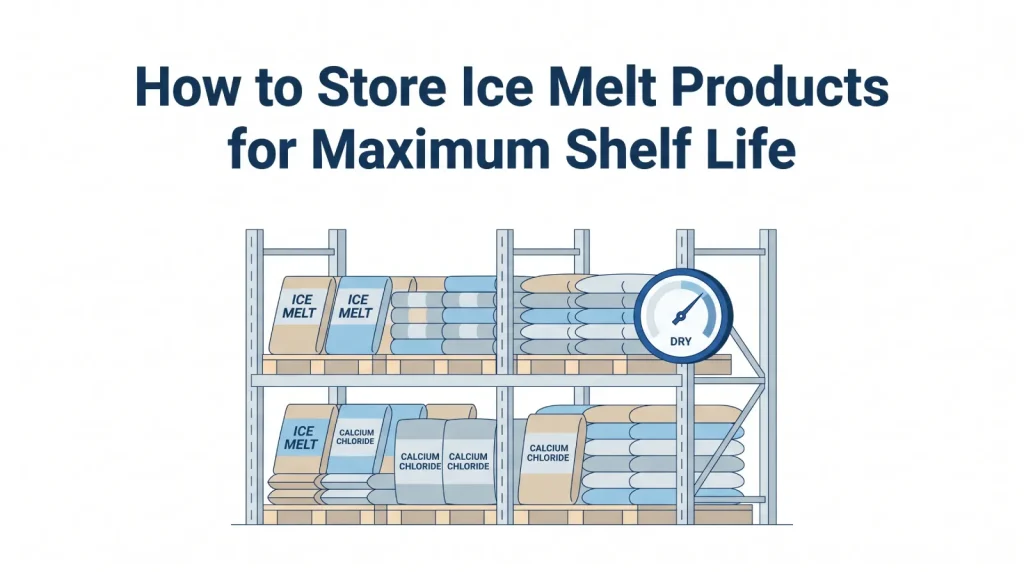
What Makes Calcium Chloride Different During Storage?
Unlike many other deicing materials, Calcium Chloride is highly hygroscopic. This means it naturally attracts water vapor from the surrounding air.
As humidity increases, the material may gradually absorb moisture until pellets begin sticking together or partially dissolving. Under very humid conditions, Calcium Chloride may even liquefy through a process known as deliquescence.
This behavior does not necessarily mean the chemical has degraded. Instead, its physical form changes, making transportation, metering, and spreading more difficult.
Different ice melt products have different storage characteristics:
| Ice Melt Product | Moisture Absorption | Typical Storage Stability | Primary Storage Concern |
|---|---|---|---|
| Calcium Chloride | Very High | Several years if kept dry | Moisture absorption |
| Magnesium Chloride | High | Good with sealed packaging | Caking |
| Sodium Chloride (Rock Salt) | Low | Long-term | Hardening from pressure |
| Calcium Magnesium Acetate | Low | Good | Package integrity |
| Potassium Acetate (Liquid) | Not applicable | Stable in closed containers | Temperature control |
Because Calcium Chloride actively attracts moisture, warehouse design and handling procedures become significantly more important than for ordinary rock salt.
Why Does Humidity Affect Deicing Storage?
Humidity is the single most important environmental factor influencing deicing storage.
Every warehouse contains some amount of airborne moisture. When relative humidity rises beyond certain levels, hygroscopic materials begin absorbing water continuously.
Several factors influence this process:
- Relative humidity inside the warehouse
- Seasonal temperature fluctuations
- Air circulation
- Packaging condition
- Storage duration
Even if products remain unopened, damaged bags or improperly sealed bulk containers allow moisture to enter over time.
According to ASTM guidance for industrial chemical storage, hygroscopic materials should be protected from unnecessary moisture exposure throughout storage and handling to preserve physical properties and packaging integrity.
How Moisture Changes Stored Ice Melt
Moisture exposure may cause:
- Pellet clumping
- Powder caking
- Increased bag weight
- Reduced spreading consistency
- Difficulties during mechanical loading
Importantly, these physical changes usually occur before any meaningful chemical degradation.
For warehouse operators, preventing moisture exposure is therefore more effective than attempting to restore damaged inventory later.
What Should You Prepare Before Storing Ice Melt Products?
Proper storage begins before the first shipment arrives.
A warehouse prepared in advance greatly reduces the likelihood of damaged inventory during the winter season.
Prerequisites Checklist
Before receiving ice melt materials, prepare the following:
- Inspect roofing for water leaks.
- Verify floor drainage is functioning properly.
- Install pallets or raised storage platforms.
- Check warehouse ventilation equipment.
- Measure indoor humidity levels.
- Prepare waterproof covers for emergency use.
- Separate chemicals from incompatible materials.
- Label storage zones for inventory rotation.
Each of these steps minimizes moisture exposure while improving inventory organization.
Warehouses that perform these inspections before winter often experience fewer handling problems during peak snow season.
How to Store Ice Melt Products Step by Step
Step 1 — Inspect Every Shipment
Operation: Check packaging immediately after unloading.
Purpose: Identify punctures, torn bags, or moisture damage before products enter storage.
Expected Result: Only intact inventory is placed into warehouse stock.
Step 2 — Store Products Above Floor Level
Operation: Place all bags on pallets.
Purpose: Prevent moisture migration from concrete floors.
Expected Result: Reduced risk of condensation and bottom-layer damage.
Step 3 — Maintain Proper Warehouse Conditions
Operation: Keep storage areas cool, dry, and well ventilated.
Purpose: Minimize airborne humidity around hygroscopic materials.
Expected Result: Slower moisture absorption and improved shelf life.
Step 4 — Leave Space Between Pallets
Operation: Maintain clearance around storage stacks.
Purpose: Improve air circulation and simplify inspections.
Expected Result: More uniform storage conditions throughout the warehouse.
Step 5 — Rotate Inventory Using FIFO
Operation: Follow a First-In, First-Out inventory system.
Purpose: Reduce unnecessary long-term storage.
Expected Result: Older inventory is consumed before newer deliveries, minimizing waste.
How to Troubleshoot Common Ice Melt Storage Problems
Even in well-managed warehouses, storage issues can occur because environmental conditions change throughout the year. Regular inspections allow warehouse personnel to identify problems early and prevent minor issues from affecting larger portions of inventory.
| Symptom | Likely Cause | Recommended Solution |
|---|---|---|
| Pellets begin sticking together | High relative humidity | Lower humidity, improve ventilation, reseal opened bags |
| Powder forms hard cakes | Moisture exposure over time | Break apart only if product remains dry internally; replace severely affected material |
| Torn or leaking bags | Improper handling or stacking | Repackage immediately and isolate damaged inventory |
| Water droplets inside packaging | Condensation from temperature swings | Move inventory to a stable-temperature area and inspect surrounding pallets |
| Bottom bags appear wet | Direct floor contact | Replace damaged pallets and elevate all remaining inventory |
| White residue around storage area | Minor product leakage | Clean promptly and repair packaging to prevent additional moisture absorption |
Warehouse inspections every 30 days during the off-season and every 7–14 days during peak winter operations help detect these issues before they spread throughout stored inventory.
Why Is FIFO Better Than Long-Term Storage?
Many facilities purchase ice melt products before winter to reduce procurement risks and avoid seasonal price fluctuations. However, inventory should still be managed using the First-In, First-Out (FIFO) principle.
FIFO minimizes unnecessary storage time and reduces the chance that older inventory experiences prolonged exposure to humidity or repeated temperature changes.
Benefits of FIFO Inventory Rotation
- Maintains more consistent product condition.
- Simplifies warehouse inventory tracking.
- Reduces waste caused by damaged packaging.
- Improves stock visibility during peak winter demand.
- Supports more accurate purchasing forecasts.
Facilities that clearly label receiving dates and pallet locations typically experience fewer inventory discrepancies during snow events.
Calcium Chloride vs Rock Salt: Which Requires More Care During Storage?
Although both products are widely used for winter maintenance, their storage requirements differ considerably.
| Storage Factor | Calcium Chloride | Rock Salt (Sodium Chloride) |
|---|---|---|
| Moisture sensitivity | Very high | Low |
| Hygroscopic behavior | Yes | Minimal |
| Deliquescence risk | High in humid conditions | Very low |
| Recommended packaging | Moisture-resistant sealed bags | Standard woven bags or bulk storage |
| Importance of humidity control | Critical | Moderate |
| Long-term storage risk | Caking and liquefaction | Compression hardening |
Rock salt generally tolerates warehouse humidity better than Calcium Chloride. However, both materials benefit from dry storage, palletized stacking, and protection from precipitation.
For warehouses storing multiple deicing chemicals, separating products according to their moisture sensitivity helps reduce handling complexity and improve inventory management.
What Common Storage Mistakes Should You Avoid?
Even experienced warehouse operators sometimes overlook practices that gradually reduce product quality.
Common Mistakes to Avoid
Storing bags directly on concrete floors
Concrete naturally transfers moisture. Pallets create an air gap that significantly reduces moisture migration.
Leaving partially opened bags unsealed
Once opened, hygroscopic products immediately begin interacting with surrounding humidity. Resealing bags minimizes unnecessary exposure.
Blocking warehouse ventilation
Poor airflow allows humid air to accumulate around stored inventory, accelerating moisture absorption.
Stacking pallets too high
Excessive stacking pressure may damage lower bags and increase the risk of packaging failure.
Ignoring seasonal humidity changes
Warehouses that remain dry during winter may experience substantially higher humidity during spring and summer. Storage practices should be adjusted accordingly.
What Are the Best Practices for Long-Term Deicing Storage?
Long-term storage success depends on combining environmental control with disciplined warehouse procedures.
Best Practices
- Maintain indoor relative humidity below levels that promote moisture absorption whenever practical.
- Inspect pallets, packaging, and warehouse conditions on a scheduled basis.
- Keep products away from roof leaks, loading dock openings, and standing water.
- Separate incompatible chemicals to reduce contamination risks.
- Record receiving dates to support FIFO inventory rotation.
- Train warehouse staff on proper handling procedures to minimize packaging damage.
- Review storage conditions before each winter season begins.
Following these practices helps preserve product quality while reducing unnecessary replacement costs and operational disruptions.
Conclusion
Deicing storage is a critical part of winter maintenance planning because proper storage practices directly influence product handling, application efficiency, and inventory longevity. For hygroscopic materials such as Calcium Chloride, the most important priorities are controlling moisture exposure, protecting package integrity, and maintaining an organized inventory rotation system.
Warehouses that combine dry storage conditions, palletized stacking, regular inspections, and FIFO inventory management are better positioned to reduce waste and maintain consistent product performance throughout the winter season. When evaluating storage procedures, prioritize environmental control and routine inspections rather than relying solely on packaging quality.
FAQs
What is the ideal storage temperature for Calcium Chloride?
There is no single mandatory storage temperature for Calcium Chloride. Stable, dry conditions are generally more important than maintaining a specific temperature. Large temperature fluctuations can create condensation, which increases moisture exposure.
To improve storage conditions:
- Keep products in a covered warehouse.
- Avoid repeated heating and cooling cycles.
- Maintain good ventilation.
How long can Calcium Chloride be stored?
When kept dry in sealed packaging, Calcium Chloride can remain usable for several years because it is chemically stable. In most cases, physical changes caused by moisture—not chemical degradation—determine its practical shelf life.
Factors affecting longevity include:
- Packaging quality
- Warehouse humidity
- Storage conditions
Can opened bags be stored safely?
Yes. Opened bags can often be stored safely if they are resealed immediately after use. Exposure to humid air begins as soon as packaging is opened.
Recommended practices include:
- Reseal bags using airtight closures.
- Store opened bags separately from unopened inventory.
- Use opened material first during the next application cycle.
Is Calcium Chloride better than rock salt for long-term storage?
Neither material is universally "better"; they simply have different storage characteristics.
| Comparison | Calcium Chloride | Rock Salt |
|---|---|---|
| Moisture sensitivity | High | Low |
| Risk of caking | Higher | Lower |
| Humidity control needed | Yes | Moderate |
| Chemical stability | Excellent | Excellent |
Choose storage procedures based on the product's physical properties rather than assuming all deicers behave the same way.
What should warehouse staff inspect during routine storage checks?
Routine inspections help identify problems before they affect large quantities of inventory.
Inspect the following:
- Package condition
- Pallet stability
- Signs of water leakage
- Humidity or condensation
Can frozen Calcium Chloride still be used?
Yes. Freezing does not normally damage Calcium Chloride itself. However, condensation that forms during thawing may introduce unwanted moisture into damaged packaging.
If frozen inventory is found:
- Allow it to return to room temperature gradually.
- Inspect packaging before moving it.
- Check for moisture accumulation.
- Reseal opened containers if necessary.
Where should bulk ice melt materials be stored?
Bulk ice melt products should be stored in covered facilities that protect them from precipitation and excessive humidity.
Good storage locations typically provide:
- Weather protection
- Adequate ventilation
- Drainage away from storage piles
- Easy access for loading equipment
Does pallet wrapping prevent moisture damage?
Pallet wrapping helps reduce direct exposure during transportation and short-term storage, but it is not a complete moisture barrier.
For the best protection:
- Keep products indoors whenever possible.
- Repair damaged wrapping immediately.
- Avoid prolonged outdoor storage.
- Inspect wrapping after every movement.
- Replace torn protective covers promptly.
Is it safe to store Calcium Chloride near other chemicals?
It depends on the specific chemicals involved. Calcium Chloride should be stored according to applicable safety guidance and separated from incompatible materials where required.
Warehouse managers should review the relevant Safety Data Sheet (SDS) for all stored chemicals before arranging storage locations.
How often should warehouse inventory be inspected during winter?
Inspection frequency depends on warehouse conditions, climate, and inventory turnover.
Facilities operating in humid environments or with frequent material movement generally benefit from more frequent inspections than facilities storing products in climate-controlled warehouses. Establishing a documented inspection schedule helps ensure consistent storage practices throughout the winter season.